
Medical Tourism Blog
Post-Operative Asymmetry Solutions: Revision Rhinoplasty in Korea for Perfect Facial Balance
Table of contents
- Understanding Post-Operative Nasal Asymmetry
- Revision Rhinoplasty: A Detailed Medical Procedure
- Navigating Revision Rhinoplasty in South Korea for Medical Tourists
- Cost Analysis: Revision Rhinoplasty in South Korea vs. Global Destinations
- Patient Experiences and Outcomes with Revision Rhinoplasty for Asymmetry
- Conclusion
Considering treatment in Korea? Everything you need to know e.g. — how to avoid scams, visas, interpreters, recovery tips — in our Medical Tourism Master Guide. Plan with confidence in minutes, not weeks!
This guide explores post-operative nasal asymmetry after rhinoplasty—a common concern for many patients—and explains how Revision Rhinoplasty serves as the primary corrective procedure. We break down the causes, surgical techniques, and recovery process, with a special focus on the experience of medical tourists in South Korea. The article also compares costs and logistics with other destinations like the USA and Turkey, and highlights the importance of realistic expectations and the extended healing journey. Our goal is to provide researchers and patients with expert-level insights to help them navigate solutions for post-operative nasal asymmetry.
Understanding Post-Operative Nasal Asymmetry
Post-operative nasal asymmetry describes an uneven appearance of the nose following rhinoplasty. While some asymmetry is normal during early healing, persistent or significant unevenness can cause dissatisfaction. This may show up as uneven nostrils, a crooked nose, or a deviated nasal tip. Sometimes, these changes also affect nasal function, leading to breathing issues or discomfort.
Patients and doctors use terms like "uneven nostrils," "crooked nose," and "deviated septum" to describe these issues. Other descriptors include "tip asymmetry," "wide or large nostrils," "dorsal sloop," "columellar show," "alar retraction," "pointy tip," and "nasal scarring."
Several factors can cause asymmetry after rhinoplasty. Swelling is common and usually temporary, but scar tissue, cartilage shifting, or graft instability can create lasting changes. Sometimes, pre-existing facial asymmetries become more noticeable after surgery. If the initial procedure didn’t fully address structural issues like a deviated septum, or if complications occurred, asymmetry may persist.
While minor unevenness is expected early on, you should seek a professional evaluation if it lasts beyond 6 to 12 months, if you have breathing problems, if the asymmetry worsens, or if scar tissue causes discomfort or visible deformity.
The effects of post-operative asymmetry go beyond appearance. Many patients experience a psychological burden, with issues like a crooked nose impacting self-esteem and quality of life. Revision rhinoplasty often involves complex emotions, as patients may be dealing with disappointment from a previous surgery. Practitioners should address both the physical and emotional aspects, offering psychological support and managing expectations.
Aesthetic deformities often go hand-in-hand with functional problems. For example, a crooked septum can cause both visible asymmetry and breathing difficulties. Successful revision surgery should address both appearance and function, so patients should seek surgeons skilled in both areas.
Revision Rhinoplasty: A Detailed Medical Procedure
Revision rhinoplasty is a specialized surgery to correct problems or imperfections from a previous rhinoplasty. The main goals are to improve nasal symmetry and proportions, refine aesthetics, and fix any functional issues like breathing difficulties. The aim is to create a natural-looking nose and restore structural integrity.
This procedure is more complex than primary rhinoplasty. Scar tissue from the first surgery can make the operation more challenging, and the anatomy has already been altered. There may be less cartilage available for grafting, sometimes requiring cartilage from the ear or rib. Healing can be unpredictable, so it’s crucial to choose a surgeon with extensive experience in revision rhinoplasty.
Surgical techniques vary depending on the patient’s needs. The open rhinoplasty approach, which uses a small incision along the columella, is often preferred for better visibility and access. Closed rhinoplasty, with incisions inside the nostrils, may be used for minor revisions.
Cartilage grafting is often necessary to rebuild or support nasal structures. Septal cartilage is preferred if available, but ear or rib cartilage may be used for more extensive repairs. Surgeons may use autologous rib grafts or fresh-frozen cadaver cartilage, each with its own pros and cons.
Specific techniques address different deformities. Correcting a crooked nose may require realigning the septum and performing osteotomies (bone cuts) with spreader grafts. Osteotomies and osteoplasty reshape the nasal bones, while scar tissue management may involve surgical removal or injectable fillers for minor adjustments. Revision rhinoplasty can also address issues like dorsal irregularities, inverted V deformity, pollybeak deformity, saddle nose, hanging columella, and over-resection of the lateral crura.
Nasal tip refinement uses grafts and cartilage reshaping to correct deviations or support issues. Functional improvements often involve septoplasty to improve airflow.
Recovery varies by the extent of surgery. Minor revisions may allow a quick return to daily life, but major revisions can require 8 to 12 months—or up to 2 years for full healing. Swelling and bruising usually subside in 1 to 2 weeks, but subtle swelling can last much longer. Patients should avoid strenuous activity and sun exposure, and attend regular follow-up appointments.
Navigating Revision Rhinoplasty in South Korea for Medical Tourists
South Korea is a top destination for cosmetic surgery, attracting international patients with its advanced techniques, skilled surgeons, and competitive pricing. Korean surgeons use cutting-edge technology and have extensive experience, including with diverse ethnic backgrounds. Procedures are often more affordable than in Western countries, especially when arranged through medical tourism agencies, which offer comprehensive support.
The Process of Getting Revision Rhinoplasty in South Korea
The journey for medical tourists typically includes:
- Initial Consultation and Planning:
- Research clinics and surgeons, checking for global accreditation and references from international patients.
- Many clinics offer virtual consultations, sometimes with 3D modeling.
- Medical tourism agencies can streamline the process, matching patients with suitable surgeons.
- Travel and Accommodation:
- Agencies help with visas, flights, and transportation.
- Accommodation may be included in packages or arranged separately, costing $50–$200 USD per night.
- Avoid peak seasons for more personalized care.
- Plan for an extended stay to allow for recovery.
- Pre-Surgery Preparations:
- Pre-surgical tests (blood work, imaging) cost $100–$300 USD.
- Prepare with anti-inflammatory foods and supplements as advised by your surgeon.
- Consider a mental health check before and after surgery.
- The Surgical Experience:
- Agencies assist with check-in and clinic visits.
- Language support is crucial—look for clinics with interpreters and international patient managers.
- Surgery is usually outpatient under general anesthesia.
- Post-Operative Care and Follow-ups:
- Budget $50–$200 USD for medications.
- Lymphatic drainage massages ($50–$150 USD per session) can aid recovery.
- Regular follow-ups are essential, with some agencies offering online support after you return home.
- Strictly follow all post-op instructions for best results.
The Role and Benefits of Medical Tourism Agencies
Medical tourism agencies in Seoul offer packages covering consultations, travel, accommodation, surgery, and medications. They can help reduce costs—sometimes by up to $3,000 USD—and simplify logistics like visas and transportation. Agencies also vet clinics and surgeons, provide multilingual support, and offer practical services like airport pick-up and city tours.
However, patients should be aware of potential "hidden" costs not included in packages, such as extra consultations, pre-surgical tests, medications, extended accommodation, additional care, interpreter services, and follow-up visits. Always request a detailed breakdown of costs and budget an emergency fund of at least $1,000 USD.
Which Are the Best Clinics in Korea for Postoperative Asymmetry?
Listed below are some of the best clinics in Korea for postoperative asymmetry.
1. THEPLUS Plastic Surgery
If your postoperative asymmetry relates to a prior nose surgery, you can explore revision rhinoplasty at THEPLUS Plastic Surgery with an emphasis on restoring nasal structure, facial balance, and—where relevant—functional considerations. The clinic’s rhinoplasty-focused surgeons use an approach that connects the nose to your overall facial proportions rather than treating it in isolation.
- URL: THEPLUS Plastic Surgery Website
- Location: Gangnam-gu, Seoul
- Rhinoplasty expertise:
- Dr. Jeong Jae-yong authored “Rebuilding Nose: Rhinoplasty for Asians,” including an English educational edition for rhinoplasty surgeons.
- Dr. Kim Taek-kyun contributed rhinoplasty and revision-rhinoplasty chapters to “The 18 Masters of Korean Aesthetic Surgery.”
- Both doctors participate in professional education and academic forums including the Seoul Rhinoplasty Forum, KSPRS, and IFAAS.
- Relevant care:
- Revision rhinoplasty is offered for concerns following a previous nose operation, with the stated aim of improving structural stability and nasal appearance.
- The clinic describes its rhinoplasty philosophy as combining function with aesthetic harmony.
- Other surgical services include eyelid procedures, facial contouring, facial lifting, breast surgery, and liposuction.

2. Made Young Plastic Surgery
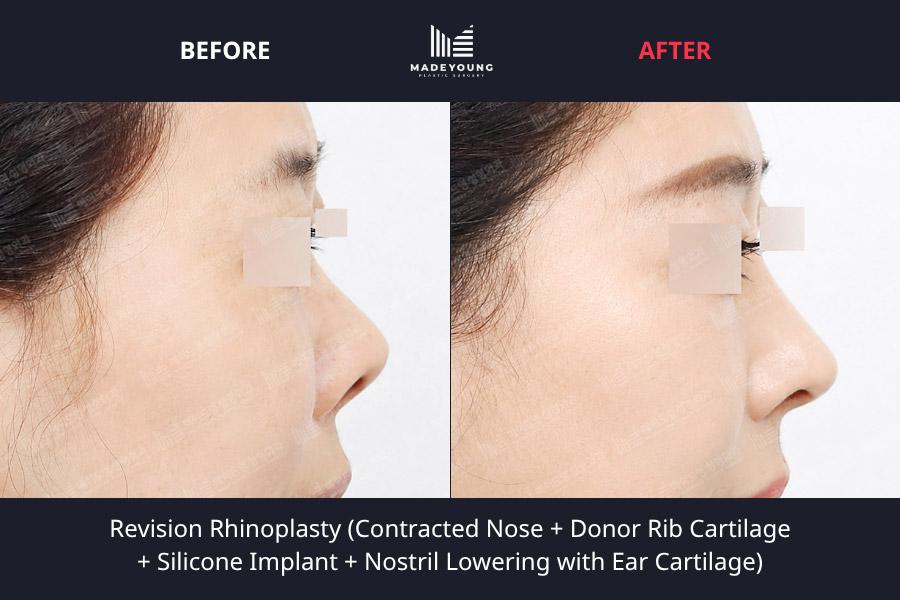
If asymmetry or other concerns developed after a previous nose operation, Made Young Plastic Surgery offers revision and reconstructive rhinoplasty with techniques intended for complex scar tissue, tissue damage, and prior implants. You can expect direct pre-procedure consultation and diagnosis by the medical team, with correction planned around the findings from your prior surgery.
- URL: Made Young Plastic Surgery Website
- Location: Seocho-gu, Seoul
- Revision approach:
- The clinic describes precise dissection intended to minimize tissue damage in revision cases.
- Techniques cited for complex revisions include micro-dissection, capsule removal, and removal of prior nasal implants when indicated.
- Revision rhinoplasty, reconstructive rhinoplasty, and rhinoplasty implant removal are listed services.
- Safety and aftercare:
- Full-time board-certified anesthesiologists are stated to be on site.
- The clinic describes one-to-one anesthesiology monitoring, with a cross-check system involving multiple anesthesiologists in an emergency.
- A separate aftercare center provides systematic post-procedure care.
- The clinic states that procedures have full CCTV coverage for transparency.
- Additional facial options: Services include facial contouring procedures, face and neck lifting, thread lifting, eyelid surgery, ptosis correction, and blepharoplasty.
3. LABOM Plastic Surgery
If postoperative asymmetry follows rhinoplasty, LABOM Plastic Surgery takes a diagnosis-first revision approach that evaluates whether the source is implant position, scarring, skin thinning, infection or inflammation, or an underlying structural issue such as septal deviation or a nasal-valve problem. Your plan can be tailored with 3D CT assessment and one-to-one nasal design, with attention to both appearance and breathing concerns.
- URL: LABOM Plastic Surgery Website
- Location: Gangnam-gu, Seoul
- Revision assessment and correction:
- 3D CT imaging is used to assess nasal-bone shape, cartilage condition, and the position of an existing implant.
- The evaluation distinguishes a malpositioned implant from a contaminated or infected implant because these situations require different management.
- Autologous cartilage grafts and dermal tissue grafts may be used to reinforce thinned nasal-tip skin.
- Implants may be removed or replaced after the cause of the original problem is confirmed.
- Timing and recovery:
- Revision is generally considered after nasal tissues have stabilized, typically 6 to 12 months after the initial operation; timing varies with your condition.
- If inflammation or infection is present, the clinic states that it must be treated and fully resolved before revision surgery.
- The stated procedure time is approximately 1 to 2 hours under sleep sedation, with same-day discharge; stitches are typically removed at about 7 days and recovery is described as about 7 to 14 days.
- Planning and follow-up:
- The clinic describes a one-to-one anesthesia system, individualized pre-operative consultation, and continuous monitoring.
- Postoperative care includes regular progress checks and structured programs for recovery, swelling, bruising, and scar management.
- Its specialists describe more than 30 years of clinical experience across facial and hand anti-aging procedures, along with ongoing academic participation and research.
Cost Analysis: Revision Rhinoplasty in South Korea vs. Global Destinations
Cost Breakdown for Revision Rhinoplasty in South Korea
Revision rhinoplasty in South Korea typically costs $8,000 to $15,000 USD, though some sources report a range as low as $5,000 to $7,500 USD. The final price depends on the procedure’s complexity, the surgeon’s reputation, and the clinic’s standing.
Additional costs to consider:
- Consultation Fees: $50–$150 USD
- Pre-Surgical Tests: $100–$300 USD
- Medications: $50–$200 USD
- Accommodation: $50–$200 USD per night
- Transportation: $100–$300 USD
- Post-Surgical Care: $50–$150 USD per session
- Interpreter Services: $30–$100 USD per hour
- Follow-Up Visits: May incur extra costs if you return home before healing is complete
- Emergency Fund: At least $1,000 USD
- Medical Insurance: Cosmetic procedures are usually not covered, though functional corrections may have partial coverage
Comparative Costs: South Korea vs. USA and Turkey
| Country | Average Cost Range (USD) | Typical Inclusions | Typical Exclusions | Waiting Time |
|---|---|---|---|---|
| South Korea | $8,000 – $15,000 | Surgery, surgeon fee, anesthesia, OR fees, some packages include aftercare, accommodation, transfers | Consultations, pre-surgical tests, extended accommodation, interpreter, lymphatic drainage, emergency fund | Generally shorter |
| USA | $12,000 – $25,000 | Surgeon fee, anesthesia, OR fees | Consultations, medications, post-op care, hotel, transfers | Weeks to months |
| Turkey | $4,000 – $7,000 | Online consultation, surgery, transfers, hotel stay, medications, care kits, follow-up | Some pre-surgical tests, extended accommodation | 1–2 weeks |
The "all-inclusive" package model in South Korea and Turkey is a major advantage for medical tourists, offering convenience and financial transparency. However, always check exactly what’s included to avoid unexpected costs.
Factors Influencing Cost and Value
Lower operational costs, favorable exchange rates, and government support make procedures more affordable in countries like Turkey and South Korea. High patient volumes also help reduce per-procedure costs. Importantly, lower prices do not mean lower quality—these countries have highly skilled surgeons and modern clinics. Patients can access excellent care at a lower cost by taking advantage of these economic factors.
Patient Experiences and Outcomes with Revision Rhinoplasty for Asymmetry
Patients seek revision rhinoplasty mainly due to dissatisfaction with the look or function of their nose after initial surgery. Common complaints include "crooked nose," "tip asymmetry," "wide or large nostrils," "dorsal sloop," "columellar show," "alar retraction," "pointy tip," and "nasal scarring." Breathing difficulties are also a frequent concern. The psychological impact can be significant, as patients may feel disappointed or self-conscious.
Revision rhinoplasty uses precise techniques to correct bones and cartilage, often dealing with scar tissue from previous surgery. Scar tissue management may involve surgical removal or fillers. Structural corrections like septum realignment can improve both appearance and breathing. Grafts from the septum, ear, or rib are often used to rebuild the nose.
It’s crucial for patients to have realistic expectations and understand that healing can take up to two years. Swelling may obscure results for months, so patience is essential. Pre-operative counseling helps set expectations and reduces anxiety. Open communication with the surgeon is important, especially if concerns persist after a year.
Experienced surgeons can achieve natural-looking results, improved symmetry, and better function. Patient satisfaction depends on thorough consultations, clear understanding of outcomes, and diligent post-op care. Tools like the Rhinoplasty Outcome Evaluation (ROE) and Standardized Cosmesis and Health Nasal Outcomes Survey (SCHNOS) help assess results.
Interestingly, primary rhinoplasty patients often want size reduction or hump removal, while revision patients focus on correcting asymmetries and structural issues. This shift means revision surgeons need specialized skills in anatomical refinement and scar management, and must tailor their consultations to address these nuanced concerns.
Conclusion
Post-operative nasal asymmetry is a common challenge after rhinoplasty, often requiring Revision Rhinoplasty for correction. This complex procedure demands specialized expertise and may involve advanced grafting techniques to restore both appearance and function. South Korea stands out as a leading destination for medical tourists, offering skilled surgeons and comprehensive support, but patients should carefully review all costs and package details. Ultimately, realistic expectations and patience during the extended healing process are key to achieving satisfying outcomes.
References
Frequently Asked Questions
Related Blogs
Korea vs. Global Standards: A Comprehensive Cost Analysis of Cleft Rhinoplasty in Medical Tourism Destinations
Explore the cost of cleft rhinoplasty in Korea, a popular destination for medical tourism due to its advanced surgical techniques and competitive pricing. Discover factors influencing the overall expense, from hospital fees to post-operative care, and what makes Korea a top choice for this specialized procedure.
Updated: Oct 21, 2026
Philtrum Reduction Costs: Choosing Korea Over the USA, Mexico, Turkey & More for Expert Care
Discover the affordability and benefits of Philtrum Reduction Surgery in Korea, a popular destination for high-quality cosmetic procedures. Explore cost factors, surgeon expertise, and why Korea is a top choice for those considering this transformative surgery.
Updated: Oct 21, 2026
Discovering the True Value: Sinus Surgery Costs in Korea Compared to Global Options
Discover the affordable options for sinus surgery in Korea, a leading destination for medical tourists seeking quality care. Learn about the factors influencing costs and what patients can expect from their experience in this highly advanced healthcare system.
Updated: Oct 21, 2026
Non-Implant Rhinoplasty in Korea: Cartilage Grafts, Recovery, Travel Planning, and Alternatives
Non-implant rhinoplasty reshapes the nose using septal, ear, or rib cartilage, with surgical or injectable and open or closed approaches and possible septal or nasal-valve correction. International patients can find guidance on candidate screening, material-specific consent, Korea stays of 10–21 days, travel timing, recovery, and follow-up.
Updated: Oct 16, 2026
Clinics offering Revision Rhinoplasty

THEPLUS Plastic Surgery Korea | Eye, Nose, Face & Body Surgery
Sinsa

Made Young Plastic Surgery: Rejuvenating Aesthetic Excellence in Korea for Face Lifts, Contouring and More
Gangnam Station

LABOM Plastic Surgery: Expertise in Non-Surgical Nose, Facial Lifting & Anti-Aging Surgeries in Korea
Apgujeong

Okay Plastic Surgery Clinic in Korea: Comprehensive Aesthetic Procedures with Sincerity and Care
Cheongdam