
Medical Tourism Blog
Inverted V Deformity Solutions: Revision Rhinoplasty in Korea for Nose Contour Correction
Table of contents
- The Inverted V Deformity: A Clinical and Anatomical Analysis
- The Art and Science of Revision Rhinoplasty: Rebuilding the Foundation
- Navigating the Medical Tourism Process in South Korea
- Which Are the Best Clinics in Korea for Inverted V Deformity?
- Cost Analysis and Financial Considerations
- Patient Outcomes and Emotional Recovery
- Conclusion
- References
Considering treatment in Korea? Everything you need to know e.g. — how to avoid scams, visas, interpreters, recovery tips — in our Medical Tourism Master Guide. Plan with confidence in minutes, not weeks!
For many patients, the decision to pursue revision rhinoplasty comes with a unique set of emotional and psychological hurdles. After undergoing a previous nasal surgery with a disappointing result, it's common to feel distressed, regretful, or even angry. Regaining trust in a new surgeon is no small feat. This guide aims to give patients an evidence-based, practical resource, moving from a clear explanation of the inverted V deformity to actionable advice and a realistic look at recovery and outcomes.
The Inverted V Deformity: A Clinical and Anatomical Analysis
Defining the Deformity
Inverted V deformity is a recognized complication, often developing after rhinoplasty—though nasal trauma can also be a culprit. This issue is easy to spot: when you look at the nose head-on, the middle third forms a V-shaped dip, sometimes with an unnatural, pinched look. Typically, there's a step-off or indentation right where the nasal bones join the upper lateral cartilages, making the bridge appear narrowed and disrupting the nose's smooth lines.
Common Pseudonyms and Associated Conditions
You might hear doctors refer to the inverted V deformity as a "scooped mid-vault" or "middle vault collapse," which describes the sinking of tissues in the nose's midsection. Importantly, this isn't just a cosmetic issue. Collapse of the internal nasal valve—a key player in proper breathing—is common, so the inverted V deformity often brings both aesthetic and functional problems, including difficulty breathing.
The Anatomical and Surgical Causes
The most frequent cause is "over-resection" of the dorsal hump, a combination of bone and cartilage at the nasal bridge. Removing too much of the hump undermines the upper lateral cartilages, causing them to cave in and create that V-shaped dip. Think of the nose’s structure as a T-frame: once that's disrupted, the cartilages lose tension and move inward, leading to collapse and narrowing of the internal valve. Closed rhinoplasty techniques, which can offer less visibility, are linked to a higher risk for this complication. This highlights why careful planning and deep anatomical understanding are so essential when altering the nasal bridge.
The Art and Science of Revision Rhinoplasty: Rebuilding the Foundation
The Nuanced Challenge of Revision Surgery
Revision rhinoplasty is considered much more complex than a first-time procedure. Scar tissue from the initial surgery makes the anatomy harder to navigate, and surgeons often find themselves working with weakened or missing cartilage and bone. The process demands advanced skills and an expert understanding of surgical techniques to restore both the nose’s function and appearance.
Foundational Surgical Techniques
Restoring the nose’s structure is the top priority when correcting an inverted V deformity.
- Spreader Grafts: These are the “gold standard.” Surgeons use straight cartilage pieces (often from the patient’s own septum) to reinforce the nasal bridge and support the collapsed upper lateral cartilages. Spreader grafts not only smooth the bridge’s contour but also open up the internal nasal valve for easier breathing.
- Spreader Flaps: As an alternative, surgeons may reshape existing cartilage (spreader flaps) to rebuild the bridge, avoiding tissue harvesting from other sites. This technique can re-establish a natural shape and support the nasal valve as well.
- Other Grafts: Sometimes, more extensive grafting is needed, particularly if the nasal tip is affected. Extended spreader grafts may be paired with a new columellar strut for extra support, and alar batten grafts can be used to shore up the external nasal valve.
Autogenous Grafts: The Cornerstone of Reconstruction
Choosing the right graft material is key. Surgeons strongly favor autogenous cartilage (from the patient), since it carries a low risk for complications like rejection or infection and gives the best long-term results.
Usually, septal cartilage is the first choice. However, many revision patients don’t have enough septal cartilage left due to their previous surgery. Surgeons then turn to donor sites like the ear (auricular concha) or rib (costal cartilage). Harvesting from these locations requires advanced expertise, further emphasizing the need for a surgeon who specializes in complex revision cases.
Surgical Approaches
Rhinoplasty can be performed via open or closed techniques. Closed rhinoplasty involves making incisions inside the nostrils, leaving no external scars, while open rhinoplasty includes a small cut on the columella for better access and visibility. Though the inverted V deformity is more often seen after closed procedures, open rhinoplasty is typically the method of choice for repairing it, as it allows the surgeon direct access for precise reconstruction.
Navigating the Medical Tourism Process in South Korea
South Korea is now a top choice for patients seeking revision rhinoplasty, thanks to its high surgical standards and experienced clinics. The process is designed with international clients in mind, ensuring robust support at every step:
- Initial Online Consultation and Preparation: Patients start with a free online consult by sending photos and medical history. The clinic then provides recommendations, price estimates, and a recovery timeline—helping set realistic expectations early.
- Booking and Pre-Travel Logistics: Once the patient agrees, they typically pay a deposit (around 10%) to secure a surgery date. Confirming travel and accommodation near the clinic is essential, as is notifying their bank of international transactions.
- Arrival and In-Clinic Consultation: Patients usually arrive a day before their first in-person consult. Final plan discussions, 3D facial scans, and pre-op testing occur at this visit to ensure safety and accuracy.
- Surgery Day and Immediate Recovery: Surgery takes a few hours (under general anesthesia), after which the patient recovers briefly and then returns to their accommodation.
- Aftercare and Recovery: Over the next 8–10 days, follow-up visits are common for suture and splint removal, with many clinics offering services like LED therapy to reduce swelling.
- Return Home: Once cleared by the surgeon, the patient can travel home and continue follow-up via local physicians or remote check-ins with the clinic.
Many Korean clinics make the process much less daunting by providing everything from bilingual staff to transportation and 24/7 support. These services aren’t just “nice to have”—they’re central to the experience, bridging language and culture gaps to offer reassurance and clear communication.
Which Are the Best Clinics in Korea for Inverted V Deformity?
Listed below are some of the best clinics in Korea for inverted v deformity.
1. THEPLUS Plastic Surgery
You may consider THEPLUS Plastic Surgery for an inverted V deformity when you need revision rhinoplasty focused on restoring nasal structure while refining appearance, with Dr. Jeong Jae-yong and Dr. Kim Taek-kyun’s practice emphasizing the combination of nasal function and facial balance.
- URL: THEPLUS Plastic Surgery Website
- Location: Gangnam-gu, Seoul
- Rhinoplasty expertise:
- Dr. Jeong and Dr. Kim have decades of rhinoplasty experience and contribute to surgical education and international professional meetings.
- Dr. Kim is a board-certified plastic surgeon whose published work includes chapters on rhinoplasty and revision rhinoplasty in “The 18 Masters of Korean Aesthetic Surgery.”
- Dr. Jeong authored “Rebuilding Nose: Rhinoplasty for Asians” and has presented rhinoplasty work at professional forums.
- Revision approach:
- Revision rhinoplasty is offered to address concerns after a prior nose operation, with an emphasis on a more stable nasal structure and refined appearance.
- The clinic describes rhinoplasty planning in terms of both appearance and structural harmony, rather than appearance alone.
- Additional services: The clinic also offers primary rhinoplasty, facial contouring, eyelid procedures, lifting treatments, breast surgery, and liposuction.

2. Made Young Plastic Surgery
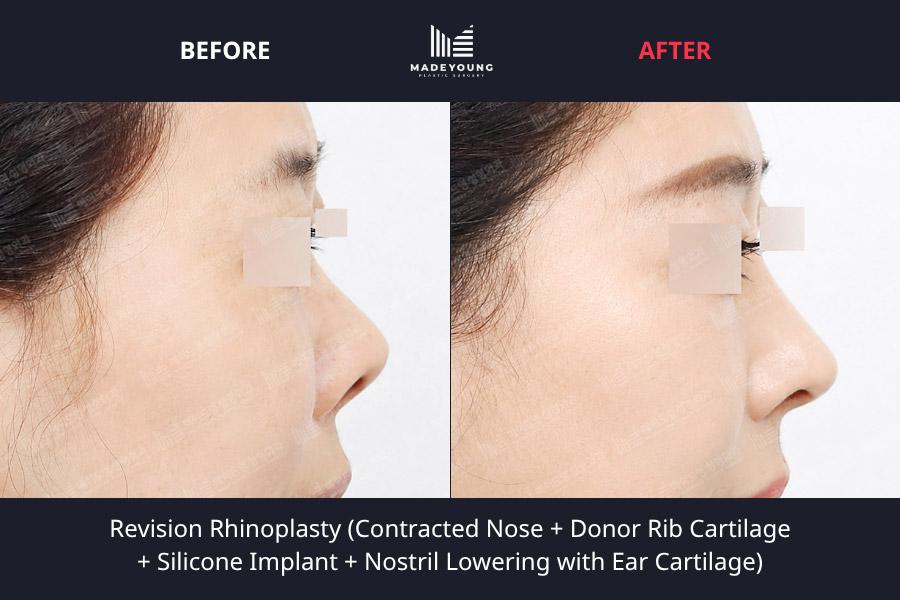
You may consider Made Young Plastic Surgery for an inverted V deformity if your prior rhinoplasty has left scar tissue, tissue damage, or an implant-related concern: its revision work describes precise dissection, micro-dissection, capsule removal, and implant removal when indicated.
- URL: Made Young Plastic Surgery Website
- Location: Seocho-gu, Seoul
- Revision techniques:
- The clinic describes experience managing complex revision cases involving scarring and tissue damage from previous surgery.
- Techniques cited for meticulous revision include micro-dissection, capsule removal, and implant removal.
- Revision rhinoplasty, reconstruction rhinoplasty, and nasal implant removal are listed services.
- Safety and monitoring:
- Full-time board-certified anesthesiologists are on site.
- Its stated monitoring model assigns one anesthesiologist to continuously monitor one person during a procedure, with additional anesthesiologist cross-checking for emergencies.
- The clinic states that procedures have CCTV coverage and that it operates a dedicated aftercare center.
- Consultation and care:
- You receive direct consultation and diagnosis from the medical team before treatment.
- The clinic reports that its doctors average more than 15 years of experience.
3. LABOM Plastic Surgery
You may consider LABOM Plastic Surgery for an inverted V deformity when you want a diagnosis-led revision assessment: the clinic uses 3D CT analysis to evaluate nasal bone and cartilage conditions, implant position, and possible functional issues before planning a personalized correction.
- URL: LABOM Plastic Surgery Website
- Location: Gangnam-gu, Seoul
- Revision assessment:
- The clinic evaluates both aesthetic and functional causes of a prior-rhinoplasty problem, including implant position, inflammation or infection, thinning tip skin, septal deviation, and nasal-valve concerns.
- 3D CT imaging is used to analyze nasal bone shape, cartilage condition, and current implant position.
- Planning is individualized to your nasal proportions and contours, with attention to overall facial harmony.
- Structural support:
- Autologous cartilage grafts and dermal tissue grafts may be used to reinforce areas of thinned nasal-tip skin.
- If an implant is involved, the clinic distinguishes malposition from contamination or infection because these require different management.
- The clinic states that underlying inflammation or infection must be resolved before revision surgery.
- Timing and recovery:
- Revision is generally considered after tissues have stabilized, often 6 to 12 months after the initial surgery, although timing depends on your condition.
- The clinic describes a typical procedure time of about 1 to 2 hours under sleep sedation, with same-day discharge.
- Stitches are generally removed at about 7 days, and the stated recovery period is approximately 7 to 14 days.
- Aftercare and planning:
- The clinic provides individualized consultation, pre-operative diagnosis, anesthesia monitoring, and regular post-operative checks.
- Its aftercare program includes recovery, swelling, bruising, and scar-management planning, with a dedicated system for international visitors.
Cost Analysis and Financial Considerations
Breakdown of Costs in South Korea
Revision rhinoplasty in South Korea can range from $5,000 to $15,000 USD. The price varies based on the procedure’s complexity, the surgeon’s reputation, and the clinic’s level of service. Some clinics bundle fees for the surgeon, anesthesia, facility, and aftercare into all-inclusive packages, which may also cover accommodation and airport transfer for convenience.
Comparative Cost Analysis for the Medical Tourist
From a global standpoint, South Korea offers mid-range pricing for revision rhinoplasty—and strong value when you consider the quality of care and skill involved. Here’s a look at how costs stack up across several countries:
| Country | Average Revision Rhinoplasty Cost (USD) |
|---|---|
| South Korea | $5,000 – $15,000 |
| Turkey | $4,200 – $5,300+ |
| Thailand | $4,000 – $7,361+ |
| USA | $7,000 – $20,000 |
| UK | $8,200 – $11,400 (£6,500 – £9,000) |
| Canada | $7,000 – $10,000 CAD |
| Australia | $9,000 – $13,000 AUD |
With pricing that reflects both expertise and access to advanced surgical techniques, South Korea is often seen as a smart choice for complex revisions. The cost may be higher than in Turkey or Thailand, but it remains much lower than in North America, the UK, or Australia—making it a favored option for patients who prioritize specialization and outcomes.
Beyond the Surgical Fee
Patients should remember to factor in other costs like airfare, lodging, transportation, meals, pre-op testing, medication, and any follow-up needs. An emergency fund of about $1,000 is wise for unexpected expenses. Some clinics offer “all-inclusive” packages, but it's always important to verify exactly what's covered to avoid surprises.
Patient Outcomes and Emotional Recovery
The Tangible Results of Correction
When revision rhinoplasty is successful, patients see meaningful improvements in both how their nose looks and how well they can breathe. Techniques such as spreader grafts help restore a natural nasal bridge and smooth out the telltale V-shaped dip, while also improving airflow by widening the internal valve. Before-and-after photos and patient testimonials often illustrate the life-changing outcomes that are possible.
Managing Expectations and the Emotional Journey
It’s not uncommon for patients to feel anxious or fixated on their nose after an unsuccessful surgery. Part of healing is finding a surgeon who is not only technically skilled but also attentive to your concerns and realistic about risks. While online forums can be a source of support and shared experience, they can also stoke anxiety with stories that might not match your circumstances. Professional consultation and individualized assessment are essential for setting healthy, realistic expectations.
Defining Success Beyond Aesthetics
What counts as a win goes beyond perfect symmetry or an Instagram-worthy nose. For many, real success is simply moving past the worry and regaining their confidence and sense of self—reconnecting with life beyond the mirror.
Conclusion
The inverted V deformity is a challenging rhinoplasty complication that affects both appearance and breathing. Correcting it requires an expert surgeon who can handle scar tissue and possible tissue shortages. South Korea stands out as a leading destination for this procedure, combining advanced skills, specialized patient support, and globally competitive pricing. With careful planning and informed choices, patients can look forward to both aesthetic improvements and emotional relief.
References
1, 2, 3, 4, 5, 6, 7, 8, 9, 10, 11, 12, 13, 14, 15, 16, 17, 18, 19, 20, 21, 22, 23, 24, 25, 26, 27, 28, 29
Frequently Asked Questions
Related Blogs

Effective Sinus Surgery for Sinus Headaches: Best Treatments Available in Korea
Discover how Korea offers advanced, minimally invasive sinus surgeries like FESS and Balloon Sinuplasty to treat sinusitis and sinus headaches. Learn about the benefits, procedures, recovery, and costs of seeking sinus treatment in Korea—an affordable and top-ranked medical tourism destination. Enhance your quality of life by addressing chronic sinus conditions with Korea’s expert ENT surgeons and
Updated: Nov 5, 2026

Long Upper Lip Solutions: Philtrum Reduction Surgery in Korea for Natural Results
Discover how Korea leads in philtrum reduction surgery, a cosmetic procedure that shortens the upper lip’s vertical length for a more balanced, youthful look. Our latest blog explores the benefits of lip lift techniques like the subnasal and bullhorn lip lift, highlighting Korea’s advanced technology, skilled surgeons, and affordable costs—ranging from $1,500 to $2,500 USD. Ideal for those seeking
Updated: Nov 1, 2026
Bilateral Cleft Nose Repair: Cleft Rhinoplasty Procedures in Korea for Optimal Results
Discover how Korea leads in bilateral cleft nose treatment with expert cleft rhinoplasty procedures. This comprehensive guide explores the complexities of bilateral cleft nose deformities and highlights how Korea's advanced surgical techniques and experienced surgeons effectively improve both appearance and nasal function. Learn why Korea is the ideal destination for medical tourism, offering top-
Updated: Oct 31, 2026

Effective Maxillary Sinus Cyst Treatment in Korea: Sinus Surgery Options
Discover how Korea leads in sinus surgery for maxillary sinus cysts with advanced minimally invasive procedures like FESS and Balloon Sinuplasty. This blog explores the causes, symptoms, and treatment options for maxillary sinus cysts, highlighting Korea's exceptional expertise, affordable costs, and state-of-the-art technology. Learn about the surgical process, recovery, and why Korea is the top
Updated: Oct 28, 2026
Clinics offering Revision Rhinoplasty

THEPLUS Plastic Surgery Korea | Eye, Nose, Face & Body Surgery
Sinsa

Made Young Plastic Surgery: Rejuvenating Aesthetic Excellence in Korea for Face Lifts, Contouring and More
Gangnam Station

LABOM Plastic Surgery: Expertise in Non-Surgical Nose, Facial Lifting & Anti-Aging Surgeries in Korea
Apgujeong

Okay Plastic Surgery Clinic in Korea: Comprehensive Aesthetic Procedures with Sincerity and Care
Cheongdam