Medical Tourism Blog
Juveacell in Korea: Types, Safety, Recovery, and Travel Planning
Table of contents
- Juveacell at a Glance
- What Is Juveacell?
- Who Is a Good Candidate for Juveacell?
- What Are the Different Types of Juveacell?
- Why Visit Korea for Juveacell?
- Key Information for International Patients
- Which Are the Best Clinics in Korea for Juveacell?
- Juveacell From Start to Finish
- Alternatives to Juveacell
- How Can I Prepare for Juveacell?
- Aftercare Advice
Considering treatment in Korea? Everything you need to know e.g. — how to avoid scams, visas, interpreters, recovery tips — in our Medical Tourism Master Guide. Plan with confidence in minutes, not weeks!
Last updated: September 2026
Juveacell at a Glance
- What it is — Juveacell is an injectable skin booster made from micronized, donor-derived human acellular dermal matrix (hADM), not a stem-cell treatment or conventional hyaluronic-acid filler.
- Best suited goals — It is intended for gradual improvement in hydration, texture, fine lines, pores, elasticity, and dermal density—not dramatic lifting or major volume replacement.
- Recovery — Most patients can resume non-strenuous activity the same day, but redness, swelling, tenderness, pinpoint marks, bruising, or small firm areas may last several days and can remain visible for 7–14 days.
- Results and evidence — Assess any skin-quality change over several weeks rather than immediately, but no independently validated Juveacell-specific final-result, maintenance, or longevity timeline has been established.
- Korea distinction — Korea provides access to locally marketed Juveacell 3% and 8% 1 cc hADM products; because it is donor-derived tissue, confirm the exact formulation, lot number, expiry date, and tissue-bank documentation before injection.
- Travel planning — Plan at least 3 days in Korea for a single uncomplicated session, including a 24–48 hour review before long-haul travel; stay 7–14 days if even minor swelling or bruising would disrupt plans.
- Key safety limitation — Juveacell should not be assumed reversible with hyaluronidase like HA filler, so the injector needs a material-specific plan for infection, nodules, hypersensitivity, and urgent vascular complications.
What Is Juveacell?
Juveacell is an injectable skin-booster treatment that places processed, cell-free human dermal matrix material beneath the skin. It aims to gradually improve hydration, texture, fine lines, pores, elasticity, and skin density rather than create major volume or lifting. It is a minimally invasive procedure performed through injections.
Who Is a Good Candidate for Juveacell?
- Skin-quality goals — Good candidates want gradual improvement in hydration, texture, fine lines, visible pores, elasticity, or dermal density rather than dramatic lifting or major volume replacement.
- Realistic treatment scope — Juveacell is intended as a particulate human acellular dermal matrix (hADM) skin booster, not a stem-cell treatment or a conventional hyaluronic-acid (HA) filler. The manufacturer identifies Juveacell 3% and 8% as human-tissue products for skin reconstruction.
- Stable treatment area — Suitable candidates have intact, settled skin in the proposed injection field, without active acne inflammation, dermatitis, open wounds, or bacterial, viral, or fungal infection.
- Able to follow up — International patients need reliable phone access, a plan for local urgent care after returning home, and willingness to share photographs for early remote review.
Defer treatment during pregnancy, breastfeeding, or attempts to conceive because Juveacell-specific safety data have not been identified; pregnancy and breastfeeding were excluded from a small trial of a different particulate hADM product, which is indirect evidence only. Active herpes simplex lesions, significant dermatitis, markedly inflamed acne, infection, and open wounds require treatment and resolution first. Bleeding disorders, low platelets, anticoagulant or antiplatelet medicines, immunosuppression, autoimmune disease, severe allergy history, keloid tendency, prior filler complications, permanent filler, threads, recent facial surgery, or recent energy-based treatment require an individualized medical assessment. No authoritative public Juveacell instructions for use or formal contraindication list was identified, so request the current product documentation and eligibility assessment before proceeding.
What Are the Different Types of Juveacell?
Juveacell 3% and 8% are the core formulations documented by the manufacturer. Public materials confirm the concentrations, but do not establish evidence-based rules for facial area, injection depth, dose, session number, or which concentration is superior.
- Juveacell 3% — A 1 cc prefilled micronized hADM formulation. Clinics commonly position it for diffuse texture, radiance, and hydration-focused treatment, but this positioning is provider guidance rather than independent comparative evidence.
- Juveacell 8% — A 1 cc prefilled micronized hADM formulation with a higher stated concentration. Provider marketing often positions it for reduced elasticity, dermal density, or support, without a published head-to-head Juveacell trial proving better results for these goals.
- Juveacell V — Some clinics market a 170 mg hADM formulation for deeper structural support. This version was not confirmed in the official manufacturer material located, so verify its availability, ingredients, indication, and traceability rather than assuming it is equivalent to Juveacell 3% or 8%.
- Injection planning — The injector selects needle and/or cannula, injection plane, volume, and facial zones after assessing skin thickness, laxity, prior filler, and vascular anatomy. These technical choices are not standardized by public Juveacell-specific evidence.
Why Visit Korea for Juveacell?
South Korea offers access to the locally marketed Juveacell product and its associated tissue supply chain. That access does not make all clinics or injection techniques equivalent. Product traceability and an injector’s complication plan are more important than marketing claims.
- Documented formulations — The manufacturer identifies Juveacell 3% and 8% as 1 cc prefilled micronized hADM products and identifies DOF as the associated tissue bank.
- Product verification — Because this is a donor-derived human-tissue product, ask for the exact product name, concentration, lot number, expiry date, and tissue/product documentation before injection.
- Evidence limits — The direct evidence base is still limited. A 20-week randomized split-face study of 20 adults found improvements with a different particulate hADM injectable versus contralateral HA, but did not establish that the tested material was Juveacell 3% or 8%, its long-term durability, or rare-event safety.
- Manufacturer processing claims — The manufacturer promotes ECELL supercritical-carbon-dioxide processing. Claims about retained extracellular-matrix components or superior outcomes remain manufacturer claims without Juveacell-specific comparative clinical evidence.
Key Information for International Patients
- Minimum stay — Plan at least 3 days for an uncomplicated single session: consultation and treatment, then availability for review during the first 24–48 hours before a long-haul flight. This is a conservative travel-planning recommendation, not a published Juveacell-label requirement.
- Visible recovery — Routine non-strenuous activity is often possible the same day. Redness, pinpoint marks, swelling, tenderness, bruising, and small firm or palpable areas can remain visible for hours to several days; minor injection effects sometimes last 7–14 days.
- Flying — No reliable Juveacell-specific evidence defines a universally safe flight interval. Base travel timing on injection extent, the early response, access to care at home, and the treating doctor’s advice.
- Itinerary impact — Avoid scheduling important photographs, events, sauna visits, hot springs, vigorous hiking, or intense workouts for the first 24–48 hours. Stay 7–14 days when even minor bruising or swelling would disrupt plans.
- Repeat treatment — No validated Juveacell-specific session schedule or maintenance interval is publicly established. If a clinic proposes a course, arrange remote continuity of care and a complication plan before departure.
- Remote follow-up — Arrange a photo or video review at 24–48 hours and a clinical review at roughly 2–4 weeks when appropriate. Obtain a direct clinic contact for concerns outside normal business hours.
Travel note: Before leaving Korea, carry the injection map, total injected volume, exact product and concentration, lot number, expiry date, consent form, photographs, and written instructions for complications. Juveacell is not assumed to be reversible with hyaluronidase in the way HA filler is.
Which Are the Best Clinics in Korea for Juveacell?
Listed below are some of the best clinics in Korea for juveacell.
1. Hev Clinic
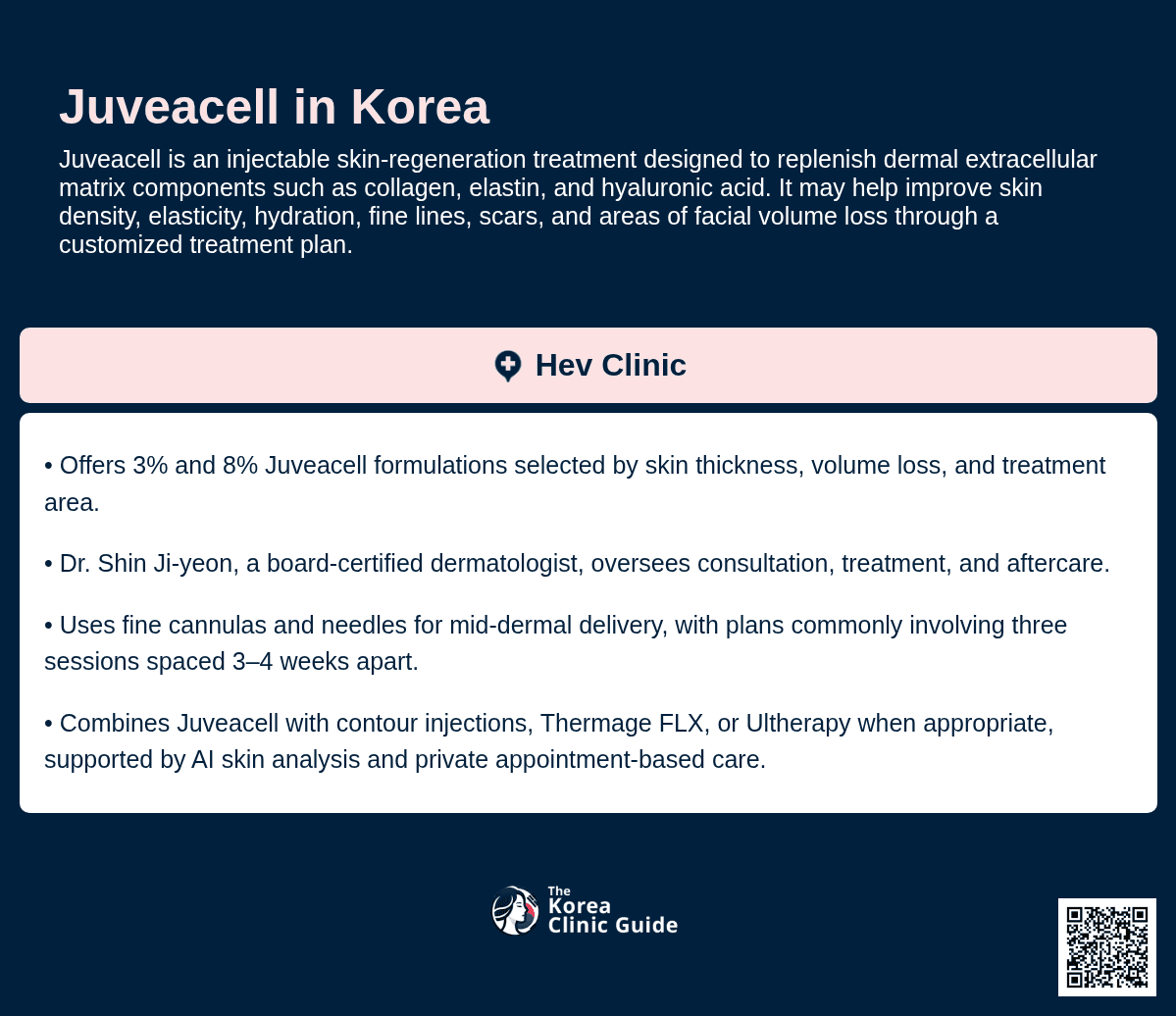
At Hev Clinic, your Juveacell plan can combine 3% and 8% formulations according to skin thickness, volume loss, and treatment area: 3% for broader superficial facial concerns such as moisture retention, fine lines, redness, and barrier support, and 8% for focused concerns including the under-eye area, sunken cheeks, scars, deep pores, and skin density.
- URL: Hev Clinic Website
- Location: Gangnam-gu, Seoul
- Procedure details:
- Juveacell is described as replenishing dermal extracellular matrix components, including collagen, elastin, and hyaluronic acid, directly into the dermal layer.
- The liquid prefilled-syringe formulation is injected into the mid-dermis with fine cannulas and needles, without powder reconstitution.
- For dermal-framework improvement, treatment is generally planned as at least three sessions spaced 3–4 weeks apart, followed by maintenance tailored to your skin condition.
- Dermatologist oversight:
- Dr. Shin Ji-yeon, a board-certified dermatologist, personally oversees consultation, treatment, and aftercare.
- Her listed roles include the Academic Committee of the Association of Korean Dermatologists and the Education Committee of the Korean Society for Anti-Aging Dermatology.
- Her anatomy-focused approach draws on work with the PENTA-A Anti-Aging Aesthetic Anatomy Research Group and is intended to guide precise targeting.
- Combination planning:
- An "empty and fill" protocol may pair New Bijou fat-dissolving injections for selected contour fat with area-specific Juveacell concentrations for volume loss and reduced elasticity.
- Juveacell can be incorporated after Thermage FLX or Ultherapy to address the dermal structure following device-based lifting.
- AI skin analysis is used to assess factors such as skin thickness, aging, and pigment depth when creating an individualized plan.
- Additional notes:
- A non-sedation, pain-controlled anesthesia approach allows you to communicate during treatment.
- Post-treatment care includes the clinic's Repair Barrier Cream, with follow-up planning aligned to an approximately 3–4-week skin regeneration cycle.
- Care is provided in an appointment-based private setting.
Juveacell From Start to Finish
- English or virtual consultation — Send clear, unfiltered photographs, medical history, current medicines and supplements, allergy information, pregnancy status, and details of previous fillers, threads, surgery, lasers, RF microneedling, or other facial procedures. Confirm that the clinic can communicate after you return home.
- In-person assessment — The treating clinician examines skin quality, thickness, laxity, asymmetry, scars, active inflammation, and prior injected material. Discuss realistic goals, alternatives, the limited Juveacell-specific evidence base, and why hADM is being selected instead of HA filler, PN, PDLLA, PLLA, calcium hydroxylapatite, or an energy-based treatment.
- Product and safety confirmation — Confirm the exact formulation, planned volume, injection areas, intended plane, lot number, expiry date, tissue-bank/product records, and material-specific plan for infection, nodules, hypersensitivity, or suspected vascular compromise. Do not proceed without a written consent process that addresses the donor-derived nature of the product.
- Cleansing and anesthesia — The skin is cleansed and topical anesthetic is commonly applied. Simple topical-anesthetic treatment generally does not require fasting, general anesthesia, admission, or an escort. Oral anxiolysis, IV sedation, nerve blocks, or combined procedures change the preparation and discharge requirements.
- Injection — The clinician injects Juveacell with a needle and/or cannula according to the individual treatment plan. Public evidence does not standardize the depth, regional dose, technique, or treatment duration; these depend on the areas treated and whether Juveacell is combined with other procedures.
- Observation and discharge — The clinic checks for immediate bleeding, swelling, pain, color change, or allergic-type symptoms, then provides written aftercare and emergency contact details. Most uncomplicated topical-anesthetic sessions are outpatient visits.
- Early recovery — Use cool compresses as directed. Do not judge the intended skin-quality result immediately, because swelling can temporarily make skin look more hydrated or full.
- Overseas follow-up — Send agreed photographs at 24–48 hours, report delayed pain, discoloration, progressive swelling, fever, or persistent/worsening lumps promptly, and complete the planned 2–4 week review. Any longer-term assessment should be cautious: no independently validated Juveacell-specific final-result or longevity timeline has been established.
Alternatives to Juveacell
The best alternative depends on whether the priority is skin quality, reversible volume, collagen stimulation, scar remodeling, or correction of substantial laxity. Non-surgical options have different materials, reversibility, downtime, and evidence; surgery is reserved for structural problems that injectables cannot correct.
PN Skin Boosters
- Option — Rejuran Healer uses polynucleotides rather than donor-derived hADM.
- Tradeoff — Consider it when the goal is skin quality and a PN-based treatment is preferred. It is not interchangeable with Juveacell, and treatment discomfort, injection pattern, course, and evidence differ.
PDLLA/HA Collagen Stimulators
- Option — Juvelook collagen booster combines PDLLA with HA for gradual collagen-oriented treatment.
- Tradeoff — This is a synthetic particulate-and-HA approach, not human dermal matrix. Discuss nodule risk, treatment plane, and whether the goal is diffuse texture improvement or localized correction.
HA Skin Boosters and Fillers
- Option — Skin boosters or facial filler can be appropriate when hydration or more predictable, adjustable volume is the goal.
- Tradeoff — HA is materially different from hADM and can generally be treated with hyaluronidase when clinically indicated; do not assume Juveacell has the same reversibility.
PLLA or Calcium Hydroxylapatite
- Option — Sculptra and Radiesse filler are collagen-stimulating injectables used in selected patients.
- Tradeoff — These products have different particle properties, timelines, dilution methods, and anatomy-specific risks. They are not direct substitutes for an hADM skin booster.
RF Microneedling or PRP
- Option — Secret RF microneedling, Potenza, or PRP facial treatment can target texture, pores, and selected scar concerns without placing hADM material.
- Tradeoff — Energy treatment and PRP address different biological targets. They may be more suitable for acne-scar texture or surface remodeling, but require assessment of pigment risk, active acne, healing capacity, and downtime.
Surgical Correction
- Option — Face lift addresses substantial laxity that a skin booster cannot lift.
- Tradeoff — Surgery provides structural repositioning but involves incisions, anesthesia, a much longer recovery, and greater travel and follow-up demands.
How Can I Prepare for Juveacell?
- Medical disclosure — Provide all medicines, supplements, allergies, medical conditions, pregnancy or breastfeeding status, previous cosmetic procedures, and relevant records before booking. Specifically disclose prior filler complications, permanent filler, threads, autoimmune disease, immunosuppression, keloid scars, herpes simplex, and recent facial treatments.
- Blood-thinning medicines — Do not independently stop aspirin, warfarin, apixaban, rivaroxaban, clopidogrel, corticosteroids, immunosuppressants, or any prescribed medicine. The prescribing clinician and injector must decide whether changes are appropriate. Ask about nonessential bruising-promoting supplements such as fish oil, vitamin E, ginkgo, garlic supplements, and high-dose NSAIDs before treatment.
- Active skin problems — Postpone treatment for cold sores, open wounds, active acne inflammation, dermatitis, or any bacterial, viral, or fungal infection in the injection area. Ask the clinician about an antiviral plan when there is a history of recurrent facial herpes.
- Alcohol and heat — Avoid alcohol and significant heat exposure before treatment when the clinic directs it, particularly if bruising or flushing is a concern.
- Treatment-day skin — Arrive with clean skin and avoid applying heavy makeup, irritating acids, retinoids, or exfoliants to the planned injection area unless the clinic gives different instructions.
- Sedation arrangements — Topical anesthetic alone generally does not require fasting or an escort. For oral sedation, IV sedation, nerve blocks, or combined procedures, follow the clinic’s fasting rules exactly and arrange an adult escort and supervised accommodation if required.
- Travel logistics — Keep flights flexible for at least 24–48 hours after treatment, book accommodation with easy clinic access, and avoid scheduling the procedure immediately before an important event.
Travel note: Bring a translated medication list and save the clinic’s after-hours number before treatment. Confirm clinic-specific requirements and follow the treating doctor’s individualized instructions over general guidance.
Aftercare Advice
Protect the treated area and treat escalating pain or color change as urgent, not as normal recovery.
- Cooling and contact — Use intermittent cool compresses as directed. Avoid pressure, vigorous massage, facial devices, and unnecessary touching of treated areas unless the injector specifically instructs otherwise.
- Activity and heat — Avoid strenuous exercise, alcohol, sauna or steam rooms, hot yoga, and substantial heat for roughly 24–48 hours unless the injector gives different instructions.
- Skincare and makeup — Keep puncture sites clean. Avoid makeup and irritating skincare until puncture sites have closed; then use gentle products and broad-spectrum SPF 50 on exposed skin. Do not use acids, retinoids, scrubs, or aggressive facial treatments until the clinic clears them.
- Expected short-term effects — Redness, tenderness, swelling, pinpoint marks, bruising, temporary firmness, and small palpable bumps commonly improve over hours to several days. Minor injection-related marks can remain visible for 7–14 days.
- Emergency warning signs — Seek same-day in-person assessment for increasing or disproportionate pain, white/blotchy or blue-purple discoloration, cool skin, rapidly worsening swelling, spreading redness, pus, fever, hives, facial swelling, ulceration, or persistent/worsening lumps. Sudden visual symptoms, severe headache, weakness, facial droop, or speech difficulty are emergencies; vascular compromise after facial injections is uncommon but time-sensitive.
- Result assessment and follow-up — Early swelling can create a misleading hydrated or fuller appearance. Assess tissue-remodeling changes over several weeks, not immediately, and complete the agreed 24–48 hour remote check and 2–4 week review.
Follow the treating doctor’s instructions over general advice, and contact the clinic promptly when anything appears wrong.
Frequently Asked Questions
Related Blogs
Comparing Global Costs of Pico Fraxel: Why Korea is a Top Choice for Skin Rejuvenation Without Compromise
Discover the affordability of Pico Fraxel laser treatments in Korea, where cutting-edge technology meets competitive pricing. Explore why many are choosing Korea for their skincare journey and how it compares to global costs.
Updated: Oct 21, 2026
Optimize Your Wellness: See Why Vitamin Injections in Korea Offer Value Beyond Costs Compared to the USA & More
Discover the latest trends in the cost of vitamin injections in Korea, exploring factors affecting pricing and popular clinics. Learn how these wellness treatments can boost your energy and overall health.
Updated: Oct 21, 2026
Laser Tattoo Removal Costs: Is Korea Your Best Option Compared to the USA, Turkey, and Beyond?
Discover the factors influencing the cost of laser tattoo removal in Korea, from technology and expertise to session frequency. Explore why Korea is becoming a popular destination for this effective and advanced cosmetic procedure.
Updated: Oct 21, 2026
Unlock Radiant Skin: Comprehensive Cost Analysis of Steroid Injections for Scars in Korea vs USA, Turkey & More
Explore the cost of steroid injections for scars in Korea, a popular cosmetic procedure aimed at minimizing the appearance of scar tissue. This article breaks down the pricing, factors influencing cost, and potential savings compared to other countries.
Updated: Oct 21, 2026