Medical Tourism Blog
Acellular Dermal Matrix (ADM) Breast Augmentation in Korea: Candidates, Surgical Methods, Recovery and Travel Planning
Table of contents
- Acellular Dermal Matrix (ADM) Breast Augmentation at a Glance
- What Is Acellular Dermal Matrix (ADM) Breast Augmentation?
- Who Is a Good Candidate for Acellular Dermal Matrix (ADM) Breast Augmentation?
- How Is Acellular Dermal Matrix (ADM) Breast Augmentation Performed?
- Why Visit Korea for Acellular Dermal Matrix (ADM) Breast Augmentation?
- Key Information for International Patients
- Which Are the Best Clinics in Korea for Acellular Dermal Matrix Adm Breast Augmentation?
- Acellular Dermal Matrix (ADM) Breast Augmentation From Start to Finish
- Alternatives to Acellular Dermal Matrix (ADM) Breast Augmentation
- How Can I Prepare for Acellular Dermal Matrix (ADM) Breast Augmentation?
- Aftercare Advice
Considering treatment in Korea? Everything you need to know e.g. — how to avoid scams, visas, interpreters, recovery tips — in our Medical Tourism Master Guide. Plan with confidence in minutes, not weeks!
Last updated: October 2026
Acellular Dermal Matrix (ADM) Breast Augmentation at a Glance
- What ADM does — ADM is a decellularized human- or animal-derived tissue scaffold sutured inside the breast to reinforce the implant pocket or add coverage over visible edges; it does not add meaningful breast volume.
- Best suited to complex revisions — Its main aesthetic role is selected revision surgery for recurrent bottoming out, lateral displacement, symmastia, weak lower-pole support, thin-tissue rippling, or recurrent Baker grade III–IV capsular contracture—not routine first-time augmentation.
- Recovery and final result — Surgery is usually outpatient or involves one overnight stay; desk work may be possible after 1–2 weeks with clearance, strenuous and upper-body activity is commonly restricted for 4–6 weeks, and a more stable breast shape is assessed around 3–6 months.
- Korea travel timeline — International patients should plan to remain in Korea for 10–14 days for examination, surgery, early wound or drain checks, and fitness-to-fly review; complex capsulectomy, implant exchange, drains, or complications can require longer.
- Important risks and limits — ADM adds risks such as seroma, infection, delayed incorporation, inflammatory redness, graft contraction, or extrusion, and it cannot remove excess skin, reliably lift a low nipple, or make implants lifetime devices.
- Evidence and Korea distinction — Korean surgeons have experience with locally available ADM products such as MegaDerm, but the identified Korean evidence is mainly reconstructive and does not prove better cosmetic outcomes, lower complication rates, or faster recovery for international patients.
- Product details matter — Ask for the exact ADM trade name, human/porcine/bovine source, size, thickness, and placement, plus implant details; evidence from one matrix or technique cannot be assumed to apply to another.
What Is Acellular Dermal Matrix (ADM) Breast Augmentation?
Acellular dermal matrix (ADM) breast augmentation uses a processed tissue scaffold with breast implants to reinforce internal soft-tissue support, usually during revision surgery. It aims to stabilize displaced implants, strengthen weak support, and improve coverage of visible implant edges or rippling. It is a surgical procedure, generally performed under general anesthesia.
Who Is a Good Candidate for Acellular Dermal Matrix (ADM) Breast Augmentation?
- Complex revision needs — Good candidates have recurrent implant malposition, including bottoming out, lateral displacement, or symmastia; weak inframammary-fold or lower-pole support; thin tissue with visible rippling; or recurrent Baker grade III–IV capsular contracture.
- Thin soft-tissue coverage — ADM can add an internal scaffold over selected areas where an implant edge is visible or palpable. It does not add meaningful breast volume.
- Primary augmentation with unusually poor support — Selected first-time augmentation or augmentation-lift patients with poor tissue quality can be considered, but ADM is not established as a routine addition to uncomplicated primary augmentation.
- Realistic revision goals — Suitable patients understand that ADM reinforces an implant pocket; it does not remove excess skin, reliably lift a low nipple, or make implants lifetime devices.
Avoid elective ADM-assisted surgery during pregnancy or breastfeeding, with active infection, an unresolved seroma or hematoma, wound problems, suspected implant infection, uncontrolled diabetes, significant immunosuppression, untreated bleeding disorders, or an unsafe general-anesthesia risk. Current nicotine use—including smoking, vaping, nicotine pouches, and nicotine replacement—can compromise blood supply, healing, and matrix incorporation; stop for the surgeon-specified interval. Prior chest irradiation, recurrent infection, poor skin blood supply, or a history of multiple failed revisions requires individualized assessment. The surgeon must also confirm the matrix source and processing agents, since products can be human-, porcine-, or bovine-derived and relevant hypersensitivity is a contraindication.
How Is Acellular Dermal Matrix (ADM) Breast Augmentation Performed?
ADM placement is tailored to the structural problem, tissue thickness, implant plane, and accompanying revision steps. The matrix is a decellularized extracellular-matrix sheet that is sutured internally and gradually incorporated into host tissue.
- Lower-pole or fold sling — ADM reinforces the inframammary fold, lower pole, or lateral pocket to help control bottoming out, lateral displacement, and stretched pocket tissues.
- Anterior coverage or onlay — The surgeon places ADM over areas of thin coverage to camouflage implant edges, rippling, or contour irregularities.
- Capsular-contracture revision — A revision can combine capsulectomy or capsulotomy, implant exchange, pocket repair or plane change, and ADM placement. Evidence is strongest for selected recurrent contracture cases, not prevention in routine primary augmentation.
- Partial versus extensive coverage — The amount of ADM is based on the defect. Larger coverage requires more dissection and introduces additional incorporation, seroma, and infection considerations; more material is not automatically better.
- Matrix selection — Human, porcine, and bovine products differ in source, thickness, cross-linking, processing, sterility, and preparation. Ask for the exact trade name, source, size, thickness, and planned position; results from one product cannot be assumed for another.
Why Visit Korea for Acellular Dermal Matrix (ADM) Breast Augmentation?
Korean surgeons use ADM products in implant-based breast surgery, including locally available products such as MegaDerm. However, the Korea-specific evidence identified for this procedure is chiefly reconstructive rather than cosmetic. It does not demonstrate better cosmetic outcomes, lower complication rates, or faster recovery for international patients.
- Local ADM familiarity — Korean publications describe MegaDerm use in implant-based reconstructive settings, demonstrating local experience with this material class while not proving an advantage in cosmetic ADM revision or augmentation for travelers.
- Product-specific planning matters — Ask the clinic to document the implant manufacturer, model, fill, surface, and placement plane, alongside the ADM trade name, biological source, dimensions, and regulatory status. These details are essential for future imaging and revision planning.
- Evidence limitation — A 2024 systematic review of recurrent capsular-contracture treatment identified nine studies covering 481 breasts. Only three retrospective controlled cohorts used Strattice; pooled recurrence was lower than with conventional revision treatment, but the review called for randomized trials. This evidence cannot be generalized to all ADMs, first-time augmentation, or every revision technique.
- No interchangeable-product assumption — Broader reviews continue to identify a need for high-quality comparative, long-term data between matrices. Reconstruction evidence cannot be converted into expected complication rates for cosmetic augmentation because cancer treatment, mastectomy flaps, radiation, and patient selection differ substantially.
Key Information for International Patients
- Minimum stay — Plan 10–14 days in Korea for an ADM-assisted augmentation or revision, allowing for an in-person examination, surgery, early wound and drain checks where relevant, and a fitness-to-fly review. Complex capsulectomy, implant exchange, drains, complications, and clot risk can require a longer stay.
- Flight timing — Do not take a long-haul flight without written clearance from the operating surgeon. On a cleared flight, follow the prescribed clot-prevention plan, walk periodically when safe, hydrate appropriately, and do not lift cabin luggage.
- Early recovery — The first several days bring the greatest pain, tightness, bruising, swelling, fatigue, and need for hematoma surveillance. Desk-based work is often possible after 1–2 weeks only when the surgeon clears it.
- Itinerary restrictions — Avoid carrying suitcases, overhead reaching, pushing, pulling, upper-body exercise, chest training, and strenuous activity for roughly 4–6 weeks or longer when extensive revision requires it. Build a low-activity itinerary and arrange help with luggage.
- Follow-up at home — Arrange a clinician at home before travel. A local doctor is not automatically obligated to assume postoperative responsibility for surgery performed overseas.
- Records to take home — Obtain an English operative report, implant card and labels, ADM product labels, medication list, drain and wound instructions, emergency contacts, and a remote-follow-up schedule.
Travel note: Keep flights flexible. Early departure is not a substitute for a postoperative examination, especially after capsulectomy, implant exchange, extensive pocket repair, or drain placement.
Which Are the Best Clinics in Korea for Acellular Dermal Matrix Adm Breast Augmentation?
Listed below are some of the best clinics in Korea for acellular dermal matrix adm breast augmentation.
1. BongBong Plastic Surgery Dermatology
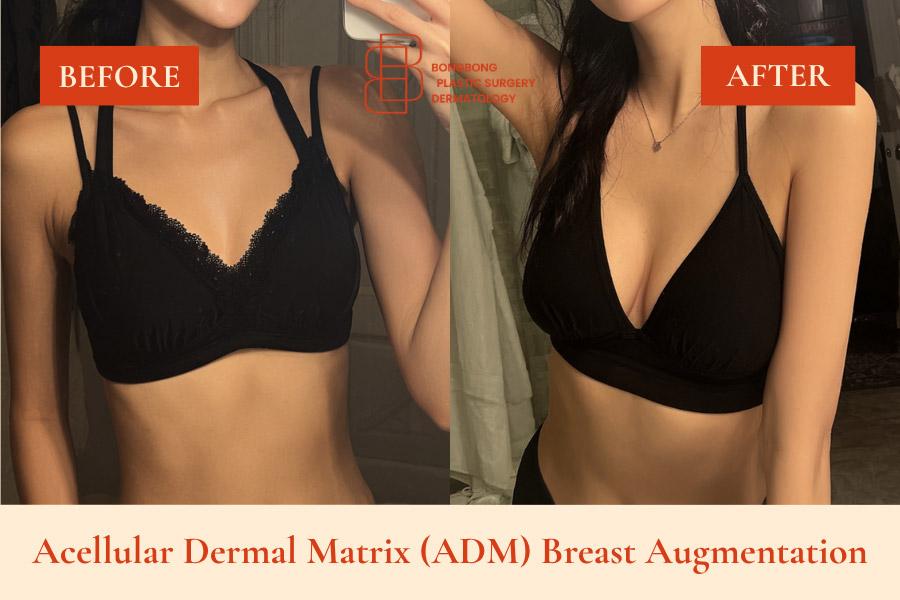
You may consider BongBong Plastic Surgery Dermatology if you are interested in its BiVOL approach to breast augmentation: the clinic describes this trademarked technique as using injectable acellular dermal matrix (ADM) with PDLLA, high-purity hyaluronic acid, and stem cells rather than a breast implant. The clinic states that the ADM is gradually replaced by your own tissue and that volume can be tailored rather than limited to fixed implant sizes.
- URL: BongBong Plastic Surgery Dermatology Website
- Location: Gangnam-gu, Seoul
- Procedure details:
- BiVOL stands for Bio-Integrated Volume & Structure and is described by the clinic as an implant-free approach focused on adding volume while building breast structure.
- The clinic lists ADM, PDLLA, high-purity hyaluronic acid, and stem cells as components of the BiVOL technique.
- ADM is also used in breast reconstruction; at this clinic, it is presented as a tissue-graft material for its augmentation approach.
- Surgical team and research:
- Dr. Sung Soo Park is the clinic director, a board-certified plastic surgeon, and lists breast augmentation as a main specialty.
- Dr. Park also directs the clinic’s Basic Cell Research Institute, which is connected to the stem-cell component of BiVOL.
- Dr. Min Gu Kang and Dr. Youngwoong Choi are board-certified plastic surgeons who list breast surgery.
- Dr. Jin Young Lee is the anesthesiologist and is described by the clinic as having 15 years of plastic-surgery anesthesia experience.
- The clinic states that its stem-cell lab has an R&D department certified by the Korean Ministry of Science and ICT.
- Other breast options: The clinic also lists implant augmentation with ADM support, fat-transfer augmentation, filler augmentation, breast reconstruction, breast reduction, and nipple correction.
Acellular Dermal Matrix (ADM) Breast Augmentation From Start to Finish
- Remote review and planning — Send prior operative reports, implant cards, requested breast photographs, imaging, medication and supplement lists, allergy history, nicotine status, and details of previous complications. Ask whether English-language or virtual consultation is available. Remote review helps planning but cannot replace physical examination.
- In-person surgical assessment — In Korea, the surgeon examines breast skin quality, tissue thickness, nipple position, asymmetry, implant pocket dimensions, implant plane, capsule status, and the cause of rippling or malposition. The plan can change to include implant exchange, capsular work, pocket repair, fat grafting, a lift, or implant removal.
- Testing and consent — Preoperative testing is individualized according to medical history and anesthesia requirements. Confirm the implant details and exact ADM product, source, dimensions, placement, expected scars, drain plan, and revision contingencies before signing consent.
- Anesthesia and surgery — Surgery is generally performed under general anesthesia. The surgeon often uses an existing scar, releases or removes problematic capsule when indicated, repairs the pocket, exchanges or places the implant, and sutures ADM into the planned reinforcement or coverage position. Extensive revision can take longer than uncomplicated primary augmentation.
- Recovery and discharge — Most patients leave the same day or stay one night, depending on revision extent, drain use, anesthesia recovery, and local protocol. Dressings, a prescribed support garment, pain medicines, and written restrictions are provided.
- Early Korea follow-up — Attend wound and implant-position checks and drain visits if drains were placed. The team assesses swelling, bruising, bleeding, infection, wound healing, and early pocket stability before considering flight clearance.
- Remote follow-up and long-term monitoring — Send scheduled photographs and report concerns promptly after returning home. Breast implants are not lifetime devices; future revision, removal, or replacement can be necessary. For silicone-gel implants, FDA labeling recommends ultrasound or MRI at 5–6 years after implantation and every 2–3 years afterward to screen for silent rupture; MRI is recommended when ultrasound findings are symptomatic or equivocal.
Alternatives to Acellular Dermal Matrix (ADM) Breast Augmentation
The best alternative depends on the underlying problem. Structural pocket failure can require surgical repair, while thin coverage or modest contour concerns can sometimes be addressed without ADM. A lift treats skin excess and nipple descent; fat grafting improves coverage but does not provide the same pocket reinforcement.
Standard Implant Augmentation
- Best fit — First-time augmentation with adequate skin, soft-tissue coverage, and implant-pocket support.
- Tradeoff — Avoids ADM material and added dissection, but does not address a weak or previously distorted pocket. See breast augmentation.
Conventional Revision Without ADM
- Best fit — Patients whose pocket can be corrected with capsulorrhaphy, capsular flaps, capsulotomy or capsulectomy, implant downsizing or exchange, and/or a pocket-plane change.
- Tradeoff — Uses native capsule and sutures rather than a biologic matrix, but may be less suitable when tissues are repeatedly stretched or especially thin. See revision breast surgery and capsular contracture treatment.
Fat Grafting
- Best fit — Modest volume enhancement, contour refinement, and camouflage of thin-tissue rippling.
- Tradeoff — Uses the patient's own fat but does not mechanically reinforce the fold or implant pocket, and repeat sessions can be required. See breast fat grafting.
Breast Lift With or Without Implant Exchange
- Best fit — Excess skin and nipple descent are the main concerns.
- Tradeoff — Removes skin and reshapes the breast, which ADM alone cannot do, but adds scars and has its own healing considerations. See breast lift.
Implant Removal
- Best fit — Patients who no longer want implants or have repeated implant-related complications.
- Tradeoff — Removal can be combined with a lift or fat grafting, but breast volume and skin envelope will change. See breast implant.
How Can I Prepare for Acellular Dermal Matrix (ADM) Breast Augmentation?
- Send complete records early — Provide prior operative notes, implant cards, breast imaging, prior infection or seroma records, cancer or radiation history, and details of all revisions. This information determines whether ADM, pocket repair, a lift, or implant removal is appropriate.
- Disclose medicines and supplements — Give the surgeon and anesthesiologist a full list of prescription drugs, aspirin, NSAIDs, anticoagulants, antiplatelet drugs, hormonal medicines, vitamins, fish oil, vitamin E, and herbal products. Do not stop prescribed blood thinners independently; the prescribing clinician and surgeon must provide a coordinated plan.
- Stop nicotine as directed — Stop cigarettes, vaping, nicotine pouches, and nicotine replacement for the exact interval set by the surgeon. Nicotine can compromise incision healing and ADM incorporation.
- Follow fasting instructions — Follow the clinic’s written rules for food, clear liquids, alcohol, and regular medicines before general anesthesia. Do not rely on a generic fasting schedule.
- Protect the treatment area — Avoid sunburn, skin injury, breast-area injections, and treatments that could irritate the planned incision area. Report acne, rash, cuts, fever, or any infection before surgery.
- Arrange practical support — Book nearby accommodation, arrange an adult companion for the first night when required, and plan help with bags, laundry, and transport. Do not drive after anesthesia or while taking sedating pain medicine.
- Plan recovery-friendly travel — Choose flexible flights and avoid travel commitments that require lifting, long walking days, hot baths, swimming, or upper-body activity.
Travel note: Confirm who will assess a wound problem after returning home before booking surgery. Early remote advice does not replace emergency assessment for a rapidly enlarging breast, breathing symptoms, or suspected infection.
The operating surgeon’s individualized instructions take precedence over general preparation guidance; confirm all medication changes, nicotine timing, fasting, tests, companion requirements, and travel dates in writing.
Aftercare Advice
Protect the repaired pocket and healing tissues: early overactivity, lifting, nicotine exposure, and unapproved massage can jeopardize an ADM-assisted revision.
- Support garment and dressings — Wear the prescribed bra or garment exactly as directed. Follow the surgeon’s instructions for bathing, dressings, tape, drains, and incision care; do not independently add silicone, creams, heat, ice, or lymphatic massage.
- Activity restriction — Avoid lifting suitcases, overhead reaching, pushing, pulling, chest exercise, and strenuous activity for roughly 4–6 weeks unless the surgeon sets a different timeline. ADM-assisted revision can need more cautious recovery than uncomplicated augmentation because tissue incorporation and pocket repair must heal.
- Avoid nicotine and submersion — Continue avoiding nicotine. Do not swim, use hot tubs, or submerge incisions until the surgeon confirms full wound healing.
- Watch for urgent symptoms — Seek urgent surgical care for rapidly increasing swelling or firmness, marked new asymmetry, escalating one-sided pain, fever, spreading redness or warmth, pus or foul drainage, wound separation, fainting, persistent vomiting, calf pain or swelling, chest pain, or shortness of breath. A late new breast swelling also requires prompt assessment.
- Expect gradual settling — Bruising, swelling, tightness, limited arm movement, and fatigue are most prominent in the first days. Implant position and shape continue to settle for months; a more stable cosmetic result is usually judged at 3–6 months, while scars can mature for up to a year.
- Keep scheduled follow-up — Attend all Korea appointments before departure and complete remote reviews after returning home. Keep the implant and ADM documentation for future imaging and revision care.
Follow the treating doctor’s written instructions over general advice, and contact the clinic promptly when healing appears abnormal or symptoms worsen.
Frequently Asked Questions
Related Blogs
Global Cost Showdown: Understanding Breast Surgery Expenses in Korea vs. Other Major Destinations
Discover the factors that influence the cost of breast surgery in Korea, from medical expertise to facilities and post-operative care. Explore how Korea's competitive pricing and advanced technology make it a popular destination for cosmetic procedures.
Updated: Oct 21, 2026
Korean Excellence in Cosmetic Tattooing: A Global Price Comparison for Areola Tattoos
Discover the factors that influence the cost of areola tattoos in Korea, offering insights into pricing variations based on location, artist expertise, and design complexity. Explore why more individuals are choosing this empowering procedure and learn what to expect in terms of investment.
Updated: Oct 21, 2026
Breast Reduction: Exploring Korea's Value vs. Global Costs and Services in Leading Destinations
Discover the cost of breast reduction surgery in Korea and explore the factors influencing pricing, including surgical techniques and hospital reputation. Learn how Korea's medical infrastructure offers competitive options for those seeking this popular cosmetic procedure.
Updated: Oct 20, 2026
Exploring the Price Spectrum: Revision Breast Surgery Costs in Korea Versus Global Alternatives
Discover the cost-effective solutions for revision breast surgery in Korea, where top-tier medical facilities and experienced surgeons provide high-quality care. Explore why international patients choose Korea for affordable procedures without compromising on safety and results.
Updated: Oct 19, 2026