
Medical Tourism Blog
Viveve Laser in Korea: RF Treatment, Safety, Evidence and Travel Planning
Table of contents
- Viveve Laser at a Glance
- What Is Viveve Laser?
- Who Is a Good Candidate for Viveve Laser?
- How Is Viveve Laser Performed?
- Why Visit Korea for Viveve Laser?
- Key Information for International Patients
- Which Are the Best Clinics in Korea for Viveve Laser?
- Viveve Laser From Start to Finish
- Alternatives to Viveve Laser
- How Can I Prepare for Viveve Laser?
- Aftercare Advice
Considering treatment in Korea? Everything you need to know e.g. — how to avoid scams, visas, interpreters, recovery tips — in our Medical Tourism Master Guide. Plan with confidence in minutes, not weeks!
Last updated: September 2026
Viveve Laser at a Glance
- What it is — Despite the name, Viveve is not a laser: it is a non-incisional, cryogen-cooled monopolar radiofrequency treatment, usually applied around the vaginal opening in an outpatient visit.
- Who may benefit — The main study population was premenopausal adults with at least one full-term vaginal delivery, self-reported laxity during intercourse, and a normal pelvic examination; a gynecologic evaluation should rule out infection, prolapse, pelvic-floor injury, menopause-related dryness, and urinary disorders first.
- Evidence and results — In one sham-controlled trial, 43.5% of treated participants versus 19.6% of sham participants reported no laxity at 6 months, but this was a subjective result in a narrowly selected group; evidence for sexual function and stress incontinence remains low-certainty or insufficient.
- Recovery and repeat care — There is usually no incision or admission, and non-strenuous activity can often resume the same day without sedation; published protocols required avoiding vaginal intercourse and tampons for 10 days, while no evidence-based maintenance or repeat-treatment schedule is established.
- Not a treatment for structural problems — Viveve does not repair prolapse, fistula, pelvic-floor muscle avulsion, or significant anatomical defects, and it is not an established cure for stress urinary incontinence; pelvic-floor training is first-line for stress or mixed leakage.
- Korea travel plan — Plan 2–3 days in Korea for an in-person examination, outpatient treatment, and access to the treating team before a long-haul flight; arrange remote follow-up at 1–2 weeks and reassessment at 3–6 months.
- Korea-specific device check — Before booking, obtain current MFDS documentation for the exact Viveve console and disposable tip: an indexed record lists the 2019 Viveve 2.0 permit as cancelled or withdrawn on December 10, 2025, and no evidence shows superior outcomes in Korea.
What Is Viveve Laser?
Viveve, often inaccurately called a laser treatment, uses cooled radiofrequency energy without incisions around the vaginal opening. It is marketed for concerns about vaginal laxity, but benefits for sexual symptoms or urinary leakage are not established and evaluation should identify the underlying cause. Viveve is a non-surgical outpatient procedure.
Who Is a Good Candidate for Viveve Laser?
- Evaluated vaginal-laxity concerns — The pivotal trial enrolled premenopausal adults aged 18 years or older with at least one full-term vaginal delivery, self-reported laxity during intercourse, and a normal genitopelvic examination.
- Normal or near-normal pelvic anatomy — Suitable candidates have no substantial prolapse, fistula, marked perineal distortion, or suspected levator muscle injury that needs reconstructive or pelvic-floor care.
- Realistic treatment goals — Good candidates understand that Viveve is a non-incisional, cryogen-cooled monopolar radiofrequency (RF) treatment, not a laser, and that it does not guarantee anatomical tightening, sexual-function improvement, or continence.
- Diagnosed stress leakage — Leakage with coughing, laughing, exercise, or sneezing needs pelvic-floor or urogynecology assessment before considering RF; it is different from urgency leakage, infection, prolapse, or fistula.
Pregnancy and breastfeeding are unsuitable because fetal and nursing-child risks have not been established. Defer treatment for active vaginitis, urinary tract infection, sexually transmitted infection, unexplained bleeding, genital lesions, or pelvic infection. An implantable pacemaker, automatic implantable cardioverter-defibrillator (AICD), other implanted electrical device, known or suspected pelvic malignancy, significant prolapse, fistula, or a markedly thin rectovaginal septum requires specialist assessment or excludes treatment. Do not label undiagnosed pelvic pain, vulvodynia, vaginismus, painful intercourse, or sexual dysfunction as “laxity”: these symptoms have different causes and treatments. Moderate-to-severe stress urinary incontinence, intrinsic sphincter deficiency, postpartum muscle avulsion, and prolapse are not corrected by Viveve.
How Is Viveve Laser Performed?
There are no meaningful patient-facing types of Viveve. The relevant difference is the treatment target and protocol, which should follow a documented diagnosis rather than marketing language.
- Vaginal-laxity or introitus protocol — A single-session, surface-cooled monopolar RF treatment focused around the vaginal opening. The pivotal sham-controlled study used active treatment at 90 J/cm²; 43.5% of active-treatment participants versus 19.6% of sham participants reported no laxity at six months. This was a subjective outcome in a narrowly selected study population.
- SUI-oriented research protocol — Small studies have used wider treatment coverage in the distal vaginal canal and periurethral-support region, including 5-cm and 8-cm tips and protocols of 220 pulses. This is indication-dependent or investigational treatment, not an established cure for stress urinary incontinence.
- Treatment hardware — Published protocols use a disposable treatment tip, coupling fluid, cryogen cooling, an RF console, and a return pad. Ask for the exact console model, disposable tip, target area, planned energy protocol, and the clinical reason that protocol fits the diagnosis.
Why Visit Korea for Viveve Laser?
Viveve in Korea requires unusually careful regulatory verification. It is not enough to see a 2019 announcement or a clinic marketing page: obtain documentation for the exact console and disposable tip proposed. No peer-reviewed comparative evidence shows that Viveve in South Korea has better effectiveness, safety, durability, or patient-reported outcomes than treatment elsewhere.
- Current MFDS status requires confirmation — An independently indexed record identifying Viveve 2.0 model VIVGE02 as MFDS permit 수허 19-412, issued in December 2019, lists the permit as cancelled or withdrawn on December 10, 2025. The record should be treated as a reason to verify status directly with the provider, not as proof that no valid replacement authorization exists.
- Written device documentation — Before booking flights, request current MFDS documentation for the exact system and tip, the authorized intended use, the clinician’s credentials, and written confirmation of who manages complications after departure.
- Evidence-informed consent matters — A 2024 systematic review found that apparent sexual-function benefits in observational studies were not reproduced when analysis was limited to randomized trials. A 2026 review judged RF evidence for study-defined laxity response low-certainty, short-term, and largely subjective, and concluded pelvic-floor muscle training should be first-line.
Key Information for International Patients
- Minimum stay — Plan 2–3 days in Korea for an in-person gynecologic or urogynecologic consultation, examination, outpatient treatment, and ideally access to the treating team before a long-haul flight.
- Admission and activity — The treatment is ordinarily outpatient, with no incision or hospital admission. Ordinary non-strenuous activity is generally possible the same day when no sedative medication is used.
- Flight timing — Next-day flying can be feasible for a well patient without sedation, bleeding, escalating pain, urinary difficulty, or suspected infection, but this is travel-planning inference rather than a Viveve-specific trial standard. Delay travel and obtain assessment when symptoms develop.
- Sedation arrangements — Unsedated treatment does not inherently require a companion. Arrange an escort and do not drive or travel alone until cleared by the clinician if oral or IV sedation, anxiolytic medicines, mobility limitations, or communication needs affect safe independent travel.
- Sex and tampon restriction — Published Viveve trial protocols required no vaginal intercourse or tampon use for 10 days. The treating clinician can set a different restriction based on examination findings and protocol.
- Remote follow-up — Obtain an English procedure note and emergency contact before departure. Arrange a remote check at 1–2 weeks and symptom review at 3–6 months; infection symptoms, significant bleeding, severe pain, or acute urinary problems require local in-person care.
Travel note: Keep the final days of the trip flexible. Do not schedule treatment immediately before an overnight flight, a remote excursion, or an itinerary where urgent gynecologic assessment would be difficult.
Which Are the Best Clinics in Korea for Viveve Laser?
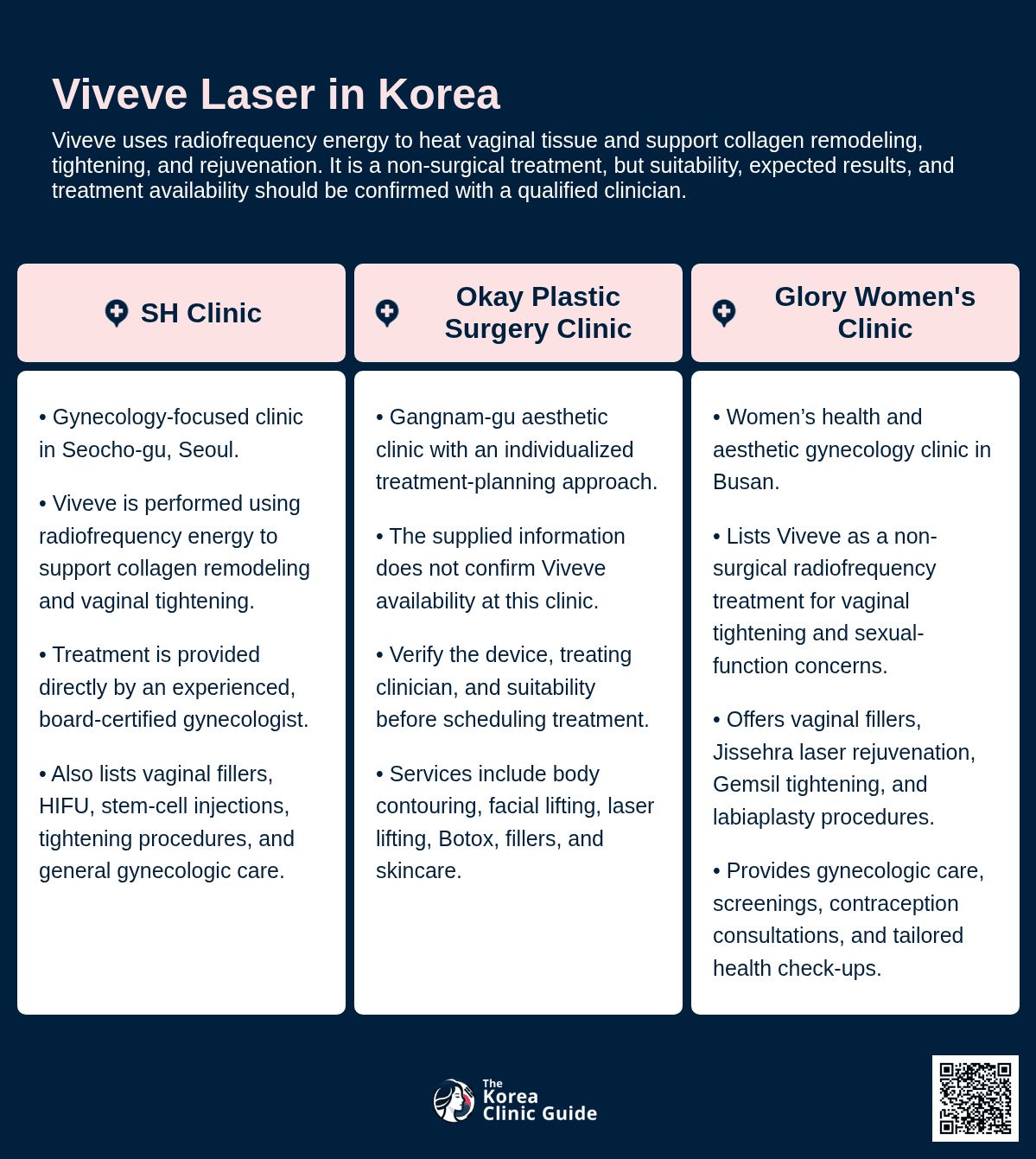
Listed below are some of the best clinics in Korea for viveve laser.
1. SH Clinic
You may consider SH Clinic for Viveve because its gynecology-focused setting offers this radiofrequency vaginal rejuvenation treatment under the direct care of an experienced, board-certified gynecologist. The clinic describes Viveve as a non-surgical option intended to heat vaginal tissue and stimulate collagen for improved firmness.
- URL: SH Clinic Website
- Location: Seocho-gu, Seoul
- Procedure details:
- Viveve uses radiofrequency thermal energy applied to vaginal tissue to support collagen remodeling and tightening.
- The clinic states that one treatment may produce noticeable changes over time; individual results, timing, and durability should be discussed during your consultation.
- SH Clinic reports that tightening effects can remain after a year, but outcomes vary by your anatomy, childbirth history, symptoms, and other factors.
- Clinical care:
- Procedures are stated to be performed directly by a board-certified gynecologist who received a commendation from the Minister of Health and Welfare.
- The clinic specializes in gynecology and women’s care, which may be relevant if you want evaluation of vaginal-health concerns alongside an aesthetic treatment.
- Related services:
- Available vaginal rejuvenation options listed by the clinic include vaginal fillers, stem-cell injections, vaginal HIFU, vaginal tightening procedures, and implant surgery.
- The gynecology clinic also provides general gynecological care.
2. Okay Plastic Surgery Clinic
You may consider Okay Plastic Surgery Clinic if you are looking for a clinic with a broad aesthetic practice and an individualized-treatment approach; however, the supplied information does not confirm that it offers Viveve or another radiofrequency vaginal rejuvenation treatment. You should verify Viveve availability, the treating clinician, and whether the treatment is appropriate for your goals before proceeding.
- URL: Okay Plastic Surgery Clinic Website
- Location: Gangnam-gu, Seoul
- What the clinic documents:
- The clinic describes individualized aesthetic planning and a team that includes a female plastic surgeon with extensive experience.
- Its listed services focus on body contouring, breast procedures, facial lifting, eye surgery, rhinoplasty, scar care, and skincare rather than gynecologic treatments.
- Related aesthetic services:
- Non-surgical lifting options listed include thread lifting and laser lifting for facial skin tightening.
- The clinic also lists Botox, fillers, medical skincare, pigmentation treatments, and acne/scar care.
3. Glory Women's Clinic
You may consider Glory Women’s Clinic for Viveve because it lists Viveve as a non-surgical radiofrequency treatment designed to tighten vaginal tissue and improve sexual function, within a clinic dedicated to women’s health and aesthetic gynecology. This may be useful if you want vaginal-rejuvenation care alongside evaluation of broader gynecologic concerns.
- URL: Glory Women's Clinic Website
- Location: Busanjin-gu, Busan
- Procedure details:
- Viveve is described as a non-surgical radiofrequency treatment for vaginal tissue tightening and improved sexual function.
- Your expected benefits and suitability should be assessed in relation to your symptoms, medical history, and treatment goals.
- Aesthetic gynecology options:
- The clinic also lists vaginal fillers, Jissehra laser vaginal rejuvenation, Gemsil thread-based vaginal tightening, mini labiaplasty, labiaplasty revision, clitoral hood reduction, and petite vaginal surgery.
- Having several listed options may allow discussion of whether a non-surgical radiofrequency approach or another treatment better matches your concerns.
- Women’s health services:
- Services include assessment and treatment for menstrual problems, abnormal bleeding, vaginitis, sexually transmitted diseases, and cystitis.
- The clinic lists cervical and ovarian cancer screening, contraception consultations, and tailored health check-ups.
Viveve Laser From Start to Finish
- Remote pre-screening — Share childbirth and menopausal history, urinary and sexual symptoms, prior pelvic surgery, cancer treatment, implanted devices, medications, allergies, infection symptoms, and pregnancy possibility. Request an English or virtual consultation where available; a questionnaire and quotation do not establish a diagnosis.
- Travel and documentation check — Confirm the in-person appointment, ask for current MFDS documentation for the exact device and tip, and obtain a written plan for complications and remote follow-up before purchasing non-flexible flights.
- In-person assessment — Expect a symptom history and genitopelvic examination. Pregnancy assessment is appropriate where relevant; urinary symptoms can require urinalysis or culture, while discharge or lesions can require infection testing.
- Diagnosis and consent — The clinician should distinguish laxity from genitourinary syndrome of menopause, infection, prolapse, pelvic-floor injury, vulvodynia, vaginismus, and urinary disorders. Review the limited evidence, alternatives, risks, and intended treatment target. In the United States, FDA clearance is for general-surgical electrocoagulation and hemostasis, not vaginal rejuvenation, incontinence, menopausal symptoms, or sexual dysfunction.
- Outpatient RF treatment — The clinician places a return pad and uses coupling fluid with a disposable 5-cm or 8-cm tip. Cryogen cooling protects the contact surface while monopolar RF heats tissue beneath it. Treatment duration depends on the protocol; a published SUI-oriented protocol of 220 pulses took about one hour.
- Discharge — Most patients leave the same day. Receive written instructions on intercourse and tampon restrictions, activity, warning signs, medication use, and a direct emergency contact before leaving the clinic.
- Recovery and overseas follow-up — Resume non-strenuous routine activity when well and unsedated, but avoid vaginal intercourse and tampons for at least 10 days unless the treating clinician gives different instructions. Arrange remote review at 1–2 weeks and reassessment at 3–6 months; do not judge the final effect immediately after treatment.
Alternatives to Viveve Laser
The right alternative depends on the diagnosis. Non-surgical options avoid the anesthesia and recovery of surgery but can require sustained participation or repeat care; surgery can address defined structural defects but has materially greater recovery and complication burdens.
Pelvic-Floor Muscle Training
- Best role — Supervised pelvic-floor muscle training for at least three months is first-line for stress or mixed urinary incontinence.
- Tradeoff — It does not surgically repair muscle avulsion or prolapse, but it addresses pelvic-floor function without vaginal energy treatment. See female incontinence treatment.
Menopause and Vaginal Dryness Treatment
- Best role — Dryness, irritation, recurrent urinary symptoms, and menopausal painful sex fit genitourinary syndrome of menopause more closely than “laxity.”
- Options — Vaginal moisturizers and lubricants, low-dose vaginal estrogen when medically appropriate, vaginal DHEA, or ospemifene are diagnosis-specific options. Estrogen-dependent cancer requires coordinated gynecology and oncology advice. See vaginal dryness treatment.
Continence Procedures
- Best role — A continence pessary, urethral bulking, or sling surgery can be considered after specialist evaluation of confirmed stress incontinence.
- Tradeoff — These procedures target continence mechanisms directly, unlike RF, but injections and surgery carry their own procedural risks and follow-up needs.
Vaginoplasty or Reconstructive Repair
- Best role — Significant vaginal-opening defects, prolapse, levator injury, fistula, or structural concerns need urogynecology or reconstructive gynecology assessment.
- Tradeoff — Vaginoplasty and pelvic muscle restoration surgery can address selected structural concerns, but involve anesthesia, wound healing, longer sexual-activity restrictions, and surgical complication risks.
Other Vaginal Energy Devices
- Best role — CO₂ or Er:YAG laser and other RF systems are sometimes marketed for similar symptoms.
- Tradeoff — They are not interchangeable with Viveve and share important evidence limitations; treatment should not replace diagnosis-specific care. See vaginal tightening laser treatment.
How Can I Prepare for Viveve Laser?
- Medical disclosure — Provide a complete list of prescription medicines, over-the-counter drugs, vitamins, herbal products, anticoagulants or antiplatelets, diabetes medicines, hormone therapy, allergies, implanted devices, prior pelvic procedures, obstetric history, cancer treatment, and possible pregnancy.
- Medicine changes — Do not independently stop aspirin, clopidogrel, warfarin, apixaban, rivaroxaban, insulin, GLP-1 medicines, hormones, or antidepressants. Obtain instructions from both the treating clinician and the clinician who manages those medicines.
- Infection and bleeding screening — Report discharge, odor, genital lesions, urinary burning, fever, pelvic pain, unexpected bleeding, or a recent sexually transmitted infection before traveling. Defer treatment until the cause is diagnosed and treated.
- Fasting and sedation — Fasting is generally unnecessary for an unsedated office treatment. Follow facility-specific fasting instructions if oral or IV sedation is proposed.
- Day-of preparation — Follow instructions on bathing and external hygiene. Do not douche or use intravaginal products unless the clinic specifically directs their use.
- Travel logistics — Book flexible flights, avoid scheduling treatment just before major travel, and arrange an escort when sedation or anxiety medication is planned.
Travel note: Bring a printed medication list and records of major pelvic procedures or cancer treatment. Ask in advance for the English procedure note needed by a doctor at home.
Confirm all clinic-specific requirements with the treating doctor; individualized instructions take precedence over general guidance.
Aftercare Advice
Protect the treated area, follow the sexual-activity restriction exactly, and treat new pelvic or urinary symptoms as medical issues rather than routine recovery.
- Activity — Resume ordinary non-strenuous activity when well and no sedative was used. Follow the clinician’s instructions on exercise, lifting, and travel when treatment was extensive or symptoms occur.
- Vaginal restrictions — Follow the conservative research-protocol restriction of no vaginal intercourse or tampons for at least 10 days unless the treating clinician gives a different timeframe. Avoid douching and intravaginal products unless prescribed.
- Hygiene and comfort — Use clinician-approved gentle external hygiene. Report discomfort that worsens rather than improves, especially burning, blistering, or increasing pelvic pain.
- Warning signs — Seek prompt medical care for heavy or persistent bleeding, fever, foul-smelling discharge, worsening pelvic pain, painful urination, inability to urinate, blistering or burn symptoms, severe new leakage, or persistent painful intercourse.
- Follow-up and results — Arrange remote review at 1–2 weeks and a symptom reassessment at 3–6 months. The pivotal laxity study measured its primary outcome at six months, and there is no established evidence-based maintenance or repeat-treatment interval.
Follow the treating doctor’s individualized instructions and contact the clinic promptly when anything appears wrong; seek local in-person assessment for severe pain, infection symptoms, bleeding, or acute urinary problems.
Frequently Asked Questions
Related Blogs
G-spot Filler in Korea: Evidence, Safety, Recovery, and Travel Planning
G-spot filler involves nonstandardized anterior vaginal-wall injections, most often temporary hyaluronic acid, with uncertain sexual-function benefits and potential risks. International patients should plan 2–3 days in Korea for assessment and review, obtain treatment records, and arrange follow-up care.
Updated: Sep 28, 2026
PRP Vaginal Rejuvenation in Korea: Evidence, Procedure Steps, Recovery and Travel Planning
PRP vaginal rejuvenation uses a patient’s processed blood plasma for targeted vaginal, vulvar, clitoral, or periurethral injections after pelvic-health assessment, but protocols and evidence of benefit are not standardized. The article covers candidate screening, Korea travel planning, preparation, recovery, warning signs, follow-up, and diagnosis-specific alternatives for dryness, pain, incontine
Updated: Sep 28, 2026
G-spot Amplification in Korea: Evidence, Safety, Recovery and Travel Planning
G-spot amplification involves injecting filler into a patient-identified area of the anterior vaginal wall near the urethra, but no standardized target or proven sexual-function benefit exists. The article covers candidacy, product and clinic verification in Korea, travel planning, aftercare, warning signs, and alternatives such as sexual-health evaluation and pelvic-floor therapy.
Updated: Sep 28, 2026
Adenomyosis in Korea: Diagnosis, Fertility Decisions, and Treatment Options
Adenomyosis care begins with gynecologic assessment, ultrasound or MRI, and treatment selection based on symptoms, anatomy, anemia, and fertility goals. Options include medication, LNG-IUS, HIFU, UAE, adenomyomectomy, or hysterectomy, with travel-stay guidance, recovery planning, warning signs, and follow-up information for international patients.
Updated: Sep 22, 2026
Clinics offering Viveve Laser

SH Clinic: Comprehensive Women's, Men's & Couples' Health Services in Korea
Sinsa

Okay Plastic Surgery Clinic in Korea: Comprehensive Aesthetic Procedures with Sincerity and Care
Cheongdam

Gangnam Esther Women's Clinic in Korea: Comprehensive Women's Health, Aesthetic and Stem Cell Treatments
Sinnonhyeon Station

Glory Women's Clinic in Korea: Comprehensive Women's Health Care, Gynecology, and Aesthetic Procedures
Seomyeon