Medical Tourism Blog
Pelvic Muscle Restoration Surgery in Korea: Types, Recovery, Risks and Travel Planning
Table of contents
- Pelvic Muscle Restoration Surgery at a Glance
- What Is Pelvic Muscle Restoration Surgery?
- Who Is a Good Candidate for Pelvic Muscle Restoration Surgery?
- What Are the Different Types of Pelvic Muscle Restoration Surgery?
- Why Visit Korea for Pelvic Muscle Restoration Surgery?
- Key Information for International Patients
- Which Are the Best Clinics in Korea for Pelvic Muscle Restoration Surgery?
- Pelvic Muscle Restoration Surgery From Start to Finish
- Alternatives to Pelvic Muscle Restoration Surgery
- How Can I Prepare for Pelvic Muscle Restoration Surgery?
- Aftercare Advice
Considering treatment in Korea? Everything you need to know e.g. — how to avoid scams, visas, interpreters, recovery tips — in our Medical Tourism Master Guide. Plan with confidence in minutes, not weeks!
Last updated: September 2026
Pelvic Muscle Restoration Surgery at a Glance
- Diagnosis-specific surgery — Pelvic Muscle Restoration Surgery is an umbrella term, not one operation; treatment may involve prolapse repair, perineal reconstruction, apical suspension, sacrocolpopexy, or a separately planned continence procedure.
- Best candidates — Candidates have a documented, bothersome cystocele, rectocele, uterine or vault prolapse, perineal-body defect, or confirmed stress incontinence that has not responded adequately to physiotherapy, a pessary, or other conservative care.
- Recovery period — Protected healing usually takes 6–8 weeks: gentle walking starts early, desk work may be possible in 2–4 weeks after an uncomplicated repair, and lifting, high-impact exercise, swimming, and vaginal intercourse generally wait for surgical clearance.
- Travel commitment — International patients should plan to remain in Korea at least 10–14 days after an uncomplicated minimally invasive operation, because CDC guidance advises avoiding flights for at least 10 days after abdominal surgery and the surgeon must clear travel.
- Korea distinction — South Korea has published experience with robotic sacrocolpopexy, including a 200-case single-surgeon single-port robotic series from 2020–2023, but this does not prove superior outcomes or apply to every pelvic-floor repair.
- Mesh and symptom limits — A prolapse operation may not resolve every urinary, bowel, pain, or sexual symptom; abdominal mesh sacrocolpopexy also requires explicit consent because mesh erosion, pain, scarring, and possible further surgery can occur.
- No routine maintenance — Successful reconstructive repair does not require planned maintenance sessions, but postoperative review before departure and arranged follow-up at home are essential, particularly after mesh or combined procedures.
What Is Pelvic Muscle Restoration Surgery?
Pelvic Muscle Restoration Surgery is an umbrella term for operations that repair pelvic-floor support problems, perineal defects, or related continence conditions. It aims to relieve bothersome bulge, pressure, bladder, bowel, or functional symptoms and restore support based on the diagnosed problem. It is surgical; some operations use vaginal incisions, while others are performed through minimally invasive abdominal approaches.
Who Is a Good Candidate for Pelvic Muscle Restoration Surgery?
- Symptomatic prolapse — Good candidates have a documented cystocele (bladder prolapse), rectocele, uterine prolapse, or vaginal-vault prolapse causing a bulge, pressure, incomplete bladder emptying, bowel difficulty, or daily-life limitations.
- Perineal-body defect — A postpartum perineal scar, widened vaginal opening, or damaged perineal body can be assessed for perineorrhaphy or perineoplasty when the anatomical defect matches the symptoms.
- Defined continence condition — Stress urinary incontinence can require a separately planned continence procedure, rather than being assumed to improve after prolapse repair alone.
- Conservative treatment has not been enough — Surgery is considered when pelvic-floor physiotherapy, a pessary, or symptom-management measures have not given acceptable relief.
- Clear treatment goals — Suitable patients understand whether the aim is prolapse support, perineal reconstruction, continence treatment, uterine preservation, or a combination—not generalized “tightening.”
Pelvic Muscle Restoration Surgery is an umbrella directory term, not one standardized operation. Pregnancy, plans for future pregnancy, or incomplete childbearing often warrant deferring elective repair because pregnancy and vaginal birth can compromise results; ACOG identifies future pregnancy plans as an important factor in prolapse-surgery decisions. Active infection, unexplained bleeding, a pelvic mass, possible malignancy, uncontrolled diabetes, anemia, serious cardiopulmonary disease, ongoing nicotine exposure, and unmanaged constipation or chronic cough require assessment or optimization first. A urogynecologist or appropriately trained gynecologic surgeon should document the exact defect, POP-Q compartment and stage when prolapse is present, and whether surgery is likely to address the specific urinary, bowel, pain, or sexual symptoms.
What Are the Different Types of Pelvic Muscle Restoration Surgery?
The correct operation depends on the affected vaginal compartment or pelvic support level, prior surgery, future fertility plans, sexual-function goals, and whether mesh or uterine preservation is acceptable.
- Native-tissue vaginal repair — Anterior colporrhaphy supports an anterior-wall cystocele; posterior colporrhaphy supports a posterior-wall rectocele. Perineorrhaphy reconstructs the perineal body. These repairs use sutures and the patient’s tissue rather than permanent abdominal mesh.
- Vaginal apical suspension — Uterosacral-ligament suspension or sacrospinous fixation restores support at the vaginal apex for uterine or vaginal-vault prolapse. It is often combined with compartment-specific vaginal repair when indicated.
- Sacrocolpopexy or sacrohysteropexy — For apical or vault prolapse, mesh is attached through the abdomen to support the vagina at the sacrum. Sacrohysteropexy is a related uterus-preserving operation. ACOG distinguishes abdominal sacrocolpopexy mesh from vaginally placed prolapse mesh.
- Laparoscopic, robotic, or open route — Sacrocolpopexy can use conventional laparoscopy, robot-assisted laparoscopy, or an open abdominal incision. The route affects incision pattern, admission, and recovery, but not every patient is suitable for minimally invasive surgery.
- Obliterative surgery — Colpocleisis narrows or closes the vagina to treat severe prolapse. It permanently prevents penetrative vaginal intercourse and is only suitable for patients who do not want to retain that function.
- Combined functional repair — A documented prolapse repair can be combined with hysterectomy, uterus-preserving suspension, or a continence procedure such as a midurethral sling. The combined plan must be individually justified and consented to.
Why Visit Korea for Pelvic Muscle Restoration Surgery?
South Korea has published experience with minimally invasive robotic sacrocolpopexy for selected prolapse patients. This supports access to this surgical approach, not a claim that Korea produces better outcomes than equivalent care elsewhere. The label “pelvic muscle restoration” still requires careful diagnosis-specific planning at the individual hospital.
- Robotic sacrocolpopexy experience — A Korean retrospective report describes a single-surgeon series of 200 single-port robotic sacrocolpopexies at Korea University Guro Hospital from 2020 to 2023, supporting local clinical experience with this approach in selected patients.
- Minimally invasive access — Korean clinical publications include technical and comparative work in robotic sacrocolpopexy, including experience from Seoul Asan Medical Center; this is evidence of availability, not proof of superiority for every prolapse repair or perineal procedure.
- Evidence limitation — The available Korea-specific literature is concentrated on retrospective sacrocolpopexy research. It does not establish outcomes for perineoplasty, postpartum levator or perineal repair, generalized vaginal tightening, combined continence surgery, or international patients.
- Credentials and communication — Verify the surgeon’s urogynecology or reconstructive-pelvic-surgery training, hospital capability for complications, English communication, and any accreditation directly. CDC notes that accreditation is a quality-process marker, not a guarantee of an individual outcome.
Key Information for International Patients
- Minimum stay — Plan to remain in Korea for at least 10–14 days after an uncomplicated minimally invasive reconstructive operation. Open surgery, combined hysterectomy or continence treatment, urinary retention, infection, bleeding, or bowel concerns require a longer stay.
- Flight timing — Do not book a non-changeable return flight. CDC advises avoiding air travel for at least 10 days after abdominal surgery and notes that a 10–14-day delay after major surgery reduces travel-related risk.
- Clot prevention — Surgery, reduced mobility, and long-haul flights all increase venous-thromboembolism risk. Obtain a surgeon-specific plan for walking, calf exercises, hydration, compression stockings when appropriate, and prescribed medication; do not independently start aspirin or enoxaparin.
- Itinerary impact — Expect early walking and short local outings only. Avoid lifting luggage, strenuous sightseeing, alcohol-heavy activities, saunas, hot tubs, swimming, and long excursions during early healing.
- Repeat care — No maintenance sessions are planned after a successful repair. However, postoperative assessment before departure and local follow-up after return are essential, especially after mesh surgery or combined procedures.
- Records and remote follow-up — Arrange a clinician at home before travel and leave with English copies of the operative report, discharge summary, anesthesia record, pathology results when relevant, generic medication list, and mesh or implant manufacturer, product, and lot details when used. CDC specifically advises pre-arranged follow-up and English medical records.
Travel note: A video consultation can review records and travel feasibility, but it cannot replace an in-person pelvic examination, compartment assessment, and anesthesia evaluation.
Which Are the Best Clinics in Korea for Pelvic Muscle Restoration Surgery?
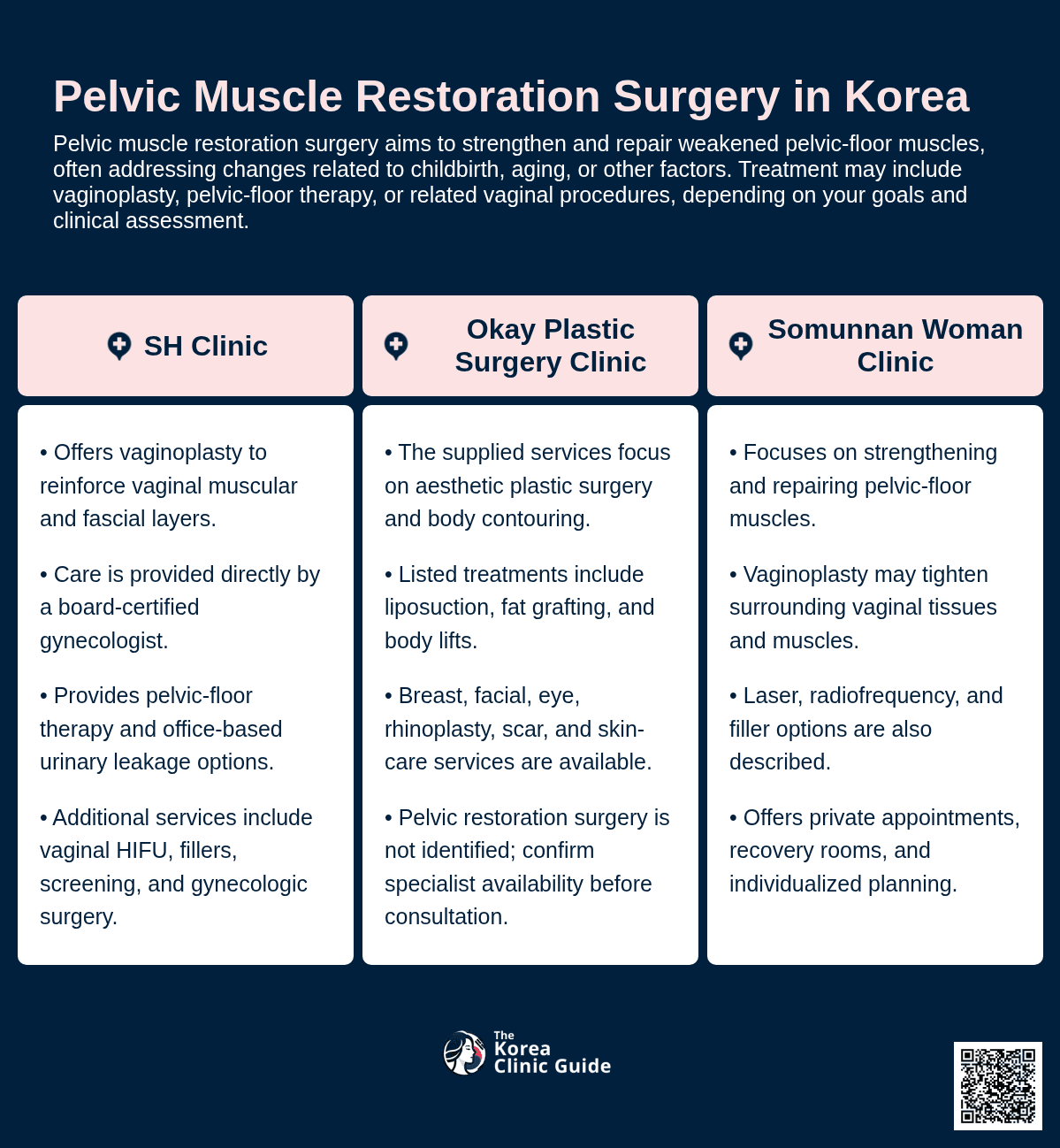
Listed below are some of the best clinics in Korea for pelvic muscle restoration surgery.
1. SH Clinic
At SH Clinic, you can discuss pelvic muscle restoration through vaginoplasty, which reinforces vaginal muscular and fascial layers to improve tone and pelvic support, including changes that may follow childbirth. Your gynecologic care and procedure are performed directly by a board-certified gynecologist recognized with a Minister of Health and Welfare commendation.
- URL: SH Clinic Website
- Location: Seocho-gu, Seoul
- Procedure details:
- Vaginoplasty is described as tightening the vaginal canal by reinforcing muscular and fascial layers.
- The clinic also offers pelvic-floor therapy and office-based options for stress or urge urinary leakage.
- Gynecologic options:
- Available vaginal rejuvenation options include vaginal fillers, stem-cell injections, vaginal HIFU treatments, vaginal tightening, and implant surgery.
- Vaginal HIFU uses focused ultrasound to promote collagen remodeling and elasticity without downtime, according to the clinic.
- Care setting:
- SH Clinic is a specialized women’s-care clinic with gynecology services ranging from general care to gynecologic surgery.
- The clinic also provides cervical and ovarian cancer screening, including Pap smears, HPV testing, and ultrasound.
2. Okay Plastic Surgery Clinic
Okay Plastic Surgery Clinic’s provided services focus on aesthetic plastic surgery, body contouring, breast procedures, facial surgery, and skin care; they do not identify pelvic muscle restoration surgery, vaginoplasty, or related pelvic-floor treatment. If you are considering this procedure, you would need to confirm whether it is offered and whether your concerns can be assessed by an appropriate specialist.
- URL: Okay Plastic Surgery Clinic Website
- Location: Gangnam-gu, Seoul
- What the listed services cover:
- Body services include liposuction, fat grafting, contouring treatments, and abdominal or arm lifts.
- Other listed areas include breast surgery, facial lifting, eye surgery, rhinoplasty, scar care, and medical skin care.
- Clinic approach:
- The clinic describes individualized treatment planning and a team that includes a female plastic surgeon with extensive experience.
- No pelvic-floor procedure details, gynecologic credentials, or postoperative pathway for pelvic muscle restoration are provided in the supplied information.
3. Somunnan Woman Clinic
At Somunnan Woman Clinic, pelvic muscle restoration is intended to strengthen and repair pelvic-floor muscles affected by childbirth, aging, or other factors, with potential benefits for urinary control and sexual satisfaction. You receive care in a women-focused setting that emphasizes privacy, one-on-one doctor appointments, and individualized planning.
- URL: Somunnan Woman Clinic Website
- Location: Gangnam-gu, Seoul
- Procedure details:
- Pelvic muscle restoration is designed to strengthen and repair weakened pelvic-floor muscles.
- The clinic identifies childbirth and aging among factors that can contribute to pelvic-floor weakness.
- Potential functional goals include improved urinary control and sexual satisfaction.
- Related treatment options:
- Vaginoplasty removes excess vaginal lining and tightens surrounding soft tissues and muscles for functional and aesthetic concerns.
- Laser or radiofrequency vaginal tightening is offered to tighten the vaginal canal and may help with urinary incontinence.
- Vaginal filler is a minimally invasive option intended to restore vaginal volume and elasticity.
- Privacy and recovery:
- One-on-one appointments mean the doctor sees only one person at a time.
- Dedicated recovery rooms are available after procedures before you go home.
- The clinic describes multidisciplinary collaboration to tailor care to your needs.
Pelvic Muscle Restoration Surgery From Start to Finish
- Remote inquiry and records review — Send childbirth history, previous pelvic or abdominal operations, symptom description, medication and allergy list, relevant imaging or tests, prior pessary or physiotherapy treatment, and fertility or uterine-preservation preferences. Confirm whether English or interpreter-supported video consultation is available.
- Diagnosis-focused consultation — The surgeon clarifies whether the problem is prolapse, a perineal defect, stress incontinence, pain, or another condition. A generalized request for tightening is not enough to select reconstructive surgery.
- In-person examination and testing — After arrival, expect a pelvic examination and POP-Q compartment assessment when prolapse is suspected. Blood and urine tests, pregnancy testing, ECG, post-void residual measurement, urine culture, urodynamics, or bowel evaluation are used when clinically indicated.
- Operative planning and consent — Confirm the exact operation, route, native-tissue versus mesh plan, uterine preservation or hysterectomy plan, possible continence procedure, anesthesia, catheter use, hospital stay, risks, and contingency plans. Discuss mesh-specific risks explicitly when sacrocolpopexy is proposed.
- Anesthesia and surgery — Most reconstructive operations use general anesthesia. Vaginal native-tissue repairs and perineal repairs can have shorter operative and discharge timelines than abdominal procedures; laparoscopic or robotic sacrocolpopexy is often outpatient or overnight, while open surgery commonly needs about 2–3 hospital days.
- Immediate recovery and discharge checks — A temporary urinary catheter and, after some vaginal repairs, vaginal packing can be used. Pain control, early assisted walking, bowel planning, and a voiding assessment guide discharge readiness.
- Early postoperative review in Korea — Attend the scheduled wound, symptom, and mobility review before travel. The operating team must confirm fitness to fly and provide individualized VTE prevention instructions.
- Home recovery and remote follow-up — Share the operative documentation with the clinician at home, complete remote follow-up as arranged, and seek in-person care promptly for warning signs or unresolved urinary, bowel, prolapse, pain, or sexual symptoms.
Alternatives to Pelvic Muscle Restoration Surgery
Non-surgical choices avoid anesthesia, incisions, and surgical recovery but do not restore support in every significant defect. Surgical alternatives differ in durability, mesh exposure, future sexual function, uterine preservation, and recovery; select them based on the documented diagnosis rather than marketing terminology.
Pelvic-Floor Physical Therapy
- Best for — Mild prolapse symptoms, pelvic-floor weakness, some incontinence patterns, and patients who want to postpone surgery.
- Tradeoff — It can improve muscle function and symptoms but cannot reliably correct advanced anatomical prolapse or a major perineal-body defect.
Vaginal Pessary
- Best for — Patients seeking non-operative prolapse support, those awaiting surgery, or people who are not medically ready for surgery.
- Tradeoff — A fitted device supports prolapsed organs while in place but needs ongoing fitting, cleaning, and follow-up.
Native-Tissue or Uterus-Preserving Repair
- Best for — Patients with prolapse who want a surgical option without abdominal mesh, or who want to discuss preserving the uterus.
- Tradeoff — Vaginal suspension and abdominal sacrohysteropexy involve different routes, materials, and risk profiles; ACOG notes that prolapse can often be treated successfully without mesh.
Hysterectomy-Based Repair
- Best for — Selected patients with uterine prolapse or a separate uterine indication where hysterectomy is appropriate.
- Tradeoff — Hysterectomy is not automatically required for prolapse repair. Discuss its distinct recovery, pathology implications, and whether uterine-preserving support is feasible. See hysterectomy.
Colpocleisis
- Best for — Severe prolapse in patients who do not want future penetrative vaginal intercourse.
- Tradeoff — It offers strong support for appropriately selected patients but permanently closes or narrows the vagina.
Continence-Focused Treatment
- Best for — Confirmed stress urinary incontinence without a need for prolapse reconstruction, or urinary symptoms that require separate assessment.
- Tradeoff — Leakage, urgency, and incomplete emptying have different causes. See female incontinence treatment rather than assuming a prolapse operation will resolve all bladder symptoms.
How Can I Prepare for Pelvic Muscle Restoration Surgery?
- Confirm the diagnosis and exact operation — Ask for the documented prolapse compartments and stage, planned repair names, surgical route, mesh plan, uterus-preservation or hysterectomy decision, and whether a sling or other concurrent procedure is proposed.
- Disclose every medicine and supplement — Provide prescriptions, over-the-counter products, vitamins, herbal preparations, anticoagulants, antiplatelet drugs, diabetes medicines, hormone therapy, and allergies. Do not independently stop, bridge, or restart anticoagulants, aspirin, diabetes medication, or hormones; the prescribing clinician and anesthesia team must give the plan.
- Follow fasting instructions exactly — The hospital will set the food, clear-liquid, and medicine cut-off times for general anesthesia. Do not use a generic fasting schedule instead.
- Reduce healing risks — Stop smoking and nicotine exposure when the surgeon recommends; smoking increases anesthesia, pulmonary, infection, and wound-healing risks. Optimize diabetes, blood pressure, anemia, chronic cough, and constipation before surgery.
- Plan bowel care — Discuss a stool softener or laxative plan before surgery if constipation is recurrent or opioid pain medicine is expected. Straining can worsen pain and place stress on a healing repair.
- Arrange discharge support — Stay in accessible accommodation near the hospital, arrange an adult companion for discharge and the first night after anesthesia, and stock simple meals, water, and prescribed medicines.
- Keep travel flexible — Avoid fixed long-haul flights, intensive tourism, and accommodation changes during the first 10–14 postoperative days. Confirm insurance coverage for complications and care after return.
Travel note: Pack loose clothing, easy-on shoes, a small carry-on rather than heavy luggage, and translated copies of your medical history. Do not plan to carry bags through airports during the protected healing period.
Confirm all clinic-specific medicine, fasting, testing, admission, and travel requirements with the treating doctor; individualized instructions take precedence over general guidance.
Aftercare Advice
Protect the repair from pressure and strain during the first 6–8 weeks; feeling better before that does not mean internal healing is complete.
- Walk, but do not strain — Begin short, gentle walks as directed and increase ordinary activity gradually. Avoid heavy lifting, lifting children or luggage, high-impact exercise, repeated squatting, and constipation-related straining until surgeon clearance.
- Protect vaginal healing — Avoid vaginal intercourse, tampons, swimming, baths, hot tubs, and other immersion until the surgeon confirms healing, commonly for 6–8 weeks after vaginal repair.
- Support bladder and bowel recovery — Drink regularly, take prescribed pain and bowel medicines, and contact the team for inability to urinate, burning urinary symptoms, persistent vomiting, marked bloating, or failure to pass stool or gas as instructed.
- Watch for urgent complications — Seek urgent care for fever, worsening abdominal or pelvic pain, heavy vaginal bleeding, foul-smelling discharge, incision redness or pus, calf pain or swelling, chest pain, fainting, coughing blood, or shortness of breath.
- Resume work and exercise gradually — Desk or light work can be feasible in about 2–4 weeks after an uncomplicated repair. Physically demanding work needs longer; the timeline depends on the surgical route, combined procedures, pain control, fatigue, and healing.
- Assess results after healing — Anatomical support is restored during surgery, but swelling, fatigue, urinary or bowel adjustment, and comfort can continue improving for weeks. Persistent bulge symptoms, leakage, pain, painful intercourse, or recurrent prolapse need reassessment rather than routine “maintenance.”
Follow the treating doctor’s individualized instructions and contact the clinic promptly when something appears wrong.
Frequently Asked Questions
Related Blogs
Female Incontinence in Korea: Diagnosis, Treatment Options, Travel Planning and Recovery
Female incontinence care begins with diagnosis of stress, urgency, mixed, or other leakage patterns, followed by conservative treatment, medication, injections, neuromodulation, or surgery when appropriate. International patients can find assessment steps, procedure details, Korea stay planning, follow-up needs, recovery restrictions, and warning signs after bladder Botox or sling surgery.
Updated: Sep 21, 2026
Vaginal Implant in Korea: Dreamcore Evidence, Safety, Recovery, and Alternatives
Dreamcore vaginal implant placement uses a permanent silicone band passed through pelvic fascia via vaginal incisions, but evidence is limited to one case report involving concurrent mesh repair and a sling. The article covers candidate assessment, device documentation, a planned 2–3-week Korea stay, travel precautions, recovery restrictions, follow-up needs, warning signs, and established prolaps
Updated: Sep 21, 2026
Laser Labiaplasty in Korea: Techniques, Recovery, Risks, and Travel Planning
Laser labiaplasty permanently reduces or reshapes labia minora tissue using CO2 or Er:YAG laser techniques, with trim, wedge, and selected central reduction approaches. The article covers candidacy, travel and follow-up planning in South Korea, recovery restrictions, preparation, alternatives, and warning signs requiring urgent care.
Updated: Sep 21, 2026
Clitoroplasty with Laser in Korea: Methods, Recovery, Risks and Travel Planning
Laser clitoroplasty may involve reduction, recession, repositioning, or reconstruction, with laser use limited to incision or coagulation rather than a standardized procedure. The article covers candidate screening, risks, Korea travel planning, preparation, recovery, aftercare, and alternatives such as clitoral hood reduction.
Updated: Sep 21, 2026