Medical Tourism Blog
Clitoral Hood Reduction in Korea: Methods, Recovery, Risks and Travel Planning
Table of contents
- Clitoral Hood Reduction at a Glance
- What Is Clitoral Hood Reduction?
- Who Is a Good Candidate for Clitoral Hood Reduction?
- How Is Clitoral Hood Reduction Performed?
- Why Visit Korea for Clitoral Hood Reduction?
- Key Information for International Patients
- Which Are the Best Clinics in Korea for Clitoral Hood Reduction?
- Clitoral Hood Reduction From Start to Finish
- Alternatives to Clitoral Hood Reduction
- How Can I Prepare for Clitoral Hood Reduction?
- Aftercare Advice
Considering treatment in Korea? Everything you need to know e.g. — how to avoid scams, visas, interpreters, recovery tips — in our Medical Tourism Master Guide. Plan with confidence in minutes, not weeks!
Last updated: September 2026
Clitoral Hood Reduction at a Glance
- What it does — Clitoral hood reduction is same-day surgery that conservatively removes excess clitoral-prepuce skin while preserving the clitoral glans and its protective hood; it does not remove clitoral tissue.
- Best candidates — Appropriate candidates are consenting adults in stable health with persistent hood-related rubbing or a personal appearance concern, realistic expectations, and no partner pressure; infection, unexplained skin changes, pregnancy, or untreated vulvar disease require assessment first.
- Recovery timeline — Soreness, bruising, and swelling are common for 1–2 weeks; sedentary activity may be manageable at about 1 week, swelling improves substantially around 6 weeks, and final contour and scar maturation take roughly 3–6 months.
- Healing restrictions — Avoid direct clitoral stimulation, masturbation, penetrative sex, tampons, cycling, running, swimming, heavy lifting, and strenuous exercise for 4–6 weeks or until the surgeon confirms healing.
- Long-lasting but irreversible — The tissue reduction is intended to be permanent rather than a maintenance treatment, but over-removal can cause tenderness, hypersensitivity, altered sensation, or loss of protective tissue that cannot simply be restored.
- Evidence limitation — No technique has proven superior, and most published outcomes combine hood reduction with labiaplasty; isolated surgery cannot responsibly promise increased sensation, improved orgasm, or sexual-function improvement.
- Korea travel planning — International patients should plan 7–10 days in Korea for examination, surgery, and an early wound review, then obtain written flight clearance; Korea has registered international-patient facilities but no Korea-specific comparative outcome evidence for this procedure.
What Is Clitoral Hood Reduction?
Clitoral hood reduction is an elective operation that removes a limited amount of skin from the clitoral hood while preserving its protective function. It addresses persistent rubbing or appearance concerns related to hood tissue, not orgasm or sexual-sensation problems. It is a surgical procedure, usually performed as same-day outpatient surgery.
Who Is a Good Candidate for Clitoral Hood Reduction?
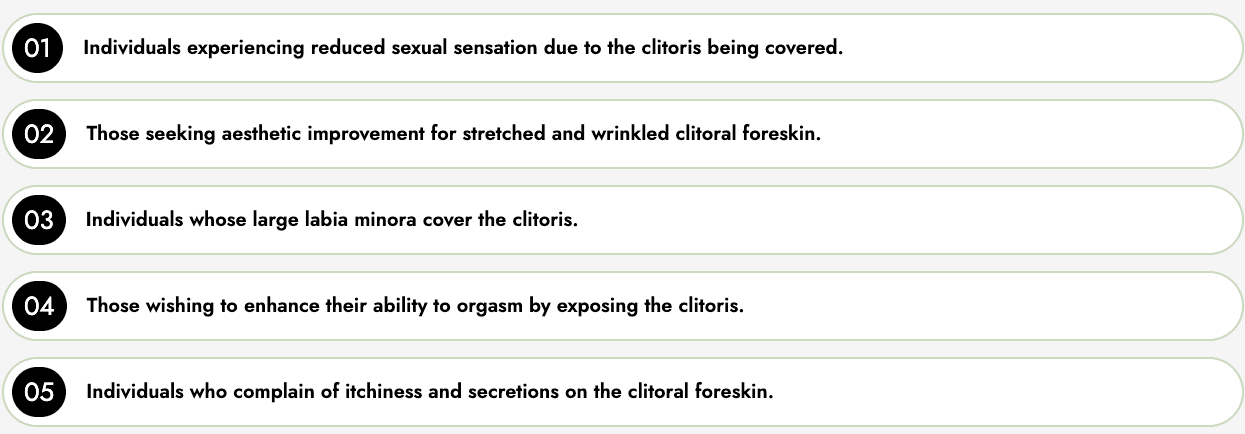
- Persistent hood-tissue concern — Consenting adults with ongoing rubbing, tugging or irritation from redundant clitoral-prepuce tissue, or a personally held appearance concern, can discuss conservative reduction.
- Realistic surgical goal — Suitable candidates understand that the clitoral hood normally protects the glans, that vulvar anatomy varies widely, and that surgery cannot guarantee symmetry, increased sensation or improved orgasm.
- Stable health and informed choice — Candidates should be medically fit for the planned anesthesia, able to follow 4–6 weeks of activity restrictions, and making the decision without partner pressure.
- Clear anatomy and diagnosis — A surgeon should distinguish hood excess from prominent labia minora, mons fullness, pelvic-floor pain, dermatologic disease, clitoral adhesions and clitoral phimosis before proposing surgery.
Elective female genital cosmetic surgery requires particular caution in adolescents; it is generally inappropriate before age 18 unless there is a diagnosed congenital malformation or another specific medical indication, as reflected in professional guidance on elective genital cosmetic surgery. Defer elective surgery during pregnancy or when childbirth is imminent. Active vulvar, vaginal or urinary infection, sores, unexplained skin changes and inflammatory vulvar disease require diagnosis and treatment first. Uncontrolled diabetes, bleeding disorders, significant immunosuppression, or anticoagulant or antiplatelet medicines that cannot be safely managed are important barriers. Clitoral adhesions or phimosis associated with lichen sclerosus require disease-directed assessment rather than cosmetic reduction; evidence for release procedures is low certainty and recurrence is common.
How Is Clitoral Hood Reduction Performed?
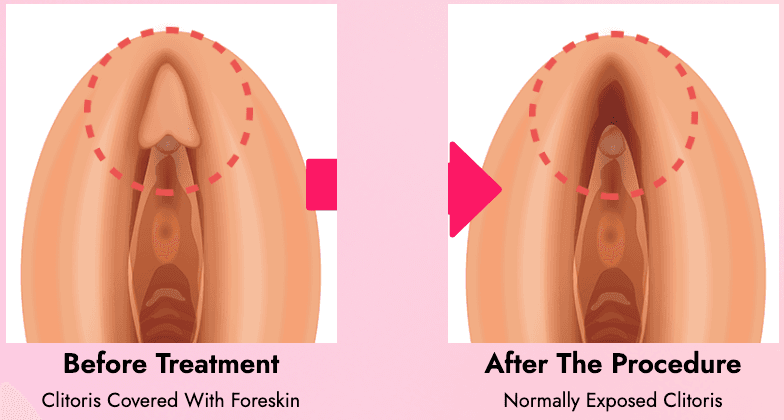
There are several operative design decisions, but no standardized patient-facing “type” of isolated hood reduction has proven superior for sensation, appearance or sexual outcomes.
- Standalone conservative reduction — The surgeon removes a limited amount of redundant preputial skin, preserves adequate tissue to protect the glans, and closes the incision with absorbable sutures. Local anesthesia, local anesthesia with sedation, or general anesthesia depends on surgical extent and facility practice.
- Combined hood reduction and labiaplasty — This approach addresses both labia minora and hood tissue when both contribute to the concern. It creates a larger healing area and usually requires the longer labiaplasty recovery restrictions. A small prospective cohort of combined procedures found no reduction in measured external-genital sensitivity through 12 months, but this does not establish outcomes for isolated hood reduction.
- Incision and tissue design — Direct excision or trimming can be performed alone or integrated with edge, wedge or composite labiaplasty designs. Crease pattern, asymmetry, scar placement and preservation of protective tissue should determine the plan.
- Device claims — Do not treat “laser hood reduction” as proof of better safety or results. Available tool-comparison findings concern labiaplasty rather than isolated hood surgery and cannot be transferred directly.
Why Visit Korea for Clitoral Hood Reduction?
Korea has an established system for receiving international patients, but no Korea-specific peer-reviewed outcome registry or comparative study was identified for clitoral hood reduction. That gap matters: international-patient infrastructure does not prove superior safety or outcomes for this operation. Choose a named operating surgeon and assess the actual surgical plan rather than relying on destination marketing.
- International-patient framework — Korea’s Medical Korea registered-institution system provides a starting point for checking facilities that participate in the national foreign-patient program.
- Documented care coordination — Ask the facility what language support, consent translation, anesthesia documentation, operative records and video follow-up it can provide. These practical arrangements are more important for a sensitive outpatient operation than a generic promise of “medical tourism” service.
- Surgeon-led planning — Insist that the named surgeon performs the in-person examination, markings and every operative step. Request a diagram stating exactly what hood tissue will be removed, how the glans and neurovascular structures will be protected, and whether labiaplasty is proposed.
- Evidence limitation — Published studies mainly combine labiaplasty with hood reduction. The most recent review found low-certainty, largely uncontrolled evidence and no clearly superior technique, so neither Korean nor international providers can responsibly promise sexual-function improvement from isolated surgery. Read the evidence limitation.
Key Information for International Patients
- Minimum stay — Plan 7–10 days in Korea for in-person assessment, surgery, an early wound review and contingency time. This is cautious travel planning, not a universal evidence-based flight interval.
- Flight timing — Do not fly on the day of surgery after sedation or general anesthesia. Obtain written clearance from the operating surgeon before long-haul travel; timing depends on anesthesia, bleeding, swelling, wound healing, complications and whether labiaplasty was combined.
- Early recovery — Soreness, bruising and swelling are expected for 1–2 weeks. Sedentary work or gentle routine activity is often manageable at about one week when comfortable, while swelling improves substantially by roughly six weeks.
- Itinerary impact — Avoid cycling, running, swimming, heavy lifting, strenuous exercise, tampons, penetrative sex, masturbation and direct clitoral stimulation for 4–6 weeks or until the surgeon confirms healing. A combined labiaplasty means following the longer restriction period.
- Remote follow-up — Arrange a video review with the operating team and identify an OB-GYN or appropriate clinician at home before travel. A local clinician can decline non-urgent management of a complication from surgery performed elsewhere.
- Documents and support — Leave Korea with the operative note, anesthesia record, medication list, discharge instructions and emergency contact details. Bring a companion for the first night after sedation or general anesthesia.
Travel note: No clitoral-hood-reduction-specific long-haul flight rule was identified. Use the surgeon’s written clearance and keep flights flexible, consistent with general WHO travel-health guidance.
Which Are the Best Clinics in Korea for Clitoral Hood Reduction?
Listed below are some of the best clinics in Korea for clitoral hood reduction.
1. SH Clinic
For clitoral hood reduction, SH Clinic offers care within a gynecology-focused practice where surgeries and procedures are performed directly by an experienced, board-certified gynecologist. You can expect evaluation in a setting that also provides a broad range of women’s health and vaginal-rejuvenation services.
- URL: SH Clinic Website
- Location: Seocho-gu, Seoul
- Clinical care:
- Procedures are performed directly by a board-certified gynecologist who has received a commendation from the Minister of Health and Welfare.
- The clinic focuses on gynecology and women’s care.
- Related services:
- Gynecologic services include labiaplasty, vaginoplasty, vaginal HIFU treatments, vaginal fillers, stem-cell injections, and vaginal implant surgery.
- General women’s health services include cervical and ovarian cancer screening and urinary-incontinence treatment.
2. Okay Plastic Surgery Clinic
Okay Plastic Surgery Clinic presents an individualized aesthetic-care approach for clitoral hood reduction, with a team that includes a female plastic surgeon with extensive experience. The provided information does not specifically list clitoral hood reduction, so you should confirm whether the procedure is available and whether its approach fits your goals.
- URL: Okay Plastic Surgery Clinic Website
- Location: Gangnam-gu, Seoul
- Care approach:
- The clinic describes tailored treatment planning based on your individual needs and aspirations.
- Its team includes a female plastic surgeon with extensive experience.
- Other available services:
- Aesthetic services include body contouring, breast surgery, hairline procedures, facial lifting, eye surgery, rhinoplasty, scar care, and medical skincare.
- Non-surgical offerings include Botox, fillers, pigmentation care, acne and scar treatments, and laser lifting.
3. Daegu Spring Women's Clinic
You may consider Daegu Spring Women’s Clinic for clitoral hood reduction because it specifically lists the procedure among its women’s external-surgery services. The clinic describes the surgery as reducing the clitoral hood’s size, with potential goals of improved hygiene and sexual pleasure, within a broader women’s-health practice.
- URL: Daegu Spring Women's Clinic Website
- Location: Jung-gu, Daegu
- Procedure focus:
- Clitoral hood reduction is specifically offered as a women’s external-surgery procedure.
- The clinic describes the procedure as reducing the size of the clitoral hood.
- Related women’s care:
- Other external-surgery options include labiaplasty, hymen restoration, and nipple reduction surgery.
- Vaginal-health services include vaginal tightening procedures, fillers, ultrasound and thermal treatments, and laser-based options.
- General gynecology, cervical-cancer screening, contraception, pregnancy care, and menopause-related care are also listed.
Clitoral Hood Reduction From Start to Finish
- Remote inquiry and consultation — Provide medical history, medication and supplement lists, allergies, previous surgery records and a clear description of functional and appearance concerns. Confirm whether English-language or interpreter-supported consultation is available. Send photographs only through a privacy-protected medical system if the clinic requests them, and understand that surgery remains contingent on examination in Korea.
- In-person surgeon assessment — The surgeon examines the vulvar anatomy, reviews pain and sexual history, checks for infection or dermatologic disease, and distinguishes hood tissue from labia minora prominence, adhesions, phimosis and other causes of symptoms. Discuss no surgery, diagnosis-specific treatment, standalone reduction and combined labiaplasty.
- Preoperative clearance and plan — Testing depends on health history and anesthesia: pregnancy testing, blood tests, urinalysis and anesthetic review are possible. Review consent, medications, surgical markings and a written tissue-preservation plan. Confirm the named surgeon will perform the operation.
- Anesthesia and surgery — Local anesthesia alone, local anesthesia with sedation, or general anesthesia is selected according to the extent of surgery and facility protocol. The surgeon conservatively removes clitoral-hood skin only; this is not clitoroplasty and should not remove clitoral tissue. Absorbable sutures usually close the incision.
- Recovery room and discharge — Staff monitor pain, nausea, bleeding and the ability to urinate before same-day discharge. Follow anesthesia instructions on driving, being alone, alcohol, public transport and important decisions. A responsible adult should stay the first night after sedation or general anesthesia.
- Early wound review in Korea — Attend a review commonly scheduled within the first postoperative week. The team checks swelling, bruising, hematoma, wound-edge separation, infection signs, urination and pain control before discussing travel clearance.
- Overseas follow-up — Complete scheduled video follow-ups and send wound photographs only through the clinic’s secure channel when requested. Seek urgent local assessment rather than waiting for a video appointment if bleeding, infection signs, severe pain or inability to urinate develops.
Alternatives to Clitoral Hood Reduction
Surgical alternatives are appropriate only when they address the actual source of the concern. A non-surgical diagnostic or supportive approach avoids irreversible tissue removal; surgery can alter tissue contour but carries risks to healing, sensation and comfort.
Diagnosis-Specific Treatment
- Adhesions or phimosis — Clitoral adhesions and phimosis are distinct from cosmetic hood excess. Treat lichen sclerosus, dermatitis, infection, pelvic-floor pain or sexual pain first; clinically indicated release is different from cosmetic unhooding.
- Evidence tradeoff — Release procedures for diagnosed adhesions or phimosis have shown possible improvement in pain and sexual-function measures, but the evidence is low certainty.
Labiaplasty
- Primary target — Consider labiaplasty when labia minora tissue, rather than the hood, is the main source of friction or appearance concern.
- Combination decision — Conservative hood tailoring can be combined with labiaplasty, but it is not automatically necessary and expands the healing area.
Clitoroplasty
- Different operation — Clitoroplasty concerns clitoral tissue itself in selected reconstructive, endocrine or gender-affirming contexts. It is not a cosmetic substitute for clitoral hood reduction.
- Risk tradeoff — Its sensory, anatomical and ethical considerations are materially different from removing limited preputial skin.
Revision Labiaplasty
- Healed persistent concern — Revision labiaplasty is reserved for a persistent problem after prior vulvar surgery, usually after swelling resolves and scars mature over several months.
- Added complexity — Scar tissue and reduced available tissue make further excision less predictable; over-resected protective hood tissue cannot simply be restored.
How Can I Prepare for Clitoral Hood Reduction?
- Medical disclosure — Give the surgeon and anesthesia team a complete list of prescription medicines, over-the-counter drugs, vitamins, herbal products, allergies, diabetes, bleeding history, prior genital surgery and mental-health history relevant to consent.
- Medicines and supplements — Do not independently stop anticoagulants, antiplatelets, diabetes medicines or psychiatric medicines. The prescribing clinician and surgical team must coordinate any changes and timing.
- Nicotine cessation — Follow the surgeon’s policy for cigarettes, vaping, nicotine pouches, gum and patches. Smoking is associated with increased postoperative complications and impaired healing.
- Fasting and alcohol — Follow the facility’s exact fasting instructions for sedation or general anesthesia. Avoid alcohol according to the anesthesia team’s instructions; do not use a generic online fasting schedule.
- Vulvar skin preparation — Avoid shaving, waxing, depilatories and new irritating vulvar products shortly before surgery unless the surgeon directs otherwise. If hair removal is needed, general surgical infection-prevention guidance favors clipping over shaving because shaving can injure skin. See WHO guidance.
- New symptoms — Report menstruation, possible pregnancy, urinary symptoms, unusual discharge, sores, fever, rash or new genital irritation immediately. Do not proceed with elective surgery until the surgeon has assessed concerning symptoms.
- Travel and accommodation — Book nearby private lodging with easy bathroom access, reliable phone/data service and flexible flights. Pack loose breathable underwear, loose clothing, pads or panty liners, prescribed medicines, a thermometer and a wrapped cold pack.
- Companion and transport — Arrange an adult companion for the first night after sedation or general anesthesia. Do not plan to drive, travel alone on public transport or make major decisions immediately after anesthesia.
Travel note: Schedule the early in-person wound check before departure and keep enough flexibility to extend the stay if bleeding, swelling or wound healing requires review.
Confirm the treating doctor’s clinic-specific medicine, fasting, hygiene and travel requirements; individualized instructions take precedence over this general guidance.
Aftercare Advice
Protect the healing tissue from friction, pressure, heat and sexual stimulation until the operating surgeon confirms that the incision has healed.
- Hygiene and incision care — Take prescribed medicines exactly as directed. Keep the area clean and dry according to the surgeon’s instructions; gentle showering and patting dry are commonly preferred over soaking early on. Do not apply unapproved creams, fragrance, “feminine wash,” herbal products, topical anesthetics or antibiotic ointment.
- Swelling and comfort — Use a wrapped cold pack over underwear, never directly on skin, for brief intervals. Rest with pelvic elevation and wear loose, breathable clothing. Bruising, soreness and swelling are common for 1–2 weeks.
- Activity restrictions — Walk gently as comfort permits. Avoid tampons, penetrative sex, masturbation, direct clitoral stimulation, cycling, horseback riding, running, swimming, hot tubs, heavy lifting and strenuous exercise for 4–6 weeks or until cleared.
- Expected healing — Swelling usually improves substantially by around six weeks. Final contour and scar maturation take about 3–6 months. Do not assess a need for revision while early swelling and scar change are still evolving.
- Urgent warning signs — Seek urgent local medical assessment for heavy or increasing bleeding, rapidly enlarging or one-sided swelling, a firm painful lump, severe or worsening pain, fever, foul-smelling drainage, spreading redness, pus, wound opening, inability to urinate, persistent vomiting after anesthesia, new numbness or distressing hypersensitivity.
- Follow-up — Attend the Korean wound check before departure and complete scheduled video reviews after returning home. Send records to a local clinician when urgent in-person care is needed.
Follow the treating doctor’s instructions over general advice and contact the clinic promptly when anything appears wrong.
Frequently Asked Questions
Related Blogs
Labia Majora Whitening in Korea: Methods, Safety, Recovery, and Travel Planning
Labia majora whitening requires specialist assessment of benign external pigmentation, with options including trigger control, monitored topicals, peels, non-ablative lasers, or fractional CO2 treatment. The article covers candidate screening, Korea travel planning, treatment steps, preparation, aftercare, follow-up, and warning signs requiring in-person care.
Updated: Sep 20, 2026
Labia Minora Whitening in Korea: Methods, Safety Limits, Travel Planning, and Aftercare
Labia minora whitening may involve clinician-directed topical agents, superficial peels, or energy-based treatments, but no standardized safe protocol or reliable evidence of effectiveness for labia minora tissue exists. The article covers candidate screening, in-person diagnosis, travel and follow-up planning in Korea, recovery precautions, aftercare, risks, and alternatives such as reassurance o
Updated: Sep 20, 2026
Abortion in Korea: Methods, Access Uncertainty, Travel Planning and Aftercare
Abortion methods include medication abortion, vacuum aspiration, and D&E, selected according to gestational age, clinical assessment, medical history, and follow-up access. International patients considering Korea should obtain written confirmation of services, plan follow-up and emergency care, and account for uncertain local availability and regulations.
Updated: Sep 19, 2026
Vaginal Filler in Korea: Types, Evidence, Recovery, Risks and Travel Planning
Vaginal filler uses hyaluronic acid injections for labia majora volume loss or carefully diagnosed postmenopausal vulvovaginal atrophy, following in-person screening and a documented treatment plan. In Korea, quoted costs range from ₩650,000–₩5,600,000 (about US$500–$4,100); international patients should plan follow-up, obtain product records, and know urgent warning signs.
Updated: Sep 18, 2026