Medical Tourism Blog
TruSculpt Fat Dissolving Laser in Korea: RF Body Contouring, Results, Recovery and Travel Planning
Table of contents
- TruSculpt Fat Dissolving Laser at a Glance
- What Is TruSculpt RF Body Contouring?
- Who Is a Good Candidate for TruSculpt RF Body Contouring?
- How Is TruSculpt RF Body Contouring Performed?
- Why Visit Korea for TruSculpt RF Body Contouring?
- Key Information for International Patients
- Which Are the Best Clinics in Korea for Trusculpt Fat Dissolving Laser?
- TruSculpt Fat Dissolving Laser From Start to Finish
- Alternatives to TruSculpt RF Body Contouring
- How Can I Prepare for TruSculpt RF Body Contouring?
- Aftercare Advice
Considering treatment in Korea? Everything you need to know e.g. — how to avoid scams, visas, interpreters, recovery tips — in our Medical Tourism Master Guide. Plan with confidence in minutes, not weeks!
Last updated: September 2026
TruSculpt Fat Dissolving Laser at a Glance
- Not a fat-dissolving laser — TruSculpt is a noninvasive monopolar radiofrequency treatment that heats tissue through skin-contact applicators; it uses no incision, cannula, injected drug, or routine sedation.
- Best for small, pinchable deposits — It is intended for modest contour refinement of stable, localized subcutaneous fat, often on the abdomen or flanks—not weight loss, obesity, visceral fat, hernias, diastasis recti, or major loose skin.
- Results take 8–12 weeks — Contour change is not immediate: a small abdomen/flank study found a mean 4.6 mm fat-layer reduction at 12 weeks after one session, with improvement continuing from week 8 to week 12.
- Minimal downtime, but heat injury is possible — Most people can resume gentle daily activity the same day, though redness, warmth, swelling, tenderness, altered sensation, or firmness may last hours to a few days; severe pain, blistering, or worsening redness needs prompt assessment.
- Allow 1–2 days in Korea — For an uncomplicated RF-only session, plan consultation and treatment on day 1 and consider a next-day skin check before a long-haul flight; postpone travel if there is marked swelling, significant pain, blistering, or a suspected burn.
- Verify the Korean device authorization — A small Seoul study evaluated an earlier TruSculpt protocol for under-chin fat, but it does not prove better Korean outcomes or confirm current MFDS authorization, available handpieces, or approved body areas; request written confirmation before booking.
- Implants and pregnancy can rule it out — Treatment should be deferred during pregnancy and generally avoided with pacemakers, defibrillators, or certain implants near the treatment or return-pad area; disclose IUDs, mesh, plates, screws, tattoos, scars, hernias, medicines, and skin conditions at consultation.
What Is TruSculpt RF Body Contouring?
TruSculpt is an external radiofrequency body-contouring treatment that heats localized fat through skin-contact applicators; despite its name, it is not a fat-dissolving laser. It aims to modestly refine small, pinchable areas of subcutaneous fat rather than produce weight loss or large-volume body reshaping. TruSculpt is a non-surgical, noninvasive procedure with no incisions, injections, or routine sedation.
Who Is a Good Candidate for TruSculpt RF Body Contouring?
- Localized, pinchable fat — Good candidates want modest refinement of a stable deposit of subcutaneous fat, commonly on the abdomen or flanks, rather than weight loss or major body reshaping.
- Stable weight and realistic goals — TruSculpt RF is intended for incremental contour change. It does not treat visceral abdominal fat, obesity, diastasis recti, hernia, or substantial loose skin.
- Healthy treatment-area skin — The proposed area needs intact skin and normal enough sensation to report excessive heat or pain during treatment.
- Able to wait for assessment — Published body studies assessed results at 8–12 weeks, not immediately after treatment. In a small abdomen/flank study, one session produced a mean 4.6 mm reduction in ultrasound-measured fat-layer thickness at 12 weeks; this is not a guaranteed personal result. Read the study evidence
Do not undergo treatment during pregnancy or when pregnancy is possible. Pacemakers, implantable cardioverter-defibrillators, other active electronic implants, and metallic, electronic, time-released medical, or superficial cosmetic implants in or near the treatment or return-pad area require exclusion or specific clinician review; disclose an IUD, mesh, plates, screws, and tattoos with possible metallic pigment. Defer treatment for open wounds, infection, rash, recent sunburn, suspicious or cancerous lesions, a healing fracture, or direct treatment over the spinal column. Adults require an in-person medical assessment when there is anticoagulant or antiplatelet use, a bleeding disorder, uncontrolled diabetes, immunosuppression, inflammatory skin disease, keloid tendency, prior surgery, scar, hernia, active cancer treatment, breastfeeding, or current or recent isotretinoin use within six months.
How Is TruSculpt RF Body Contouring Performed?
TruSculpt is not a laser and does not inject a fat-dissolving drug. It is an external monopolar radiofrequency platform that heats tissue through skin-contact applicators; device models, handpieces, and permitted areas must be verified locally. Cutera describes the current applicator configurations.
- Hands-free 2 MHz RF — Adhesive applicators can treat several positions simultaneously, such as around the abdomen or flanks. One published protocol used up to six applicators in a 15-minute session.
- Handheld 2 MHz RF — The clinician directs a larger handheld applicator over a defined area, allowing placement to follow the individual contour.
- Focused 1 MHz handheld RF — A smaller applicator is intended for more targeted placement. Confirm that this handpiece and the proposed body area are included in the device’s current Korean authorization.
- RF plus muscle stimulation — TruSculpt flex is a separate electrical muscle-stimulation treatment sometimes scheduled for a muscle-definition goal. It is not extra RF fat reduction, has separate contraindications, and combined-treatment research cannot predict the result from RF alone. The combined-treatment study was small.
Why Visit Korea for TruSculpt RF Body Contouring?
Published Korean evidence shows that an earlier truSculpt monopolar-RF protocol was studied at Seoul institutions for submental fat reduction. It does not establish that TruSculpt is superior in Korea, or confirm current Korean availability, MFDS authorization, handpieces, or permitted treatment areas in 2026. Treat verification—not destination marketing—as the key reason to investigate carefully.
- Korea-specific clinical evidence — A small 2016 Seoul-based study treated 21 people for submental fat twice at one-month intervals and reported reductions in measured circumference and fat thickness through six months after the final treatment. It was non-comparative and limited to the under-chin area, so it cannot be extrapolated to abdomen or flanks. Review the Korean study
- Exact-device confirmation — Request the model name, serial or model documentation, applicator configuration, planned treatment areas, and the clinic’s confirmation of current MFDS authorization and intended use before booking. U.S. FDA 510(k) clearance is not Korean MFDS authorization.
- Documented care pathway — Select a provider that identifies the medically responsible clinician, supplies English consent and aftercare, records treatment parameters and photographs, and provides a practical contact route after departure.
- Evidence limitation — No peer-reviewed head-to-head research identified better TruSculpt outcomes, safety, clinician training, or durability in South Korea than elsewhere. The direct evidence base also remains small and uses differing device generations and protocols.
Key Information for International Patients
- Minimum stay — Plan 1–2 days for an uncomplicated RF-only session: consultation and treatment on day 1, with an optional next-day skin check before a long-haul flight.
- Flight timing — No high-quality TruSculpt-specific evidence sets a mandatory delay before flying. Fly only when the reaction is mild and stable; delay travel for significant pain, blistering, marked swelling, or a suspected burn.
- Treatment-day logistics — This is normally an outpatient procedure without sedation. A companion, medical transport, and special accommodation are not routinely needed after a mild reaction.
- Itinerary impact — Most people can walk, work, and sightsee lightly the same day or over the next few days if comfortable. Avoid sauna visits, hot baths, hot tubs, heating pads, and strenuous activity while the treated area remains hot, swollen, or tender.
- Remote follow-up — Arrange a 4–6 week review and send standardized photographs or measurements at 8–12 weeks if the clinic offers remote review. Obtain copies of consent, treatment areas, device details, parameters, and aftercare before leaving Korea.
Travel note: Do not schedule this treatment immediately before an important beach event, sports day, or a flight that cannot be changed. Temporary redness, tenderness, swelling, altered sensation, and palpable firmness can occur even when no formal downtime is expected.
Which Are the Best Clinics in Korea for Trusculpt Fat Dissolving Laser?
Listed below are some of the best clinics in Korea for trusculpt fat dissolving laser.
1. Reverse Clinic - Jongno
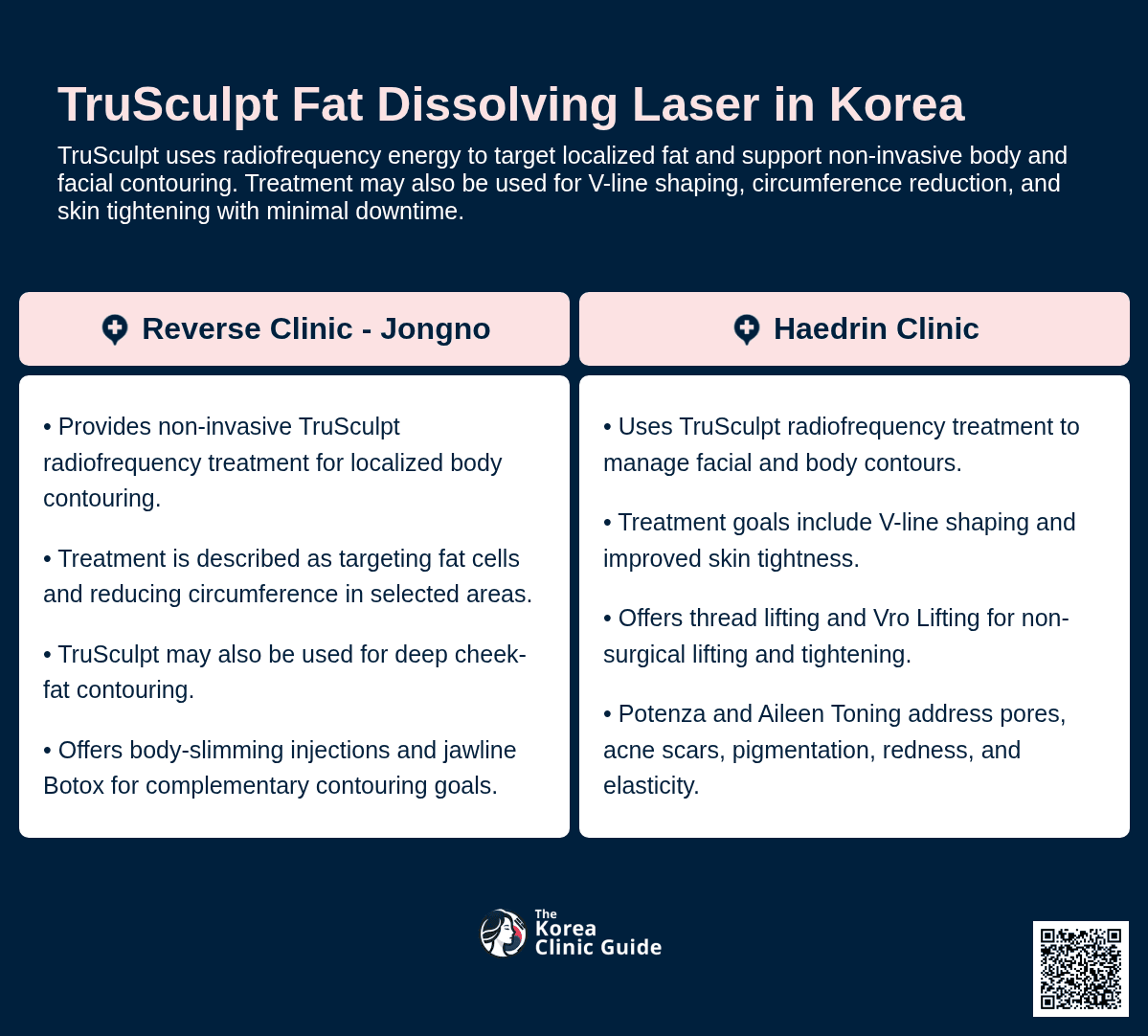
You may consider Reverse Clinic - Jongno if you want a non-invasive TruSculpt treatment for localized contouring: the clinic describes its TruSculpt service as using radiofrequency energy to target fat cells and reduce circumference in selected body areas.
- URL: Reverse Clinic - Jongno Website
- Location: Jongno-gu, Seoul
- Procedure details:
- TruSculpt is described as a radiofrequency-based, non-invasive body-contouring treatment.
- The clinic also lists TruSculpt for deep cheek-fat contouring (심부볼).
- Related services:
- Body-slimming injections are available for localized fat deposits.
- Jawline Botox is offered for jaw-muscle slimming and may also help with teeth grinding.
2. Haedrin Clinic
At Haedrin Clinic, you can expect TruSculpt radiofrequency treatment intended to manage facial and body lines, with stated uses including V-line shaping and skin tightening. This may suit you if your goal is non-surgical contouring rather than an invasive fat-reduction procedure.
- URL: Haedrin Clinic Website
- Location: Seodaemun-gu, Seoul
- Procedure details:
- TruSculpt uses radiofrequency to manage face and body contours.
- The clinic describes V-line shaping and skin-tightening effects as treatment goals.
- Related contouring and lifting options:
- Thread lifting is available for lifting sagging skin with immediate results described by the clinic.
- Vro Lifting combines ultrasound and high-frequency radio waves for skin tightening.
- Secret Laser delivers high-frequency radio waves into the skin and uses different handpieces for more precise treatment.
- Skin-focused services:
- Potenza offers customized needle-tip treatments for pores and acne scars.
- Aileen Toning is offered for pigmentation concerns, facial redness, and skin elasticity.
TruSculpt Fat Dissolving Laser From Start to Finish
- Remote inquiry and English consultation — Send clear photographs, your goals, prior body-contouring history, current weight stability, and full medical and implant history. Ask for confirmation of English communication, the exact device model, current MFDS authorization, intended anatomical area, clinician accountability, and written aftercare.
- In-person assessment — The clinician examines whether fullness is pinchable subcutaneous fat rather than visceral fat, loose skin, diastasis recti, a hernia, or another structural concern. They review scars, sensation, skin condition, pregnancy possibility, implants, medicines, supplements, isotretinoin, and relevant medical conditions.
- Measurements and treatment plan — Consistent photographs, circumference measurements, or both are taken when result tracking is planned. Routine blood tests and imaging are not generally required for an uncomplicated session, but a suspected hernia, mass, uncontrolled illness, or healing problem warrants targeted assessment.
- Skin preparation and applicator placement — The area is cleaned, marked, and fitted with hands-free adhesive applicators or treated with a handheld applicator on intact skin. No incision, cannula, injected drug, general anesthesia, or routine sedation is used.
- RF heating session — The applicators deliver monopolar RF energy externally. Expect warmth, pressure, and tolerable discomfort; report sharp, escalating, or excessive heat immediately. A published abdomen/flank protocol used four 15-minute treatment increments across four areas, or 60 minutes of active treatment, while total appointment time also includes consultation, positioning, photographs, and review. See the published protocol
- Immediate skin check and discharge — The clinician checks the treated skin and explains expected warmth, redness, swelling, tenderness, itching, altered sensation, or firmness. Leave independently when comfortable after a normal mild reaction; obtain assessment before leaving if pain is severe, blistering develops, dizziness occurs, or a thermal injury is suspected.
- Recovery and result review — Resume gentle normal activity as tolerated. Do not judge the contour immediately: an interim review at 4–6 weeks can guide planning, while standardized assessment is more useful at 8–12 weeks.
- Overseas follow-up — Contact the clinic promptly for concerning symptoms and use local medical care for urgent problems after returning home. Confirm the remote follow-up route before travel rather than relying only on messaging after a complication.
Alternatives to TruSculpt RF Body Contouring
Non-surgical options are best for modest localized contour refinement and generally involve less recovery, but their effect is not equivalent to surgical fat removal. Procedures that remove fat surgically can create larger, more predictable changes but require incisions, anesthesia or sedation, compression, recovery time, and acceptance of surgical risk.
Cryolipolysis
- Best suited to — Localized, pinchable fat for patients considering a noninvasive cooling-based alternative.
- Key tradeoff — It uses cooling rather than RF and has a different risk profile, including the uncommon risk of paradoxical adipose hyperplasia.
- Related procedure — CoolSculpting.
Fat-Dissolving Injections
- Best suited to — Selected localized deposits only when the product and body area are label-appropriate.
- Key tradeoff — A treatment series and considerable swelling can be required; suitability depends strongly on the anatomical site and product.
- Related procedure — Fat-dissolving injections.
Muscle Stimulation
- Best suited to — People whose primary aim includes muscle definition rather than fat reduction alone.
- Key tradeoff — Electrical muscle stimulation does not replace a fat-reduction procedure and carries separate device contraindications.
- Related procedure — Emsculpt.
Liposuction
- Best suited to — Patients seeking larger-volume contour change and willing to accept a surgical recovery.
- Key tradeoff — Liposuction is more invasive but generally offers a more substantial and predictable reduction than external RF.
- Related procedure — Abdominal liposuction.
How Can I Prepare for TruSculpt RF Body Contouring?
- Confirm the device and treatment plan — Obtain written confirmation of the exact TruSculpt model, applicators, current MFDS authorization and intended use, clinician responsible, anatomical areas, English consent, and complication contact pathway before purchasing non-refundable flights.
- Disclose medicines and supplements — Provide a complete list of prescription and over-the-counter medicines, anticoagulants, antiplatelets, NSAIDs, diabetes and weight-loss medicines, corticosteroids, isotretinoin, fish oil, vitamin E, herbal products, and photosensitizing drugs. Do not stop prescribed anticoagulants, antiplatelets, diabetes medicines, or other essential medicines independently.
- Report implants and medical history — Declare an IUD, mesh, plates, screws, body-contouring implants, pacemaker, defibrillator, tattoos, previous surgery, scars, hernia, altered sensation, bleeding or clotting history, diabetes, skin disease, cancer treatment, breastfeeding, and pregnancy possibility.
- Protect the treatment area — Arrive with clean, intact skin. Postpone treatment for infection, rash, open skin, sunburn, or significant irritation; avoid heavy tanning before the appointment.
- Food and hydration — Fasting is generally not required for external RF. Eat normally or have a light meal unless the treating facility gives different written instructions, and avoid arriving dehydrated.
- Alcohol, smoking, and travel — No high-quality TruSculpt-specific evidence defines a mandatory alcohol or smoking stop period. Avoid heavy alcohol intake and keep flights flexible because an unexpected significant skin reaction should be assessed before travel.
Travel note: Book the treatment early enough to allow a next-day skin check and keep the provider’s English emergency contact, consent, and treatment records accessible during your journey.
The treating doctor’s individualized instructions take precedence; confirm the clinic’s device-specific requirements before treatment.
Aftercare Advice
Treat the area gently and act early if pain or skin changes are worsening rather than improving.
- Activity — Resume walking and ordinary daily activity as tolerated. Avoid strenuous exercise while the area is painful, hot, swollen, or significantly tender.
- Heat and friction — Avoid heating pads, sauna, hot tubs, very hot baths, and vigorous rubbing. Wear clothing that does not compress or chafe a tender treated area.
- Skin care and sun — Keep the skin clean and do not pick, massage aggressively, or apply irritating products to a reactive area. Use broad-spectrum SPF 50 on exposed treated skin, especially if redness persists.
- Expected short-term effects — Warmth, redness, swelling, tenderness, itching, altered sensation, and temporary firmness or nodules can occur immediately and commonly settle over hours to a few days.
- Warning signs — Contact the clinic promptly for severe or worsening pain, blistering, a suspected burn, expanding redness, drainage, fever, major swelling, persistent or progressive numbness, or a rapidly enlarging lump. Seek urgent local or emergency care for chest pain, shortness of breath, fainting, or another systemic emergency.
- Results and follow-up — Keep weight stable and arrange standardized photographs or measurements at 8–12 weeks. A small body study found continued improvement between week 8 and week 12, so assess results on that timeline rather than immediately after treatment. Review the body-contouring evidence
Follow the treating doctor’s instructions and contact the clinic when anything appears wrong.
Frequently Asked Questions
Related Blogs
Nuviju in Korea: Treatment Process, Recovery, Safety, and Travel Planning
Nuviju is a prescription cholic-acid injection for adults with moderate-to-severe pinchable fat beneath the chin, delivered in a mapped series of preplatysmal-fat injections at least one month apart. The article covers candidacy screening, Korea travel planning, recovery reactions and warning signs, aftercare, and alternatives such as liposuction, neck lift, and deoxycholic acid.
Updated: Oct 13, 2026
Juveacell in Korea: Types, Safety, Recovery, and Travel Planning
Juveacell is a donor-derived hADM skin booster for gradual improvement in hydration, texture, fine lines, pores, elasticity, and dermal density, with 3% and 8% formulations documented by the manufacturer. Learn about candidate screening, injection steps, recovery, aftercare, product verification, and travel planning for treatment in Korea.
Updated: Oct 13, 2026
PRF Injection in Korea: Uses, Evidence, Recovery, and Travel Planning
PRF injections use a patient’s processed blood for facial skin or scalp treatment, typically through a series of superficial injections with short-term redness, swelling, or bruising. International patients should plan 2–3 days in Korea, arrange next-day and remote follow-up, verify the clinic’s processing protocol, and obtain English treatment records and emergency contact details.
Updated: Oct 13, 2026
Milia Under Eyes Treatment: Milia Removal Procedures in Korea for Clearer, Smoother Skin
Discover how Korea leads in safe, effective Milia removal techniques such as manual extraction, electrosurgery, and laser ablation. This blog explores the benefits of choosing Korea for milia treatment, offering advanced technology, skilled dermatologists, and affordable pricing. Perfect for medical tourists seeking quick, professional solutions to benign keratin cysts beneath the eyes and on the
Updated: Oct 12, 2026