
Medical Tourism Blog
Skin Whitening Injection in Korea: Evidence, Safety, Travel Planning, and Alternatives

Table of contents
- Skin Whitening Injection at a Glance
- What Is a Skin Whitening Injection?
- Who Is a Good Candidate for a Skin Whitening Injection?
- How Is a Skin Whitening Injection Performed?
- Why Visit Korea for a Skin Whitening Injection?
- Key Information for International Patients
- Which Are the Best Clinics in Korea for Skin Whitening Injection?
- Skin Whitening Injection From Start to Finish
- Alternatives to a Skin Whitening Injection
- How Can I Prepare for a Skin Whitening Injection?
- Aftercare Advice
Considering treatment in Korea? Everything you need to know e.g. — how to avoid scams, visas, interpreters, recovery tips — in our Medical Tourism Master Guide. Plan with confidence in minutes, not weeks!
Last updated: September 2026
Skin Whitening Injection at a Glance
- What it is — A “skin whitening injection” is usually a glutathione IV drip, IV push, or injection, sometimes combined with vitamin C, B vitamins, or alpha-lipoic acid; it is not a standardized medical treatment.
- Evidence does not support it — A 2025 systematic review found only one placebo-controlled IV glutathione study, with no statistically significant skin-lightening result, and advised against IV use because benefit is unproven and adverse effects are a concern.
- No predictable results — There is no validated dose, infusion duration, number of sessions, maintenance schedule, or reliable timeline for onset, degree, durability, or reversibility of skin-lightening effects.
- Minimal local downtime, meaningful risks — An uncomplicated peripheral IV may cause only short-lived bruising or soreness, but reactions can include allergy, infection, contaminated-product reactions, kidney or liver injury, severe rash, and IV-site complications.
- Not for unexplained pigmentation — Melasma, acne-related post-inflammatory hyperpigmentation, lentigines, and new dark patches need a dermatologist’s diagnosis and targeted treatment rather than a generalized whitening IV.
- Korea distinction — In Korea, “white jade” usually refers to a glutathione-based IV, while “Cinderella” commonly refers to alpha-lipoic acid; they are different products, and cosmetic whitening is not an approved indication for the referenced Korean glutathione injection.
- Travel and repeat visits — No Korea-specific benefit, minimum stay, safe flight interval, or repeat-treatment protocol has been established, so travel should not be planned around a course of cosmetic infusions.
What Is a Skin Whitening Injection?
A skin whitening injection is a cosmetic intravenous infusion or injection, usually containing glutathione with or without other ingredients, marketed to lighten or brighten skin. It is intended to address generalized skin-tone lightening, but evidence does not establish reliable benefit for this goal; diagnosed dark patches need targeted dermatology care. It is a minimally invasive procedure because it uses a needle and IV access.
Who Is a Good Candidate for a Skin Whitening Injection?
- Appropriate next step — People concerned about melasma, acne-related post-inflammatory hyperpigmentation (PIH), lentigines, or a new darkening patch need a dermatologist’s diagnosis and cause-directed treatment rather than a whitening IV.
- People seeking generalized lightening — There are no evidence-based ideal candidates for intravenous (IV) glutathione to lighten normal baseline skin colour. The most recent systematic review concluded that IV glutathione should not be used for this purpose because efficacy evidence is inadequate and adverse effects are a concern.
- People seeking tone-evening treatment — A dermatology plan is more appropriate when the goal is to address uneven pigment caused by acne, eczema, hormones, UV exposure, visible light, friction, or pigment-inducing medicines.
Elective IV glutathione for generalized skin lightening should be avoided. Do not undergo cosmetic IV treatment during pregnancy, while trying to conceive, or while breastfeeding; reproductive and lactation safety data are inadequate. Kidney or liver disease, abnormal renal or liver tests, dehydration, fever, active infection, unstable heart or lung illness, an infected cannulation site, or a history of serious allergy require medical assessment rather than elective exposure. A cocktail containing tranexamic acid needs separate physician review for clotting history, thrombophilia, estrogen-containing contraception or hormone therapy, migraine with aura, pregnancy or postpartum status, and kidney disease. Do not proceed when the exact ingredients, dose, product source, expiry date, lot number, prescriber, sterile preparation process, and emergency plan cannot be verified.
How Is a Skin Whitening Injection Performed?
“Skin whitening injection” is a marketing term, not a standardized treatment. In Korea, “white jade” commonly describes a glutathione-based IV product, while “Cinderella” injection is often marketed around thioctic acid (alpha-lipoic acid); they are different formulations and neither has an established IV skin-lightening protocol.
- Glutathione IV drip — Reduced glutathione is diluted in IV fluid and delivered through a peripheral cannula over a clinic-determined period. No validated dose, dilution, infusion duration, number of sessions, or maintenance interval exists for skin lightening.
- IV push or intramuscular shot — Faster injection formats have the same central problem: credible evidence does not establish skin-lightening efficacy or long-term safety.
- Combination cocktail — Vitamin C, B vitamins, alpha-lipoic acid, and sometimes other drugs are added to glutathione. Each ingredient has distinct contraindications, interactions, and quality-control requirements; combining them does not create an evidence-based pigment treatment.
- Tranexamic-acid-containing IV — Tranexamic acid is not interchangeable with glutathione or a routine cosmetic-IV additive. Its clotting-risk assessment must be documented by a physician before any consideration.
Request the complete formula, amount of every active ingredient, diluent, route, manufacturer, expiry date, lot number, prescriber identity, monitoring plan, and emergency protocol in writing.
Why Visit Korea for a Skin Whitening Injection?
Korea offers commercially marketed “white jade” and other cosmetic IV drips, but availability does not establish a medical advantage. There is no evidence-based reason to travel to Korea specifically for IV glutathione skin lightening. A diagnosed pigment disorder is better assessed by a dermatologist than treated as a generic whitening request.
- Off-label context — A current Korean reference to the MFDS drug-information record reports that Tathion Injection has approved uses including drug or alcohol intoxication treatment and improvement of liver function in chronic liver disease, not cosmetic whitening; ask for the actual current Korean product label and confirmation that the proposed use is off-label.
- Evidence limitation — A 2025 systematic review of glutathione for skin lightening found only one placebo-controlled IV study, with a non-significant result, and advised against IV use for skin lightening.
- Product verification matters — Sterile-IV quality cannot be assumed from a clinic’s location or marketing. The FDA has reported endotoxin-related reactions and hospitalizations after inappropriate glutathione material was used in compounded sterile injectables.
- Dermatology-first care — Korea can be a destination for an in-person dermatology assessment of melasma, PIH, lentigines, acne, or dermatitis, but that is distinct from endorsing a cosmetic glutathione drip.
Key Information for International Patients
- Minimum stay — No validated minimum stay in Korea exists for this elective IV treatment, and no Korea-specific clinical advantage has been established. Remain for the treating clinician’s immediate observation period if an infusion is performed.
- Repeat visits — Do not book travel around a proposed course or “maintenance” schedule. No evidence-based session interval, cumulative dose, or maintenance protocol exists.
- Flights — No validated post-infusion flight interval exists after an uncomplicated peripheral IV. Do not fly with breathing symptoms, wheeze, facial or throat swelling, fainting, chest pain, fever, rigors, rash, jaundice, reduced urine, or significant IV-site pain and swelling.
- Itinerary impact — Needle-related recovery is usually limited to short-lived soreness or bruising at the cannula site, but serious infusion, product-contamination, allergic, kidney, liver, or skin reactions are possible and their rate with repeated cosmetic use is unknown.
- Remote follow-up — Obtain a written treatment record listing every ingredient, dose, route, manufacturer, expiry date, and lot number. Delayed fever, blistering rash, mucosal sores, jaundice, reduced urine, or worsening IV-site symptoms require local in-person assessment, not remote cosmetic follow-up.
- Companion and transport — A companion is sensible for severe anxiety, prior fainting, substantial medical conditions, language barriers, or a long journey home. Do not drive or travel alone while dizzy, faint, breathless, or otherwise unwell.
Travel note: Travelling internationally solely for an unproven cosmetic IV is difficult to justify because no reliable onset, degree, durability, reversibility, or safe repeat-treatment timeline has been established.
Which Are the Best Clinics in Korea for Skin Whitening Injection?
Listed below are some of the best clinics in Korea for skin whitening injection.
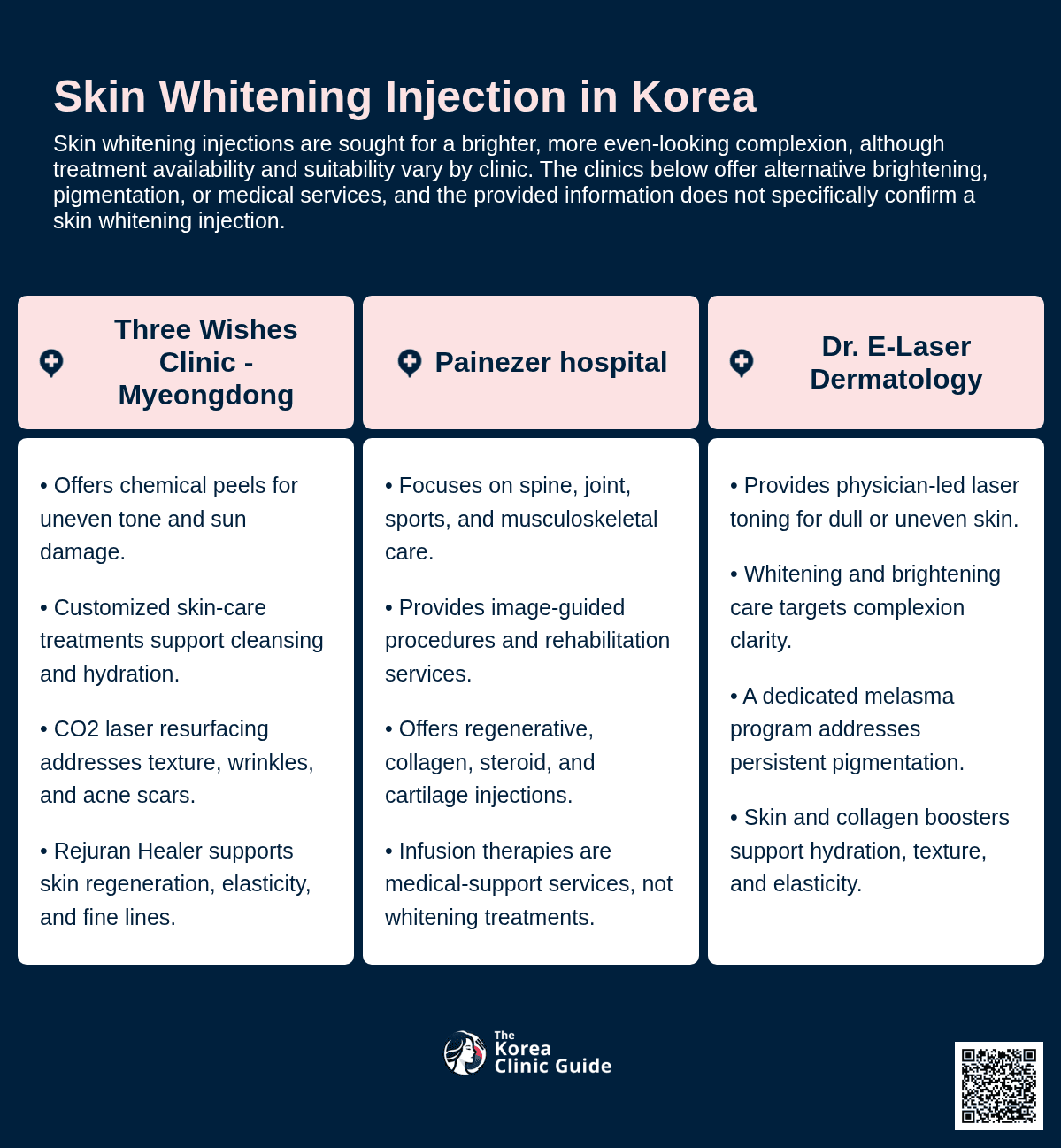
1. Three Wishes Clinic - Myeongdong
For skin-brightening concerns, you can discuss non-injection options at Three Wishes Clinic - Myeongdong, including chemical peels and customized skin-care treatments; the provided information does not specifically list a skin whitening injection.
- URL: Three Wishes Clinic - Myeongdong Website
- Location: Jung-gu, Seoul
- Skin-focused options:
- Chemical peels exfoliate damaged outer layers and are listed for uneven tone, sun damage, fine lines, and mild scars.
- Customized skin-care treatments may include cleansing, hydration, and maintenance facials tailored to individual concerns.
- CO2 laser resurfacing is listed for improving wrinkles, acne scars, and overall skin texture.
- Rejuran Healer injections use polynucleotide technology and are described as supporting skin regeneration, texture, elasticity, and fine lines.
2. Painezer hospital
Painezer Hospital’s documented services focus on non-surgical spine, joint, and sports-related pain care rather than cosmetic skin whitening, and the provided information does not list a skin whitening injection.
- URL: Painezer hospital Website
- Location: #502,#503, 5th Floor, Parkrio A complex, Olympicro 37 gil 130, Sonngpa-gu, Seoul, Korea
- Relevant clinic scope:
- Its care model includes image-guided procedures, rehabilitation, physical-therapy modalities, and supportive infusion therapies for musculoskeletal concerns.
- Listed injections include prolotherapy, PDRN regenerative injections, collagen injections, steroid injections, cartilage injections, and selective nerve root blocks.
- Supportive infusion offerings include high-dose amino acid IV therapy, albumin infusion, and TPN-style nutrition IV therapy; these are presented for nutritional or medical-support purposes, not skin whitening.
3. Dr. E-Laser Dermatology
At Dr. E-Laser Dermatology, you can explore physician-led brightening and pigmentation care tailored to your skin condition and goals, particularly laser-based toning, whitening/brightening care, and a melasma program; the provided information does not specifically list a skin whitening injection.
- URL: Dr. E-Laser Dermatology Website
- Location: 2F, 830 Seolleung-ro, Gangnam-gu, Seoul, Korea
- Brightening and pigmentation care:
- The Toning Program is designed for dull or uneven tone and aims to support a clearer, smoother, more radiant appearance.
- Whitening Brightening care targets dullness and uneven complexion to improve overall skin clarity.
- The Melasma Program uses laser-based care for melasma and persistent pigmentation concerns.
- Supporting skin treatments:
- Skin Booster treatments focus on hydration, glow, and skin vitality.
- Collagen Booster treatments are intended to support collagen production, skin resilience, texture, and elasticity.
- Acne scar and pore-and-scar treatments address uneven texture and textural irregularities that can affect overall skin appearance.
- Care approach: The clinic is reservation-only and describes its laser and aesthetic care as physician-led and tailored to your skin condition and goals.
Skin Whitening Injection From Start to Finish
- First contact and virtual consultation — Provide medical history, allergy and prior-infusion-reaction history, pregnancy or breastfeeding status, and a complete list of medicines, supplements, and herbal products. Request English communication where needed and the proposed formula in writing. A clinic should not promise a shade change remotely.
- Diagnosis before treatment — At an in-person visit, distinguish normal skin-colour variation from melasma, PIH, lentigines, active dermatitis, acne, medication-related pigmentation, or another condition. Standardized photographs can help monitor a diagnosed pigment disorder.
- Ingredient and risk review — Confirm each ingredient and its dose, the product label, manufacturer, expiry date, lot number, route, prescriber, sterile preparation process, and emergency plan. Renal or hepatic history and targeted testing can be relevant when history or proposed ingredients warrant it, but no screening panel makes cosmetic IV glutathione proven safe.
- Decision point — Decline treatment if the formula or safety documentation is unavailable, if an active medical issue is present, or if the aim is generalized baseline-colour lightening. Discuss evidence-based management when a specific pigment disorder is diagnosed.
- Cannulation and observation if treatment proceeds — Staff place a peripheral IV cannula or administer the proposed injection using sterile single-use supplies. An IV drip is delivered over a clinic-determined period; there is no validated cosmetic whitening duration. Report burning, pain, dizziness, nausea, rash, chest symptoms, or breathing difficulty immediately, and stop the infusion if a reaction occurs.
- Discharge — Leave only when feeling well after the clinic’s observation period. Receive written records of all administered products and clear emergency contact instructions before departing.
- Overseas follow-up — Send the treatment record to any clinician who evaluates a subsequent reaction. Seek urgent local care rather than waiting for online follow-up for severe or persistent symptoms.
Alternatives to a Skin Whitening Injection
For a diagnosed pigment condition, targeted dermatology care has a clearer rationale than an IV cocktail, although treatments still need careful selection because irritation and poorly selected procedures can worsen melasma or PIH. Non-surgical options are the relevant alternatives; aggressive procedures are not automatically better for pigment.
Dermatology-led pigmentation treatment
- Best suited to — Melasma, PIH, lentigines, or medication-related pigmentation after diagnosis and trigger review.
- Approach — Treatment can include prescription hydroquinone, retinoids, azelaic acid, or selected triple-combination creams under medical supervision, alongside treatment of acne or dermatitis when present.
- Tradeoff — Results depend on the diagnosis, adherence, and trigger control; irritation can worsen pigmentation. See pigmentation treatment.
Laser or pico toning
- Best suited to — Carefully selected focal or diffuse pigment concerns assessed by a dermatologist.
- Approach — Laser-based treatment targets pigment, often through a planned series rather than a single visit.
- Tradeoff — Incorrect device settings, excessive treatment, or poor patient selection can aggravate melasma or PIH. Learn about laser toning and pico toning.
Chemical peeling
- Best suited to — Selected superficial uneven tone and acne-related PIH after active inflammation is controlled.
- Approach — A clinician applies a chemical solution to promote controlled exfoliation.
- Tradeoff — Peels can cause irritation and pigment worsening, especially when strength, skin preparation, and aftercare are poorly matched. See chemical peeling.
How Can I Prepare for a Skin Whitening Injection?
- Medical disclosure — Give the clinician a complete history of kidney or liver disease, abnormal blood tests, clotting history, allergies, prior anaphylaxis, severe drug rashes, fainting, pregnancy plans, breastfeeding, and previous injection reactions.
- Medication and supplement list — Disclose prescription drugs, anticoagulants, diabetes and blood-pressure medicines, hormonal contraception or hormone therapy, vitamins, herbal products, and any oral or injectable glutathione, vitamin C, alpha-lipoic acid, or tranexamic acid. Do not independently stop prescribed medicines; no validated supplement washout makes cosmetic IV glutathione safe or effective.
- Tranexamic acid — Ask specifically whether it is included. Do not accept it as a routine “whitening” ingredient without documented physician assessment of thrombotic and kidney risk.
- Food and hydration — Eat and hydrate normally for a simple peripheral IV unless the treating doctor gives different instructions for an independently indicated procedure. Do not attend while dehydrated, intoxicated, febrile, or acutely unwell.
- Product documentation — Obtain the formula, dose, diluent, route, manufacturer, expiry date, lot number, prescriber identity, and emergency protocol before consenting. Cancel if the clinic cannot provide these details.
- Travel planning — Keep flights and major excursions flexible. Arrange transport and consider a companion when there is a fainting history, anxiety, medical complexity, or a language barrier.
Travel note: Do not schedule an infusion immediately before a flight or remote transfer when there is no practical access to medical care should symptoms develop.
The treating doctor’s individualized instructions take precedence; confirm clinic-specific requirements before travel.
Aftercare Advice
An uncomplicated IV needs little local recovery, but treat new systemic symptoms or worsening cannula-site symptoms as a medical issue, not routine cosmetic downtime.
- Cannula site — Keep the dressing on for the period instructed, keep the site clean, and avoid unnecessary rubbing or heavy contact until tenderness settles.
- Activity and travel — Resume normal activity only when feeling well. Do not drive, fly, exercise intensely, use saunas, or travel alone while dizzy, faint, breathless, feverish, or unwell.
- Urgent warning signs — Stop the infusion and seek urgent in-person care for breathing difficulty, wheeze, lip, tongue, or throat swelling, fainting, chest pain, high fever or rigors, rapidly spreading or blistering rash, mouth, eye, or genital sores, jaundice, markedly reduced urine, or a hot, red, swollen, painful IV site. Bring the product and treatment record.
- Pigment care — For melasma or PIH, use broad-spectrum, water-resistant SPF 30+ daily; a tinted sunscreen with iron oxides can add visible-light protection for melasma. Reapply outdoors and use shade and protective clothing, consistent with photoprotection guidance for melasma.
- Results and further sessions — Do not judge or pursue repeat infusions based on marketing schedules. IV glutathione has no established onset, degree, durability, reversibility, or maintenance timeline for skin lightening.
Follow the treating doctor’s instructions and contact the clinic or seek local medical care promptly when something appears wrong.
Frequently Asked Questions
Related Blogs
Hypertrophic Scar Treatment in Korea: Methods, Recovery, Travel Planning, and Results
Hypertrophic scar treatment uses silicone, pressure therapy, injections, vascular or fractional laser, and surgery based on scar thickness, redness, symptoms, and movement restriction. The article covers candidate screening, staged treatment, Korea travel timing, aftercare, warning signs, and follow-up planning.
Updated: Sep 16, 2026
Beauty IV Therapy in Korea: Formulas, Safety, Recovery, and Travel Planning
Beauty IV Therapy involves a clinician-led assessment, formula confirmation, peripheral IV infusion over about 30–90 minutes, observation, and written aftercare. The article covers candidacy, risks, Korea travel planning, preparation, alternatives, and follow-up, while noting that cosmetic benefits and maintenance schedules are not established.
Updated: Sep 16, 2026
Misko in Korea: Candidacy, Procedure, Recovery, Risks and Travel Planning
Misko uses absorbable nasal threads under local anesthesia to provide temporary, subtle tip projection, rotation, columellar support, or limited contour refinement; it does not replace surgery for major reshaping or airway concerns. The article covers candidate screening, treatment steps, Korea travel planning, recovery and aftercare, warning signs, and alternatives including filler, rhinoplasty,
Updated: Sep 16, 2026
Skin Tag Removal in Korea: Methods, Recovery, Risks, and Travel Planning
Skin tag removal involves in-person assessment followed by snip or shave excision, electrosurgery, cryotherapy, ligation, or selected laser treatment based on diagnosis, location, tissue needs, and pigment or scar risk. The article covers Korea travel planning, pathology and follow-up, preparation, recovery timelines, wound care, and warning signs requiring prompt review.
Updated: Sep 16, 2026
Clinics offering Skin Whitening Injection

Three Wishes Clinic - Myeongdong, Korea: Advanced Botox, Fillers, Laser, and Skin Treatments for Confidence and Care
Myeongdong

PangPang Clinic: Korea's Premier Thread Lifting and Skin Rejuvenation Specialist in Gangnam, Seoul
Sinsa
BLS Main Branch Korea (Cheongdam) – Signature Lifting, Skin Analysis & Event Facial Programs
Cheongdam

Onlif Plastic Surgery - Top Lifting Procedures Clinic in Korea for Facial and Body Contour Enhancement
Gangnam Station