Medical Tourism Blog
Perineoplasty in Korea: Candidacy, Surgery, Recovery and Travel Planning
Table of contents
- Perineoplasty at a Glance
- What Is a Perineoplasty?
- Who Is a Good Candidate for a Perineoplasty?
- How Is a Perineoplasty Performed?
- Why Visit Korea for a Perineoplasty?
- Key Information for International Patients
- Which Are the Best Clinics in Korea for Perineoplasty?
- How Much Does a Perineoplasty Cost in Korea?
- Perineoplasty From Start to Finish
- Alternatives to a Perineoplasty
- How Can I Prepare for a Perineoplasty?
- Aftercare Advice
Considering treatment in Korea? Everything you need to know e.g. — how to avoid scams, visas, interpreters, recovery tips — in our Medical Tourism Master Guide. Plan with confidence in minutes, not weeks!
Last updated: September 2026
Perineoplasty at a Glance
- What it treats — Perineoplasty reconstructs the perineal body and vaginal opening after childbirth-related widening, tearing, episiotomy scarring, or distortion; it does not automatically tighten the full vaginal canal.
- Typical cost in Korea — The listed price is ₩5,000,000, approximately US$3,700, for perineoplasty; scar revision, vaginoplasty, or added rectocele, posterior-wall, or prolapse repair can change the quote.
- Recovery milestones — Plan a low-demand first 1–2 weeks, avoid heavy lifting and strenuous activity for at least 4–6 weeks, and avoid vaginal penetration or tampons for about 6 weeks; more extensive repairs may require 6–8 weeks.
- When results settle — Swelling and discharge can last days to several weeks, with a postoperative review commonly at 6–8 weeks and a more stable anatomical and functional result assessed around 3 months.
- Best candidates — Candidates should have an examination-confirmed perineal defect, widened opening, or symptomatic scar that matches their symptoms, rather than nonspecific sexual concerns, dryness, pelvic-floor spasm, or untreated prolapse.
- Key risk and limitation — Over-tightening can cause new or persistent entry pain: one retrospective 38-patient study reported 87.9% self-reported success at 6 months but 10% new dyspareunia, and overall outcome evidence remains limited.
- Korea travel planning — Remain in Korea about 14–21 days after an uncomplicated standalone repair and obtain surgeon clearance before a long-haul flight; Korea’s international-patient registration framework may aid coordination but does not prove superior perineoplasty outcomes.
What Is a Perineoplasty?
Perineoplasty is an operation that reconstructs the tissue between the vaginal opening and anus, often after childbirth-related stretching, tearing, or scar formation. It aims to restore perineal support, improve a widened or distorted vaginal opening, and relieve scar-related discomfort in selected patients. Perineoplasty is a surgical procedure.
Who Is a Good Candidate for a Perineoplasty?
- Post-childbirth structural change — Good candidates have a documented widened vaginal opening, deficient perineal body, troublesome episiotomy or tear scar, or visible distortion after childbirth that matches their symptoms.
- Scar-related symptoms — Selected patients have pain at the vaginal entrance from a localized scar, provided examination confirms that scar tissue—not pelvic-floor spasm, dryness, infection, or a vulvar pain condition—is the cause.
- Combined pelvic-floor repair — Patients undergoing posterior vaginal-wall, rectocele, or prolapse repair sometimes need perineal-body reconstruction as part of that operation.
- Informed surgical goal — Suitable candidates understand that perineoplasty reconstructs the tissue between the vaginal opening and anus and narrows the opening when necessary; it does not automatically tighten the full vaginal canal or treat low libido, urinary incontinence, orgasm difficulty, or relationship concerns.
Elective surgery should be delayed during pregnancy, as ACOG advises postponing elective non-obstetric surgery until after delivery. Active vaginal, vulvar, urinary, or systemic infection; unexplained bleeding; an unassessed pelvic mass; anemia, uncontrolled diabetes, significant heart or lung disease, or a clotting issue need assessment and treatment first. Nicotine exposure impairs healing; the American College of Surgeons recommends stopping smoking well before surgery. Pelvic pain, vaginismus, high-tone pelvic-floor dysfunction, vulvodynia, severe dryness or atrophy, bowel symptoms, fecal incontinence, known anal-sphincter injury, or significant prolapse require specialist evaluation because narrowing can worsen pain or fail to address the real condition.
How Is a Perineoplasty Performed?
Perineoplasty and perineorrhaphy are often used interchangeably, but the actual operation can range from localized scar revision to a combined posterior pelvic-floor repair. Ask for the exact operative name, tissues being repaired, and whether vaginal-canal narrowing is planned; perineoplasty is not automatically the same operation as vaginoplasty.
- Standalone or revision perineoplasty — The surgeon releases or removes problematic scar tissue where appropriate, rebuilds separated perineal muscles, and reconstructs the perineal body with dissolving sutures. This suits a localized perineal gap, scar, or widened introitus.
- Posterior repair plus perineoplasty — Posterior colporrhaphy, rectocele repair, levator work, or prolapse surgery addresses a diagnosed posterior vaginal-wall or support defect. It is a more extensive operation with separate bowel, urinary, and rectal-injury risks.
- Vaginoplasty or colpoperineoplasty — This more extensive approach addresses both the vaginal opening and part of the canal, generally through posterior vaginal-wall dissection and mucosal work. Consider vaginoplasty only after a clear discussion of the additional narrowing and recovery burden.
- Anesthesia and setting — Local anesthesia with sedation, regional anesthesia, or general anesthesia is selected according to the extent of repair and clinical setting. A standalone procedure is commonly outpatient or involves one overnight stay; combined repairs can require longer observation.
Why Visit Korea for a Perineoplasty?
South Korea has a formal framework for registered providers treating international patients. That can support travel coordination and interpretation, but it does not prove better perineoplasty results than other destinations. No high-quality comparative research establishes superior Korean safety, technique, sexual-function outcomes, revision rates, or satisfaction for this procedure.
- International-patient framework — Korea regulates the attraction and treatment of foreign patients under its medical-tourism legal framework. Confirm that the facility is registered and establish who will coordinate records, interpretation, discharge instructions, and remote follow-up.
- Appropriate specialty assessment — Perineal symptoms can overlap with prolapse, rectocele, anal-sphincter injury, vulvar pain, and pelvic-floor dysfunction. Seek an operating clinician with relevant obstetrics-gynecology, urogynecology, or reconstructive surgical qualifications rather than accepting a generic “vaginal rejuvenation” consultation.
- Terminology safeguards — Published practice remains inconsistent: indications, techniques, and outcome measures vary, and a surgeon survey identified the need for clearer selection and technique standards. Obtain a written description of whether the plan is perineoplasty only, posterior repair plus perineoplasty, or vaginoplasty/colpoperineoplasty.
Key Information for International Patients
- Minimum stay — Plan to remain in Korea for about 14–21 days after an uncomplicated standalone repair, preferably until a surgeon reviews the wound and clears long-haul travel. Combined posterior, prolapse, sphincter, or sling procedures often need a longer stay.
- Flight timing — There is no universal evidence-based date for safe long-haul flying after perineoplasty. Urogynecology guidance ranges from avoiding long trips for 2 weeks to permitting air travel at 3 weeks after broader surgery; individual readiness depends on the operation, healing, mobility, bleeding, and clot risk.
- Itinerary impact — Keep the first 1–2 weeks low demand. Avoid carrying luggage, long walking days, cycling, strenuous sightseeing, hot baths, swimming, and activities that increase pelvic pressure.
- Repeat visits — Surgical perineoplasty has no routine “session” schedule. A postoperative examination is commonly planned at 6–8 weeks, with internal healing and a more stable functional result assessed at about 3 months, particularly after combined repair.
- Remote follow-up — Before departure, arrange a secure remote-review pathway with the Korean team and identify a local gynecologist or urogynecologist who can examine the wound if needed. Send only clinic-requested photographs through an approved secure channel.
Travel note: Do not purchase an early non-refundable return flight. The operating surgeon—not a standard online timeline—must clear travel after reviewing the actual reconstruction and recovery.
Which Are the Best Clinics in Korea for Perineoplasty?
Listed below are some of the best clinics in Korea for perineoplasty.
1. SH Clinic
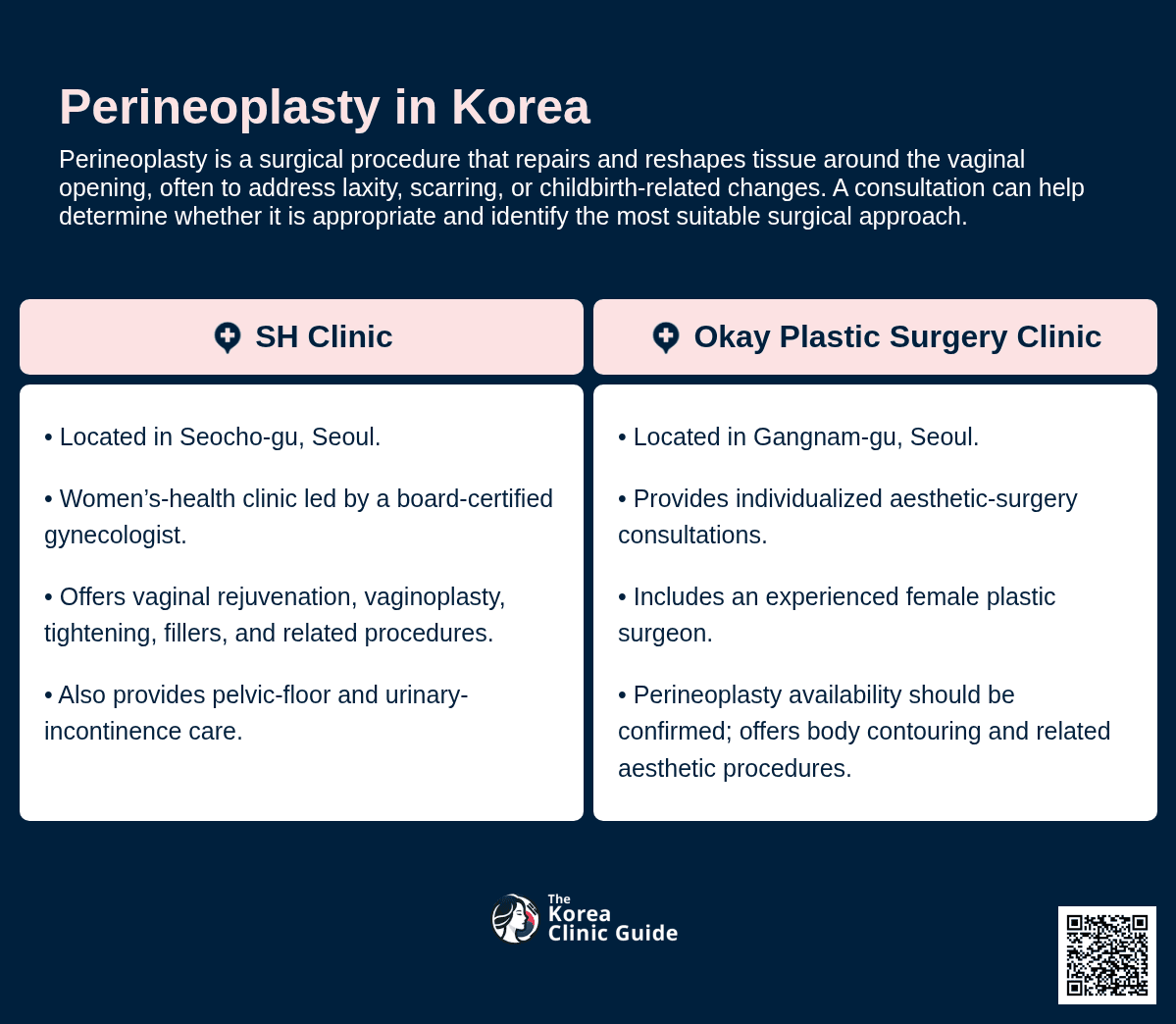
For perineoplasty considerations, SH Clinic offers a women’s-health setting with vaginal rejuvenation and gynecologic surgical services performed directly by an experienced, board-certified gynecologist. You can discuss whether perineoplasty is appropriate for your concerns alongside the clinic’s vaginal tightening and pelvic-support options.
- URL: SH Clinic Website
- Location: Seocho-gu, Seoul
- Gynecologic care:
- The clinic provides women’s health services ranging from general gynecology to vaginal rejuvenation options.
- Listed vaginal services include vaginoplasty, vaginal fillers, stem cell injections, HIFU treatment, vaginal tightening, and implant surgery.
- Vaginoplasty is described as reinforcing vaginal muscular and fascial layers to improve tone and pelvic support.
- Physician care:
- Surgeries and procedures are stated to be performed directly by the clinic’s board-certified gynecologist.
- The gynecologist has received a commendation from the Minister of Health and Welfare.
- Related considerations:
- The clinic lists urinary-incontinence care, including pelvic-floor therapy and office-based procedures, which may be relevant if you have leakage concerns in addition to tissue laxity.
- Cervical and ovarian cancer screening services include Pap smears, HPV testing, and ultrasound.
2. Okay Plastic Surgery Clinic
Okay Plastic Surgery Clinic may be worth considering if you want an individualized aesthetic-surgery consultation with access to a female plastic surgeon and a broad range of body-contouring services. The supplied information does not specifically confirm that the clinic offers perineoplasty, so you should clarify procedure availability, surgeon involvement, and whether its approach fits your goals.
- URL: Okay Plastic Surgery Clinic Website
- Location: Gangnam-gu, Seoul
- Consultation approach:
- The clinic describes individualized treatment planning tailored to your needs and aspirations.
- Its team includes a female plastic surgeon with extensive experience.
- Related aesthetic services:
- Body-contouring offerings include liposuction, line-fat treatment, fat grafting, contouring treatment, and abdominal or arm lifts.
- The clinic also provides breast surgery, facial lifting, eye surgery, rhinoplasty, scar care, and medical skincare services.
How Much Does a Perineoplasty Cost in Korea?
Perineoplasty is listed at ₩5,000,000 (approximately US$3,700). Individual quotes vary because a limited standalone perineal-body repair uses different operative work and resources than scar revision or combined pelvic-floor reconstruction.
| Procedure Price | Korean Won (₩) | USD ($) |
|---|---|---|
| Low Price | ₩5,000,000 | $3,700 |
| High Price | ₩5,000,000 | $3,700 |
Exchange rate as of 2026-09-06: 1 KRW = 0.000741 USD.
What Affects the Price?
- Standalone perineoplasty versus scar revision — A repair limited to rebuilding the perineal body and vaginal opening is less extensive than revision of a painful, distorted episiotomy or childbirth scar. Scar release or excision and careful recalibration of the opening add dissection, suturing, and operating time.
- Combined posterior vaginal-wall, rectocele, or prolapse repair — Adding posterior colporrhaphy, rectocele repair, or prolapse surgery extends treatment beyond the perineum into deeper pelvic support tissues. This requires more operative time, surgical materials, anesthesia and facility resources, and can require longer postoperative observation.
- Extent of vaginal reconstruction — Perineoplasty addresses the perineal body and introitus; vaginoplasty or colpoperineoplasty also addresses the vaginal canal. Canal dissection, mucosal work, and additional muscle repair make the latter a more extensive operation with greater operating-room and anesthesia requirements.
- Anesthesia and postoperative observation requirements — Local anesthesia with sedation, regional anesthesia, or general anesthesia may be selected according to the reconstruction’s extent and setting. A standalone outpatient repair differs in facility and anesthesia use from a combined repair that requires overnight observation, temporary catheterization, or vaginal packing.
Cost tip: Request an itemized quote stating what is included, with the planned operation named explicitly—for example, perineoplasty only, posterior repair plus perineoplasty, or vaginoplasty/colpoperineoplasty—and clarifying anesthesia, facility use, tests, consumables, medications, and postoperative reviews.
The US$3,700 conversion is approximate, based on an exchange rate of 0.000741 KRW/USD dated 2026-09-06. Check the exchange rate again when budgeting.
Perineoplasty From Start to Finish
- Remote screening — Send childbirth, episiotomy or tear history, previous pelvic operations, symptoms, reproductive plans, bowel and bladder symptoms, medicines, allergies, and nicotine use. Many providers can offer an English-language or interpreter-supported virtual consultation, but no remote assessment replaces a pelvic examination.
- Travel and surgical planning — Confirm the planned procedure in writing, expected length of stay, anesthesia, accommodation needs, companion requirements, and a flexible departure plan. Clarify whether the quote and consent cover only perineoplasty or additional posterior/prolapse repair.
- In-person pelvic assessment — After arrival, the surgeon performs a consented external and internal examination to assess scar location, perineal body, genital-hiatus width, pelvic-floor tone, prolapse, dryness, pain, and signs of infection or another diagnosis.
- Testing and anesthesia review — Testing is selective: pregnancy testing, CBC or hemoglobin, glucose or HbA1c, urinalysis or culture for urinary symptoms, and vaginitis or STI testing when indicated. The anesthesia team reviews medical conditions, airway risk, fasting, and medication instructions.
- Surgery — Under local anesthesia with sedation, regional anesthesia, or general anesthesia, the surgeon examines the area under anesthesia, treats scar tissue only where appropriate, makes a limited incision, brings supportive perineal muscles together, calibrates the opening to avoid excessive narrowing, and closes with absorbable sutures. A standalone repair is often outpatient and commonly takes place with same-day discharge or one overnight stay.
- Immediate recovery and discharge — Expect soreness, swelling, light bleeding, or discharge. A catheter and vaginal packing are sometimes used after a posterior vaginal repair and are usually removed the same day or next day. Leave with written pain-control, bowel-care, wound-care, activity, and emergency-contact instructions.
- Korean postoperative review — Attend a wound and travel-readiness review before departure where feasible. Report increasing pain, fever, foul discharge, wound separation, urinary difficulty, or heavy bleeding immediately.
- Overseas follow-up — Complete the planned 6–8-week review remotely and/or with a local gynecologist. Contact the operating team earlier for pain with bowel movements, persistent tightness, entry pain, recurrent scar pain, or new bowel symptoms.
Alternatives to a Perineoplasty
The right alternative depends on whether the problem is a true perineal structural defect, prolapse, scar pain, dryness, or pelvic-floor overactivity. Non-surgical options avoid an incision and the risk of over-tightening, but they cannot rebuild a substantially deficient perineal body; more extensive surgery treats additional anatomy but increases recovery and complication burden.
Pelvic-floor physical therapy
- Best for — High-tone pelvic floor, vaginismus, pelvic pain, mild symptoms of openness, and postpartum functional rehabilitation without a major anatomical defect.
- Tradeoff — Pelvic-floor training can improve sexual-function measures, but the evidence certainty is low and therapy cannot reconstruct a substantial tear-related perineal defect.
Scar and pain-directed care
- Best for — Localized scar sensitivity, vulvodynia, dermatitis, infection, or menopause-related dryness rather than a confirmed support defect.
- Tradeoff — Treatment can include targeted pain care, scar management, lubricants, moisturizers, or clinically appropriate local vaginal estrogen. It addresses the cause of pain without surgically narrowing the opening.
Posterior or prolapse repair
- Best for — Diagnosed rectocele, posterior compartment prolapse, or pelvic-support symptoms.
- Tradeoff — This is condition-specific reconstructive surgery, not cosmetic tightening. It can be combined with perineal repair when indicated, but bowel and pelvic-floor recovery becomes more important.
Vaginoplasty
- Best for — Patients with a confirmed need to address both the introitus and vaginal canal after specialist assessment.
- Tradeoff — Vaginoplasty or revision vaginoplasty is more extensive than standalone perineoplasty and has greater potential for narrowing, pain, and prolonged recovery.
Energy-based vaginal treatment
- Best for — It is not an equivalent treatment for a scarred or deficient perineal body.
- Tradeoff — The FDA has not approved energy-based devices for vaginal cosmetic surgery or sexual dysfunction, and guideline evidence is heterogeneous and generally low certainty. Consider laser vaginal rejuvenation only after understanding that it cannot replace anatomical reconstruction.
How Can I Prepare for a Perineoplasty?
- Medical disclosure — Provide complete records of childbirth injuries, episiotomy, prior pelvic surgery, prolapse, bowel or bladder symptoms, blood clots, diabetes, heart or lung disease, allergies, and previous anesthesia problems.
- Medicines and supplements — Give the surgeon and anesthesiologist every prescription drug, over-the-counter medicine, vitamin, herbal product, cannabis/CBD product, and nicotine product. Do not stop prescribed anticoagulants or antiplatelet drugs independently; obtain a written individualized plan. NSAIDs, fish oil, vitamin E, garlic, ginseng, ginkgo, turmeric, and St John’s wort need review because of bleeding or anesthesia-interaction concerns, while diabetes and GLP-1 medicines need anesthesia-specific directions.
- Nicotine and alcohol — Stop smoking, vaping, and other nicotine exposure as far in advance as the surgical team directs and remain nicotine-free during healing. Avoid alcohol according to the anesthesia instructions and while using opioid pain medicine.
- Fasting — Follow the anesthesiologist’s written fasting plan exactly. For many healthy elective-anesthesia patients, clear liquids are allowed until 2 hours before anesthesia, but solid-food timing and essential morning medicines depend on aspiration risk and medication regimen.
- Operative-area care — Keep the vulvar and perineal area clean and dry. Do not shave, wax, use depilatories, or try new fragranced or irritating products shortly before surgery unless the surgeon specifically directs it.
- Travel arrangements — Arrange elevator-access accommodation close to the facility, easy bathroom access, minimal luggage handling, and a responsible adult to take you to accommodation and stay for the first 24 hours after sedation or anesthesia. Avoid public transit immediately after surgery.
- Flexible itinerary — Book a low-demand stay of 14–21 days after standalone surgery and retain flexibility for an extended stay if pain, bleeding, wound healing, or a combined repair delays clearance.
Travel note: Pack loose underwear, pads rather than tampons, prescribed medicines, a thermometer, and copies of the operative and discharge records for a clinician at home.
Confirm every medication stop, fasting interval, testing requirement, and travel plan with the treating doctor; individualized instructions take precedence over general guidance.
Aftercare Advice
Protect the repair from pressure, friction, infection, and constipation until the surgeon confirms that healing is adequate.
- Pain and swelling — Soreness, swelling, light bleeding, and discharge can last days to several weeks. Take prescribed pain medicine as directed; acetaminophen/paracetamol with or without an approved NSAID is commonly used. Contact the clinic if pain is worsening rather than gradually improving.
- Bowel protection — Drink fluids, eat fiber, and use the surgeon-directed stool softener or laxative. Do not strain during bowel movements because straining stresses the reconstruction.
- Activity limits — Take short, frequent walks soon after surgery, but avoid heavy lifting, squats, cycling, running, high-impact exercise, core straining, heavy housework, and strenuous exercise for at least 4–6 weeks. Plan a low-demand recovery for the first 1–2 weeks.
- Vaginal and wound care — Use pads, not tampons. Do not insert tampons, douches, sex toys, or anything else into the vagina, and avoid vaginal penetration for about 6 weeks; some combined repairs require 6–8 weeks. Shower if permitted, but wait for approval before baths, hot tubs, or swimming.
- Sexual recovery — Resume intercourse gradually only after clinical clearance. Initial tenderness or dryness can occur; lubricant can help, but stop for sharp pain and seek review for persistent tightness or entry pain.
- Urgent warning signs — Seek urgent local care for fever or chills, foul-smelling discharge, rapidly increasing swelling, wound opening, inability to urinate, persistent vomiting, heavy bleeding that soaks a pad in under an hour, large clots, calf pain or swelling, chest pain, or shortness of breath, as postoperative pelvic-repair guidance advises.
- Result timing and review — Attend the 6–8-week review. Internal healing and a more stable anatomical and functional result are generally assessed around 3 months. Evidence for sexual-function benefit remains limited: a retrospective study of 38 patients reported 87.9% self-reported success at 6 months but 10% new dyspareunia, while a systematic review found major limitations from inconsistent techniques and outcome measures.
Follow the treating doctor’s instructions over general timelines, and contact the clinic promptly when bleeding, pain, wound appearance, urination, bowel function, or discharge appears wrong.
Frequently Asked Questions
Related Blogs
G-spot Filler in Korea: Evidence, Safety, Recovery, and Travel Planning
G-spot filler involves nonstandardized anterior vaginal-wall injections, most often temporary hyaluronic acid, with uncertain sexual-function benefits and potential risks. International patients should plan 2–3 days in Korea for assessment and review, obtain treatment records, and arrange follow-up care.
Updated: Sep 28, 2026
PRP Vaginal Rejuvenation in Korea: Evidence, Procedure Steps, Recovery and Travel Planning
PRP vaginal rejuvenation uses a patient’s processed blood plasma for targeted vaginal, vulvar, clitoral, or periurethral injections after pelvic-health assessment, but protocols and evidence of benefit are not standardized. The article covers candidate screening, Korea travel planning, preparation, recovery, warning signs, follow-up, and diagnosis-specific alternatives for dryness, pain, incontine
Updated: Sep 28, 2026
G-spot Amplification in Korea: Evidence, Safety, Recovery and Travel Planning
G-spot amplification involves injecting filler into a patient-identified area of the anterior vaginal wall near the urethra, but no standardized target or proven sexual-function benefit exists. The article covers candidacy, product and clinic verification in Korea, travel planning, aftercare, warning signs, and alternatives such as sexual-health evaluation and pelvic-floor therapy.
Updated: Sep 28, 2026
Viveve Laser in Korea: RF Treatment, Safety, Evidence and Travel Planning
Viveve is a non-incisional, cryogen-cooled monopolar RF treatment—not a laser—used in selected patients after gynecologic assessment, with limited evidence for vaginal-laxity symptoms and no established cure for incontinence. International patients considering treatment in Korea can review candidate criteria, MFDS device verification, outpatient recovery, 10-day intercourse and tampon restrictions
Updated: Sep 22, 2026