Medical Tourism Blog
G-spot Amplification in Korea: Evidence, Safety, Recovery and Travel Planning
Table of contents
- G-spot Amplification at a Glance
- What Is G-Spot Amplification?
- Who Is a Good Candidate for G-Spot Amplification?
- How Is G-Spot Amplification Performed?
- Why Visit Korea for G-Spot Amplification?
- Key Information for International Patients
- Which Are the Best Clinics in Korea for G Spot Amplification?
- G-spot Amplification From Start to Finish
- Alternatives to G-Spot Amplification
- How Can I Prepare for G-Spot Amplification?
- Aftercare Advice
Considering treatment in Korea? Everything you need to know e.g. — how to avoid scams, visas, interpreters, recovery tips — in our Medical Tourism Master Guide. Plan with confidence in minutes, not weeks!
Last updated: September 2026
G-spot Amplification at a Glance
- What it is — G-spot amplification, or a G-shot, is an elective office injection that places temporary filler—often hyaluronic acid—into a patient-identified area of the anterior vaginal wall near the urethra to create local bulk.
- Benefit is unproven — No high-quality controlled evidence shows that the injection reliably improves orgasm, arousal, sexual satisfaction, pain with sex, or quality of life; the proposed G-spot has no agreed anatomical location or discrete structure.
- Recovery and results — Same-day discharge is typical after an uncomplicated local-anesthetic injection, but tenderness, swelling, bruising, spotting, and urinary irritation can occur; no validated result timeline, sexual-activity restriction, or maintenance schedule exists.
- Who should defer — Pregnancy or breastfeeding, active genital or urinary infection, genital lesions, unexplained bleeding or pelvic pain, and inflamed tissue require deferral and medical assessment before any elective injection.
- Important risks — Potential harms include infection, bleeding, allergic or inflammatory reactions, persistent pain, altered sensation, urinary irritation or retention, tissue injury, scarring, and no benefit; delayed filler reactions may occur weeks, months, or years later.
- Korea travel planning — No evidence-based minimum Korea stay or safe post-procedure flight interval is known, so avoid last-day treatment, remain for an in-person review, and do not fly with pain, bleeding, fever, worsening swelling, urinary difficulty, discharge, or tissue-color change.
- Korea-specific verification — Confirm the clinic is registered to treat foreign patients and obtain English records with the filler name, volume, lot number, injection plane, and complication contact; MFDS previously cautioned that facial fillers were not authorized for nonapproved sites including reproductive organs, so current product indication must be verified.
What Is G-Spot Amplification?
G-spot amplification is an elective injection of temporary filler into an area of the vaginal wall intended to create local fullness. It is marketed to enhance sensation or sexual response during penetration, but reliable improvement in arousal, orgasm, or satisfaction has not been established. It is a minimally invasive, non-surgical office procedure.
Who Is a Good Candidate for G-Spot Amplification?
- Potential candidate — An adult with a stable, personal interest in trying a temporary anterior vaginal-wall filler after a confidential gynecologic and sexual-health assessment.
- Informed-consent candidate — Someone who understands that “G-shot” and G-spot amplification are marketing terms, that the intended target is anatomically uncertain, and that benefit can be absent or temporary.
- Follow-up candidate — A person able to attend an in-person review before leaving Korea and arrange care at home if delayed filler-related symptoms develop.
Pregnant or breastfeeding patients should defer elective filler treatment because dermal-filler safety has not been established in these settings, as noted in an MFDS safety communication. Active genital, vaginal, urinary, or systemic infection, genital lesions, inflamed tissue, unexplained bleeding, or unexplained pelvic pain require assessment before any injection. Do not use this procedure to address dyspareunia, urinary symptoms, inability to use tampons, a pelvic mass or bulge, low desire, lifelong anorgasmia, or distressing sexual dysfunction without a gynecologic and sexual-health evaluation. A bleeding disorder, antithrombotic treatment, prior anaphylaxis, or allergy to the proposed filler or anesthetic requires individualized medical review; do not independently stop prescribed aspirin, clopidogrel, warfarin, apixaban, rivaroxaban, or other antithrombotic medicines.
How Is G-Spot Amplification Performed?
There are no validated patient-facing types of G-spot amplification. The important practical differences are the injected material and technique, neither of which has high-quality evidence for improving orgasm, arousal, or sexual satisfaction.
- Absorbable hyaluronic-acid filler — HA filler is commonly marketed for temporary bulk in a patient-identified area of the anterior vaginal wall near the urethra. Hyaluronidase can sometimes be considered for HA-related problems, but reversibility is not guaranteed and facial-filler safety data do not establish safety for intravaginal injection.
- Collagen or other filler material — Historically described materials have product-specific allergy and inflammatory-reaction concerns and can be harder to manage if complications occur.
- Needle or cannula technique — The clinician should disclose the planned instrument, injection plane, anesthetic, volume, and complication protocol. There is no standardized anatomical target, injection plane, volume, or needle-versus-cannula approach supported by high-quality evidence.
- PRP injection — PRP, sometimes marketed as an O-shot, is a different intervention rather than a filler equivalent. It does not validate G-spot filler treatment or establish a reliable sexual-function benefit.
- Products to refuse — Avoid permanent fillers, injectable silicone, unlabelled products, needle-free injection devices, and self-injection. Request the manufacturer, composition, amount, lot number, expiry date, and the product's current Korean authorization and indication in writing.
Why Visit Korea for G-Spot Amplification?
There is no credible published evidence that G-spot amplification is safer, more effective, or longer lasting in Korea than elsewhere. Korea's international-patient framework can support basic provider due diligence, but it does not validate this elective indication or confirm a product's authorization for intravaginal use.
- Foreign-patient registration check — Use Korea's official registered medical institution system to verify that the institution is registered to treat foreign patients. This is a practical safeguard, not evidence that the procedure works.
- Regulatory verification — Ask the institution to confirm the exact product's current MFDS status and approved indication. In a 2016 safety communication, the MFDS cautioned against use of facial fillers at nonapproved sites including reproductive organs; that notice does not determine every product's status today.
- Documented care plan — Require English consent and records stating the product, volume, lot number, injection site and plane, anesthetic, injector credentials, and an urgent-complication and overseas-follow-up plan.
- Evidence limitation — A systematic review found no agreement on the G-spot's existence, location, size, or nature, and a detailed cadaveric study did not identify a discrete macroscopic G-spot structure. Read the anatomical evidence review before treating local bulk as a predictable treatment target.
Key Information for International Patients
- Minimum stay — No evidence-based minimum number of days in Korea has been established. Remain available for an in-person review rather than scheduling the injection immediately before departure.
- Flight timing — No validated post-procedure flight interval exists. Do not fly with pain, bleeding, urinary difficulty, increasing swelling, fever, abnormal discharge, or tissue-color change.
- Same-day discharge — An uncomplicated local-anesthetic injection is generally presented as an office procedure with same-day discharge, but tenderness, swelling, bruising, spotting, and urinary irritation can still disrupt travel plans.
- Repeat visits — Marketing often suggests another treatment after several months, but there is no evidence-based maintenance interval. Do not book a future trip on an assumed duration of effect.
- Remote follow-up — Obtain a reachable clinic contact and an English procedure record before leaving. Delayed filler reactions can occur weeks, months, or years after injection and can require assessment after returning home.
Travel note: Keep flights and accommodation flexible, identify a gynecologist or urgent-care service at home before travel, and leave Korea only after the clinic confirms that pain, bleeding, swelling, and urination are satisfactory.
Which Are the Best Clinics in Korea for G Spot Amplification?
Listed below are some of the best clinics in Korea for g spot amplification.
1. SH Clinic
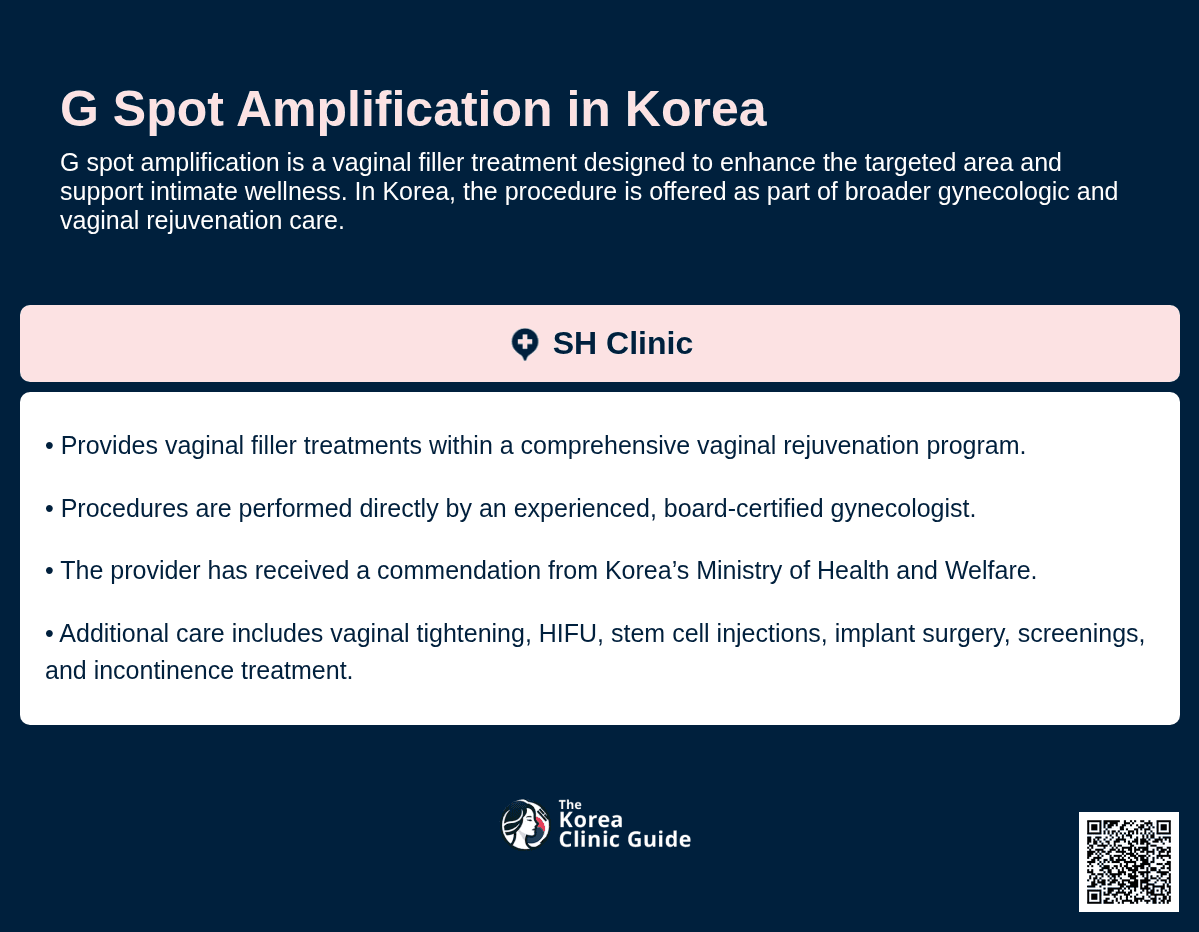
For G Spot Amplification, you can receive care at a specialized gynecology clinic that offers vaginal filler treatments within a broader range of vaginal rejuvenation options. Your procedure is performed directly by an experienced, board-certified gynecologist who has received a Minister of Health and Welfare commendation.
- URL: SH Clinic Website
- Location: Seocho-gu, Seoul
- Gynecologic care:
- Vaginal fillers are offered alongside vaginal tightening, stem cell injections, vaginal HIFU treatments, and implant surgery.
- The clinic also provides general gynecologic services, including cervical and ovarian cancer screening and urinary incontinence care.
- Provider and setting:
- Procedures are performed directly by the clinic’s board-certified gynecologist.
- The clinic focuses on women’s healthcare and gynecology.
G-spot Amplification From Start to Finish
- English or virtual consultation — Share medical history, allergies, pregnancy possibility, pelvic surgery, prior fillers or PRP, current medicines and supplements, urinary or vaginal symptoms, and the specific sexual concern. The clinic should explain that G-shot benefit has not been established in controlled trials.
- Goal and symptom assessment — A qualified clinician reviews dryness, menopausal symptoms, pain with intercourse, pelvic-floor symptoms, urinary concerns, medication effects, mood, trauma, relationship concerns, and anatomical complaints. Unexplained pain, bleeding, infection symptoms, or a mass require evaluation rather than filler injection.
- In-person examination and testing — The clinician determines whether a pelvic examination, pregnancy test, urinalysis or culture, STI testing, or further gynecologic work-up is indicated. There is no universal laboratory panel for this procedure.
- Consent and product verification — Before proceeding, confirm the exact filler, manufacturer, composition, volume, expiry date, lot number, intended injection site and plane, anesthetic plan, Korean authorization status, and management plan for bleeding, infection, allergy, urinary symptoms, and suspected tissue injury.
- Injection visit — The procedure is usually performed in an office setting with topical and/or local anesthesia. The practitioner injects material into a patient-identified region of the anterior vaginal wall near the urethra; this is not a standardized anatomical target. Published descriptions identify HA or collagen-like bulking material, but do not establish a proven technique or outcome.
- Immediate observation and discharge — The clinic checks pain, bleeding, swelling, and the ability to urinate before same-day discharge. Receive written aftercare instructions, a direct urgent-contact route, and complete records before leaving.
- Review and overseas follow-up — Attend the planned in-person review before travel where possible. Send photographs only when the clinic requests them, report symptoms promptly, and provide the product record to any clinician treating a delayed problem at home.
Alternatives to G-Spot Amplification
The right alternative depends on the underlying concern. Non-surgical sexual-health and pelvic-floor care can address identifiable causes of pain, dryness, arousal difficulty, or orgasm concerns; surgery is reserved for a clearly diagnosed structural problem, not for presumed G-spot enhancement.
Sexual-health evaluation
- Best for — Low desire, arousal difficulty, orgasm concerns, medication-related changes, mood symptoms, relationship distress, trauma-related concerns, endocrine conditions, or neurologic contributors.
- Tradeoff — This approach does not create local vaginal bulk, but it investigates treatable causes rather than assuming one anatomical point explains sexual response.
Pelvic-floor physical therapy
- Best for — Painful penetration, vaginismus, pelvic-floor overactivity, or difficulty using tampons.
- Tradeoff — Treatment takes repeated sessions and active participation, but targets muscle dysfunction that a filler injection does not treat.
Vaginal dryness care
- Best for — Dryness, burning, irritation, menopausal genitourinary symptoms, or friction-related discomfort.
- Tradeoff — Individualized gynecologic care, lubricants, moisturizers, and clinically appropriate hormonal or nonhormonal options address tissue symptoms. Do not extrapolate a small pre-post study of vaginal HA injection for atrophy to G-spot amplification or orgasm outcomes, as explained in the study record. Related information is available for vaginal dryness.
Structural gynecologic surgery
- Best for — Confirmed prolapse, post-obstetric structural change, or another defined anatomical condition after gynecologic or urogynecologic assessment.
- Tradeoff — Surgery has more substantial recovery, anesthesia, wound, and travel implications and should not be pursued simply to treat orgasm or arousal concerns. See vaginoplasty and pelvic muscle restoration surgery.
PRP or energy-based vaginal treatments
- Best for — Patients considering commercially marketed sexual-wellness procedures after receiving a full diagnostic evaluation.
- Tradeoff — PRP vaginal rejuvenation and laser vaginal rejuvenation are not proven substitutes for evidence-based diagnosis and care, and they do not establish that filler amplification is effective.
How Can I Prepare for G-Spot Amplification?
- Medical disclosure — Provide a complete list of prescribed medicines, over-the-counter drugs, NSAIDs, fish oil, vitamin E, ginkgo, garlic products, and herbal preparations. Also report allergies, prior anaphylaxis, prior genital fillers, pelvic surgery, bleeding history, pregnancy possibility, and urinary, vaginal, bleeding, or pain symptoms.
- Antithrombotic medicines — Do not stop aspirin, clopidogrel, warfarin, apixaban, rivaroxaban, or other prescribed antiplatelet or anticoagulant treatment on your own. The prescribing clinician and injector must coordinate any change.
- Infection and symptom screening — Postpone treatment and seek assessment for genital sores, rash, unusual discharge, fever, urinary burning, pelvic pain, unexplained bleeding, or suspected pregnancy.
- Fasting and sedation — Local-anesthetic-only treatment generally does not require fasting. If oral anxiolysis or sedation is planned, follow the facility's fasting instructions, arrange an adult escort, and do not drive or travel alone until cleared.
- Product records — Before paying or consenting, request the product name, manufacturer, composition, volume, lot number, expiry date, proposed injection plane, Korean authorization/indication, and written complication plan.
- Travel logistics — Avoid scheduling treatment on the last day in Korea. Book flexible flights and accommodation, arrange a review before departure, and identify care at home for complications.
Travel note: Bring an English medical summary and leave Korea with an English procedure record; delayed filler complications are harder to assess when the product and injection details are unknown.
Confirm the treating doctor's clinic-specific medication, fasting, transport, and travel requirements, which take precedence over general guidance.
Aftercare Advice
Treat new or worsening genital, urinary, bleeding, or systemic symptoms as a reason to contact the clinic promptly rather than as routine recovery.
- Activity and contact — Follow the clinician's restrictions on intercourse, tampon use, penetrative devices, cycling, strenuous exercise, and direct pressure. No validated procedure-specific abstinence or activity-restriction interval exists, so do not rely on a marketing timetable.
- Comfort and hygiene — Keep the area clean and follow the clinic's washing, medication, and pain-relief instructions. Do not insert creams, antiseptics, or other products unless the treating clinician approves them.
- Expected short-term effects — Tenderness, swelling, bruising, light spotting, and urinary irritation can occur after injection. There is no validated final-result timeline, and absence of improvement is possible.
- Urgent warning signs — Seek urgent assessment for severe or increasing pain, heavy bleeding, fever, foul discharge, rapidly increasing swelling, inability to urinate, spreading redness, open or draining wounds, pale, gray, blue, or black tissue, hives, breathing difficulty, or neurologic symptoms.
- Follow-up and records — Attend the planned review before departure and retain the filler and anesthetic record indefinitely. Delayed inflammatory or filler-related reactions have been reported weeks, months, or years after injection, as discussed in a review of filler complications.
Follow the treating doctor's individualized instructions and contact the clinic immediately when something appears wrong.
Frequently Asked Questions
Related Blogs
G-spot Filler in Korea: Evidence, Safety, Recovery, and Travel Planning
G-spot filler involves nonstandardized anterior vaginal-wall injections, most often temporary hyaluronic acid, with uncertain sexual-function benefits and potential risks. International patients should plan 2–3 days in Korea for assessment and review, obtain treatment records, and arrange follow-up care.
Updated: Sep 28, 2026
PRP Vaginal Rejuvenation in Korea: Evidence, Procedure Steps, Recovery and Travel Planning
PRP vaginal rejuvenation uses a patient’s processed blood plasma for targeted vaginal, vulvar, clitoral, or periurethral injections after pelvic-health assessment, but protocols and evidence of benefit are not standardized. The article covers candidate screening, Korea travel planning, preparation, recovery, warning signs, follow-up, and diagnosis-specific alternatives for dryness, pain, incontine
Updated: Sep 28, 2026
Viveve Laser in Korea: RF Treatment, Safety, Evidence and Travel Planning
Viveve is a non-incisional, cryogen-cooled monopolar RF treatment—not a laser—used in selected patients after gynecologic assessment, with limited evidence for vaginal-laxity symptoms and no established cure for incontinence. International patients considering treatment in Korea can review candidate criteria, MFDS device verification, outpatient recovery, 10-day intercourse and tampon restrictions
Updated: Sep 22, 2026
Adenomyosis in Korea: Diagnosis, Fertility Decisions, and Treatment Options
Adenomyosis care begins with gynecologic assessment, ultrasound or MRI, and treatment selection based on symptoms, anatomy, anemia, and fertility goals. Options include medication, LNG-IUS, HIFU, UAE, adenomyomectomy, or hysterectomy, with travel-stay guidance, recovery planning, warning signs, and follow-up information for international patients.
Updated: Sep 22, 2026