Medical Tourism Blog
G-spot Filler in Korea: Evidence, Safety, Recovery, and Travel Planning
Table of contents
- G-spot Filler at a Glance
- What Is G-spot Filler?
- Who Is a Good Candidate for G-spot Filler?
- How Is G-spot Filler Performed?
- Why Visit Korea for G-spot Filler?
- Key Information for International Patients
- Which Are the Best Clinics in Korea for G Spot Filler?
- G-spot Filler From Start to Finish
- Alternatives to G-spot Filler
- How Can I Prepare for G-spot Filler?
- Aftercare Advice
Considering treatment in Korea? Everything you need to know e.g. — how to avoid scams, visas, interpreters, recovery tips — in our Medical Tourism Master Guide. Plan with confidence in minutes, not weeks!
Last updated: September 2026
G-spot Filler at a Glance
- What it is — G-spot filler is an outpatient, usually hyaluronic-acid injection placed under the anterior vaginal wall near the urethrovaginal septum to create temporary bulking; it involves no incision.
- Benefits are unproven — It is not an established treatment for orgasm, arousal, low desire, or sexual dissatisfaction: no high-quality sham-controlled trial has shown that anterior-wall filler improves these outcomes.
- Recovery and restrictions — Same-day discharge is often possible after local anesthetic, but soreness, swelling, spotting, pressure, or urinary discomfort may last several days; avoid intercourse, tampons, toys, and other vaginal insertion until the clinician clears it.
- Korea travel plan — International patients should plan at least 2–3 days in Korea for an in-person gynecologic assessment, treatment only if appropriate, and a next-day or 24–48-hour review before long-haul travel.
- Who should avoid it — Do not proceed with infection, genital sores, unexplained bleeding, persistent pelvic pain, urinary symptoms, suspected prolapse, pregnancy, or breastfeeding until appropriate assessment; anticoagulant or antiplatelet medicines require prescriber coordination.
- Key safety limitation — The G-spot has no universally agreed anatomical location, and injection techniques, volumes, durability, repeat-treatment intervals, and complication rates are not standardized; risks include infection, pain, urinary problems, nodules, altered sensation, and injury to nearby structures.
- Korea-specific safeguard — Korea may simplify foreign-patient logistics and interpretation, but has no proven outcome advantage; obtain an English record with the exact filler brand, ingredients, lot number, volume, injection plane, anesthetic, and complication plan before leaving.
What Is G-spot Filler?
G-spot filler is an elective injection of a temporary bulking material, usually hyaluronic acid, into the front wall of the vagina. It is marketed to increase sensation during penetration, but it does not reliably treat orgasm, arousal, desire, pain, dryness, or sexual dissatisfaction. It is a minimally invasive, commonly off-label procedure performed without an incision.
Who Is a Good Candidate for G-spot Filler?
- Informed adult candidates — Adults seeking an elective, temporary anterior-vaginal-wall volume procedure who understand that it is commonly marketed as G-spot amplification, not an established treatment for sexual dysfunction.
- People with a clear, assessed concern — Candidates have discussed whether the main issue is penetration-related sensation, dryness, pain, low desire, arousal difficulty, orgasmic difficulty, urinary symptoms, or menopausal change.
- Patients who accept uncertain benefit — Good candidates do not expect an injection to guarantee orgasm or correct concerns driven by clitoral stimulation, lubrication, pelvic-floor dysfunction, medication effects, hormonal change, pain, mental health, trauma, or relationship factors.
- People able to arrange follow-up — International patients need time in Korea for a post-treatment review and access to gynecologic care at home if pain, urinary symptoms, bleeding, or infection develops.
Do not proceed with active vaginal, vulvar, urinary, pelvic, or systemic infection; genital sores; untreated inflammation; unexplained bleeding; persistent pelvic pain; a pelvic mass; new dyspareunia; recurrent urinary symptoms; or suspected prolapse until the cause has been assessed. Pregnancy and breastfeeding are exclusions because safety of elective hyaluronic-acid filler injection in this setting has not been established. A bleeding disorder, uncontrolled coagulation problem, or anticoagulant or antiplatelet treatment requires coordination with the prescribing clinician; never stop warfarin, apixaban, rivaroxaban, clopidogrel, aspirin, or similar medicines independently. The clinician must also assess allergy to the proposed product, bacterial-fermentation-derived HA, lidocaine, or other anesthetic components, plus capacity to provide voluntary consent without coercion or unrealistic expectations.
How Is G-spot Filler Performed?
“G-spot filler” describes several nonstandardized approaches rather than one validated procedure. The proposed target is usually submucosal tissue of the anterior vaginal wall near the urethrovaginal septum, but anatomy research remains contested: studies have not agreed on the G-spot’s existence, location, size, or nature.
- Hyaluronic-acid filler injection — Cross-linked HA is the most commonly marketed temporary bulking material. HA can sometimes be degraded with hyaluronidase, but vaginal reversal protocols, dosing, and outcomes are not standardized.
- Landmark-based placement — The clinician uses pelvic examination findings and the patient’s description of sensitivity to select a site. No validated examination or mapping method predicts improved arousal, orgasm, satisfaction, or penetration-related pleasure.
- Needle or blunt cannula — This is an injector technique choice, not a proven outcome advantage. No high-quality G-spot-filler-specific comparison establishes that either approach is safer or more effective.
- Autologous-fat augmentation — Fat is harvested from another body area and grafted to the anterior vaginal wall. It is materially more invasive than HA injection, requires donor-site recovery, and has variable graft survival.
- Other or permanent materials — Collagen-like, biostimulatory, and permanent materials differ in persistence, removability, and inflammatory risk. Avoid injectable silicone, unknown materials, and needle-free high-pressure injection; the FDA specifically warns about serious injury from needle-free filler devices.
Why Visit Korea for G-spot Filler?
Korea can be practical for visitors who need coordinated appointments, interpretation, and medical-travel administration. It does not have demonstrated superiority in G-spot-filler outcomes, and the procedure’s central efficacy and safety gaps apply in every country. Choose a clinician and product documentation, not a destination-based marketing claim.
- Foreign-patient infrastructure — Korea’s official medical-tourism platform provides information for overseas patients, while the Medical Korea visa route and official visa information can support travel planning when applicable.
- Opportunity for in-person reassessment — A multi-day visit allows a gynecologic consultation, examination, consent discussion, treatment only when still appropriate, and a 24–48-hour review before departure.
- Documented-product safeguards — Request the exact HA filler brand and formulation, manufacturer, ingredients, lot or batch number, injected volume, anatomical location and tissue plane, anesthetic, and date in an English record. Legal availability or facial-filler marketing does not establish that a specific product is approved or labeled for vaginal use in Korea.
- Evidence limitation — The relevant registered HA study was open-label and uncontrolled, focused on vaginal hydration or atrophy, and only listed the G-spot among suggested intimate-area locations. It does not show that anterior-wall filler improves orgasm, arousal, or sexual satisfaction.
Key Information for International Patients
- Minimum stay — Plan 2–3 days for an in-person gynecologic assessment, outpatient treatment only after renewed consent, and a next-day or 24–48-hour review. This is prudent travel planning, not a G-spot-filler-specific evidence-based standard.
- Same-day discharge — Uncomplicated treatment under local anesthetic can allow discharge once pain is controlled and urination is comfortable. Sedation requires an escort and changes fasting, driving, alcohol, decision-making, and discharge rules.
- Flights — Do not schedule a long-haul flight immediately after treatment. Remain in Korea through the planned review; postpone travel and seek in-person assessment for fever, heavy bleeding, escalating pain, urinary retention, allergic symptoms, or suspected infection.
- Itinerary restrictions — Keep the procedure day low-key. Avoid activities that prevent observation of worsening pelvic pain, bleeding, swelling, or urinary discomfort, and do not plan spa bathing or swimming before clinician clearance.
- Remote follow-up — Arrange a video or messaging review at about 1–2 weeks, obtain an English treatment record before leaving, and identify a gynecology or urogynecology clinician at home who can assess persistent symptoms.
Travel note: A coordinator can assist with scheduling and interpretation, but obtain a video consultation with the actual treating physician before booking flights. Confirm the complication plan, including access to hyaluronidase when HA filler is proposed.
Which Are the Best Clinics in Korea for G Spot Filler?
Listed below are some of the best clinics in Korea for g spot filler.
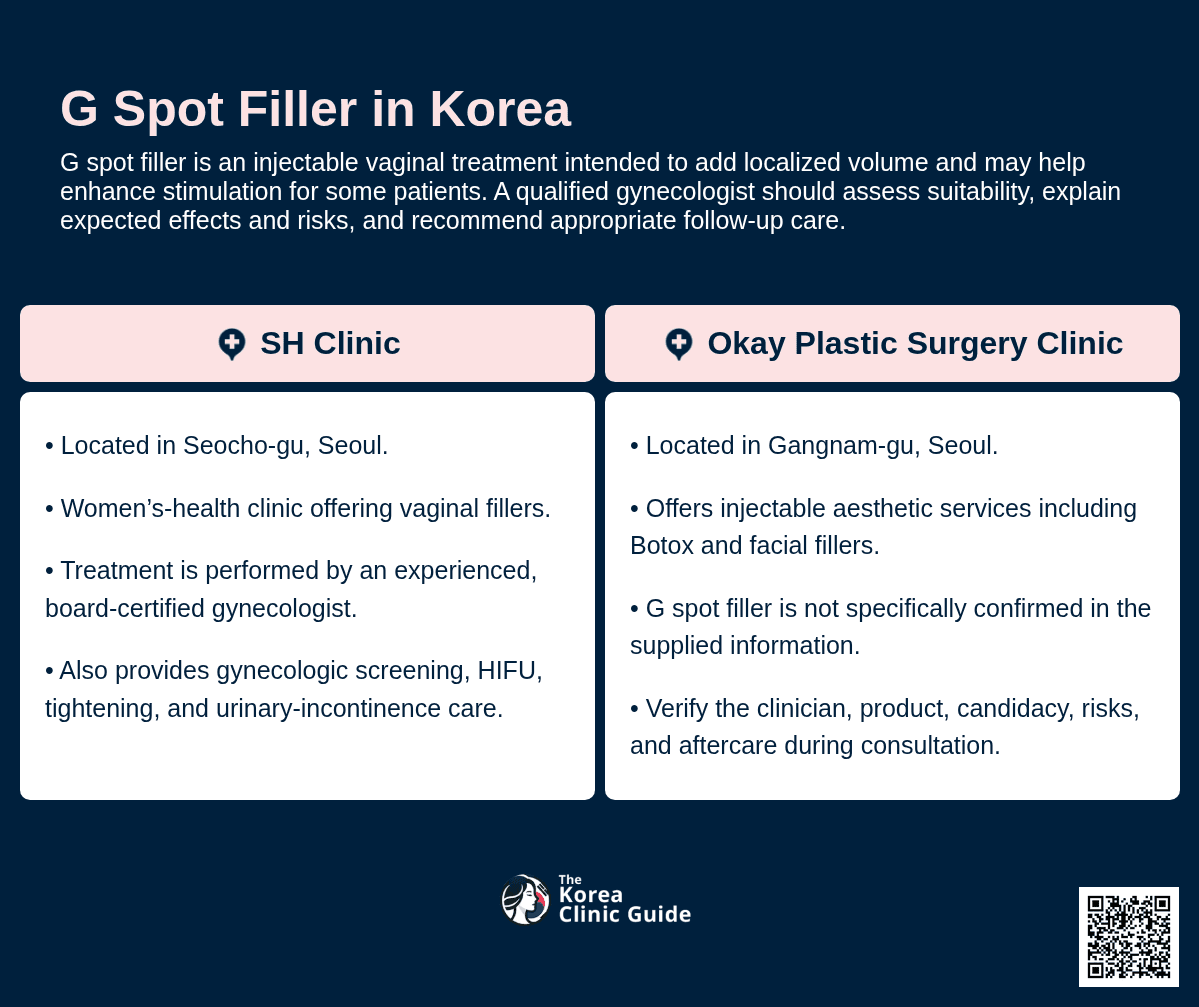
1. SH Clinic
You may consider SH Clinic for G Spot Filler because its women’s-health service line specifically includes vaginal fillers, and procedures are performed directly by an experienced, board-certified gynecologist who has received a Minister of Health and Welfare commendation.
- URL: SH Clinic Website
- Location: Seocho-gu, Seoul
- Gynecologic care:
- The clinic focuses on gynecology and provides women’s-health services alongside vaginal rejuvenation options.
- Its listed vaginal treatments include vaginal fillers, stem-cell injections, HIFU laser treatments, vaginal tightening, and implant surgery.
- Relevant considerations:
- Your suitability, filler choice, expected effects, risks, and follow-up plan should be assessed directly by the gynecologist before treatment.
- The clinic also lists gynecologic screening and urinary-incontinence care, which may be relevant if you have broader pelvic or vaginal health concerns.
2. Okay Plastic Surgery Clinic
For G Spot Filler, the supplied information does not confirm that Okay Plastic Surgery Clinic provides this specific gynecologic procedure. You can expect an individualized aesthetic-care approach and injectable filler services, but you should verify directly whether it offers G Spot Filler, who performs it, and whether you are an appropriate candidate.
- URL: Okay Plastic Surgery Clinic Website
- Location: Gangnam-gu, Seoul
- Injectable services:
- The clinic lists Botox and filler treatments within its petit and skincare services, described for wrinkles, volume loss, and facial contouring.
- The available information does not specify vaginal or G-spot filler treatment.
- Care approach:
- The clinic describes tailored treatment planning and a team that includes a female plastic surgeon with extensive experience.
- Ask for a procedure-specific consultation covering the product used, expected outcome, potential risks, aftercare, and clinician qualifications for this treatment.
G-spot Filler From Start to Finish
- Remote physician consultation — Speak with the treating physician by video, not only a coordinator. Discuss the specific concern, medical history, allergies, prior pelvic procedures, medications, pregnancy possibility, symptoms of infection, and the unproven sexual-function benefit.
- Product and travel planning — Request the product name, formulation, manufacturer, intended volume, injection plane, local-anesthetic or sedation plan, estimated appointment duration, post-treatment review timing, and an English complication plan. Arrange accommodation nearby and a responsible escort if sedation is planned.
- In-person gynecologic assessment — The clinician repeats the history, performs an examination, and determines whether injection remains appropriate. Urinalysis or culture can be indicated for urinary symptoms; testing for vaginitis or sexually transmitted infection can be indicated for discharge, odor, sores, itching, pain, or infection risk; pregnancy testing can be appropriate when pregnancy is possible.
- Consent and treatment decision — Review that the target anatomy and expected sexual benefit are uncertain, that the use may be off-label, and that no high-quality sham-controlled trial has established improved orgasm, arousal, satisfaction, or penetration-related pleasure. Decline treatment if the explanation, material, or follow-up plan is unclear.
- Anesthesia and injection — The clinician uses topical anesthetic, local anesthetic injection, anesthetic-containing filler, or a sedation plan where appropriate. Under sterile conditions, the proposed anterior vaginal-wall region is injected with the agreed material; HA filler injection is usually an outpatient procedure without an incision.
- Observation and discharge — The team monitors pain, bleeding or spotting, swelling, allergic symptoms, and the ability to urinate. After local anesthesia alone, discharge can occur the same day when the patient is comfortable; after sedation, leave with a responsible adult and do not drive or drink alcohol.
- Early review in Korea — Attend the next-day or 24–48-hour review before long-haul travel. Report increasing pain, fever, foul-smelling discharge, heavy bleeding, increasing swelling, urinary difficulty, or a painful firm mass.
- Overseas follow-up — Complete the planned 1–2-week remote review and keep the procedure record. Seek local in-person gynecology or urogynecology care for persistent or worsening symptoms after returning home.
Alternatives to G-spot Filler
The best alternative depends on the actual problem. Non-surgical care can address dryness, pain, pelvic-floor dysfunction, medication effects, or sexual-health concerns without placing filler near the urethra; surgery is reserved for diagnosed structural problems and has greater recovery and complication burdens. Energy-based treatments and PRP are not substitutes for diagnosis simply because they are marketed as non-surgical.
Sexual-health assessment
- Best for — Low desire, arousal difficulty, orgasmic concerns, trauma-related concerns, medication effects, mood symptoms, or relationship distress.
- Tradeoff — Assessment, education, psychotherapy, sex therapy, and couples counseling address contributors to sexual response but do not create an immediate bulking effect. Female sexual health concerns often have physical, psychological, interpersonal, and contextual contributors.
Menopause and vaginal dryness treatment
- Best for — Dryness, burning, recurrent urinary discomfort, or painful intercourse associated with genitourinary syndrome of menopause.
- Options — Vaginal moisturizers, lubricants, and clinician-directed treatments such as low-dose vaginal estrogen can treat the underlying condition rather than attempt to change an uncertain sensitive target.
- Related reading — Vaginal dryness treatment.
Pelvic-floor therapy
- Best for — Pain with sex, penetration difficulty, pelvic-floor overactivity, postpartum symptoms, or selected urinary symptoms.
- Tradeoff — Pelvic-floor physical therapy and dilator therapy when indicated require repeated sessions and active participation, but they target muscle dysfunction rather than adding volume to the vaginal wall.
Urogynecology care
- Best for — Stress urinary incontinence, suspected prolapse, recurrent urinary symptoms, or a sensation of vaginal bulge or pressure.
- Options — Assessment can lead to pelvic-floor treatment, pessary use, or surgery when a diagnosed structural condition warrants it. Consider pelvic muscle restoration surgery only after specialist assessment.
Energy-based vaginal treatment
- Best for — Patients considering a device-based approach after diagnosis and a careful evidence discussion.
- Tradeoff — Laser and radiofrequency vaginal “rejuvenation” have separate safety and evidence limitations; ACOG notes that vaginal laser therapy is not FDA-approved for menopausal symptoms, urinary incontinence, or sexual problems. Related options include vaginal laser rejuvenation and PRP vaginal rejuvenation.
How Can I Prepare for G-spot Filler?
- Physician consultation first — Complete a video consultation with the treating physician before travel. Ask whether the clinician considers the procedure elective and off-label, what material is proposed, where it will be placed, and how complications will be managed after departure.
- Medicines and supplements — Provide a complete list of prescription medicines, over-the-counter medicines, supplements, and allergies. Aspirin, NSAIDs, anticoagulants, antiplatelets, fish oil, vitamin E, ginkgo, garlic, ginseng, and turmeric or curcumin can affect bleeding or interact with medicines; follow the prescriber’s and treating doctor’s instructions on any changes.
- Do not stop prescriptions alone — Never independently stop warfarin, apixaban, rivaroxaban, dabigatran, clopidogrel, aspirin, or another prescribed medicine. The prescribing clinician must decide whether interruption is safe.
- Infection and symptom disclosure — Report discharge, odor, itching, genital sores, fever, urinary burning, recurrent urinary infection, pelvic pain, new pain with sex, unusual bleeding, or possible pregnancy before arriving. Do not mask suspected infection with intravaginal self-treatment.
- Fasting and alcohol — Local-anesthetic injection generally does not require fasting. Follow the clinic’s written fasting instructions if oral, inhaled, or IV sedation is planned, and avoid alcohol around the procedure as directed.
- Treatment-area care — Arrive clean, but do not douche or use fragranced washes. Wear loose underwear and bring a pad for possible spotting.
- Accommodation and transport — Stay close to the facility through the first night and keep flights flexible until after the 24–48-hour review. Arrange a private ride and responsible adult escort after any sedation.
Travel note: Do not book a same-day long-haul departure. A complication that affects urination, causes escalating pelvic pain, or suggests infection needs in-person assessment before travel.
Confirm the treating doctor’s individualized medication, fasting, transport, testing, and abstinence requirements; those instructions take precedence over general guidance.
Aftercare Advice
Protect the injection area, monitor urinary function and infection symptoms, and do not resume vaginal insertion until the treating clinician specifically clears it.
- Rest and discomfort — Keep activity light on the treatment day. Temporary soreness, pressure, swelling, spotting, or urinary discomfort can occur for several days, but G-spot-filler-specific recovery data do not establish a dependable timeline; use only clinician-approved pain relief.
- Vaginal restrictions — Avoid intercourse, fingers, sex toys, tampons, menstrual cups, douching, and other vaginal insertion until cleared. A one-week intercourse restriction reported in a small fat-grafting protocol cannot be assumed to apply to HA filler.
- Water and heat — Avoid swimming, hot tubs, baths, and other water exposure until the clinician confirms that the injection area has settled. Choose showers unless instructed otherwise.
- Follow-up and records — Attend the planned 24–48-hour review before leaving Korea and complete remote follow-up at about 1–2 weeks. Keep the English record listing product, lot or batch number, amount, injection location and plane, date, and anesthetic.
- Urgent warning signs — Seek urgent in-person care for fever, chills, heavy bleeding, foul-smelling discharge, rapidly increasing swelling, escalating pelvic or vaginal pain, inability to urinate, painful urination with systemic symptoms, hives, breathing difficulty, fainting, chest pain, shortness of breath, or a new firm painful mass.
Follow the treating doctor’s written instructions over generic guidance and contact the clinic promptly when anything appears wrong.
Frequently Asked Questions
Related Blogs
PRP Vaginal Rejuvenation in Korea: Evidence, Procedure Steps, Recovery and Travel Planning
PRP vaginal rejuvenation uses a patient’s processed blood plasma for targeted vaginal, vulvar, clitoral, or periurethral injections after pelvic-health assessment, but protocols and evidence of benefit are not standardized. The article covers candidate screening, Korea travel planning, preparation, recovery, warning signs, follow-up, and diagnosis-specific alternatives for dryness, pain, incontine
Updated: Sep 28, 2026
G-spot Amplification in Korea: Evidence, Safety, Recovery and Travel Planning
G-spot amplification involves injecting filler into a patient-identified area of the anterior vaginal wall near the urethra, but no standardized target or proven sexual-function benefit exists. The article covers candidacy, product and clinic verification in Korea, travel planning, aftercare, warning signs, and alternatives such as sexual-health evaluation and pelvic-floor therapy.
Updated: Sep 28, 2026
Viveve Laser in Korea: RF Treatment, Safety, Evidence and Travel Planning
Viveve is a non-incisional, cryogen-cooled monopolar RF treatment—not a laser—used in selected patients after gynecologic assessment, with limited evidence for vaginal-laxity symptoms and no established cure for incontinence. International patients considering treatment in Korea can review candidate criteria, MFDS device verification, outpatient recovery, 10-day intercourse and tampon restrictions
Updated: Sep 22, 2026
Adenomyosis in Korea: Diagnosis, Fertility Decisions, and Treatment Options
Adenomyosis care begins with gynecologic assessment, ultrasound or MRI, and treatment selection based on symptoms, anatomy, anemia, and fertility goals. Options include medication, LNG-IUS, HIFU, UAE, adenomyomectomy, or hysterectomy, with travel-stay guidance, recovery planning, warning signs, and follow-up information for international patients.
Updated: Sep 22, 2026