Medical Tourism Blog
Revision Vaginoplasty in Korea: Methods, Recovery, Risks and Travel Planning
Table of contents
- Revision Vaginoplasty at a Glance
- What Is Revision Vaginoplasty?
- Who Is a Good Candidate for Revision Vaginoplasty?
- How Is Revision Vaginoplasty Performed?
- Why Visit Korea for Revision Vaginoplasty?
- Key Information for International Patients
- Which Are the Best Clinics in Korea for Revision Vaginoplasty?
- How Much Does Revision Vaginoplasty Cost in Korea?
- Revision Vaginoplasty From Start to Finish
- Alternatives to Revision Vaginoplasty
- How Can I Prepare for Revision Vaginoplasty?
- Aftercare Advice
Considering treatment in Korea? Everything you need to know e.g. — how to avoid scams, visas, interpreters, recovery tips — in our Medical Tourism Master Guide. Plan with confidence in minutes, not weeks!
Last updated: September 2026
Revision Vaginoplasty at a Glance
- Purpose — Revision vaginoplasty corrects a specific problem after transfeminine vaginoplasty or vulvoplasty, ranging from external scarring, webbing, contour, or urinary spraying to canal stenosis, depth loss, prolapse, or fistula repair.
- Starting cost — Listed pricing in Korea is ₩17,000,000, approximately US$12,600; the final quote depends heavily on whether treatment is a limited external revision or a deeper skin-graft, peritoneal, or bowel reconstruction.
- Best candidates — Suitable candidates have a clearly defined concern, stable health, complete records from prior surgery, realistic goals, and the ability to follow wound care, follow-up, and long-term dilation if a vaginal canal is reconstructed.
- Recovery commitment — Canal reconstruction commonly involves packing and a urinary catheter for about 5–7 days, at least 6 weeks away from strenuous activity, and roughly 3 months or longer before penetrative sex, subject to surgical clearance.
- Dilation requirement — When a canal is revised or rebuilt, dilation usually begins after packing removal or the surgeon’s first review, is most intensive for the first 3–6 months, and may remain necessary long term to preserve depth and width.
- Korea travel plan — International patients undergoing canal revision should plan to remain in South Korea for at least 3–4 weeks for inpatient recovery, dilation teaching, wound and voiding checks, and an in-person fitness-to-fly assessment.
- Korea evidence limit — A Korean rectosigmoid reconstruction series included 17 patients, including 3 redo cases, but Korea has no robust revision-specific outcomes dataset for international patients; confirm the exact multidisciplinary team and proposed technique rather than assuming destination-wide superiority.
What Is Revision Vaginoplasty?
Revision vaginoplasty is a gender-affirming reconstructive procedure performed after prior vaginoplasty or vulvoplasty to correct a specific concern. It can improve comfort, urinary function, external appearance, or vaginal function according to the person’s goals. It is surgical, ranging from focused external correction to more extensive reconstruction.
Who Is a Good Candidate for Revision Vaginoplasty?
- Clearly defined revision need — Good candidates have a specific functional or anatomical concern after transfeminine vaginoplasty or vulvoplasty, such as introital or canal stenosis, depth loss, painful scarring, urinary spraying, prolapse, fistula, labial webbing, or clitoral-hood contour.
- Goals matched to anatomy — State whether receptive vaginal penetration is a goal. This determines whether an external revision, scar release, canal reconstruction, or acceptance of a shorter or zero-depth anatomy is appropriate.
- Ready for reconstruction and follow-up — Candidates can provide informed consent, have stable medical and mental-health conditions, realistic expectations, reliable postoperative support, and the ability to follow dilation and wound-care instructions when a canal is reconstructed.
- Complete surgical history available — Bring the primary operative report, later reoperation records, current dilation history, imaging, cultures, medication list, and allergy information. The revision team needs to know whether the original lining was penile/scrotal skin, graft, peritoneum, or bowel.
Active genital, urinary, skin, or systemic infection; untreated STI; unexplained discharge, bleeding, urinary symptoms, or suspected fistula require assessment and treatment before elective surgery. Uncontrolled diabetes, anemia, malnutrition, major heart or lung disease, clotting disorders, and unmanaged venous-thromboembolism risk require optimization or can delay surgery. Nicotine from smoking, vaping, replacement products, or pouches significantly impairs wound and graft healing; many reconstructive programs require cessation and may test for it. Unless urgent problems such as tissue necrosis, urinary retention, major bleeding, or fistula demand immediate care, revision should wait until primary-surgery tissues have healed and the cause of the concern is established. Abdominal, peritoneal, or intestinal reconstruction also requires individualized anesthetic and colorectal assessment, particularly after prior abdominal surgery or with inflammatory bowel disease, bowel pathology, or extensive adhesions.
How Is Revision Vaginoplasty Performed?
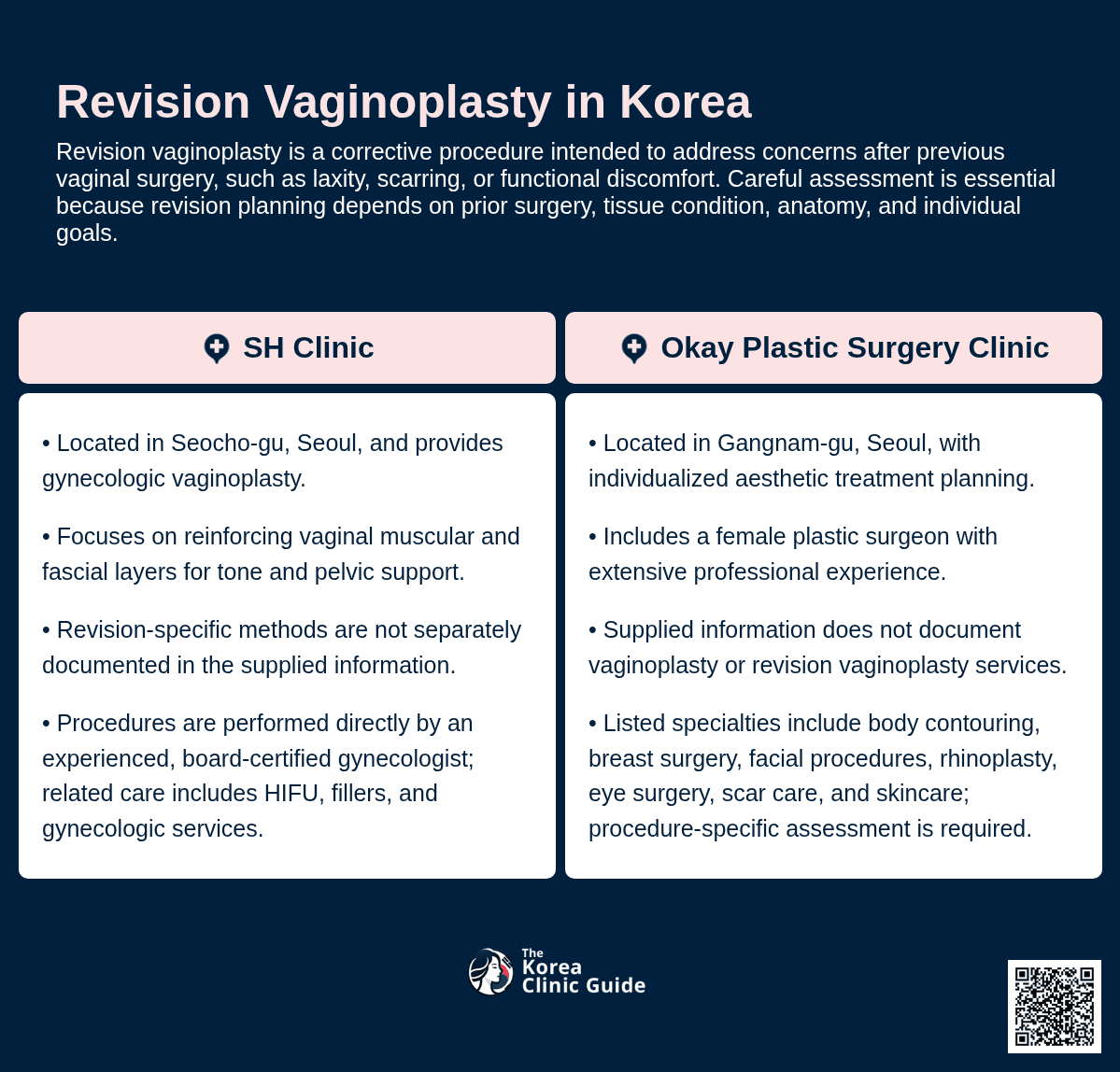
Revision vaginoplasty ranges from a focused external correction to major pelvic reconstruction. Examination, the primary operative report, canal measurements, dilation tolerance, and urinary or bowel symptoms determine the approach.
- External vulvar revision — Revision labiaplasty, clitoral-hood or clitoroplasty revision, scar release, granulation-tissue treatment, and urethral-meatus revision address asymmetry, webbing, prominent scars, contour, or urinary spraying. These procedures are smaller than canal reconstruction but still require protection of sensation, clitoral neurovascular structures, and flap blood supply.
- Scar release with full-thickness skin graft — The surgeon releases introital or canal scar tissue and relines or augments the canal with a skin graft. This avoids bowel transfer but creates a donor-site wound, depends on graft take, and requires sustained dilation. In a retrospective comparison of 53 secondary reconstructions, intestinal reconstruction produced greater mean depth than skin grafting, while postoperative complication rates did not differ significantly; its nonrandomized design cannot establish a best option.
- Robotic or laparoscopic peritoneal-flap revision — Vascularized peritoneal tissue is mobilized through abdominal access and joined to the canal remnant after deep scar release. It avoids an external graft donor site and provides abdominal visualization in a scarred pelvis, but requires specialized abdominal surgery and has limited long-term comparative revision evidence.
- Intestinal canal reconstruction — Usually sigmoid or rectosigmoid bowel is transferred to create or replace a canal when local tissue is inadequate or severe canal loss has occurred. It can provide durable depth and mucosal lubrication, but adds bowel-specific risks including ileus, obstruction, leak, abscess, mucus discharge, diversion colitis, and late intestinal complications.
- Fistula, prolapse, or urinary reconstruction — Rectoneovaginal fistula, neovaginal prolapse, urethral stricture, retention, and urinary fistula are complication-driven problems. Repair can require coordinated colorectal, reconstructive urology, plastic-surgery, anesthesia, and pelvic-floor care, sometimes in stages.
Why Visit Korea for Revision Vaginoplasty?
Revision vaginoplasty in Korea requires verification of the exact hospital team and technique rather than reliance on a destination-wide claim. Published Korean experience demonstrates multidisciplinary intestinal reconstruction capability, but it does not show that Korea has better revision outcomes than other countries. Ask whether the treating center can provide urology, colorectal surgery, anesthesia, inpatient care, and structured overseas follow-up for the proposed reconstruction.
- Published rectosigmoid reconstruction experience — A Korean retrospective 3D laparoscopic rectosigmoid series included 17 patients, 15 of whom were transfeminine; three procedures were redo reconstructions. Mean initial depth was 15.2 cm, one patient was readmitted within 30 days, and mean follow-up was about 25 months. This is evidence of local technical activity, not an individualized outcome forecast or a comparison with other destinations.
- Multidisciplinary intestinal capability — A 2026 Korean report described a two-stage free-jejunal graft vaginoplasty performed in 10 transfeminine patients at Korea University Anam Hospital. The small technical series supports specialized colorectal and plastic-surgery collaboration, but it studied primary procedures rather than revision vaginoplasty.
- Evidence limitations matter — There is no robust Korea-specific dataset for international revision patients. Most revision evidence internationally consists of retrospective single-center series with inconsistent definitions of stenosis, success, depth, sexual function, and reoperation. Primary vaginoplasty results should not be presented as revision results; a primary penile-inversion review also notes substantial variation in complication definitions and patient-reported outcomes.
- Questions to resolve before booking — Confirm the proposed tissue source, expected admission, packing and catheter plan, dilation protocol, emergency contact route, local follow-up schedule, and whether intraoperative findings could change the plan to a staged or different reconstruction.
Key Information for International Patients
- Minimum stay — Plan at least 3–4 weeks in South Korea after canal revision. Abdominal, robotic peritoneal, or bowel reconstruction, a complication, or a surgeon’s longer follow-up protocol can extend that stay. A limited external-only revision can require less local time but still needs a workable overseas follow-up plan.
- Hospital recovery — External revision can be ambulatory or a short admission. Deep canal, peritoneal, robotic, and intestinal revisions generally require several inpatient days. Packing and a urinary catheter commonly remain for about 5–7 days after canal reconstruction.
- Flight timing — Do not book a fixed return flight until the Korean surgeon performs an in-person wound, voiding, mobility, and fitness-to-fly assessment. Long-haul travel soon after major pelvic or abdominal surgery requires an individualized clot-prevention plan.
- Dilation and itinerary impact — Dilation commonly begins after packing removal or at the first surgeon-directed review. It is usually most intensive during the first 3–6 months and can remain necessary long term when a canal is present. Build private time, luggage space for requested supplies, and accommodation suitable for this care into the itinerary.
- Activity limits — Plan at least 6 weeks away from heavy lifting and strenuous exercise. Cycling, swimming, and penetrative vaginal sex are often restricted for about 3 months or longer, depending on the repair and surgical clearance.
- Support after discharge — A trusted adult is strongly advisable for the first 1–2 weeks after discharge, particularly after canal, abdominal, or bowel reconstruction. Solo travelers need accessible accommodation, meals, pharmacy access, reliable phone service, transport, and a 24-hour escalation plan.
- Remote follow-up — Arrange local follow-up before leaving home, ideally with a clinician familiar with neovaginal complications. Obtain operative, anesthesia, and discharge summaries; a medication list; dilation instructions; and named remote clinical contact before departure.
Travel note: Stay near the operating hospital in accommodation with elevator access, a private bathroom, reliable data service, and privacy for dilation. Do not drive while taking opioid analgesics or until the surgeon confirms safe mobility and emergency braking.
Which Are the Best Clinics in Korea for Revision Vaginoplasty?
Listed below are some of the best clinics in Korea for revision vaginoplasty.
1. SH Clinic
For revision vaginoplasty, SH Clinic offers gynecologic vaginoplasty focused on tightening the vaginal canal through reinforcement of muscular and fascial layers; the supplied information does not specify a separate revision technique or revision-case process. Your procedure is performed directly by the clinic’s experienced, board-certified gynecologist.
- URL: SH Clinic Website
- Location: Seocho-gu, Seoul
- Procedure focus:
- Vaginoplasty is described as reinforcing vaginal muscular and fascial layers to improve vaginal tone and pelvic support.
- The clinic also offers non-surgical vaginal rejuvenation options, including vaginal HIFU, vaginal fillers, and stem cell injections.
- Gynecologic care:
- SH Clinic provides general gynecologic care alongside gynecologic surgery and vaginal rejuvenation services.
- Related services include cervical and ovarian cancer screening and treatment options for urinary incontinence.
- Clinician credentials: All surgeries and procedures are stated to be performed directly by a board-certified gynecologist who has received a commendation from the Minister of Health and Welfare.
2. Okay Plastic Surgery Clinic
For revision vaginoplasty, the supplied information for Okay Plastic Surgery Clinic does not document vaginoplasty or revision vaginoplasty services. It does describe individualized aesthetic treatment planning by specialized professionals, including a female plastic surgeon with extensive experience, so you would need procedure-specific assessment before determining whether the clinic can address your revision goals.
- URL: Okay Plastic Surgery Clinic Website
- Location: Gangnam-gu, Seoul
- Relevant considerations:
- The clinic describes individualized treatment planning intended to address your specific needs and goals.
- A female plastic surgeon with extensive experience is included among the clinic’s specialized professionals.
- Documented services:
- The supplied services focus on body contouring, breast surgery, hairline procedures, facial lifting, eye surgery, rhinoplasty, scar care, and skincare.
- Revision services are specifically listed for eye plastic surgery and rhinoplasty, not for vaginoplasty.
How Much Does Revision Vaginoplasty Cost in Korea?
Revision Vaginoplasty is listed at ₩17,000,000 (approximately US$12,600). Individual quotes vary because revision can range from a limited external vulvar correction to deep canal reconstruction requiring abdominal or bowel surgery.
| Procedure Price | Korean Won (₩) | USD ($) |
|---|---|---|
| Low Price | ₩17,000,000 | $12,600 |
| High Price | ₩17,000,000 | $12,600 |
Exchange rate as of 2026-09-06: 1 KRW = 0.000741 USD.
What Affects the Price?
- External-only revision versus canal reconstruction — A revision labiaplasty, clitoral-hood revision, scar release, or urethral-meatus correction generally uses a more limited operative field than repair of introital stenosis or restoration of vaginal depth. Canal work requires deeper dissection, longer operating time, general anesthesia, and often inpatient monitoring with packing and a urinary catheter.
- Reconstructive lining method — Perineal scar release with a full-thickness skin graft adds graft harvest, donor-site care, graft-placement resources, and follow-up for graft healing and dilation. Robotic or laparoscopic peritoneal-flap reconstruction requires abdominal access and specialized minimally invasive equipment; intestinal reconstruction additionally requires bowel surgery and colorectal resources.
- Complication-directed repair — Revision for a rectoneovaginal fistula, prolapse, urinary obstruction, urethral stricture, or urinary fistula is more complex than contour-focused revision. These repairs can require urologic, colorectal, pelvic-floor, or other multidisciplinary involvement, as well as additional operative steps and facility monitoring.
Cost tip: Request an itemized quote stating what is included, particularly the planned revision method, anesthesia, operating-room and admission use, graft or bowel-related components where relevant, tests, medicines, supplies, and scheduled follow-up.
The US$12,600 figure is an approximate conversion using the exchange rate dated 2026-09-06. Check the exchange rate again when budgeting.
Revision Vaginoplasty From Start to Finish
- Remote consultation and records review — Send the original operative report, discharge summary, complication and reoperation history, dilation history, medication and allergy list, laboratory results, imaging, cultures, and secure clinical photographs only when requested. Confirm whether the likely operation is external-only, skin-graft, peritoneal, intestinal, urinary, colorectal, or staged.
- Travel and communication planning — Confirm English-language or interpreter arrangements, the expected local stay, admission estimate, companion requirements, postoperative accommodation, and the hospital’s remote-contact pathway. Ask whether unexpected operative findings could change the procedure or require a second stage.
- In-person examination and testing — The team reviews scars, external anatomy, canal dimensions and dilation tolerance where relevant, and urinary or bowel symptoms. Testing commonly includes blood count, renal and electrolyte studies, blood type and screen, urinalysis or culture, and anesthesia-directed testing; ECG, coagulation testing, STI testing, imaging, endoscopy, or urology/colorectal review are ordered when indicated.
- Final surgical and anesthesia plan — The surgeon explains the tissue source, expected depth or external change, donor-site implications, risks to sensation and urinary or bowel function, packing, catheter, drains, dilation schedule, and realistic limits. Major revisions are generally performed under general anesthesia.
- Revision surgery and admission — An external correction can be outpatient or short-stay. Deep scar release, canal reconstruction, robotic peritoneal work, or bowel transfer usually requires several days of inpatient monitoring. The team monitors bleeding, wound status, urinary drainage, pain control, clot prevention, walking, and bowel function after abdominal procedures.
- Packing removal, voiding checks, and dilation teaching — For canal reconstruction, packing and the urinary catheter are often removed around postoperative day 5–7. Begin dilation only at the surgeon’s specified time, with supervised instruction on dilator size, depth, lubricant, frequency, and force.
- Discharge and local review — Leave hospital only after pain is manageable with oral medication, mobility is safe, wounds are acceptable, and the voiding, bowel, and dilation plan is clear. Attend required Korean wound and fitness-to-fly reviews before travel.
- Overseas follow-up — Follow the operating team’s schedule for early remote review and arrange in-person care locally. Approximately 1-month, 3-month, and 1-year reviews are common after uncomplicated genital reconstruction, but the surgeon’s protocol controls.
Alternatives to Revision Vaginoplasty
The appropriate alternative depends on whether the priority is penetration, relief of a complication, urinary function, or external appearance. Non-canal approaches avoid deep pelvic reconstruction but cannot restore canal depth; bowel, peritoneal, and skin-graft reconstructions involve different tissue sources and risks rather than interchangeable products.
Optimized dilation and local treatment
- Best suited for — Early or limited narrowing, minor scar tightness, or granulation tissue when examination confirms that surgery is not immediately required.
- Tradeoff — This avoids an operation but cannot reliably correct severe stenosis, major depth loss, fistula, prolapse, or a structural urinary problem. Do not force dilation through severe resistance or pain.
External-only vulvar revision
- Best suited for — Labial webbing, asymmetry, contour concerns, clitoral-hood issues, selected scars, or urethral-meatus concerns without a need for canal reconstruction.
- Tradeoff — Recovery is generally shorter than deep revision, but it does not restore vaginal depth and still carries risks to blood supply, scarring, sensation, and clitoral structures. See revision labiaplasty and revision clitoroplasty.
Accepting shorter or zero-depth anatomy
- Best suited for — People who do not want receptive vaginal penetration and wish to avoid the risks and lifelong dilation demands of canal reconstruction.
- Tradeoff — This is a valid anatomical goal, but later canal creation is more complex than preserving a functional canal. Discuss this decision explicitly before revision.
Primary-technique reconstruction options
- Best suited for — Severe canal loss or failed prior reconstruction where the surgeon considers skin graft, peritoneal flap, or intestinal tissue appropriate.
- Tradeoff — A second opinion is particularly important before repeat deep pelvic dissection or bowel surgery. For background on initial reconstruction options, see vaginoplasty and penile-inversion vaginoplasty.
How Can I Prepare for Revision Vaginoplasty?
- Provide complete records — Send the original operative report, all revision and complication records, imaging, cultures, dilation history, medication list, allergies, and prior anesthesia problems well before travel. The tissue used in the first operation directly affects revision planning.
- Disclose every medicine and supplement — List estrogen, antiandrogens, anticoagulants, antiplatelets, diabetes medicines, HIV medicines, psychiatric medicines, injections, over-the-counter products, vitamins, and herbs. Aspirin, NSAIDs, warfarin, direct oral anticoagulants, clopidogrel, fish oil, vitamin E, garlic, ginkgo, ginseng, and St John’s wort can affect bleeding or anesthesia. Do not independently stop prescribed medication.
- Get a written hormone and clot plan — Estrogen management and venous-thromboembolism prevention must be individualized by the surgeon, anesthesiologist, and prescribing clinician; there is no universal perioperative hormone-stop rule.
- Stop all nicotine as directed — Follow the surgeon’s cessation interval for smoking, vaping, nicotine replacement, and nicotine pouches. Disclose any recent exposure honestly because nicotine substantially increases wound- and graft-healing risk.
- Follow fasting and bowel instructions exactly — Use only the hospital’s written fasting plan and, for intestinal surgery, its bowel-preparation protocol. Do not independently use enemas, laxatives, cleanses, or prolonged fasting.
- Clarify hair-removal needs — Hair removal matters mainly when hair-bearing skin will line a newly reconstructed canal. It is not handled the same way for peritoneal or bowel lining, so ask which tissue is planned.
- Plan recovery accommodation and transport — Arrive early enough to recover from jet lag and complete testing. Book flexible travel, accessible accommodation near the hospital, and a companion where possible. Bring requested dilators or lubricant, loose front-opening clothes, medications in original containers, and records.
- Avoid alcohol and disclose substances — Do not drink alcohol with opioids, sedatives, or antibiotics that prohibit alcohol. Tell anesthesia staff about cannabis or THC, CBD, stimulants, and other substance use.
Travel note: Buy insurance that explicitly addresses postoperative complications and medical evacuation, then verify exclusions in writing. A standard travel policy often does not cover planned surgery or related complications.
Confirm the treating doctor’s clinic-specific medicine, nicotine, fasting, bowel-preparation, and travel requirements; their individualized instructions take precedence over general guidance.
Aftercare Advice
Protect the reconstruction, follow the prescribed dilation plan exactly, and seek in-person emergency care promptly when serious symptoms develop.
- Dilation — Start only when the operating team directs, commonly after packing removal or at the first postoperative review. Use the prescribed dilator size, lubricant, depth, frequency, and force. Penetrative sex does not replace dilation. Stop and contact the clinic for severe resistance, severe pain, or sudden inability to dilate after previously successful dilation.
- Wound and hygiene care — Wash hands before genital care and use only approved cleansing products, ointments, and dressings. Avoid baths, hot tubs, pools, and ocean water until every incision and donor site has healed. Protect fully healed abdominal or donor-site scars with clothing and SPF 50 sunscreen only when the surgical team authorizes it.
- Movement and restrictions — Walk and increase mobility when cleared to reduce clot risk. Avoid heavy lifting and strenuous exercise for at least 6 weeks. Avoid cycling, swimming, and penetrative vaginal sex for about 3 months or longer until the surgeon confirms that the specific repair is healed.
- Expected healing — Swelling, bruising, mild asymmetry, spotting, and non-foul drainage can occur early. Swelling often improves over 6–8 weeks, while scars, revised external contours, and stable canal depth or width continue to mature for 6–12 months.
- Urgent warning signs — Seek urgent local assessment for heavy bleeding; fever or chills; rapidly increasing pain or swelling; spreading redness; foul or purulent drainage; wound opening or dark tissue; inability to urinate; persistent vomiting or dehydration; calf pain or swelling; chest pain; shortness of breath; severe new abdominal pain; gas or stool from the vagina; fecal-smelling discharge; or sudden loss of dilation ability.
- Follow-up — Attend all Korean reviews before flying and send requested wound updates through the clinic’s secure channel after returning home. Keep a local clinician and emergency department plan in place; overseas messaging alone is not adequate for urgent complications.
Follow the treating doctor’s specific instructions over this general guidance and contact the clinic promptly when healing appears abnormal.
Frequently Asked Questions
Related Blogs
G-spot Filler in Korea: Evidence, Safety, Recovery, and Travel Planning
G-spot filler involves nonstandardized anterior vaginal-wall injections, most often temporary hyaluronic acid, with uncertain sexual-function benefits and potential risks. International patients should plan 2–3 days in Korea for assessment and review, obtain treatment records, and arrange follow-up care.
Updated: Sep 28, 2026
PRP Vaginal Rejuvenation in Korea: Evidence, Procedure Steps, Recovery and Travel Planning
PRP vaginal rejuvenation uses a patient’s processed blood plasma for targeted vaginal, vulvar, clitoral, or periurethral injections after pelvic-health assessment, but protocols and evidence of benefit are not standardized. The article covers candidate screening, Korea travel planning, preparation, recovery, warning signs, follow-up, and diagnosis-specific alternatives for dryness, pain, incontine
Updated: Sep 28, 2026
G-spot Amplification in Korea: Evidence, Safety, Recovery and Travel Planning
G-spot amplification involves injecting filler into a patient-identified area of the anterior vaginal wall near the urethra, but no standardized target or proven sexual-function benefit exists. The article covers candidacy, product and clinic verification in Korea, travel planning, aftercare, warning signs, and alternatives such as sexual-health evaluation and pelvic-floor therapy.
Updated: Sep 28, 2026
Viveve Laser in Korea: RF Treatment, Safety, Evidence and Travel Planning
Viveve is a non-incisional, cryogen-cooled monopolar RF treatment—not a laser—used in selected patients after gynecologic assessment, with limited evidence for vaginal-laxity symptoms and no established cure for incontinence. International patients considering treatment in Korea can review candidate criteria, MFDS device verification, outpatient recovery, 10-day intercourse and tampon restrictions
Updated: Sep 22, 2026