
Medical Tourism Blog
Misko in Korea: Candidacy, Procedure, Recovery, Risks and Travel Planning

Table of contents
- Misko at a Glance
- What Is Misko?
- Who Is a Good Candidate for Misko?
- How Is Misko Performed?
- Why Visit Korea for Misko?
- Key Information for International Patients
- Which Are the Best Clinics in Korea for Misko?
- Misko From Start to Finish
- Alternatives to Misko
- How Can I Prepare for Misko?
- Aftercare Advice
Considering treatment in Korea? Everything you need to know e.g. — how to avoid scams, visas, interpreters, recovery tips — in our Medical Tourism Master Guide. Plan with confidence in minutes, not weeks!
Last updated: September 2026
Misko at a Glance
- What it is — Misko is a minimally invasive nasal thread treatment using short cog threads, chiefly to create modest tip projection, rotation, columellar support, or limited contour refinement under local anesthetic.
- Best suited for — Healthy adults seeking a subtle, temporary non-surgical change with adequate existing tip support are the best candidates; thick skin, weak cartilage, scar tissue, and pre-existing asymmetry can limit definition.
- Not a rhinoplasty substitute — Threads do not remove bone or cartilage or create permanent structural change, so they cannot reliably reduce a hump or nasal width, correct major deviation or obstruction, or deliver durable reshaping.
- Recovery and result timing — Contour change is visible immediately, but swelling and bruising can take several days to settle; allow 7–14 days before important events and judge symmetry more reliably at about 2–4 weeks.
- Longevity — Misko-specific durability is not established; absorbable thread effects vary by material, placement, anatomy, and any added filler, so repeat treatment may be needed rather than expected permanent correction.
- Korea travel planning — Plan a 4–7-day stay in Korea to allow an in-person review before departure, and obtain English aftercare, product records, and an after-hours contact; no validated Misko-specific no-fly interval exists.
- Key safety distinction — Confirm whether hyaluronic-acid filler is included, because it is a separate nasal injection procedure with rare but serious vascular risks including skin injury, visual loss, and stroke; Misko itself also lacks a standardized, controlled clinical protocol.
What Is Misko?
Misko is a minimally invasive nasal thread treatment that uses absorbable cog threads to support and refine selected areas of the nose. It aims to create subtle, temporary improvement in tip projection, rotation, columellar support, or limited contour definition without changing bone or cartilage. Misko is minimally invasive, performed through small puncture sites under topical or local anesthetic rather than surgical rhinoplasty.
Who Is a Good Candidate for Misko?
- Subtle tip-contour goals — Good candidates are healthy adults seeking modest nasal-tip projection, tip rotation, columellar support, or limited bridge-and-tip refinement without surgery.
- Temporary-result acceptance — The procedure suits people who understand that absorbable threads do not create permanent bone or cartilage change and that repeat treatment can be needed.
- Realistic nasal anatomy — Better candidates have sufficient existing tip support and accept that thick skin, asymmetry, weak cartilage, scar tissue, and prior treatments limit visible definition.
- Non-surgical preference — Misko is for people who prefer a short local-anesthetic outpatient treatment over surgical recovery, not for those seeking major structural reshaping.
Do not proceed over active acne, cellulitis, herpes, sinus or nasal-skin infection, open wounds, or unexplained inflammation near an entry point. Pregnancy and breastfeeding are reasons to defer elective treatment because procedure-specific safety data are inadequate. Prior rhinoplasty, particularly with implants, grafts, or other foreign material, needs specialist assessment: published reports describe difficult infection and scarring in previously operated noses. Uncontrolled diabetes, significant immunosuppression, bleeding disorders, anticoagulant or antiplatelet treatment, allergies to planned products, and a history of severe filler, thread, scar, or granulomatous reactions also require individualized review. Misko is not an alternative to surgery for hump reduction, substantial width reduction, major deviation, airway obstruction, or durable structural correction.
How Is Misko Performed?
Misko is a proprietary nasal-thread concept rather than one universally standardized protocol. The clinically important question is the exact thread plan and whether injections are added.
- Misko-focused tip threads — Available professional descriptions associate Misko with short, cannula-associated cog threads designed principally to improve nasal-tip projection. The direct Misko literature is limited to an indexed conference report and professional description, not a controlled clinical protocol.
- Generic thread rhinoplasty — PDO, PLLA/PCL, or PCL thread systems can be placed for selected tip elevation, columellar support, or dorsal augmentation. Material, thread configuration, insertion plane, and anatomy all affect contour and durability; broader thread-rhinoplasty evidence remains heterogeneous.
- Threads with hyaluronic-acid filler — Filler can add volume or camouflage a small contour depression, but it is a separate procedure. Nasal filler carries a distinct risk of vascular occlusion, skin injury, visual loss, and stroke, documented in a systematic review of nonsurgical rhinoplasty.
- Threads with botulinum toxin — Toxin can be used selectively to reduce depressor-septi muscle activity. A small nonrandomized 2025 study of mixed nonsurgical approaches used a non-Misko LA/CL thread system and found higher satisfaction with triple treatment, but its small unequal groups do not establish a Misko standard of care.
Why Visit Korea for Misko?
Korea has an established infrastructure for international medical visitors and a large aesthetic-treatment market. That does not make Misko a proven Korean standard, nor does it resolve the limited Misko-specific evidence. Choose the clinician and documented treatment plan, not the branding alone.
- International-patient infrastructure — Korea’s national Medical Korea platform provides a formal route for overseas patients seeking treatment information and support.
- Language-support capacity — Seoul has publicly described dedicated interpretation support for foreign medical tourists, including a city plan to deploy medical interpretation coordinators. Confirm the clinic’s own English consent, after-hours contact, and follow-up arrangements before booking.
- Clear product verification matters — Ask for the device name, polymer, cog design, thread count, insertion sites, and treatment plane in writing. Misko is not a single independently validated protocol, and no fully published Misko-specific controlled study establishes standard technique, durability, or complication rates.
- Combination-treatment scrutiny — Confirm whether the quote includes hyaluronic-acid filler or botulinum toxin. The available 2025 comparative study used a different thread system and small groups, so its findings cannot be presented as proof of Misko outcomes.
Key Information for International Patients
- Minimum stay — Plan 4–7 days in Korea, ideally with an in-person review before departure. This is a conservative travel-planning allowance, not an evidence-based universal no-fly interval.
- Flight timing — No validated flight restriction exists specifically for Misko or nasal PDO threads. Delay departure and arrange urgent examination for escalating pain, abnormal skin color, infection symptoms, an exposed thread, or any suspected filler-related vascular event.
- Social recovery — Allow 7–14 days before important photographs, meetings, or events. Tenderness, swelling, bruising, tightness, and a foreign-body sensation commonly last several days; a small 2025 study reported thread-treatment adverse effects resolved by one week, but that cannot predict every material or technique.
- Activity and itinerary — Keep the first days low-key. Avoid strenuous exercise, swimming, saunas, steam rooms, hot tubs, facial treatments, and activities with a risk of nasal impact until the treating clinician clears them.
- Follow-up plan — Obtain English written aftercare, procedure records, product details, and an after-hours contact before leaving Korea. Remote messaging is useful for routine progress but cannot replace in-person assessment of infection, extrusion, skin-color change, or severe pain.
- Sedation and companions — Thread-only treatment under topical or local anesthetic usually does not require a companion. Arrange an escort and do not drive if oral or IV sedation is used.
Travel note: Keep flights and accommodation flexible until the early review is complete, especially when threads are combined with nasal filler.
Which Are the Best Clinics in Korea for Misko?
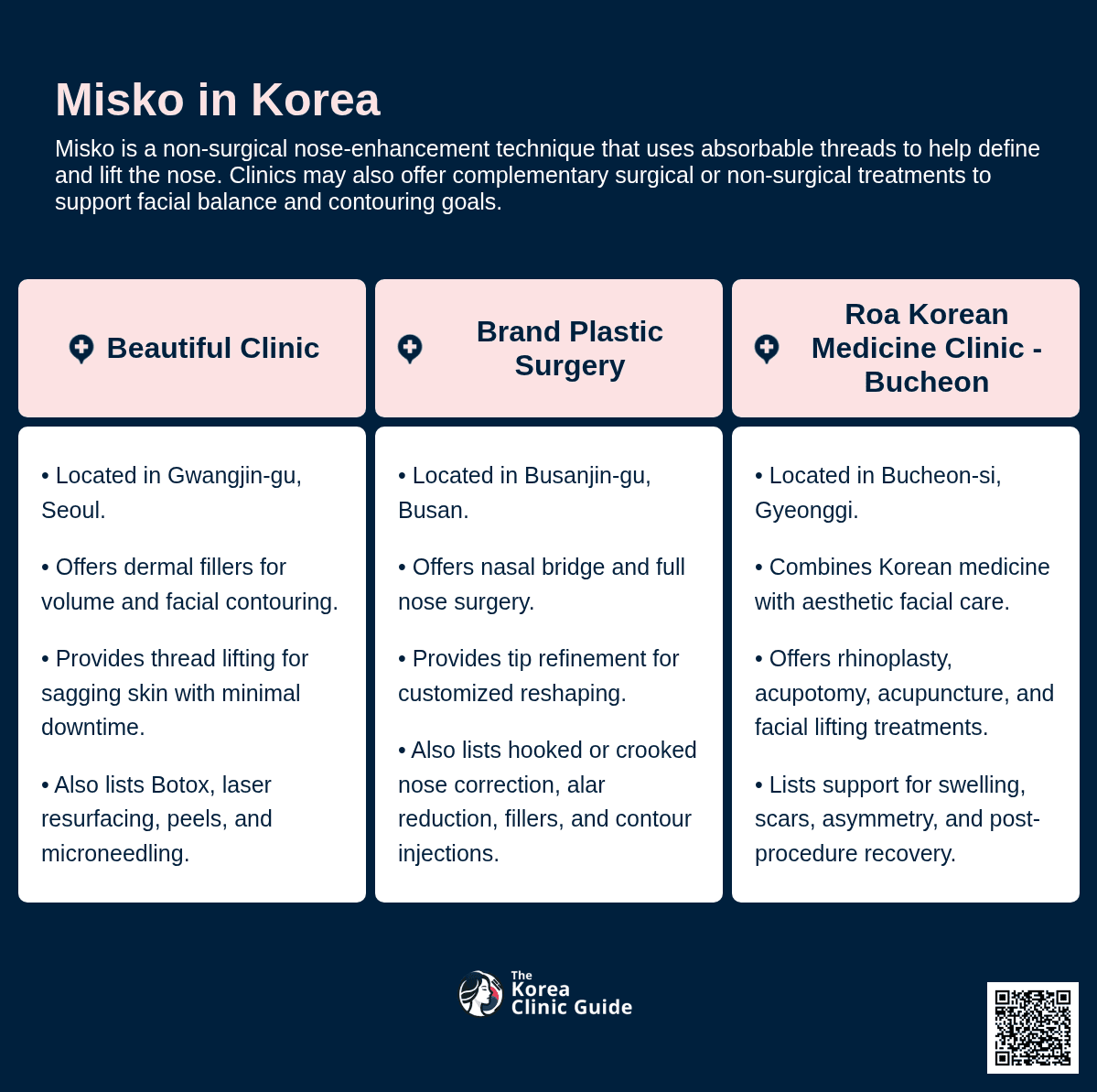
Listed below are some of the best clinics in Korea for misko.
1. Beautiful Clinic
If you are considering Misko alongside non-surgical facial contouring, you can discuss options such as dermal fillers and thread lifting at Beautiful Clinic. Its listed facial treatments focus on restoring volume, refining contours, and lifting sagging skin with minimal downtime for thread lifting.
- URL: Beautiful Clinic Website
- Location: Gwangjin-gu, Seoul
- Facial contouring options:
- Dermal fillers are used to restore volume, smooth wrinkles, and enhance facial contours, with immediate results that may last from several months to more than a year.
- Thread lifting uses threads to lift and tighten sagging skin as a non-surgical facelift approach.
- Botox is listed for reducing wrinkles and fine lines by temporarily relaxing underlying muscles.
- Related skin treatments: Laser skin resurfacing, chemical peels, and microneedling are available for concerns including texture, fine lines, scars, blemishes, and uneven tone.
2. Brand Plastic Surgery
If you are considering Misko in Korea, Brand Plastic Surgery may be relevant when you want to explore surgical nose reshaping: its listed nose procedures include nasal bridge surgery, full nose surgery with tip refinement, hooked or crooked nose correction, and alar base reduction. You can also consider complementary facial options such as fillers, contour injections, and scar revision where appropriate to your goals.
- URL: Brand Plastic Surgery Website
- Location: Busanjin-gu, Busan
3. Roa Korean Medicine Clinic - Bucheon
If you are exploring Misko with an emphasis on facial balance and non-surgical contouring, Roa Korean Medicine Clinic - Bucheon offers rhinoplasty as well as acupotomy and acupuncture intended to enhance facial contours and address asymmetry. You can expect a treatment range that combines Korean medicine-based approaches with aesthetic care, including support for swelling and scar management after surgery.
- URL: Roa Korean Medicine Clinic - Bucheon Website
- Location: Bucheon-si, Gyeonggi
- Facial contouring and skin care:
- Facial asymmetry, square-jaw acupuncture, lifting, wrinkle treatment, and youth acupuncture are listed facial services.
- The clinic also lists care for acne, acne scars, facial flushing, seborrheic dermatitis, and keratosis pilaris.
- Post-procedure support:
- Swelling management, scar treatment, sagging-cheek treatment, facial-paralysis rehabilitation, and post-liposuction care are listed.
- TMJ disorder and pelvic-misalignment treatments use acupuncture and manual therapy.
Misko From Start to Finish
- Remote inquiry and consultation — Send standardized unfiltered frontal, oblique, profile, and basal photographs. Ask whether English virtual consultation is available and state exactly what change is wanted: tip projection, rotation, columellar support, or minor contour camouflage.
- Medical screening and treatment-plan confirmation — Disclose prior rhinoplasty, implants, grafts, threads, filler, trauma, breathing problems, allergies, pregnancy possibility, smoking or vaping, medical conditions, and all medicines and supplements. Confirm the exact thread brand, polymer, cog design, count, planned nasal areas, and whether filler or botulinum toxin is included.
- Travel coordination — Schedule enough time for an in-person review before flying home. Ask for a written emergency plan for infection, thread exposure, and, if filler is planned, vascular compromise.
- In-person assessment and consent — The clinician examines skin thickness, tip support, asymmetry, scar tissue, and evidence of prior foreign material. Healthy patients often need no extensive testing for a short local-anesthetic treatment, but diabetes, bleeding risk, anticoagulants, pregnancy possibility, and relevant medical history can require testing or medical clearance.
- Marking and anesthesia — The nose is cleansed, marked, and treated with topical and/or local anesthetic. Follow fasting instructions only if sedation is planned; fasting is generally not required for local anesthesia alone unless the facility directs otherwise.
- Thread placement — The clinician makes small puncture sites and passes threads through the planned tissue plane to create the intended support effect. Misko descriptions focus on short cannula-associated cog threads for tip projection. If filler is used, it is a separate injection procedure with separate vascular risk.
- Immediate assessment and discharge — The clinician checks the early contour and entry sites, then provides aftercare, emergency contact information, and treatment documentation. The appointment is usually outpatient; duration depends on thread number and whether injection treatment is added.
- Early recovery review — Expect visible early contour change, but do not judge symmetry or request an early touch-up while swelling is present. Attend an in-person check before departure where possible.
- Remote follow-up — Send progress photographs only as requested. Seek local urgent care and notify the Korean clinic immediately for worsening pain, fever, drainage, spreading redness, exposed material, or skin-color changes; do not rely on remote follow-up for these problems.
Alternatives to Misko
Non-surgical choices can create selected volume or contour changes with less downtime, but they cannot remove bone, cartilage, or tissue. Surgery offers structural and potentially durable correction, with a longer recovery and operative risks.
Hyaluronic-Acid Nose Filler
- Best for — Small depressions, limited bridge augmentation, and camouflage of selected contour irregularities.
- Tradeoff — Filler adds volume; it cannot make the nose smaller or correct substantial deviation.
- Critical risk — Nasal injections have rare but serious vascular risks, including occlusion, skin necrosis, visual loss, and stroke. Read about nonsurgical rhinoplasty or nose filler with that risk in mind.
Rhinoplasty
- Best for — Dorsal-hump reduction, true narrowing, major straightening, structural tip work, durable cartilage or bone change, and combined airway goals.
- Tradeoff — Surgery involves anesthesia, incisions, a substantially longer recovery, and surgical revision risk, but it addresses changes that threads cannot.
- Related option — Explore rhinoplasty when the goal is structural reshaping rather than temporary support.
Tip Plasty
- Best for — Concerns driven by actual tip-cartilage shape, weak support, bulbosity, or persistent tip asymmetry.
- Tradeoff — It is surgery, but can alter cartilage architecture rather than temporarily supporting overlying soft tissue.
- Related option — Tip plasty is more appropriate when tip anatomy, rather than a subtle contour deficit, is the main issue.
How Can I Prepare for Misko?
- Medical disclosure — Tell the clinician about prior nasal surgery, implants, grafts, threads, filler, trauma, breathing symptoms, allergies, autoimmune disease, diabetes, bleeding history, pregnancy possibility, and all prescription and non-prescription products.
- Blood-thinning medicines and supplements — Disclose warfarin, direct oral anticoagulants, clopidogrel, aspirin, NSAIDs, vitamin E, fish oil or omega-3, ginkgo, garlic, ginseng, and turmeric or curcumin. Do not stop prescribed aspirin, anticoagulants, or antiplatelet medicines without instructions from the prescribing clinician and treating doctor.
- Skin and infection check — Postpone treatment for sunburn, acne flares, herpes, broken skin, redness, sinus infection, or nasal-skin infection near planned entry points.
- Nicotine and alcohol — Avoid smoking, vaping, nicotine exposure, recreational drugs, and alcohol for the period specified by the clinician. Nicotine can impair healing and alcohol can worsen bruising and swelling.
- Fasting and transport — Eat and drink normally for local-anesthetic treatment unless told otherwise. Follow fasting instructions exactly when oral or IV sedation is planned, arrange an escort, and do not drive after sedating medication.
- Travel logistics — Book flexible flights, stay close enough for early review, and avoid scheduling the procedure immediately before major events or long-haul departure.
Travel note: Bring a written medicine list with generic names and doses, plus prior rhinoplasty or filler records when available.
Confirm the treating doctor’s clinic-specific requirements, which take precedence over general preparation guidance.
Aftercare Advice
Protect the nose from pressure, heat, impact, and unnecessary manipulation during early healing.
- Hands off — Do not press, squeeze, massage, pick, or deliberately reshape the nose. Avoid tight eyeglasses, sunglasses, masks, or other bridge pressure unless the treating clinician specifically approves them.
- Activity and heat — Avoid strenuous exercise, swimming, hot tubs, saunas, steam rooms, and excessive heat until cleared. Avoid contact sports and situations where the nose could be bumped.
- Swelling management — Sleep with the head elevated if comfortable and use only the cold-compress method recommended by the clinic. Expect tenderness, swelling, bruising, tightness, or a foreign-body sensation for several days.
- Other facial procedures — Do not arrange facial massage, nasal injections, microneedling, lasers, energy-based treatments, or other procedures near the nose without approval.
- Sun protection and result timing — Protect healing skin from sun exposure; use broad-spectrum SPF 50 on intact skin when permitted. Early contour is immediate, but assess the result after swelling stabilizes, commonly at 2–4 weeks.
- Urgent warning signs — Seek same-day in-person assessment for escalating pain, spreading redness or warmth, fever, pus or foul drainage, open wounds, visible or protruding thread, worsening deformity, persistent numbness, blanching, gray-blue mottling, blistering, dark discoloration, or ulceration. If filler was used, sudden severe pain, skin blanching, visual symptoms, eyelid droop, double vision, severe headache, weakness, or other neurologic symptoms are emergencies.
Follow the treating doctor’s individualized instructions and contact the clinic promptly when anything appears wrong.
Frequently Asked Questions
Related Blogs
Dehydrated Lips Treatment with Hydro Injection in Korea: Effective Solutions for Moisturizing and Rejuvenation
Discover the benefits of Hydro Injection in Korea, a leading solution for dehydrated lips caused by cheilitis and related conditions. This minimally invasive procedure uses hyaluronic acid-based treatments to deeply hydrate, smooth, and rejuvenate lips, addressing issues such as chapped lips and fine lines. Korea’s advanced clinics offer expert care, streamlined processes, and cost-effective optio
Updated: Oct 3, 2026
Allergic Pigmentation Treatment with Pico Toning in Korea: Effective Solutions for Clear Skin
Discover how Pico Toning laser treatment in Korea effectively addresses Post-Inflammatory Hyperpigmentation (PIH), also known as allergic pigmentation or post-inflammatory brown spots. This advanced skin pigmentation procedure uses ultra-short pulses to break down melanin, making Korea a top destination for safe, affordable, and expert care. Learn about the treatment process, benefits, costs, and
Updated: Oct 3, 2026
Sallow Complexion Solutions: Skin Whitening Injection Treatment in Korea for Radiant Skin
Discover how Korea leads in medical tourism for skin whitening and treatment of sallow complexion. This blog explores causes like anemia and vitamin deficiencies, details Korea’s innovative skin whitening injections—featuring glutathione, vitamin C, and tranexamic acid—outlining procedures, costs, and patient experiences. Learn how Korea’s advanced clinics offer safe, effective treatments to brigh
Updated: Oct 2, 2026
Effective Korea PDRN Injection Treatments for New Stretch Marks
Discover how PDRN injections in Korea offer an advanced treatment for new stretch marks (striae rubrae). Known for stimulating collagen, elastin, and skin regeneration, Korea's expert clinics provide effective solutions for early-stage stretch marks. Benefit from cutting-edge techniques in medical tourism-friendly environments, with affordable costs and proven results. Learn how Korea’s PDRN tre
Updated: Oct 1, 2026
Clinics offering Misko

Haru Clinic Korea | Fully-Customized Full-Face Non-Surgical Rejuvenation With Threads, Botox & Fillers
Sinsa

Wrinkle Plastic Surgery Clinic in Korea: Premier Cosmetic Procedures for Face and Body Enhancement
Gangnam Station

Mi and Mi Clinic - Gangnam: Premier Beauty & Well-being Services in Korea
Gangnam Station

Beautiful Clinic in Korea: Comprehensive Aesthetic and Medical Procedures for Enhanced Beauty and Confidence
Konkuk University