Medical Tourism Blog
Hand Fat Grafting in Korea: Procedure, Recovery, Risks, and Travel Planning
Table of contents
- Hand Fat Grafting at a Glance
- What Is Hand Fat Grafting?
- Who Is a Good Candidate for Hand Fat Grafting?
- How Is Hand Fat Grafting Performed?
- Why Visit Korea for Hand Fat Grafting?
- Key Information for International Patients
- Which Are the Best Clinics in Korea for Hand Fat Grafting?
- Hand Fat Grafting From Start to Finish
- Alternatives to Hand Fat Grafting
- How Can I Prepare for Hand Fat Grafting?
- Aftercare Advice
Considering treatment in Korea? Everything you need to know e.g. — how to avoid scams, visas, interpreters, recovery tips — in our Medical Tourism Master Guide. Plan with confidence in minutes, not weeks!
Last updated: October 2026
Hand Fat Grafting at a Glance
- What it does — Hand fat grafting is an outpatient procedure that removes your own fat by small-volume liposuction and injects it into the backs of the hands to restore fullness and soften the appearance of veins, tendons, and bony contours.
- Best candidates — Suitable candidates have dorsal-hand volume loss, enough safely harvestable donor fat, stable weight, good healing capacity, and realistic expectations; it is not a treatment for hand pain, arthritis, Raynaud phenomenon, or nerve and tendon conditions.
- Recovery — Expect swelling, bruising, hand soreness, and donor-site discomfort, with limited forceful gripping, lifting, and exercise for about 1–2 weeks; hand dressings are commonly kept in place for roughly 3–4 days when directed.
- Results and repeat treatment — Swelling initially obscures the contour, and meaningful assessment of retained fat should wait about 3–6 months; some fat resorption is unpredictable, and a 65-patient series found 12% wanted one additional grafting session.
- What it cannot correct — Fat transfer restores volume but does not reliably remove brown spots, sun damage, marked loose skin, or all visible vessels, which may need laser, resurfacing, vascular treatment, or skin excision instead.
- Korea travel planning — International patients should plan at least 7–10 days in Korea for examination, outpatient treatment, early wound review, and surgeon clearance for long-haul travel; avoid an inflexible immediate return flight because surgery, liposuction, and prolonged travel can raise clot risk.
- Korea-specific consideration — Korea offers Medical Korea registered-hospital and foreign-patient accreditation programs, but these support international-patient services rather than proving superior hand-fat-grafting results; confirm the individual surgeon’s credentials, anesthesia plan, emergency pathway, English records, and remote follow-up.
What Is Hand Fat Grafting?
Hand fat grafting transfers a small amount of your own fat to restore volume in the backs of the hands. It aims to make prominent veins, tendons, and bony contours less noticeable for a fuller, more youthful appearance. It is a surgical procedure because fat is harvested through liposuction and injected into the hands.
Who Is a Good Candidate for Hand Fat Grafting?
- Volume-loss concern — Good candidates want fuller-looking backs of the hands and less visible veins, extensor tendons, bones, and thin crepey skin.
- Adequate donor fat — The procedure requires enough safely harvestable fat, commonly from the abdomen, flanks, thighs, knees, or back.
- Stable health and weight — Adults with stable weight, good healing capacity, and controlled medical conditions are better positioned for predictable recovery.
- Realistic treatment goal — Fat transfer restores dorsal-hand volume; it does not reliably remove brown spots, sun damage, prominent vessels, or marked loose skin without separate treatment.
- Aftercare and travel capacity — Candidates need to protect the grafted hands, attend an early local review, and remain reachable for remote follow-up after returning home.
Hand fat grafting is not appropriate during pregnancy or breastfeeding, with active infection, open wounds, dermatitis, or uncontrolled inflammatory disease at the hand or donor site. Uncontrolled diabetes, significant vascular disease, poor circulation, uncorrected bleeding disorders, poorly controlled hypertension, and nicotine exposure can impair healing or graft survival. Anticoagulants and antiplatelet drugs require coordination with the prescribing clinician rather than independent discontinuation. This cosmetic procedure is not a treatment for hand pain, arthritis, neuropathy, Raynaud phenomenon, tendon disease, or systemic-sclerosis hand problems; these require assessment by an appropriate hand specialist or rheumatologist.
How Is Hand Fat Grafting Performed?
There are no standardized consumer-facing types of hand fat grafting. The practical differences are how fat is harvested and prepared, where it is placed, and whether treatment addresses only the back of the hand or also selected finger areas.
- Donor-site selection — The abdomen, flanks, thighs, knees, back, or another accessible fat depot can provide the graft. Selection depends on available fat, scars, body contour, and the planned liposuction extent.
- Harvest and processing — Surgeons use low-trauma aspiration, then prepare the fat by decantation, centrifugation, filtration, or washing. Published research has not established one processing method as superior for cosmetic hand outcomes.
- Structural micro-aliquot placement — A blunt cannula deposits small, low-pressure parcels of fat in layers beneath dorsal-hand skin, usually over the deep fascia. This approach aims to avoid vessels and tendons while creating even volume.
- Treatment extent and volume — Published series commonly report about 10–30 mL per hand, tailored to baseline atrophy, skin thickness, and desired correction. Some patients have dorsal-hand treatment only; others have limited extension toward the fingers when anatomy supports it.
- Combination treatment — Fat improves volume loss, while pigment, photodamage, texture, visible vessels, or pronounced skin laxity often require a separate skin-directed or surgical treatment.
Why Visit Korea for Hand Fat Grafting?
South Korea has established infrastructure for overseas patients, but there is no evidence that hand fat grafting performed in Korea produces superior retention, safety, satisfaction, or revision rates compared with other countries. Choose a provider based on the individual surgeon’s credentials, anesthesia plan, complication pathway, and follow-up process—not destination alone.
- International-patient oversight framework — Korea’s official Medical Korea registered-hospital directory helps patients identify institutions registered to serve foreign patients.
- Accreditation option — The Korean Accreditation Program for Hospitals Serving Foreign Patients evaluates participating institutions’ international-patient services. Accreditation supports service infrastructure; it does not verify an individual surgeon’s hand-fat-grafting results.
- Evidence-aware consent is essential — A 2022 systematic review included 10 studies and 320 patients, reporting high self-reported satisfaction but only Level 3 evidence, inconsistent retention measures, and a need for stronger long-term research.
- Records and continuity need advance confirmation — Before booking, confirm English consent, operative and anesthesia records, an emergency-transfer plan, written complication policy, and scheduled post-return video or photo reviews.
Key Information for International Patients
- Minimum local stay — Plan at least 7–10 days in Korea for an in-person examination, outpatient procedure, early hand and donor-site review, and fitness-to-fly decision. This is a conservative planning window, not a validated universal flight timetable.
- Return-flight timing — Do not book an inflexible immediate long-haul departure. Liposuction plus surgery and prolonged travel can increase venous-thromboembolism risk; prior clots, obesity, estrogen use, smoking, and other risk factors need individualized planning consistent with CDC travel guidance on blood clots.
- Early recovery impact — Expect bruising, swelling, hand soreness, donor-site discomfort, and restricted forceful gripping or lifting for roughly 1–2 weeks. Keep the first several days free of heavy sightseeing, luggage handling, spa treatments, and activities that could hit or compress the hands.
- Follow-up from home — Obtain the operative report, medication list, photographs, anesthesia record where relevant, and a direct contact route before leaving Korea. Arrange photo or video follow-up and identify a clinician at home who can assess a complication if needed.
- Companion and transport — Arrange a driver after sedation or general anesthesia. A companion for the first night is especially prudent after sedation, a larger donor-site harvest, or when language barriers or medical conditions add risk.
Travel note: Surgeon clearance determines when to fly. Tell the clinic your exact departure date before treatment and keep travel dates flexible in case swelling, wound issues, or medical review require a longer stay.
Which Are the Best Clinics in Korea for Hand Fat Grafting?
Listed below are some of the best clinics in Korea for hand fat grafting.
1. LABOM Plastic Surgery
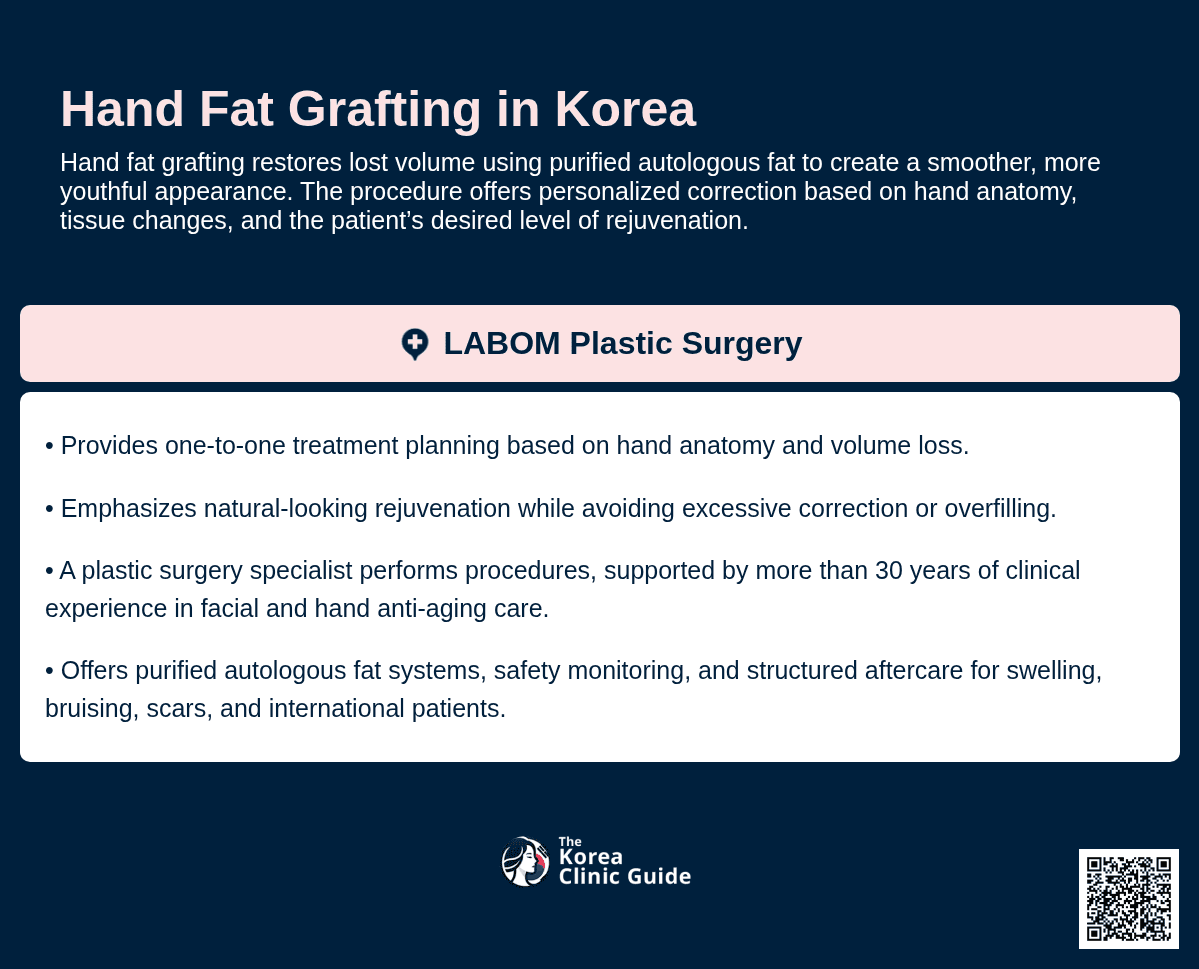
For hand fat grafting, you can expect a specialist-led anti-aging approach centered on your individual anatomy and degree of volume loss. LABOM Plastic Surgery emphasizes natural-looking correction rather than overfilling, with pre-operative diagnosis, individualized planning, and autologous fat purification systems available as part of its surgical infrastructure.
- URL: LABOM Plastic Surgery Website
- Location: Gangnam-gu, Seoul
- Personalized planning:
- Your treatment plan is designed one-to-one rather than using a standardized approach.
- The clinic’s anti-aging focus includes both facial and hand concerns, with attention to underlying tissue structure and natural shape.
- Its stated philosophy is to avoid excessive intervention and preserve a natural appearance.
- Clinical care and recovery support:
- A plastic surgery specialist directly performs each procedure, supported by more than 30 years of clinical experience across facial and hand anti-aging procedures.
- The clinic describes safe anesthesia and continuous monitoring systems, along with precise pre-operative assessment.
- Post-operative care includes regular progress checks and structured programs for recovery, swelling, bruising, and scar management.
- International visitors can receive a dedicated, systematic aftercare plan.
Hand Fat Grafting From Start to Finish
- Remote consultation and travel planning — Send health history, medication and allergy lists, smoking or nicotine status, clotting history, prior hand surgery or fillers, clear hand and donor-site photographs, and planned flight dates. Confirm whether English or virtual consultation is available, the anesthesia plan, expected local stay, and remote-follow-up policy.
- In-person assessment — The surgeon examines dorsal-hand volume loss, skin quality, tendons, veins, scars, circulation, and available donor fat. Standardized photographs are taken, and the consultation distinguishes volume loss from pigment change, vessel disease, loose skin, or functional hand pathology.
- Safety review and consent — The team reviews risks, alternatives, anesthesia, medications, and individualized testing or clearance. Pregnancy testing, laboratory tests, and anesthesia assessment are based on health history and planned treatment rather than required for every limited-volume case.
- Anesthesia and marking — The surgeon marks the donor area and hand injection zones. A smaller procedure often uses local anesthesia with or without sedation; the harvest area, fat volume, combined procedures, and medical factors determine whether deeper anesthesia is appropriate.
- Fat harvest and preparation — Small-volume liposuction removes fat from the selected donor site. The aspirate is then separated and prepared by the clinic’s chosen method, such as washing, filtration, decantation, or centrifugation.
- Hand fat injection — Using a blunt cannula, the surgeon places small, layered fat deposits beneath the dorsal-hand skin to soften the appearance of tendons, veins, and bony contours. The procedural time varies with donor harvest, treatment extent, and whether other procedures are added.
- Discharge and early local review — Most cases are outpatient. Hand dressings and donor-site care are explained in writing; donor incisions may be taped or sutured. Attend the planned review before travel, when the team checks circulation, swelling, wounds, and readiness for a long-haul flight.
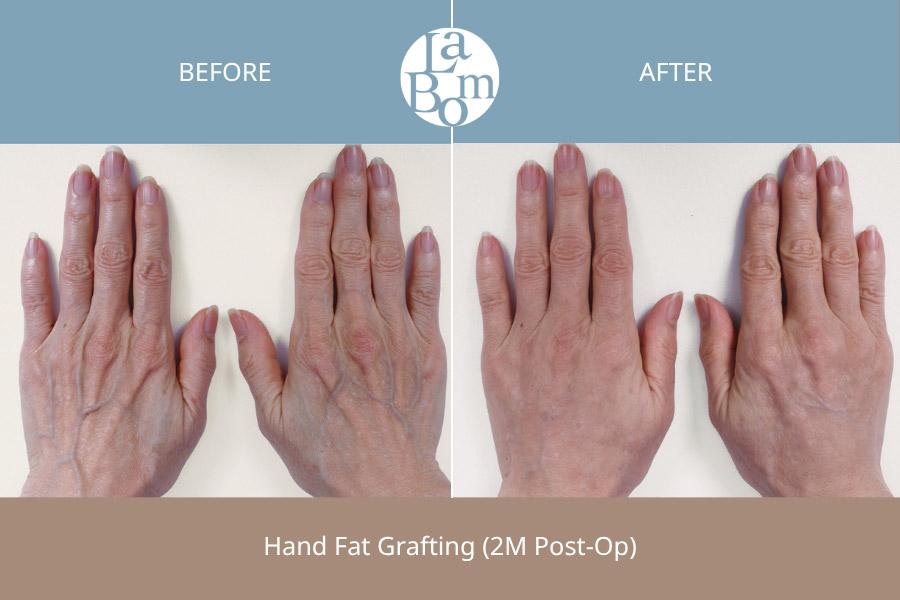
- Remote recovery review — Send scheduled photographs and attend video follow-up after returning home. Final contour assessment waits until swelling settles and fat retention stabilizes, usually around 3–6 months; revision discussions should occur only after that stage.
Alternatives to Hand Fat Grafting
The right alternative depends on whether the main problem is lost volume, pigmentation and sun damage, visible vessels, or excess loose skin. Non-surgical options avoid donor-site liposuction and have shorter downtime, but typically require maintenance; surgery can address marked skin redundancy but has greater recovery and scarring tradeoffs.
Hand Filler
Hand filler provides non-surgical volume replacement with products such as hyaluronic acid, calcium hydroxylapatite (CaHA), or poly-L-lactic acid (PLLA), depending on the product and clinician’s plan.
- Best for — Patients seeking a less invasive, temporary approach or those without sufficient donor fat.
- Tradeoff — Results require repeat treatment, and direct long-term evidence proving filler or fat grafting is superior remains limited. A recent short-term descriptive ultrasound study cannot establish comparative durability or patient-outcome superiority.
IPL, Pigment Laser, or Resurfacing
IPL, pigmentation treatment, chemical peeling, and fractional laser resurfacing such as CO2 laser or Fraxel laser target brown spots, uneven pigment, and surface texture.
- Best for — Hands where photodamage and discoloration are more noticeable than hollowing.
- Tradeoff — These treatments do not replace lost subcutaneous volume or conceal prominent tendons and veins to the same degree as fat or filler.
Vascular Laser
V-Beam laser or another vascular laser can be considered for selected visible superficial vessels.
- Best for — Vessel-related redness or selected visible vascular concerns after a proper assessment.
- Tradeoff — It does not correct global volume loss and is not a substitute for assessment of abnormal or symptomatic hand veins.
Surgical Skin Excision
Surgical skin excision addresses substantial loose skin that volume restoration alone cannot tighten.
- Best for — Marked skin redundancy after careful surgical evaluation.
- Tradeoff — Incisions, scars, and more substantial recovery make this a different decision from injectable or fat-transfer volume restoration.
How Can I Prepare for Hand Fat Grafting?
- Medication and supplement review — Give the surgeon every prescription medicine, over-the-counter drug, vitamin, and supplement. Aspirin, ibuprofen, naproxen, fish oil/omega-3, vitamin E, ginkgo, garlic, ginseng, and St. John’s wort often require review because they can affect bleeding; do not stop prescribed anticoagulants or antiplatelet drugs without coordination between the surgeon and prescribing clinician.
- Nicotine cessation — Stop cigarettes, vaping, nicotine replacement, and nicotine-containing products for the surgeon’s required interval. Nicotine reduces blood flow and is linked to higher complication risk in aesthetic surgery, as outlined in plastic-surgery smoking-risk guidance.
- Alcohol and fasting — Avoid alcohol for the interval set by the clinic. Follow the facility’s exact fasting instructions when sedation or general anesthesia is planned; do not assume a universal cut-off time.
- Medical disclosure — Report diabetes, vascular disease, high blood pressure, autoimmune disease, clot history, prior fillers or hand operations, allergies, pregnancy possibility, and any history of poor wound healing.
- Hand and skin preparation — Arrive without open wounds, active rash, or infection on the hands or donor area. Avoid excessive sun exposure, particularly when laser, IPL, peel, or pigment treatment is combined.
- Practical arrangements — Book nearby accommodation, pack loose easy-on clothing, arrange a driver after anesthesia, and keep mobile data available for translated instructions and remote follow-up. Do not plan to carry heavy luggage.
Travel note: Share your return-flight date before surgery and reserve changeable travel where possible. Early wound review and surgeon flight clearance take priority over a fixed itinerary.
Confirm the treating surgeon’s individualized medication, fasting, nicotine, transport, and wound-care requirements; these take precedence over general guidance.
Aftercare Advice
Protect both the grafted hands and liposuction donor site during the early healing period; swelling and bruising are expected, but circulation problems and infection require prompt assessment.
- Dressings and hygiene — Keep hand dressings clean and dry for the time specified by the surgical team; patient guidance commonly describes about 3–4 days after hand fat injections. Follow the clinic’s instructions for showering, donor-site tapes or sutures, and compression garments.
- Protect the graft — Do not massage, compress, puncture, or expose the hands to intense heat unless the surgeon specifically directs it. Avoid impact, tight gloves, forceful gripping, heavy lifting, gym training, and strenuous exercise until cleared; recovery depends on injection extent and donor-site liposuction.
- Swelling control — Elevate the hands while resting if instructed and take short, gentle walks to support circulation after liposuction. Do not judge symmetry or final contour during the first days or weeks.
- Sun protection — Protect treated hands from ultraviolet exposure and use broad-spectrum SPF 50 when skin is exposed, especially after combined pigment or resurfacing treatment.
- Warning signs — Seek urgent assessment for rapidly increasing one-sided swelling, severe escalating pain, pale, blue, or cold fingers, persistent numbness or weakness, spreading redness, pus, fever, wound opening, chest pain, shortness of breath, coughing blood, or one-sided calf pain/swelling.
- Result timeline and review — Swelling initially masks the result. Assess graft retention and contour at roughly 3–6 months; some fat resorption is expected and unpredictable. In a systematic review of 320 patients, reported complications included infection, cysts or irregularities, temporary altered sensation, and bruising, but the evidence was small and heterogeneous rather than a guarantee of individual risk.
Follow the treating doctor’s instructions over generic advice, attend all scheduled reviews, and contact the clinic promptly when anything appears wrong.
Frequently Asked Questions
Related Blogs

Global Umbilicoplasty Pricing: How Korea’s Top Clinics Stack Up Against US, Turkey, and Mexico
Discover why Korea is becoming a sought-after destination for affordable belly button surgery, offering cutting-edge techniques and experienced surgeons. Explore the costs, benefits, and considerations involved in undergoing this cosmetic procedure in a country known for its advanced medical services.
Updated: Oct 21, 2026
Global Cost Perspective: Fat Dissolving Laser Treatment Costs in Korea vs. USA, Mexico, Turkey, and Thailand
Discover the cost and benefits of fat dissolving laser treatments in Korea, where cutting-edge technology meets affordability. Explore how this non-invasive procedure can help you achieve your body goals without breaking the bank.
Updated: Oct 21, 2026
A World of Difference: Comparing Body Fat Dissolving Laser Costs in Korea, USA, Mexico, Turkey, and Thailand
Discover the latest insights on the cost of body fat dissolving laser treatments in Korea, known for their advanced technology and competitive pricing. Explore how these innovative procedures provide an effective solution for those seeking to achieve their desired body contour.
Updated: Oct 21, 2026
Discover CoolSculpting Cost: Korea vs USA, Mexico, Turkey, and More – Why Korea Could Be Your Best Choice
Discover the latest insights on the cost of CoolSculpting in Korea, where advanced cosmetic treatments offer competitive prices. Explore factors influencing pricing and why Korea is becoming a popular destination for non-invasive fat reduction procedures.
Updated: Oct 21, 2026