Medical Tourism Blog
Umbilical Hernia Look Improvement with Belly Button Surgery in Korea: Effective Medical Solutions
Table of contents
- Understanding Umbilical Hernias: Beyond the "Belly Button Bulge"
- "Belly Button Surgery": Medical Procedures for Umbilical Hernia Repair
- Navigating "Belly Button Surgery" in South Korea as a Medical Tourist
- Cost Analysis: Umbilical Hernia Repair in South Korea vs. Other Countries
- Patient Experiences and Outcomes: Addressing "Umbilical Hernia Look"
- Conclusions
Considering treatment in Korea? Everything you need to know e.g. — how to avoid scams, visas, interpreters, recovery tips — in our Medical Tourism Master Guide. Plan with confidence in minutes, not weeks!
Executive Summary
An umbilical hernia, often called a "belly button bulge," happens when internal tissues push through a weak spot in the abdominal wall near the navel. While this is usually harmless in infants, adults may experience discomfort and require surgery to avoid complications. "Belly Button Surgery" covers both hernia repair and cosmetic improvements (umbilicoplasty), providing effective solutions. This guide explains what umbilical hernias look like, their causes, available surgical options, and what to expect if you’re considering treatment in South Korea—a country known for advanced healthcare and competitive pricing. Patient stories highlight not just relief from symptoms but also improved abdominal appearance.
Understanding Umbilical Hernias: Beyond the "Belly Button Bulge"
An umbilical hernia appears as a soft swelling or bulge around the navel. It occurs when part of the intestine, fatty tissue, or other abdominal contents push through a weak spot in the abdominal muscles. In infants, this bulge is often most noticeable when the child cries or strains, but adults can also develop umbilical hernias, which may cause discomfort. The size of the bulge can range from a small marble to as large as a tennis ball if left untreated.
What is an Umbilical Hernia? Appearance and Symptoms
The main sign of an umbilical hernia is a visible bulge near the navel. In infants, this bulge is usually soft and painless, becoming more obvious with crying or coughing. Most pediatric umbilical hernias close on their own by age two to five. In adults, however, umbilical hernias can cause discomfort or pain, especially when straining, lifting, or during bowel movements. The bulge may change in size and often recedes when lying down. Diagnosis is typically straightforward, involving a physical exam by a healthcare provider.
Common Pseudonyms and Related Conditions
Patients often refer to umbilical hernias as a "belly button bulge." Medically, this term is specific to hernias at the umbilicus. It’s important to distinguish umbilical hernias from other types, such as inguinal hernias (groin), femoral hernias (inner thigh), incisional hernias (at surgical sites), and ventral hernias (front abdominal wall). An "epigastric hernia" is a ventral hernia above the belly button. Knowing these differences helps ensure accurate diagnosis and treatment.
Causes and Risk Factors
Umbilical hernias result from the abdominal muscles not fully closing where the umbilical cord passed during fetal development. In adults, factors that increase abdominal pressure—like obesity, multiple pregnancies, fluid buildup (ascites), chronic cough, constipation, vomiting, or previous surgeries—can lead to hernias. Infants, especially those born prematurely or with low birth weight, are more prone to umbilical hernias. Among adults, women with multiple pregnancies or those who are overweight are at higher risk.
Potential Complications and When to Seek Medical Attention
While most umbilical hernias are harmless, especially in children, complications can occur in adults. The most serious is incarceration, where tissue becomes trapped, and strangulation, where blood supply is cut off. This can cause severe pain, tenderness, discoloration, fever, constipation, and vomiting, and may lead to tissue death and infection. Adults diagnosed with an umbilical hernia are generally advised to have elective repair. Seek immediate medical attention if you experience pain, swelling, or discoloration at the hernia site, or if the bulge can’t be pushed back in.
"Belly Button Surgery": Medical Procedures for Umbilical Hernia Repair
"Belly Button Surgery" usually refers to umbilical hernia repair, sometimes with cosmetic improvements to the navel. The goal is to return the protruding tissue to the abdomen and strengthen the abdominal wall, relieving symptoms and preventing complications.
Surgical Necessity and Types of Anesthesia
Surgery is the only definitive treatment for umbilical hernias in adults. It’s recommended to relieve discomfort, remove the bulge, and prevent complications like incarceration or strangulation. In children, surgery is considered if the hernia is painful, stuck, restricts blood supply, or hasn’t closed by age 3 or 4. The type of anesthesia—general, spinal, epidural, or local with sedation—depends on the patient’s health, hernia size, and surgical approach, and is decided together with the surgeon.
Open Hernia Repair (Herniorrhaphy/Hernioplasty)
Open hernia repair is a common method for umbilical hernias. The surgeon makes a single incision near or under the belly button, pushes the herniated contents back, and repairs the abdominal wall.
- Herniorrhaphy (Suture Repair): The hole is closed with strong, non-dissolvable stitches, usually for small hernias in patients with strong tissue.
- Hernioplasty (Mesh Repair): A synthetic mesh is placed over or under the weak area for added strength, reducing recurrence risk. Mesh is often recommended for adults. Open repairs are usually outpatient procedures, with recovery taking 3 to 6 weeks.
Laparoscopic Hernia Repair
Laparoscopic hernia repair is minimally invasive, using a laparoscope (a thin tube with a camera) and small incisions. The surgeon views the hernia on a monitor and uses special tools to repair the defect, often with mesh. This method leaves smaller scars and may have a quicker recovery—sometimes just 1 to 2 weeks. It’s often chosen for larger hernias or patients at higher risk of wound complications. General anesthesia is typically required.
Mesh vs. Non-Mesh Repair
Choosing mesh or non-mesh repair is a key decision.
- Mesh Repair: Synthetic mesh reinforces the abdominal wall, lowering recurrence risk. Polypropylene mesh is used for open repairs, while composite meshes are used for laparoscopic repairs. Mesh is standard for most adult hernia repairs.
- Non-Mesh (Suture) Repair: The defect is stitched closed without mesh, avoiding rare mesh complications but with a higher recurrence rate (10-12%). This is usually reserved for small hernias in patients with strong tissue. Some advanced suture techniques, like the "Tomas Technique," can lower recurrence rates. Biological mesh may be used if synthetic mesh isn’t suitable.
The choice depends on hernia size, patient health, surgeon’s expertise, and patient preference. Mesh is generally preferred for larger or recurrent hernias.
Recovery and Post-Operative Care
Most umbilical hernia repairs are outpatient procedures. Pain and discomfort are common for a few days and can be managed with medication. Swelling around the navel may last several weeks.
Key recovery tips:
- Activity: Avoid heavy lifting or strenuous activity for 4 to 6 weeks. Light walking is encouraged. Return to light work in 2-3 days; heavy lifting jobs may require 4-6 weeks off.
- Incision Care: Keep the area clean and dry. Follow your doctor’s instructions for wound care. Showering is usually allowed after 24-48 hours, but avoid baths for two weeks.
- Diet and Hydration: Resume a normal diet as tolerated. Drink plenty of water to prevent constipation.
- Support Garments: An abdominal binder may help reduce swelling and pain.
- Follow-up: Attend all follow-up appointments to monitor healing.
Recovery varies by individual, but most people return to normal activities within a few weeks.
Navigating "Belly Button Surgery" in South Korea as a Medical Tourist
South Korea is a top destination for medical tourism, attracting patients seeking high-quality care, including umbilical hernia repair. The country’s advanced medical infrastructure, competitive pricing, and streamlined process make it appealing for international patients.
Best Clinics in Korea for Umbilical Hernia Look
Listed below are the best clinics in Korea for umbilical hernia look:
| Clinic Name | Key Features | Special Techniques |
|---|---|---|
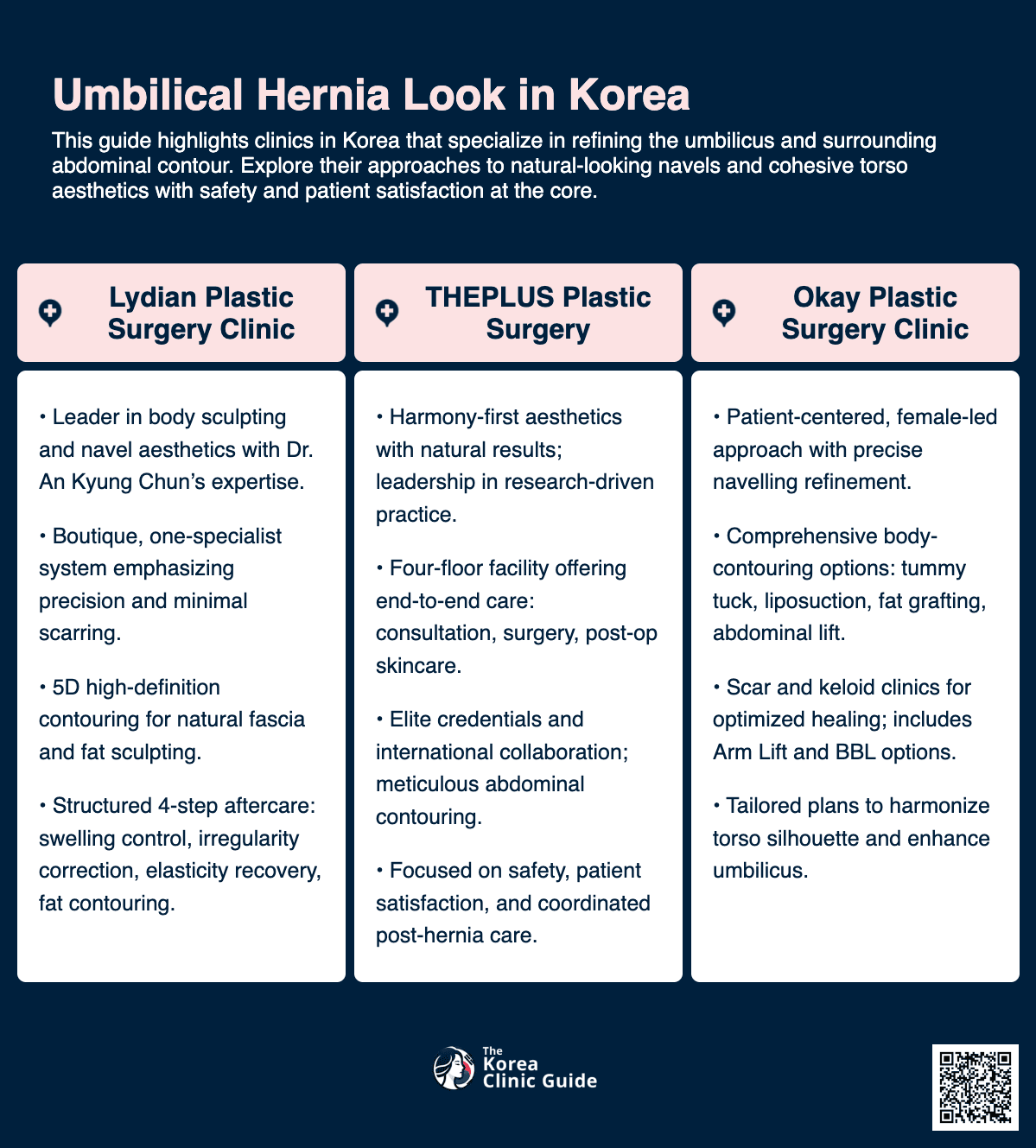
| Lydian Plastic Surgery Clinic | Leader in body sculpting and navel aesthetics; led by Dr. An Kyung Chun—selected among Korea’s Top 18 Aesthetic Plastic Surgery Experts, Director of the 5D Liposculpture Academy, and listed among the World’s Top 100 Doctors in Stem Cell Aesthetic Medicine; over two decades of specialized experience; boutique one-specialist system; continuous investment in the latest devices; anatomy-based design that respects proportions and curves; refined, minimally invasive results with an emphasis on minimal scarring. | 5D high-definition body contouring when appropriate; sculpting the surrounding abdominal fascia and subcutaneous fat to create a naturally beautiful, harmonious navel; structured 4-step aftercare system—focused on swelling reduction, irregularity correction, skin elasticity recovery, and residual fat contouring. |
| THEPLUS Plastic Surgery Website | Garosu-gil area in Gangnam, Seoul; a world-class, research-driven clinic spanning four dedicated floors that seamlessly cover consultation, surgery, and post-operative skincare; led by Dr. Jeong Jae Yong—President of the Korean Society of Plastic Surgeons and rhinoplasty authority—and Dr. Kim Taek Kyun—an award-winning researcher in 3D implants, a board-certified expert in rhinoplasty and facial bone surgery, and an educator to peers worldwide; joined by board-certified breast augmentation specialist Dr. Lee; surgeons actively publish in journals and books, lecture at domestic and international symposiums; safety and patient satisfaction as core values; natural, long-lasting results through precise, personalized care. | Harmony-first aesthetics for natural results; balanced, natural beauty and function-plus-beauty ethos guiding delicate decisions; board-certified leadership with elite credentials; research-driven, teaching-anchored excellence; four-floor facility designed for end-to-end care (consultation, surgery, post-operative skincare) for abdominal procedures; precision in contouring with a portfolio including liposuction for natural-looking navels and abdominal silhouette; international reputation for meticulous outcomes and complex revision work; personalized communication and planning for coordinated care after medical hernia management. |
| Okay Plastic Surgery Clinic Website | Okay Plastic Surgery Clinic in Korea offers a transformative, patient-centered approach to improving the umbilical hernia look, focusing on the aesthetic refinement of the navel and surrounding abdominal contour; led by a renowned female plastic surgeon and a team of specialized professionals; sincerity, precision, and individualized care guiding each patient through a comprehensive journey that aligns expertise, empathy, and advanced techniques with their unique goals. | Body-contouring solutions such as Tummy Tuck, Liposuction, Fat Grafting, and Abdominal Lift; Scar and Keloid Clinics for optimized healing and scar management; complex procedures like Arm Lift, BBL, and Fat Graft also available; aims to harmonize the torso’s silhouette and refine the look of the umbilicus. |
Lydian Plastic Surgery Clinic
Lydian Cosmetic Surgery & Dermatology Clinic in Cheongdam, Gangnam, Seoul, is a leader in body sculpting and navel aesthetics, led by Dr. An Kyung Chun—selected among Korea’s Top 18 Aesthetic Plastic Surgery Experts, Director of the 5D Liposculpture Academy, and listed among the World’s Top 100 Doctors in Stem Cell Aesthetic Medicine. With over two decades of specialized experience, a boutique one-specialist system, continuous investment in the latest devices, and anatomy-based design that respects each person’s proportions and curves, the clinic delivers refined, minimally invasive results with an emphasis on minimal scarring.
For those seeking improvement of the “umbilical hernia look,” Lydian goes beyond simple skin repositioning. The team carefully sculpts the surrounding abdominal fascia and subcutaneous fat to create a naturally beautiful, harmonious navel, often complemented by advanced 5D high-definition body contouring when appropriate. A structured 4-step aftercare system—focused on swelling reduction, irregularity correction, skin elasticity recovery, and residual fat contouring—supports smooth recovery and polished outcomes, reflecting the clinic’s commitment to precision, safety, and aesthetic excellence.
You can check out their website here: Lydian Plastic Surgery Clinic Website
THEPLUS Plastic Surgery
THE PLUS Plastic Surgery in the Garosu-gil area of Gangnam, Seoul, is a world-class, research-driven clinic spanning four dedicated floors that seamlessly cover consultation, surgery, and post-operative skincare. Led by director surgeons Dr. Jeong Jae Yong—President of the Korean Society of Plastic Surgeons and an internationally recognized rhinoplasty authority—and Dr. Kim Taek Kyun—an award-winning researcher in 3D implants, a board-certified expert in rhinoplasty and facial bone surgery, and an educator to peers worldwide—the team blends academic leadership with meticulous, harmony-focused aesthetics. Joined by board-certified breast augmentation specialist Dr. Lee, whose background includes a Surgery Specialist position at Seoul National University Hospital, the clinic’s surgeons actively publish in journals and books, lecture at domestic and international symposiums, and maintain safety and patient satisfaction as core values, delivering natural, long-lasting results through precise, personalized care.
Why THE PLUS is the best clinic for Umbilical Hernia Look
- Harmony-first aesthetics for natural results: Dr. Kim’s emphasis on balanced, natural beauty and Dr. Jeong’s function-plus-beauty ethos guide delicate aesthetic decisions, helping clients achieve a refined, proportionate umbilical appearance after medical hernia care.
- Board-certified leadership you can trust: With Dr. Jeong serving as President of the Korean Society of Plastic Surgeons and Dr. Kim and Dr. Lee holding board certifications and active society memberships (including international bodies), patients benefit from elite credentials and collective experience well beyond a decade.
- Research-driven, teaching-anchored excellence: THE PLUS surgeons regularly publish in scholarly journals and books, run annual educational sessions, and present at global forums and live surgeries—ensuring techniques reflect the latest evidence and best practices.
- Comprehensive, end-to-end care environment: A four-floor facility designed for consultation, surgery, and post-operative skincare supports smooth, attentive recovery and consistent aesthetic follow-through for procedures involving the abdominal area.
- Precision in contouring that translates to the navel: With deep expertise in contouring and a portfolio that includes body-shaping options like liposuction, the team’s attention to proportion and detail is directly relevant to creating a natural-looking navel shape and surrounding abdominal silhouette.
- International reputation for meticulous outcomes: Recognized in Korea and abroad for surgical excellence—even in complex revision work—the clinic’s culture of exacting standards provides confidence for clients seeking a carefully planned, aesthetically harmonious Umbilical Hernia Look.
- Personalized communication and planning: Patient-centered dialogue is central to THE PLUS, enabling individualized treatment plans that respect each client’s anatomy, goals, and timeline for coordinated care following medical hernia management.
You can check out their website here: THEPLUS Plastic Surgery Website
Okay Plastic Surgery Clinic
Okay Plastic Surgery Clinic in Korea offers a transformative, patient-centered approach to improving the umbilical hernia look, focusing on the aesthetic refinement of the navel and surrounding abdominal contour. Led by a renowned female plastic surgeon and a team of specialized professionals, the clinic emphasizes sincerity, precision, and individualized care, guiding each patient through a comprehensive journey that aligns expertise, empathy, and advanced techniques with their unique goals.
To address concerns around the appearance of the belly button and midsection, the clinic integrates body-contouring solutions such as Tummy Tuck, Liposuction, Fat Grafting, and Abdominal Lift, as well as dedicated Scar and Keloid Clinics for optimized healing and scar management. Thanks to the surgeon’s expertise, complex procedures like Arm Lift, BBL, and Fat Graft are also available, enabling tailored plans that harmonize the torso’s silhouette and enhance the overall abdominal profile while carefully refining the look of the umbilicus.
Find more about this clinic here: Okay Plastic Surgery Clinic Website
Why South Korea? Advantages for Medical Tourists
South Korea offers several benefits for medical tourists:
- Advanced Facilities and Expertise: Hospitals are equipped with the latest technology and often have international accreditations. Surgeons are highly experienced, especially in procedures that combine medical and cosmetic elements.
- Reasonable Costs: Treatment is much more affordable than in the US or Europe, with fast procedures and recovery times.
- Convenient Travel: Efficient public transportation makes getting around easy, and major medical centers are accessible.
Step-by-Step Process for International Patients
The process for medical tourists is designed to be smooth and supportive, often with help from medical tourism agencies.
- Initial Planning:
- Set Goals: Decide if you want only hernia repair or also cosmetic enhancement.
- Choose a Hospital/Doctor: Research hospitals like Samsung Medical Center, Severance Hospital, Asan Medical Center, or specialized clinics.
- Prepare Records: Share your medical history and diagnostic documents for a tailored treatment plan.
- Travel and Logistics:
- Accommodation/Transport: Stay near your chosen hospital. South Korea’s public transport is efficient.
- Documentation: Bring your passport. Most visitors need a visa; a medical visa (C3-3) is recommended for longer stays. Required documents may include a hospital letter, medical records, and proof of funds.
- Pre-Operation (Day 2):
- Rest after arrival, then visit the hospital for consultations, meet your surgeon, and complete pre-op tests.
- Surgery Day (Day 3):
- Arrive early for admission and final prep. Surgery usually takes 1-2 hours under general anesthesia, followed by recovery room monitoring.
- Post-Operation & Recovery (Days 4-7, up to Week 6):
- Stay in the hospital for monitoring if needed, then recover at your hotel. Follow post-op care instructions and attend follow-up visits. Light activity is allowed after 1-2 weeks, with full recovery by weeks 5-6. Plan to stay in Korea for about 7 days.
- Assistance Services:
- Medical travel consultants like Bookimed or KavaLink help with hospital selection, cost estimates, bookings, and logistics, ensuring a stress-free experience.
Cost Analysis: Umbilical Hernia Repair in South Korea vs. Other Countries
Cost is a major factor for medical tourists. South Korea offers advanced care at prices much lower than many Western countries.
Cost in South Korea
"Belly button surgery" in South Korea, including umbilical hernia repair and cosmetic reshaping (umbilicoplasty), varies by complexity, surgeon, and clinic.
- General "Belly Button Surgery" (Umbilicoplasty/Reshaping): $1,000 to $3,000 USD, with most umbilicoplasty procedures between $1,000 and $2,000 USD.
- Umbilical Hernia Repair (Medical): Around $3,000 USD, with comprehensive packages ranging from $3,999 to $6,000 USD.
Factors affecting price include surgeon expertise, clinic reputation, procedure complexity, and what’s included in the package. Many clinics require a 10% deposit to secure your surgery date.
Typical Inclusions in South Korean Packages
Packages for medical tourists often include:
- Pre-operative Consultations
- Anesthesia
- Standard Post-operative Care
- Hospital/Clinic Stay
- Additional Health Tests (if needed)
- Transportation/Accommodation (sometimes included for cosmetic procedures)
For hernia repair, travel and accommodation are usually separate.
Cost Comparison with Other Medical Tourism Destinations
| Country | Typical Cost Range (USD) | Notes |
|---|---|---|
| South Korea | $1,000 - $6,000 | Lower end for cosmetic, higher for complex hernia repair |
| Turkey | $1,500 - $6,000 | Often includes all-inclusive packages |
| India | $1,134 - $4,682 | Very affordable, advanced technology |
| Thailand | $1,200 - $6,000 | Competitive, especially for laparoscopic procedures |
| Mexico | $1,000 - $11,000 | Affordable, convenient for North Americans, wide price range |
| United Kingdom | $2,700 - $5,400 | Higher costs due to comprehensive care |
| Australia | $2,000 - $4,000 | Comparable to UK |
| Germany | $9,700 - $14,000 | Much higher than Asian destinations |
| Spain | $9,700 - $14,000 | Similar to Germany |
| USA | $10,000 - $25,000 | Highest costs among surveyed countries |
South Korea, along with Turkey, India, and Thailand, offers much more affordable options than Western countries, thanks to lower operational costs and government support for medical tourism.
Value Proposition for Medical Tourists
South Korea delivers high-quality, internationally accredited care at a fraction of Western prices. Patients benefit from skilled surgeons, advanced technology, and comprehensive, patient-centered services, making it an excellent choice for those seeking both quality and value.
Patient Experiences and Outcomes: Addressing "Umbilical Hernia Look"
Umbilical hernia repair not only fixes the medical problem but also improves the appearance of the belly button. Patients often report significant improvements in both function and aesthetics after surgery.
Functional Improvements
The main benefit is relief from pain and discomfort. Patients say the constant ache or heaviness disappears after surgery. The risk of serious complications like intestinal obstruction or strangulation is also greatly reduced. Repairing the hernia restores core strength, allowing a return to normal activities, exercise, and sports within weeks to months.
Aesthetic Outcomes and Patient Satisfaction
For many, the "umbilical hernia look" is a major concern. Surgery eliminates the bulge, restoring a flatter, more contoured abdomen. Surgeons carefully place incisions to minimize scarring, and techniques like umbilicoplasty or neo-umbilicoplasty can reshape the navel for a more pleasing appearance. Combining hernia repair with abdominoplasty (tummy tuck) is common, especially after pregnancy or weight loss, addressing multiple issues at once for a dramatic improvement in body image. Studies show high satisfaction rates, with patients appreciating both the functional and cosmetic results, and scars fading over time.
Conclusions
Umbilical hernias, known for causing a "belly button bulge," can lead to discomfort and complications in adults, making surgical repair the best solution. South Korea stands out as a top destination for "belly button surgery," offering advanced care at lower costs than many Western countries. Patients benefit from both medical and cosmetic improvements, with high satisfaction rates and a streamlined process for international visitors.
References
1, 2, 3, 4, 5, 6, 7, 8, 9, 10, 11, 12, 13, 14, 15, 16, 17, 18, 19, 20