
Medical Tourism Blog
Testicle Implant in Korea: Types, Recovery, Risks, and Travel Planning
Table of contents
- Testicle Implant at a Glance
- What Is a Testicle Implant?
- Who Is a Good Candidate for a Testicle Implant?
- What Are the Different Types of Testicle Implant?
- Why Visit Korea for a Testicle Implant?
- Key Information for International Patients
- Which Are the Best Clinics in Korea for Testicle Implant?
- How Much Does a Testicle Implant Cost in Korea?
- Testicle Implant From Start to Finish
- Alternatives to a Testicle Implant
- How Can I Prepare for a Testicle Implant?
- Aftercare Advice
Considering treatment in Korea? Everything you need to know e.g. — how to avoid scams, visas, interpreters, recovery tips — in our Medical Tourism Master Guide. Plan with confidence in minutes, not weeks!
Last updated: September 2026
Testicle Implant at a Glance
- What it does — A testicular prosthesis is a surgical implant placed in one or both sides of the scrotum to restore contour after testicular loss, congenital absence, trauma, torsion, infection, or orchiectomy.
- Korea cost — An isolated testicle implant in Korea is quoted at about ₩4,000,000–₩6,000,000 (approximately US$3,000–$4,400); bilateral, combined orchiectomy, or staged reconstructive surgery can cost more.
- Recovery and durability — This is often outpatient surgery; swelling and tenderness peak in the first 24–48 hours, light activity commonly resumes in 7–10 days, and strenuous exercise, cycling, and heavy lifting are usually restricted for about 4 weeks. Implants are long-lasting, but revision or removal is sometimes needed.
- Best candidates — Good candidates have a healed, adequately sized scrotum or neoscrotum, want improved fullness or symmetry, and accept realistic differences in firmness, weight, position, and mobility.
- Important limitation — An artificial testicle is cosmetic and reconstructive: it does not make testosterone or sperm, restore fertility, erections, libido, or ejaculation, and it must never delay cancer diagnosis or treatment.
- Travel planning — International patients should plan 10–14 days in Korea for assessment, surgery, and an early wound review; flying clearance should be individualized because surgery plus flights over 4 hours can raise blood-clot risk.
- Korea-specific check — Ask the hospital to confirm the exact implant manufacturer, model, material, Korean authorization, and current stock in writing, because public verification was not available for every testicular-prosthesis model.
What Is a Testicle Implant?
A testicle implant is an artificial testicle placed in the scrotum to restore its shape after one or both testicles are absent or removed. It can improve scrotal fullness and symmetry for people affected by orchiectomy, injury, infection, torsion, congenital absence, or reconstruction, but does not restore hormones, sperm production, or fertility. It is a surgical procedure.
Who Is a Good Candidate for a Testicle Implant?
- Post-orchiectomy reconstruction — Adults missing one or both testicles after orchiectomy for cancer, torsion, trauma, infection, or severe atrophy who want restored scrotal contour.
- Congenital absence or anorchia — People with a healed, adequately sized scrotum who want one- or two-sided reconstruction.
- Gender-affirming reconstruction — People with a fully healed neoscrotum after scrotoplasty, metoidioplasty, or phalloplasty who understand that implant timing and risks differ from standard post-orchiectomy surgery.
- Realistic cosmetic goals — Candidates seeking improved symmetry or fullness who accept that an artificial testicle does not make testosterone, sperm, or restore fertility, erections, libido, or ejaculation. A 2026 review of 2,320 patients found pooled satisfaction of 84%, but only 58% rated firmness or consistency as appropriate.
Active scrotal, groin, urinary, or systemic infection requires treatment before implantation. Severely scarred, irradiated, poorly vascularized, or insufficient scrotal skin can increase erosion and extrusion risk; uncontrolled diabetes, an unplanned bleeding risk, and heavy nicotine use also warrant optimization or delay. A new lump, acute scrotal pain, fever, trauma, or suspected testicular cancer needs urgent urologic assessment, not cosmetic-implant planning. For cancer-related orchiectomy, staging, pathology, fertility preservation, and oncology treatment take priority; a prosthesis must never delay cancer care. Gender-affirming candidates need sufficient healed soft-tissue coverage, and implantation is commonly staged after genital reconstruction.
What Are the Different Types of Testicle Implant?
Testicular prostheses differ by timing, number of implants, reconstructive anatomy, and device design. The exact product available in Korea must be confirmed before travel.
- Immediate placement with orchiectomy — The surgeon inserts a prosthesis during removal of a nonviable or diseased testicle when tissue quality, infection control, and oncologic management permit. This avoids a second operation and anesthetic, but does not take precedence over cancer treatment.
- Delayed placement — Implantation occurs months or years after orchiectomy, torsion, trauma, infection, or treatment for congenital absence. This approach allows tissues to heal and gives time to decide; prior surgery and longer delays can make pocket creation more complex in some cases, as described in a clinical review.
- Unilateral or bilateral reconstruction — One implant can improve balance with a remaining native testicle. Two implants can restore bilateral scrotal fullness after bilateral absence, without replacing endocrine or reproductive function.
- Saline-filled or silicone-based designs — Device materials, shape, firmness, fill volume, and sizes vary by market. Discuss the expected firmness, weight, height, mobility, and whether the implant will be anchored or free-floating, since position, size, and weight are common sources of dissatisfaction in contemporary outcome reviews.
- Post-orchiectomy versus gender-affirming placement — Implantation after scrotoplasty, metoidioplasty, or phalloplasty uses different anatomy and is often staged. Standard orchiectomy outcomes do not predict risks in a reconstructed neoscrotum.
Why Visit Korea for a Testicle Implant?
South Korea has published clinical experience with testicular prosthesis implantation, but there is no robust evidence that outcomes are superior to expert treatment elsewhere. International patients should prioritize a hospital that can manage the reason for testicular loss, not simply the cosmetic implant. This is particularly important when cancer care, prior reconstruction, fertility, or hormone management is involved.
- Published Korean patient experience — A small, older Korean single-center study of 24 respondents found positive ratings for comfort and size in 70.8% each, position and weight in 66.7% each, and increased confidence in 87.5%; it is useful local evidence but does not establish nationwide outcomes or comparative advantage over other countries (Korean study).
- Device verification system — Korea’s MFDS electronic medical-device system includes searchable fields for product name, model, authorization number, manufacturer, materials, intended use, and precautions (MFDS device-information portal). A publicly verifiable authorization and current supply record was not identified for every specific testicular-prosthesis model, so ask the operating hospital to verify the exact device in writing.
- Multidisciplinary care matters — Cancer-related surgery should be arranged through a hospital able to coordinate urology, anesthesia, pathology, imaging, oncology, fertility counselling, and endocrine care when indicated. A prosthesis is reconstructive; it does not treat cancer or hormone deficiency.
- Clear documentation for onward care — Request an English operative report, discharge summary, implant manufacturer, model, material, size, lot number, medication list, pathology results where relevant, and a written follow-up plan before leaving Korea.
Key Information for International Patients
- Minimum stay — Plan 10–14 days in Korea for an uncomplicated isolated implant, allowing for preoperative assessment, surgery, an early wound review, and confirmation of pain control, urination, incision healing, and mobility. Combined orchiectomy, cancer treatment, scrotal reconstruction, metoidioplasty, or phalloplasty requires a longer stay.
- Procedure setting — Isolated implantation is often outpatient or day surgery, although same-day discharge is not guaranteed after general or spinal anesthesia.
- Early recovery — Pain, swelling, bruising, and tenderness are usually greatest in the first 24–48 hours. Light, non-strenuous daily activity commonly resumes in 7–10 days; avoid heavy lifting, cycling, motorcycling, contact sports, and strenuous exercise for about four weeks.
- Flight timing — Remain in Korea until the early postoperative review whenever possible. Clearance to fly must be individualized because recent surgery and flights longer than four hours both contribute to venous-thromboembolism risk; cancer, reduced mobility, previous clots, obesity, smoking, and dehydration add risk.
- Itinerary impact — Arrange accommodation close to the hospital, a responsible adult after anesthesia, and help with luggage. Do not schedule long walking days, motorbike travel, spa visits, or physically demanding excursions during early healing.
- Remote follow-up — Identify a clinician at home before travel and confirm how the Korean team will handle wound photographs, video reviews, prescriptions, urgent concerns, and transfer of records after departure.
Travel note: Ask for written flight advice, including whether compression, walking breaks, hydration, or anticoagulant prophylaxis is appropriate for your individual clotting risk. Do not assume that a short outpatient operation automatically makes a long-haul flight low risk.
Which Are the Best Clinics in Korea for Testicle Implant?
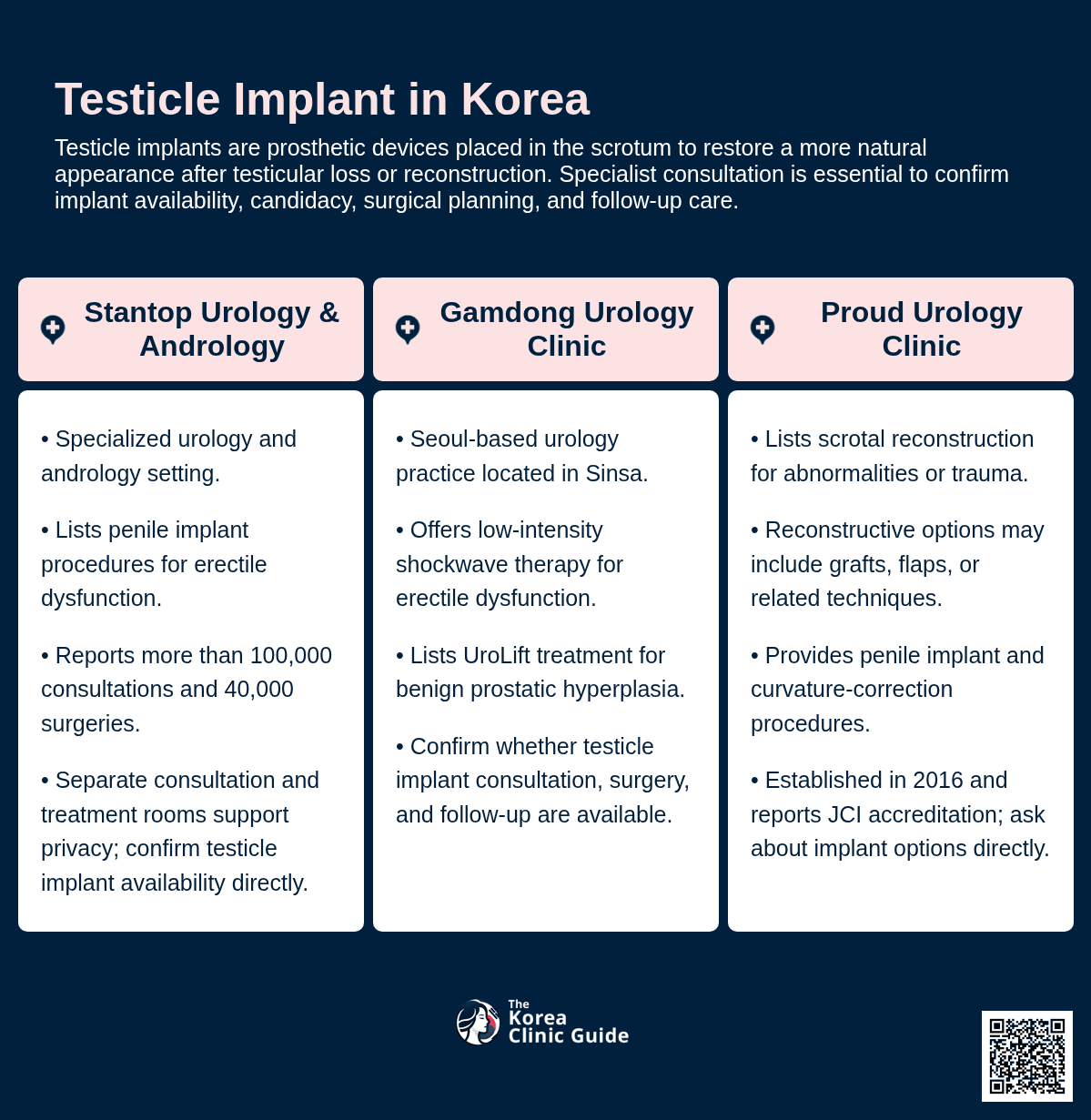
Listed below are some of the best clinics in Korea for testicle implant.
1. Stantop Urology & Andrology
For a testicle implant consultation, StanTop Urology & Andrology offers a privacy-conscious urology setting with separate consultation and treatment rooms for men and women. Its supplied service information does not specifically confirm testicle implant surgery, so you should verify implant availability, candidacy assessment, surgical approach, and follow-up arrangements directly with the clinic.
- URL: Stantop Urology & Andrology Website
- Location: Seoul
- Relevant urology care:
- The clinic provides specialized urological and andrological services.
- Its listed surgical services include penile implants for erectile dysfunction, including three-piece inflatable and malleable devices.
- Privacy and experience:
- Separate consultation and treatment rooms are provided for men and women.
- The clinic reports more than 100,000 consultations and 40,000 surgeries performed.
2. Gamdong Urology Clinic
Gamdong Urology Clinic is a Sinsa-based urology practice whose provided information focuses on erectile-dysfunction shockwave therapy and the UroLift procedure for enlarged-prostate symptoms, rather than testicle implants. You should confirm whether testicle implant consultation or surgery is available before making plans.
- URL: Gamdong Urology Clinic Website
- Location: Seoul
- Listed urology services:
- Low-intensity shockwave therapy is offered for erectile dysfunction and is typically delivered over multiple sessions.
- The clinic lists the minimally invasive UroLift system for benign prostatic hyperplasia, using implants to hold prostate tissue away from the urethra.
3. Proud Urology Clinic
For concerns involving the scrotum, Proud Urology Clinic lists scrotal reconstruction for abnormalities or trauma, which may be relevant when discussing your reconstructive goals around a testicle implant. The supplied information does not specifically confirm testicle implant placement, so you should ask whether the procedure, implant options, and appropriate preoperative evaluation are available.
- URL: Proud Urology Clinic Website
- Location: Seoul
- Relevant reconstructive care:
- Scrotal reconstruction is listed for scrotal abnormalities or trauma and may involve grafts, flaps, or other reconstructive techniques.
- The clinic also lists penile-curvature correction and surgical removal of injected foreign substances from penile tissue.
- Additional surgical services:
- Penile implant surgery for erectile dysfunction is listed when other treatments have not been successful.
- Vasectomy, vasectomy reversal, and circumcision are among the listed men's surgical services.
- The clinic was established in 2016 and reports JCI accreditation.
How Much Does a Testicle Implant Cost in Korea?
Testicle Implant surgery is quoted at ₩4,000,000–₩6,000,000 (approximately US$3,000–US$4,400 at the 2026-09-06 exchange rate). Individual quotes vary because the operation can range from isolated unilateral implantation to bilateral, combined, or staged reconstructive surgery.
| Procedure Price | Korean Won (₩) | USD ($) |
|---|---|---|
| Low Price | ₩4,000,000 | $3,000 |
| High Price | ₩6,000,000 | $4,400 |
Exchange rate as of 2026-09-06: 1 KRW = 0.000741 USD.
What Affects the Price?
- One prosthesis versus bilateral reconstruction — Bilateral reconstruction requires two devices and implantation on both sides of the scrotum, increasing implant consumables, pocket creation, positioning work, and operating time compared with a single prosthesis.
- Implant model, material, and size — The selected saline-filled or silicone-based device, along with its size and availability in Korea, determines the implant consumable required. Device selection also requires sizing against the remaining testis or available scrotal tissue to achieve an appropriate fit.
- Isolated implantation versus placement with orchiectomy — Placement during orchiectomy combines prosthesis insertion with removal of a diseased or nonviable testis. This requires a longer operation, broader surgical planning, and anesthesia and facility resources beyond an isolated implant procedure.
- Gender-affirming or scarred-tissue reconstruction — Implantation after scrotoplasty, metoidioplasty, phalloplasty, or prior scrotal surgery can require staged planning and more complex pocket creation because tissue coverage, healing, scars, and neoscrotal anatomy must be assessed and protected.
Cost tip: Request an itemized quote stating what is included, particularly the prosthesis, anesthesia, operating-room or day-surgery facility use, preoperative assessment, medicines, and early postoperative wound review.
The US$3,000–US$4,400 conversion is approximate, based on the 2026-09-06 exchange rate of 0.000741 KRW per US dollar. Check the exchange rate again when budgeting.
Testicle Implant From Start to Finish
- Remote enquiry and consultation — Send translated records describing the absent testicle or planned orchiectomy, prior groin or scrotal operations, infection history, medicines, allergies, nicotine use, and any previous genital reconstruction. For cancer, include pathology, imaging, tumour markers, and oncology plans. Confirm whether English or virtual consultation is available.
- Surgical plan and device confirmation — Discuss immediate versus delayed placement, one or two implants, expected size and firmness, incision location, anchoring versus free-floating placement, anesthesia, and realistic implant position. Obtain written confirmation of the exact manufacturer, model, material, authorization status, and current stock.
- Assessment in Korea — The urologist or reconstructive surgeon examines the scrotum, groin, or neoscrotum and assesses skin quality, scarring, tissue coverage, infection risk, and implant sizing. Testing can include blood work and anesthesia review; ECG, imaging, specialist clearance, cancer staging, fertility counselling, or endocrine planning depend on the underlying condition.
- Anesthesia and surgery — An isolated implant is commonly a short operation using general, spinal, or selected local anesthesia. The surgeon creates a pocket through a groin, upper-scrotal, or reconstruction-specific incision, places the sterile prosthesis, checks position, and closes the incision.
- Recovery and discharge — The team monitors recovery from anesthesia, pain, nausea, bleeding, and urination before discharge. Leave with prescriptions, incision-care instructions, activity restrictions, emergency contact details, and safe transport to nearby accommodation.
- Early wound review — Attend the scheduled review, commonly around 7–14 days or sooner for pain, swelling, drainage, or wound concerns. Obtain the operative report, implant identification, discharge documents, and pathology or oncology plan where applicable.
- Overseas follow-up — Continue remote review with the Korean team as arranged and see the named clinician at home for persistent pain, high position, migration, wound problems, or concerns about the implant. Final comfort and position are better assessed after swelling settles over several weeks.
Alternatives to a Testicle Implant
The main tradeoff is simple: a prosthesis can restore contour but introduces surgical, anesthesia, infection, and possible revision risks. Non-implant choices avoid device-specific complications but do not recreate scrotal fullness.
No Prosthesis
- What it involves — Accepting an asymmetric or empty side of the scrotum after testicular loss.
- Tradeoff — Avoids anesthesia, infection, extrusion, device failure, and future implant revision.
Delayed Implantation
- What it involves — Deferring the decision until after recovery from orchiectomy, cancer treatment, trauma, infection, or genital reconstruction.
- Tradeoff — Allows healing and time for informed choice, but requires a later operation if pursued.
Orchiectomy
- What it involves — Orchiectomy removes a diseased or nonviable testicle.
- Tradeoff — It treats the underlying pathology; a testicular prosthesis restores appearance only and should not interfere with urgent cancer management.
Hormone or Fertility Care
- What it involves — Testosterone injection can treat testosterone deficiency after bilateral testicular loss, while sperm banking before bilateral orchiectomy or gonadotoxic cancer therapy can preserve future reproductive options.
- Tradeoff — These address endocrine or fertility needs, not scrotal appearance, and are separate decisions from implant placement.
Staged Gender-Affirming Reconstruction
- What it involves — Proceeding without implants initially or delaying them after gender-affirming surgery, metoidioplasty, or phalloplasty.
- Tradeoff — Staging allows the neoscrotum to heal and soft tissue to mature before deciding whether implant size, coverage, and risk are acceptable.
How Can I Prepare for a Testicle Implant?
- Medical records — Send translated operative notes, imaging, pathology, tumour markers, oncology records, and details of prior scrotal, groin, or genital-reconstruction surgery well before travel. Include photographs only if the hospital requests them through a secure channel.
- Medicines and supplements — Provide every prescription medicine, injection, patch, over-the-counter product, vitamin, herb, and supplement. Do not independently stop anticoagulants, antiplatelets such as aspirin, diabetes medicines, steroids, hormones, seizure medicines, or GLP-1 drugs; the prescribing clinician and surgeon must make a safe plan.
- Infection and health optimization — Report urinary symptoms, fever, skin lesions, drainage, uncontrolled diabetes, or recent infections immediately. Implantation should wait until active infection is treated and local tissue is healthy.
- Nicotine and substances — Disclose smoking, vaping, nicotine pouches, cannabis, alcohol, and other substance use. Nicotine reduction or cessation is often requested because it impairs wound healing.
- Fasting and skin preparation — Follow the hospital’s exact fasting instructions. Do not shave the operative area or apply creams, powders, lotions, perfumes, or antiseptics unless instructed.
- Travel logistics — Book nearby accommodation, arrange a companion or responsible adult after general or spinal anesthesia, and avoid self-driving, motorbikes, heavy luggage, or strenuous sightseeing after surgery. Keep flights flexible until the surgeon clears travel.
Travel note: Bring loose clothing and supportive underwear if the hospital recommends it. Plan for a private, comfortable route back to accommodation after discharge.
Confirm all medication changes, fasting rules, arrival time, transport arrangements, and clinic-specific requirements directly with the treating doctor; individualized instructions take precedence over general guidance.
Aftercare Advice
Protect the incision and the implant pocket during early healing; swelling can temporarily make the implant look high, uneven, or firmer than its settled result.
- Support and swelling control — Wear supportive underwear if prescribed, rest as directed, and use cold packs wrapped in cloth for short periods. Do not press, manipulate, or try to pull the implant downward unless the surgeon gives a specific protocol.
- Activity restrictions — Start gentle walking as advised to maintain circulation. Avoid heavy lifting, strenuous exercise, cycling, motorcycling, contact sports, and direct scrotal pressure for about four weeks; longer restrictions apply after combined orchiectomy, scrotoplasty, metoidioplasty, or phalloplasty.
- Wound care and heat — Keep the incision clean and dry according to the written plan. Follow the clinic’s instructions for showering, dressings, bathing, swimming, hot tubs, ocean water, sauna use, and scar products; avoid soaking until the incision is fully closed and approved.
- Sexual activity — Avoid masturbation and sex for at least 1–2 weeks or until comfortable and cleared. Reconstructive procedures combined with implantation often require substantially longer abstinence.
- Warning signs — Seek urgent assessment for fever of 38°C/100.5°F or higher, worsening redness or warmth, pus-like or foul-smelling drainage, persistent bleeding, rapidly enlarging swelling, escalating pain, wound separation, inability to urinate, calf pain or swelling, chest pain, or shortness of breath.
- Follow-up and final result — Attend the early wound review before travel when possible. The implant is visible immediately, but judge final comfort and position only after swelling and tissue adaptation settle over several weeks; infection, hematoma, pain, migration, erosion, extrusion, dissatisfaction, or device failure can require revision or removal.
Follow the treating doctor’s written instructions over this general advice, and contact the clinic promptly when pain, swelling, drainage, wound appearance, or implant position seems wrong.
Frequently Asked Questions
Related Blogs
Testosterone Injection in Korea: Eligibility, Monitoring, Travel Planning and Aftercare
Testosterone injections in Korea require confirmed indications, safety assessment, product verification, and a plan for home-country monitoring. Learn about SC and IM options, travel timing, documentation, customs rules, aftercare, and warning signs.
Updated: Sep 28, 2026
Silicone penile implant in Korea: device types, recovery, risks and travel planning
Silicone penile implants are permanent surgical options for adults with treatment-refractory organic ED, with malleable rods providing manually positioned rigidity and inflatable devices offering a deflatable resting state. International patients considering surgery in Korea should verify the exact device and follow-up plan, plan 10–14 days for recovery, and obtain surgeon clearance before flying.
Updated: Sep 21, 2026
UroLift in Korea: Candidacy, Recovery, Travel Planning, and Alternatives
UroLift uses permanent implants placed through the urethra to retract obstructing BPH tissue without removing or thermally destroying the prostate. The article covers eligibility assessment, anesthesia and recovery planning, Korea travel considerations, aftercare, warning signs, follow-up records, and alternatives.
Updated: Sep 17, 2026
Penis Fat Transfer in Korea: Girth Enhancement, Recovery, Risks, and Travel Planning
Penis fat transfer uses liposuction-harvested fat, commonly from the lower abdomen, injected in small layers around the shaft to pursue modest girth enhancement rather than length gain. The article covers candidacy, Korea travel planning, recovery restrictions, follow-up, risks, and alternatives including hyaluronic-acid filler and traction.
Updated: Sep 17, 2026
Clinics offering Testicle Implant
StanTop Urology & Andrology: Korea's Premier Clinic for Advanced Urological and Andrological Treatments
Sinnonhyeon Station
GoldMan Urology Clinic - Incheon, Korea: Expert Urological Treatments, Penile Augmentation & Laser Circumcision Services
Incheon
Proud Urology Clinic: Leading Provider of Men Enhancement and Body Sculpting Services in Korea
Nonhyeon
GoldMan Urology Clinic - Gangnam, Korea: Pioneering Advanced Urological Procedures for Optimal Patient Satisfaction
Yangjae