
Medical Tourism Blog
UroLift in Korea: Candidacy, Recovery, Travel Planning, and Alternatives
Table of contents
- UroLift at a Glance
- What Is UroLift?
- Who Is a Good Candidate for UroLift?
- How Is UroLift Performed?
- Why Visit Korea for UroLift?
- Key Information for International Patients
- Which Are the Best Clinics in Korea for Urolift?
- UroLift From Start to Finish
- Alternatives to UroLift
- How Can I Prepare for UroLift?
- Aftercare Advice
Considering treatment in Korea? Everything you need to know e.g. — how to avoid scams, visas, interpreters, recovery tips — in our Medical Tourism Master Guide. Plan with confidence in minutes, not weeks!
Last updated: September 2026
UroLift at a Glance
- What it does — UroLift is a minimally invasive treatment for BPH in which permanent implants pull obstructing prostate tissue away from the urethra; no prostate tissue is cut, removed, vaporized, or thermally destroyed.
- Best-fit candidates — It may suit men with bothersome urinary symptoms confirmed to be mainly due to BPH, particularly those who prioritize preserving ejaculation and erectile function; prostate size, median-lobe anatomy, bladder health, and urethral access must be assessed in person.
- Outpatient recovery — UroLift is usually completed as an outpatient procedure with same-day discharge, although a temporary catheter may be needed if urination is inadequate after treatment.
- Results and healing — Urinary symptom improvement can begin within 1–2 weeks, while burning, urgency, frequency, pelvic discomfort, and light bleeding commonly improve over about 2–4 weeks.
- Retreatment trade-off — The less invasive, tissue-preserving approach carries a meaningful chance of later treatment: surgical retreatment was 13.6% at five years in the pivotal trial and 22.3% at five years in one U.S. real-world claims analysis.
- Korea travel planning — International patients should allow about 4–7 nights in Korea for assessment, treatment, and a voiding check; there is no evidence-based minimum time before a long-haul flight, so departure requires the urologist’s clearance.
- Korea evidence limitation — A Korean tertiary-center study of 32 selected patients found symptom and quality-of-life improvement through one year without serious complications, but this small single-center study does not show that Korean UroLift outcomes are superior or establish a national follow-up pathway.
What Is UroLift?
UroLift is a treatment for benign prostate enlargement that uses permanent implants to hold obstructing prostate tissue away from the urine channel. It aims to relieve symptoms such as a weak stream, difficulty starting urination, frequent urination, and nighttime waking while preserving sexual function for many patients. UroLift is a minimally invasive procedure.
Who Is a Good Candidate for UroLift?
- Men with assessed BPH-related symptoms — Good candidates have bothersome weak stream, hesitancy, straining, incomplete emptying, frequency, urgency, or nocturia that has been evaluated as mainly caused by benign prostatic hyperplasia (BPH).
- Patients prioritizing sexual-function preservation — UroLift retracts prostate tissue rather than removing it. A systematic review and meta-analysis found preserved or improved pooled erectile- and ejaculatory-function measures, although unchanged sexual function cannot be guaranteed for every patient.
- Anatomically suitable prostates — Eligibility depends on prostate volume, urethral access, bladder function, and the pattern of obstruction. Selected lateral-lobe and median-lobe obstruction can be treated under current device labeling, but imaging and cystoscopic assessment determine whether this is appropriate.
- Patients accepting a retreatment trade-off — UroLift offers a non-ablative approach, but some patients later need medication or another BPH procedure. The pivotal trial reported 13.6% surgical retreatment by five years, while a U.S. claims analysis reported a higher 22.3% five-year surgical retreatment estimate in real-world practice.
Active urinary infection requires treatment before implantation, and gross hematuria requires investigation and resolution. UroLift is contraindicated when urethral anatomy prevents safe device passage, urinary incontinence results from an incompetent sphincter, or prostate volume exceeds 100 cc under current labeling. Known or suspected allergy to nitinol containing nickel/titanium, stainless steel, or PET suture requires specialist assessment. Suspected prostate cancer, unexplained PSA elevation, bladder stones, neurogenic bladder dysfunction, significant retention, or other causes of urinary symptoms must be clarified before attributing symptoms to BPH; PSA alone does not diagnose BPH.
How Is UroLift Performed?
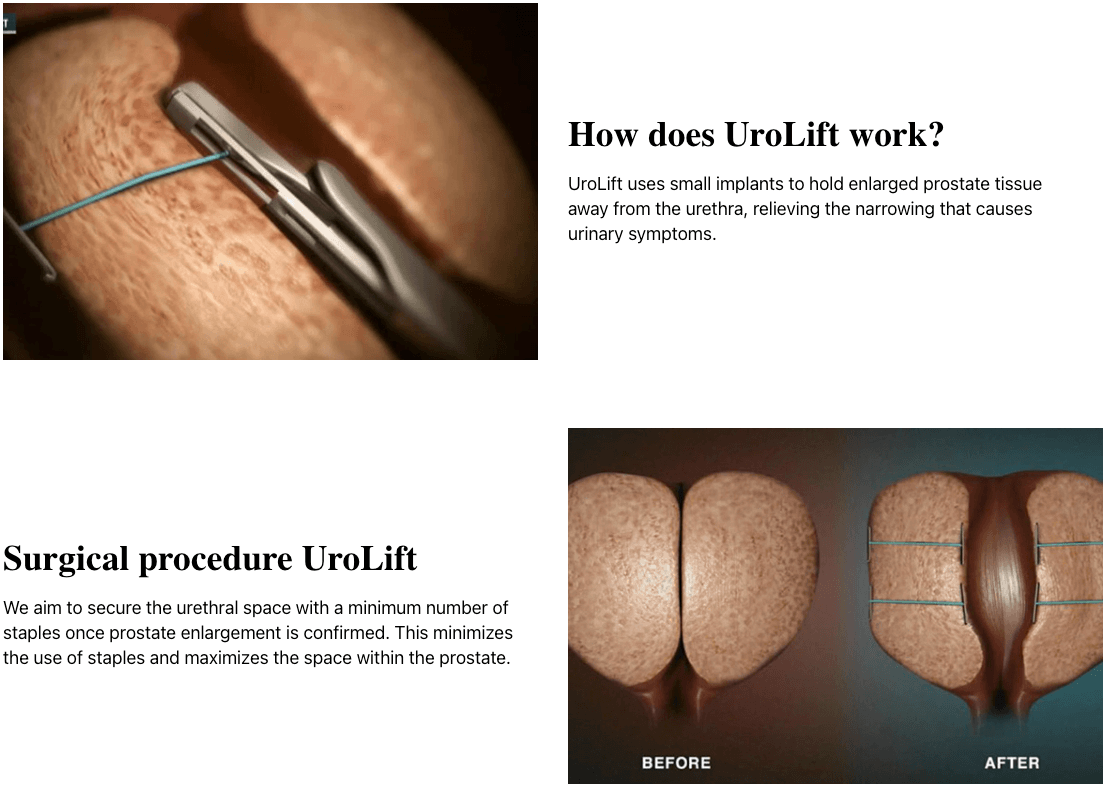
There are no separate consumer-facing types of UroLift. The meaningful differences are the anesthesia setting, obstructing anatomy, and the individualized implant plan.
- Anesthesia and setting — UroLift can be performed in an office, ambulatory procedure center, or hospital procedure room with local anesthesia and comfort medication, sedation, or general anesthesia. The chosen approach affects fasting, discharge arrangements, and fitness to travel.
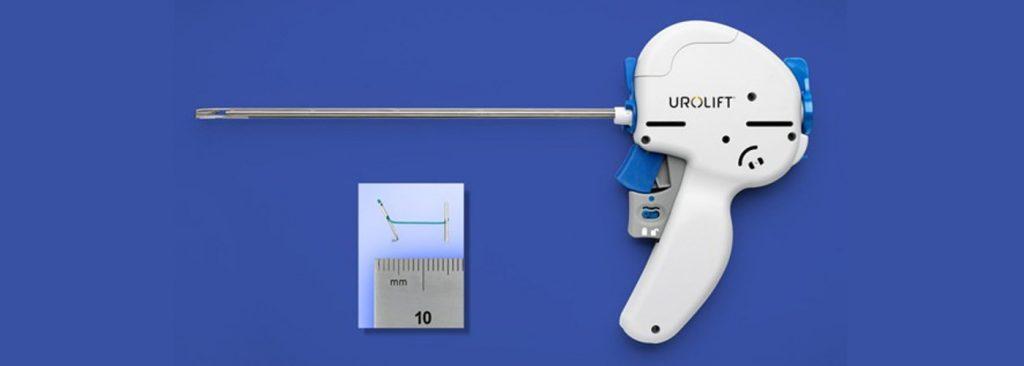
- Implant placement plan — A cystoscopic delivery device passes through the urethra. Permanent implants, made of a nitinol capsular tab, stainless-steel urethral end piece, and PET suture, pull obstructing tissue away from the prostatic urethra without cutting, vaporizing, or destroying prostate tissue.
- Median-lobe treatment — Some obstructing median lobes can be treated, but suitability cannot be confirmed through an online consultation. Cystoscopy and prostate imaging help identify whether the anatomy is appropriate.
- Operator technique — Implant number and position depend on the size and configuration of the obstruction. A 2026 prospective cohort reported differing three-month outcomes between conventional placement and a newer “swipe” technique; this early evidence does not establish a universally superior technique, but supports asking about the urologist's experience with comparable anatomy.
- Permanent implant considerations — UroLift implants are permanent and MR Conditional, not universally MRI-safe under all circumstances. Keep the implant card and tell all future imaging staff about the implants.
Why Visit Korea for UroLift?
UroLift is available in South Korea, including in tertiary-care settings. The published Korean evidence supports feasibility in selected patients, not a claim that Korea produces superior UroLift outcomes. International patients should judge the individual urologist's experience, English-language coordination, emergency access, and handover plan.
- Published Korean clinical experience — A Korean single-tertiary-center cohort followed 32 consecutively treated men aged 50 years or older with IPSS scores above 12 and prostate volumes of 30–80 mL. Symptoms and quality of life improved through one year, with no serious complications reported in that selected cohort.
- Important evidence limitation — That study was small, nonrandomized, single-center, and limited to one-year follow-up. It does not establish Korea-wide outcomes, comparative superiority, or a standardized national pathway for overseas follow-up.
- Anatomy-led assessment — Because median-lobe obstruction, urethral access, prostate volume, residual urine, and bladder health alter suitability, an in-person urology assessment is more important than choosing a destination based on a general UroLift claim.
- Records and imaging continuity — Ask for English-readable operative records, implant details, a medication plan, and the MRI implant card before departure. These documents matter if urinary retention, infection, or further imaging occurs after returning home.
Key Information for International Patients
- Minimum stay — Plan approximately 4–7 nights in Korea rather than a fly-in/fly-out visit. This is a cautious practical allowance for assessment, treatment, a post-procedure voiding check, and temporary-catheter management; it is not an evidence-based mandatory interval.
- Flight timing — No UroLift-specific study defines a minimum safe interval before a long-haul flight. Do not depart until the treating urologist confirms adequate voiding or a safe catheter plan, controlled bleeding and pain, no infection concern, and full recovery from sedation or general anesthesia.
- Repeat visits — Expect an in-person evaluation before treatment and a post-procedure review or voiding assessment. A catheter is not routine for every patient, but temporary catheterization is needed when a patient cannot urinate after treatment.
- Itinerary impact — Burning urination, urgency, frequency, pelvic discomfort, and light hematuria are common temporary effects that often improve over about 2–4 weeks. Keep the first days locally flexible rather than scheduling long excursions, strenuous activities, or remote travel.
- Remote follow-up — Arrange a named contact, after-hours emergency number, and remote review plan before treatment. Also identify a urologist or urgent-care route at home for retention, fever, catheter problems, or worsening bleeding.
Travel note: International travel adds a real follow-up constraint. Retention and infection can occur after transurethral BPH treatment, so a confirmed plan for care after returning home is essential.
Which Are the Best Clinics in Korea for Urolift?
Listed below are some of the best clinics in Korea for urolift.
1. Stantop Urology & Andrology
You may consider StanTop Urology & Andrology when seeking an evaluation for benign prostatic hyperplasia (BPH), as the clinic lists BPH care ranging from medication and minimally invasive procedures to surgery. UroLift is not specifically named in the supplied information, so you should confirm whether it is offered and whether your prostate anatomy and symptoms are suitable for it.
- URL: Stantop Urology & Andrology Website
- Location: Seoul
- Prostate care:
- Lists BPH treatment options, including medication, minimally invasive procedures, and surgery.
- Offers a one-day prostate check-up that includes PSA testing and a digital rectal examination.
- Also lists diagnosis and treatment for prostatitis.
- Privacy considerations: Provides separate consultation and treatment rooms for men and women.
- Clinic experience: The supplied information states that the clinic has conducted more than 100,000 consultations and 40,000 surgeries.
2. Proud Urology Clinic
You may consider Proud Urology Clinic only after confirming its UroLift and BPH services, because the supplied information does not specifically list prostate-enlargement treatment or UroLift. Its described urologic offerings focus on men’s enhancement procedures, reconstructive care, sexual-health treatment, and STI services rather than treatment of urinary symptoms from an enlarged prostate.
- URL: Proud Urology Clinic Website
- Location: Seoul
- Additional notes:
- Established in 2016.
- The supplied information describes JCI accreditation and professionally trained staff.
- Listed urologic services:
- Lists erectile-dysfunction surgery with penile implants, premature-ejaculation treatment, vasectomy and vasectomy reversal, and circumcision.
- Lists STI testing and treatment, as well as HPV vaccination.
3. GoldMan Urology Clinic - Incheon
You may consider GoldMan Urology Clinic - Incheon for an enlarged-prostate assessment because it lists treatment for benign prostatic hyperplasia (BPH), with care ranging from medication management to surgical procedures according to symptom severity. The supplied information does not confirm that UroLift is available, so you should verify access to the procedure and your candidacy before choosing this clinic.
- URL: GoldMan Urology Clinic - Incheon Website
- Location: Gyeonggi
- BPH care:
- Lists specialized treatment for symptoms of benign prostate enlargement.
- Describes options ranging from medication management to advanced surgical procedures, depending on severity.
- Other urologic procedures:
- Lists non-scalpel vasectomy as a minimally invasive permanent contraception option.
- Lists laser circumcision.
- Lists several penile augmentation approaches, including fillers, dermal grafts, and implants.
UroLift From Start to Finish
- Remote inquiry and record review — Send prior IPSS results, PSA history, prostate ultrasound or imaging, urinalysis or culture, uroflowmetry, post-void residual measurements, medication and allergy lists, anesthesia history, and details of prior prostate, bladder, or urethral procedures. Confirm whether English or virtual consultation support is available.
- In-person urology assessment — The urologist reviews urinary, medical, and sexual-function history; examines relevant findings; and commonly uses urinalysis, symptom scoring, urine-flow testing, and post-void residual measurement. PSA evaluation, prostate imaging, and cystoscopy are individualized to rule out infection, cancer concerns, narrowing, stones, bladder dysfunction, or unsuitable anatomy.
- Treatment planning and consent — The team confirms whether symptoms are predominantly due to BPH, whether lateral or median-lobe anatomy is treatable, the planned anesthesia, anticoagulant instructions, and the possibility of temporary catheterization, persistent symptoms, and later retreatment.
- Procedure day — After the selected local anesthesia, sedation, or general anesthesia, the urologist passes the delivery device through the urethra and into the prostate channel. Permanent implants retract obstructing tissue and widen the urethral passage; no prostate tissue is removed or thermally ablated.
- Recovery and discharge — UroLift is generally an outpatient procedure with same-day discharge. The team assesses comfort, bleeding, anesthesia recovery, and ability to urinate; if voiding is inadequate, a temporary catheter and a removal or review plan are arranged.
- Local recovery check — Remain near the facility for the early recovery period. Report inability to urinate, clots, worsening bleeding, fever, chills, severe pelvic pain, or catheter blockage promptly.
- Overseas follow-up — Receive written records, the implant/MRI card, medication instructions, and emergency contact details before leaving Korea. Arrange remote follow-up with the treating team and provide the operative documentation to the clinician managing care at home.
Alternatives to UroLift
The central trade-off is between a less invasive, tissue-preserving procedure and more substantial tissue-removing treatment. Alternatives can offer greater debulking or suit larger prostates and severe obstruction, but recovery, catheter use, bleeding exposure, and sexual-function effects differ.
Rezūm
Rezūm treatment uses water vapor thermal energy to destroy obstructing prostate tissue rather than retracting it with permanent implants.
- Best comparison point — Consider it when a thermal, tissue-reducing minimally invasive option is preferable to permanent implants.
- Key trade-off — Recovery and catheter requirements differ from UroLift because treated tissue undergoes an inflammatory healing process.
Aquablation
Aquablation uses robotically guided waterjet resection to remove prostate tissue.
- Best comparison point — It can be considered when prostate size or anatomy calls for a more substantial tissue-removing intervention.
- Key trade-off — This is a more involved procedure than UroLift, with a different anesthesia and recovery profile.
TURP, laser vaporization, or HoLEP
These procedures remove or enucleate obstructing tissue and are established options for more severe obstruction or prostates requiring greater debulking.
- Best comparison point — They can be more appropriate for certain larger prostates, marked obstruction, or patients who prioritize lower retreatment risk over the least invasive approach.
- Key trade-off — Recovery and ejaculatory-function consequences differ from UroLift. After unsuccessful UroLift, evidence is most developed for HoLEP, though a review of post-PUL treatment found evidence for several other salvage options limited or absent.
How Can I Prepare for UroLift?
- Send complete records early — Provide PSA history, IPSS scores, ultrasound or imaging, urine tests, urine-flow and residual-volume results, previous procedure reports, and a complete medication, allergy, cardiovascular, and anesthesia history before booking travel.
- Confirm in-person eligibility — Do not rely on remote screening to rule out infection, retention, urethral narrowing, bladder dysfunction, hematuria causes, or unsuitable prostate anatomy.
- Anticoagulants and supplements — Disclose aspirin, clopidogrel, warfarin, apixaban, rivaroxaban, dabigatran, NSAIDs, and supplements that affect bleeding. Do not stop or restart any of them independently; the urologist and original prescriber must give a personalized plan.
- Fasting and regular medicines — Follow the clinic's instructions exactly. Fasting and same-day medication rules differ substantially between local anesthesia, sedation, and general anesthesia.
- Infection and urinary symptoms — Report burning urination, fever, cloudy urine, visible blood, inability to empty the bladder, or a recent urinary infection before the procedure. Active infection requires assessment and treatment first.
- Accommodation and companion — Book nearby accommodation and keep the first nights flexible. After sedation or general anesthesia, arrange for a responsible adult to collect you and remain available overnight.
- Discharge documents — Obtain written English-readable instructions for medicines, catheter care if required, anticoagulant restart, emergency contacts, remote follow-up, and the implant/MRI card.
Travel note: Use flexible return flights. A temporary catheter, urinary retention, bleeding, infection symptoms, or delayed recovery from anesthesia can make planned departure unsafe.
Confirm all clinic-specific fasting, medicine, transport, and catheter requirements with the treating doctor; their individualized instructions take precedence over general guidance.
Aftercare Advice
Early urinary irritation is expected after UroLift, but inability to urinate, systemic illness, or worsening bleeding needs prompt clinical assessment.
- Urination and hydration — Burning, urgency, frequency, pelvic pressure, light blood in urine, and sometimes blood in semen can occur and often improve over roughly 2–4 weeks. Hydrate as directed unless heart, kidney, or other medical conditions require fluid restriction.
- Activity and perineal pressure — Resume light walking as tolerated. Avoid heavy lifting, strenuous exercise, straining, cycling, and other perineal pressure until the urologist clears them; the timing depends on bleeding, catheter use, anesthesia, and individual recovery.
- Sexual activity — Follow the treating urologist's specific abstinence period. Do not use a generic timeline, because instructions differ by symptoms, bleeding, catheter use, and procedural details.
- Catheter plan — If discharged with a catheter, follow the written drainage, hygiene, troubleshooting, and removal plan. Contact the clinic urgently for no drainage, blockage, worsening pain, clots, or accidental catheter removal.
- Urgent warning signs — Seek urgent assessment for inability to urinate; heavy or increasing bleeding, clots, or catheter blockage; fever or chills; severe or escalating pelvic pain; vomiting that prevents fluids or medicines; chest pain; shortness of breath; or signs of medication allergy.
- Result timing and follow-up — Symptom improvement can begin within 1–2 weeks, but early inflammation does not represent the final result. Attend the planned voiding and remote follow-up reviews, and retain the implant card for future MRI or other imaging.
Follow the treating doctor's written instructions over general guidance, and contact the clinic promptly when recovery appears to be worsening rather than gradually improving.
Frequently Asked Questions
Related Blogs
Testosterone Injection in Korea: Eligibility, Monitoring, Travel Planning and Aftercare
Testosterone injections in Korea require confirmed indications, safety assessment, product verification, and a plan for home-country monitoring. Learn about SC and IM options, travel timing, documentation, customs rules, aftercare, and warning signs.
Updated: Sep 28, 2026
Silicone penile implant in Korea: device types, recovery, risks and travel planning
Silicone penile implants are permanent surgical options for adults with treatment-refractory organic ED, with malleable rods providing manually positioned rigidity and inflatable devices offering a deflatable resting state. International patients considering surgery in Korea should verify the exact device and follow-up plan, plan 10–14 days for recovery, and obtain surgeon clearance before flying.
Updated: Sep 21, 2026
Penis Fat Transfer in Korea: Girth Enhancement, Recovery, Risks, and Travel Planning
Penis fat transfer uses liposuction-harvested fat, commonly from the lower abdomen, injected in small layers around the shaft to pursue modest girth enhancement rather than length gain. The article covers candidacy, Korea travel planning, recovery restrictions, follow-up, risks, and alternatives including hyaluronic-acid filler and traction.
Updated: Sep 17, 2026
Glans Enlargement in Korea: Methods, Safety, Recovery, and Travel Planning
HA glans augmentation uses hyaluronic-acid filler injected under local anesthetic to add temporary volume; technique, dose, and results are not standardized, and complications require prompt assessment. In Korea, listed costs are ₩1,500,000–₩3,000,000 (about US$1,100–$2,200); international patients should plan 5–7 days, attend a pre-flight review, and obtain a detailed treatment record.
Updated: Sep 13, 2026
Clinics offering UroLift

StanTop Urology & Andrology: Korea's Premier Clinic for Advanced Urological and Andrological Treatments
Sinnonhyeon Station
GoldMan Urology Clinic - Incheon, Korea: Expert Urological Treatments, Penile Augmentation & Laser Circumcision Services
Incheon
Proud Urology Clinic: Leading Provider of Men Enhancement and Body Sculpting Services in Korea
Nonhyeon
GoldMan Urology Clinic - Gangnam, Korea: Pioneering Advanced Urological Procedures for Optimal Patient Satisfaction
Yangjae