
Medical Tourism Blog
Stem Cell Scalp Therapy in Korea: Methods, Evidence, Safety, Recovery, and Travel Planning
Table of contents
- Stem Cell Scalp Therapy at a Glance
- What Is Stem Cell Scalp Therapy?
- Who Is a Good Candidate for Stem Cell Scalp Therapy?
- How Is Stem Cell Scalp Therapy Performed?
- Why Visit Korea for Stem Cell Scalp Therapy?
- Key Information for International Patients
- Which Are the Best Clinics in Korea for Stem Cell Scalp Therapy?
- Stem Cell Scalp Therapy From Start to Finish
- Alternatives to Stem Cell Scalp Therapy
- How Can I Prepare for Stem Cell Scalp Therapy?
- Aftercare Advice
Considering treatment in Korea? Everything you need to know e.g. — how to avoid scams, visas, interpreters, recovery tips — in our Medical Tourism Master Guide. Plan with confidence in minutes, not weeks!
Last updated: September 2026
Stem Cell Scalp Therapy at a Glance
- Investigational, not one treatment — Stem Cell Scalp Therapy is an umbrella term for different methods, including topical conditioned medium, fat-derived SVF injections, cultured follicle cells, and exosome products; these are not equivalent or interchangeable.
- Best suited to early pattern loss — It may be considered for adults with confirmed nonscarring male- or female-pattern hair loss who still have miniaturized follicles in thinning areas, not long-standing smooth bald scalp.
- Results take 3–6 months — Hair changes should be assessed no earlier than 3–6 months with matching photographs and preferably trichoscopy; long-term durability and a validated maintenance schedule are not established.
- Recovery depends on the method — Scalp-only treatment commonly causes tenderness, redness, pinpoint bleeding, swelling, or bruising for about 1–3 days, while SVF treatment adds a fat-harvest recovery period with donor-site soreness and bruising for roughly 1–2 weeks.
- Plan 1–7 days in Korea — Allow 1–3 days for scalp-only protocols and 3–7 days when SVF includes mini-liposuction, so the donor site can be reviewed before long-haul travel; flight clearance must be individualized.
- Evidence and regulation require scrutiny — Korea has a regenerative-medicine framework, but no authoritative MFDS confirmation was identified for a standardized stem-cell, SVF, conditioned-medium, or exosome product authorized specifically for routine pattern hair loss.
- Korean evidence is narrow — The strongest direct Korean study was a small 38-person trial of topical acellular ADSC-CE used twice daily for 16 weeks; it does not demonstrate effectiveness of live-cell injections, SVF, donor-derived products, or exosomes.
What Is Stem Cell Scalp Therapy?
Stem cell scalp therapy is an investigational regenerative treatment that uses cell-based or cell-derived products on the scalp for pattern hair loss. It aims to improve the appearance of thinning by supporting existing miniaturized hair follicles, rather than replacing permanently lost follicles. Depending on the product and delivery method, it is non-surgical, minimally invasive, or includes a surgical fat-harvest component.
Who Is a Good Candidate for Stem Cell Scalp Therapy?
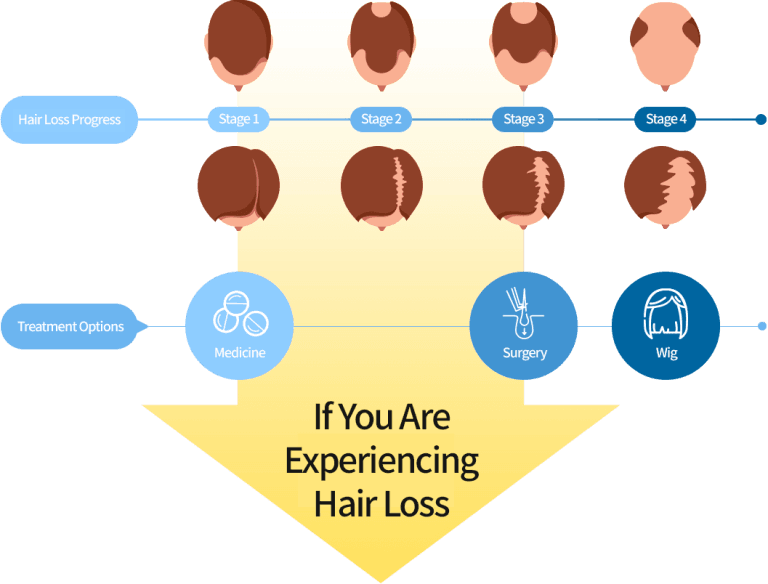
- Confirmed pattern hair loss — Appropriate discussion starts with an adult diagnosis of nonscarring androgenetic alopecia (male- or female-pattern hair loss), confirmed by scalp examination and ideally trichoscopy.
- Remaining miniaturized follicles — Candidates have thinning in areas where follicles remain, rather than long-standing smooth bald scalp where follicle loss is likely advanced.
- Investigational-treatment expectations — Suitable patients understand that this is an unstandardized regenerative adjunct, not proven follicle replacement, and agree to objective baseline and follow-up photographs.
- Established options considered — Consider these methods only after discussing standard medical hair-loss care, PRP, and transplantation where relevant.
Do not proceed before assessing sudden shedding, patchy loss, scalp pain, marked scaling, infection, inflammation, or suspected scarring alopecia; alopecia areata, telogen effluvium, traction alopecia, and cicatricial alopecia need diagnosis-specific care. Active scalp or donor-site infection, open wounds, major inflammation, or allergy to the proposed product, anesthetic, or processing component require postponement. Pregnancy and breastfeeding generally warrant deferral, while fat-harvest/SVF protocols need individualized review for bleeding disorders, anticoagulant or antiplatelet treatment, uncontrolled diabetes, serious systemic illness, active malignancy, immune disease, and local-anesthesia or liposuction risk. Published research has largely selected healthier adults, and the evidence remains heterogeneous: a 2024 review of randomized trials called for better protocol standardization and long-term outcomes research.
How Is Stem Cell Scalp Therapy Performed?
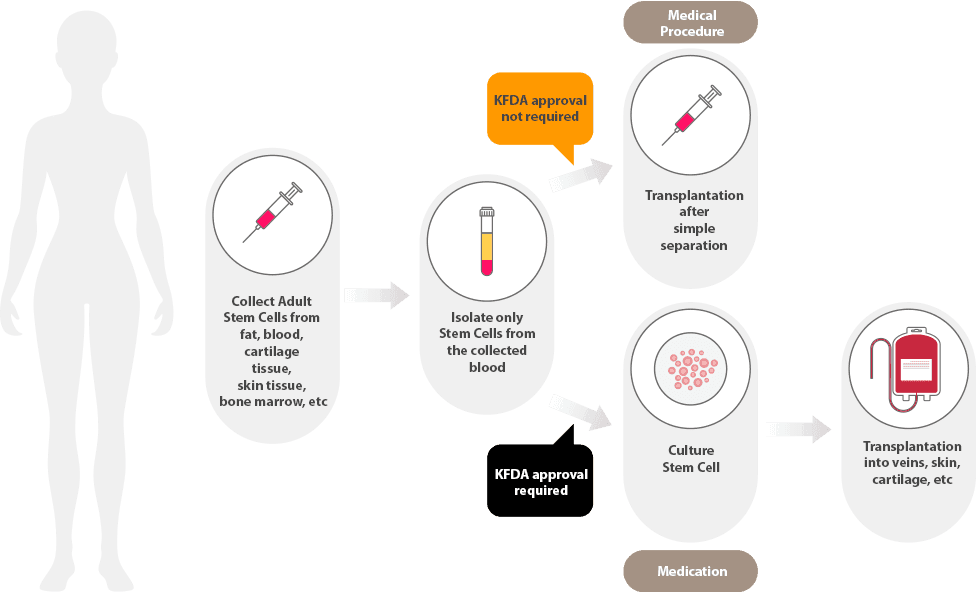
“Stem cell scalp therapy” describes materially different interventions. Confirm whether the proposed product contains living cells, a mixed cell fraction, secreted factors, or extracellular vesicles; these are not interchangeable.
- Topical ADSC-CE or ADSC-CM — Adipose-derived stem-cell constituent extract or conditioned medium contains secreted factors rather than transplanted stem cells. It is applied topically, sometimes alongside microneedling or scalp injections. A small Korean double-blind trial of 38 participants used topical ADSC-CE twice daily for 16 weeks and reported better hair-count change than vehicle, but it does not validate injected live cells, SVF, donor-derived products, or exosomes.
- Autologous adipose-SVF injection — Mini-liposuction collects a small amount of the patient’s fat; it is processed and injected into thinning scalp. Stromal vascular fraction is a mixed fraction, not purified stem cells. Harvest volume, mechanical or enzymatic processing, concentration, injection depth, and PRP use vary, and a systematic review found no standardized SVF protocol.
- SVF plus PRP — Clinics sometimes add platelet-rich plasma to SVF treatment. This combination prevents a clear conclusion about whether any observed change came from SVF, PRP, conventional hair-loss medicines, or their combination.
- Follicle-derived or dermal-sheath cup cells — This specialized approach collects follicle cells, cultures them, then reinjects them after a separate manufacturing interval. A placebo-controlled dose-finding trial followed participants to 12 months, but the authors described the observed benefit as temporary through month 9; it is not evidence for SVF, conditioned medium, or exosomes.
- Exosome or extracellular-vesicle products — Exosomes are acellular vesicles, not stem cells. Clinical evidence for androgenetic alopecia is immature; a registered umbilical-cord-mesenchymal-stem-cell exosome study remains recruiting or without posted outcomes. A trial listing does not establish effectiveness, safety, or authorization for routine care.
Why Visit Korea for Stem Cell Scalp Therapy?
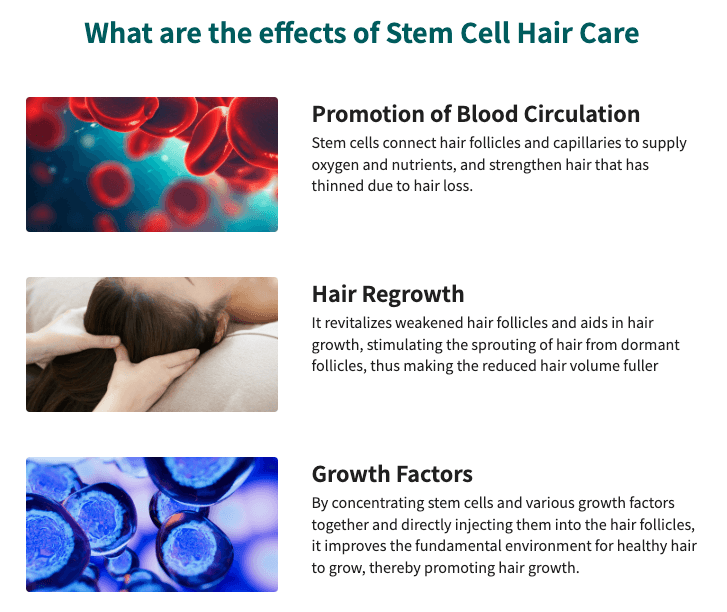
Korea has relevant regenerative-medicine research and a legal framework for advanced regenerative medicine. It does not have proven superior outcomes for commercially marketed stem cell hair treatment. Product identity, legal basis, and current authorization status require direct verification before treatment.
- Direct Korean clinical evidence — The strongest directly Korean evidence identified is the small 38-person, 16-week topical ADSC-CE randomized study. Its findings apply only to that short-term acellular topical protocol, not to live-cell injection, SVF, donor-derived cells, or exosome treatments.
- Advanced-regenerative framework — Korea’s Advanced Regenerative Medicine and Advanced Biological Products Act provides mechanisms for advanced-regenerative clinical research and advanced-biopharmaceutical manufacturing. This framework does not itself confirm that a specific scalp product is authorized for general pattern hair loss.
- Product-level verification route — The MFDS publishes drug-approval information and provides official certificate-verification pathways. This review did not identify an authoritative MFDS source confirming a standardized live-cell, SVF, conditioned-medium, or exosome product authorized specifically for routine androgenetic-alopecia treatment; request the Korean product name, manufacturer, authorization category, certificate number where applicable, and current status.
- Need for transparent consent — Ask in writing whether treatment is autologous or donor-derived; whether it contains SVF, conditioned medium, extracellular vesicles, exosomes, or PRP; and whether enzyme processing or culture expansion is used. Generic claims such as “approved” or “stem-cell-derived” are not adequate documentation.
Key Information for International Patients
- Minimum stay — Allow 1–3 days for scalp-only topical, microneedling, or injection protocols, including consultation, diagnostic review, treatment, and any requested early check. Allow 3–7 days when autologous SVF includes mini-liposuction so the donor site can be assessed before long-haul travel.
- Repeat visits — A scalp-only session can usually be completed during one trip, but cultured follicle-cell methods require a separate manufacturing interval and later reinjection. No evidence-based maintenance schedule exists for any stem-cell scalp method.
- Flight timing — There is no validated procedure-specific no-fly interval. Fat harvest, sedation, wound status, clotting history, and flight duration determine clearance; surgery plus prolonged immobility increases travel-related risk according to CDC medical-tourism guidance.
- Itinerary impact — Scalp-only care commonly causes 1–3 days of tenderness, redness, pinpoint bleeding, swelling, or bruising. SVF adds donor-site soreness, bruising, drainage, and possible compression garments for roughly 1–2 weeks.
- Remote follow-up — Arrange a named contact for post-treatment concerns and obtain English-language records before departure. Record the product, tissue source, processing, batch or lot where applicable, dose or volume, injection sites, anesthetics, adverse events, and emergency plan.
Travel note: For flights longer than four hours after fat harvest or another surgical component, discuss individualized clot prevention and in-flight movement with the treating clinician. General VTE-prevention guidance supports movement when medically appropriate, but does not replace individualized clearance.
Which Are the Best Clinics in Korea for Stem Cell Scalp Therapy?
Listed below are some of the best clinics in Korea for stem cell scalp therapy.
1. Cellinique Clinic
For stem cell scalp therapy, you can consider Cellinique Clinic if you are looking for a personalized hair-loss injection approach alongside non-incision hair restoration options. The clinic describes its stem cell hair-loss injection as a treatment intended to stimulate hair-follicle regeneration and help treat or prevent hair loss.
- URL: Cellinique Clinic Website
- Location: Gangnam-gu, Seoul
- Procedure approach:
- Offers stem cell hair-loss injections aimed at stimulating hair-follicle regeneration.
- Also provides non-incision hair transplantation, which transplants individual follicles without surgical incisions.
- Clinical focus:
- The clinic focuses on stem cell-based regeneration and offers complementary modalities including PRP and exosomes.
- Care is described as customized through personalized consultation and treatment planning.
- Physician and research activity:
- Dr. Chris Gunwoo Kim presented on high-concentration blood cell zones and SDF-1alpha injection during a 2024 Asia lecture tour.
- In 2025, Dr. Kim presented the clinic’s NovaStem Kit, described as a minimally manipulated cell biotechnology, at the Korean Obesity and Aesthetic Treatment Society spring conference.
2. Lydian Plastic Surgery Clinic
You may consider Lydian Plastic Surgery Clinic for stem cell scalp therapy if you value a regenerative-medicine setting with controlled cell processing and individualized sourcing discussions; however, the available information does not specifically describe a scalp or hair-loss stem cell protocol, so an in-person consultation would be needed to determine whether an appropriate option is available for your concerns.
- URL: Lydian Plastic Surgery Clinic Website
- Location: Gangnam-gu, Seoul
- Regenerative medicine system:
- The clinic states that it is an Advanced Regenerative Medicine Provider approved by Korea’s Ministry of Health and Welfare.
- Its system includes authorized cell-processing facilities for extracting, testing, and processing human cells.
- The clinic reports Clean Class 10,000 standards and use of disposable stem cell extraction kits.
- Cell sources: Customized extraction may use bone marrow, fat, or blood, according to individual needs.
- Related services:
- Stem cell therapy is listed among the clinic’s regenerative services, including uses intended to support tissue repair and healing in cosmetic applications.
- Stem cell fat grafting is offered for volume enhancement in areas such as the face, breasts, or buttocks.
3. SH Clinic
For stem cell scalp therapy, SH Clinic offers an autologous stem cell hair-loss treatment in which your own stem cells are injected into the scalp to target dormant follicles and support new growth without surgical grafting. The clinic states that treatment is personalized after an in-person consultation and examination.
- URL: SH Clinic Website
- Location: Seocho-gu, Seoul
- Procedure approach:
- Autologous stem cells are injected into the scalp.
- The treatment is described as aiming to awaken dormant follicles, stimulate new growth, and thicken existing strands.
- It is presented as a non-grafting option rather than a surgical hair-transplant procedure.
- Personalized care:
- SH Clinic’s Wellness & Anti-aging Program is based on personalized stem cell treatment planning.
- Experienced medical staff provide treatment after an in-person consultation and examination.
- Related hair services:
- Hair transplantation is also available for thinning areas, using transplanted healthy follicles and individualized hairline design.
- The clinic lists stem cell and regenerative treatments across hair loss, skin rejuvenation, arthritis and disc disease, autoimmune disease, and other health concerns.
Stem Cell Scalp Therapy From Start to Finish
- Remote screening and product disclosure — Send standardized photographs of the hairline, temples, top, crown, and donor area; hair-loss history; prior PRP, transplant, microneedling, and medicines; allergies; medical conditions; and pregnancy status where relevant. An English-speaking coordinator or virtual consultation should identify the exact proposed biologic before travel.
- In-person diagnosis — The clinician examines the scalp, confirms or questions the diagnosis of pattern hair loss, checks for inflammation or scarring, and takes baseline photographs and trichoscopy. Laboratory testing is targeted to findings such as sudden shedding, nutritional concern, endocrine symptoms, or systemic illness.
- Risk review and clearance — The team reviews bleeding risk, diabetes control, allergies, anesthesia tolerance, medicines, and donor-site suitability where fat harvest is planned. Agree on measurable endpoints rather than a promise of regrowth.
- Scalp-only treatment — The scalp is cleansed and may be numbed. The clinician applies topical ADSC-CE/conditioned medium, performs microneedling, or places intradermal injections across mapped thinning areas. Treatment time depends on the protocol and treated area.
- SVF treatment when selected — Under local anesthesia, a small fat volume is harvested by mini-liposuction, processed, and the resulting SVF is injected into target scalp areas. This method includes both scalp-injection and donor-site recovery.
- Discharge and early review — Receive written aftercare, emergency contact details, and an early check if requested. Confirm flight clearance before leaving Korea, particularly after fat harvest or sedation.
- Overseas follow-up and outcome review — Send matching photographs as directed and compare results no earlier than 3–6 months using the same lighting, angle, hair length, and positioning. Trichoscopy provides a more useful density comparison than casual photographs alone.
Alternatives to Stem Cell Scalp Therapy
Established and cosmetic alternatives have clearer roles than investigational cell-based approaches. Medical treatment and PRP aim to preserve or improve existing miniaturized follicles; transplantation redistributes donor follicles; micropigmentation changes appearance without growing hair.
Medical Hair-Loss Treatment
- Role — Medical hair-loss treatment can include topical minoxidil and, for appropriately selected patients, clinician-supervised antiandrogen or 5-alpha-reductase-inhibitor strategies.
- Tradeoff — These treatments require ongoing use and medical monitoring where indicated, but they have a more established role in pattern-hair-loss management than regenerative products.
Platelet-Rich Plasma
- Role — PRP for hair loss uses concentrated components from the patient’s blood, injected into thinning scalp.
- Tradeoff — PRP protocols and evidence vary, and repeat sessions are common, but it does not involve donor cells, cultured cells, or exosomes.
Hair Transplantation
- Role — Hair transplantation redistributes permanent donor follicles to areas of loss and can be more predictable for suitable candidates with adequate donor reserve and stable disease.
- Tradeoff — It is surgery with longer recovery and does not stop future progression of pattern hair loss.
Scalp Micropigmentation
- Role — Scalp micropigmentation tattoos the appearance of follicles or density into the scalp.
- Tradeoff — It provides cosmetic camouflage rather than hair regrowth and can be useful when donor supply is limited or surgery is not desired.
Hairline Correction
- Role — Hairline correction can address a receding or high hairline in carefully selected patients.
- Tradeoff — Future hair-loss progression, diagnostic certainty, and long-term donor reserve must be assessed before committing to surgical hairline design.
How Can I Prepare for Stem Cell Scalp Therapy?
- Confirm the exact intervention — Obtain the product name and manufacturer; autologous or donor origin; tissue source; whether it contains live cells, SVF, conditioned medium, extracellular vesicles, exosomes, or PRP; processing steps; dose or volume; injection plan; session count; and regulatory or clinical-research documentation.
- Disclose all medicines — Provide prescription drugs, over-the-counter medicines, supplements, nicotine use, alcohol use, allergies, chronic conditions, and prior scalp treatments. Do not independently stop finasteride, dutasteride, minoxidil, anticoagulants, antiplatelets, diabetes medicines, hormones, or immune-modifying drugs; changes require a plan from the original prescriber and treating clinician.
- Follow fasting instructions — Scalp-only treatment under local anesthesia has different requirements from fat harvest, sedation, or opioid pain control. Follow the clinic’s written instructions exactly.
- Prepare the scalp — Arrive with a clean scalp. Avoid sunburn, camouflage fibers, heavy oils, and styling products unless the clinic specifically permits them.
- Plan transport and lodging — Arrange a responsible adult and private transport after sedation, opioid medication, or mini-liposuction. Stay close enough for an early donor-site or scalp review if requested.
- Keep flights flexible — Do not book a non-changeable long-haul departure immediately after SVF with fat harvest. Flight clearance depends on the donor site, anesthesia, complications, and personal clot risk.
Travel note: Request the consent form and a commitment to provide English treatment records before paying for treatment. This is especially important for products described only with broad terms such as “stem-cell-derived” or “exosome.”
Confirm all clinic-specific medication, fasting, transport, and travel requirements with the treating doctor; individualized instructions take precedence over general guidance.
Aftercare Advice
Protect puncture sites and the donor area, and treat worsening pain, swelling, or systemic symptoms as a reason to contact the clinic promptly.
- Scalp protection — Do not rub, scratch, or massage the scalp. Avoid unapproved scalp products, hair dye, swimming, saunas, steam rooms, intense exercise, and heavy sweating until puncture sites settle; many scalp-only protocols restrict these for 24–72 hours, while deeper microneedling or combined treatment can require longer.
- Sun exposure — Keep the scalp out of direct sun while redness or punctures remain. Use a loose hat when permitted, and apply SPF 50 scalp-safe sunscreen only after the clinician confirms that the skin surface has closed.
- Donor-site care for SVF — Keep dressings clean and dry, use compression garments exactly as prescribed, walk as directed, and avoid strenuous exercise, heavy lifting, baths, and swimming until healing is confirmed. Donor-site bruising and soreness often persist for 1–2 weeks.
- Warning signs — Seek urgent care for fever, spreading redness or warmth, pus, rapidly worsening pain or swelling, persistent bleeding, fainting, generalized hives or facial swelling, chest pain, breathing difficulty, one-sided leg swelling, or new neurologic symptoms.
- Results and follow-up — Do not judge regrowth immediately. Review standardized photographs and trichoscopy at 3–6 months; no validated maintenance interval or durable long-term outcome has been established.
Follow the treating doctor’s written instructions over this general guidance, and contact the clinic promptly when the scalp or donor site appears wrong.
Frequently Asked Questions
Related Blogs
Stem Cell Treatments for Sexual Performance in Korea: Evidence, Safety, Travel Planning, and ED Alternatives
Stem cell approaches for organic erectile dysfunction remain investigational, with assessment, protocol verification, intracavernosal injection, monitoring, and follow-up requirements described. International patients should confirm regulatory status, product details, recovery needs, flight planning, emergency contacts, and records for home-urologist follow-up.
Updated: Sep 28, 2026
Stem Cell IV Therapy in Korea: Regulation, Safety, Travel Planning, and Evidence Limits
Stem cell IV therapy requires diagnosis-specific eligibility, specialist assessment, and verification of an authorized product, approved Korean treatment plan, or clinical trial. The article outlines record review, in-person testing, infusion monitoring, flexible travel, flight clearance, and coordinated overseas follow-up.
Updated: Sep 27, 2026
Stem Cell Injection in Korea: Regulation, Treatment Routes, Recovery and Travel Planning
Stem cell injection varies by cell source, processing, route, and target, requiring a confirmed diagnosis, a documented regulatory or research pathway, specialist assessment, and written follow-up planning. International patients should arrange sufficient time for evaluation and observation, obtain fitness-to-fly clearance, and leave with English treatment records and an overseas follow-up plan.
Updated: Sep 27, 2026
Why Korea is Leading for Stem Cell Fat Grafting: An In-Depth Cost Comparison with the USA, Europe, and More
Explore the affordability of stem cell fat grafting in Korea, a cutting-edge cosmetic procedure that combines regenerative medicine with aesthetic enhancement. Discover why patients worldwide are choosing Korea for high-quality treatment at competitive prices.
Updated: Sep 26, 2026
Clinics offering Stem Cell Scalp Therapy

SH Clinic: Comprehensive Women's, Men's & Couples' Health Services in Korea
Sinsa

THEPLUS Plastic Surgery Korea | Eye, Nose, Face & Body Surgery
Sinsa
Hev Clinic Korea | Premium Sinsa Clinic for Skin, Laser & Injectables
Sinsa

Made Young Plastic Surgery: Rejuvenating Aesthetic Excellence in Korea for Face Lifts, Contouring and More
Gangnam Station