
Medical Tourism Blog
Sideburn Transplant in Korea: Methods, Recovery, Travel Planning, and Alternatives
Table of contents
- Sideburn Transplant at a Glance
- What Is a Sideburn Transplant?
- Who Is a Good Candidate for a Sideburn Transplant?
- How Is a Sideburn Transplant Performed?
- Why Visit Korea for a Sideburn Transplant?
- Key Information for International Patients
- Which Are the Best Clinics in Korea for Sideburn Transplant?
- Sideburn Transplant From Start to Finish
- Alternatives to a Sideburn Transplant
- How Can I Prepare for a Sideburn Transplant?
- Aftercare Advice
Considering treatment in Korea? Everything you need to know e.g. — how to avoid scams, visas, interpreters, recovery tips — in our Medical Tourism Master Guide. Plan with confidence in minutes, not weeks!
Last updated: September 2026
Sideburn Transplant at a Glance
- What it does — A sideburn transplant moves your own follicular units—usually from the back of the scalp—into the sideburn area, using mostly single-hair grafts placed at shallow downward angles for a natural lay.
- Best candidates — It can suit stable congenital sparseness, asymmetry, mature surgical or injury scars, post-facelift loss, or selected gender-affirming goals when donor hair is adequate and future scalp-hair needs have been considered.
- Recovery window — Redness, pinpoint crusting, mild pain, and swelling are most noticeable for 1–7 days, and crusts commonly clear around days 7–10 with the clinic’s approved washing routine.
- Results and upkeep — Transplanted shafts often shed during weeks 2–8, new growth usually starts around month 3, and the result is assessed at 9–12 months; scalp-derived hairs continue growing and need regular trimming.
- Korea travel plan — International patients should practically plan 7–10 days in Korea for in-person design, outpatient treatment, and an early graft review; keep return flights flexible until the surgeon clears long-haul travel.
- Important limitations — Donor follicles are finite, and scarred skin may produce lower density or require staged sessions; active skin disease or infection, unstable hair loss, poor donor supply, and ongoing nicotine exposure can make surgery unsuitable.
- Korea-specific evidence — A Korean series of 37 post-midfacelift corrective cases used FUT or concealment-focused FUE methods, averaging 1,025 grafts and reporting high satisfaction, but it does not establish outcomes for routine unscarred cosmetic sideburn augmentation.
What Is a Sideburn Transplant?
A sideburn transplant moves a person’s own hair follicles, usually from the scalp, into the sideburn area to restore or reshape growing hair. It addresses sparse, uneven, scar-related, or absent sideburns and can create a fuller facial frame with ongoing trimming. It is a surgical hair-restoration procedure, typically performed as an outpatient treatment under local anesthesia.
Who Is a Good Candidate for a Sideburn Transplant?
- Congenital sparseness or asymmetry — Good candidates have naturally limited sideburn growth or a clear difference in position, width, direction, or density between the two sides.
- Stable hair loss or scar-related loss — Sideburn restoration can address a stable surgical, traumatic, or burn scar, including loss after facelift surgery, when the skin has matured and has adequate blood supply.
- Gender-affirming goals — Transmasculine patients seeking a more typically masculine sideburn frame can be candidates when donor supply and the expected effect of testosterone on natural facial-hair development have been assessed.
- Realistic maintenance expectations — Candidates accept that transplanted scalp follicles keep scalp-like growth behavior and need regular trimming to maintain a sideburn length and outline.
- Adequate donor hair — The posterior scalp, and occasionally the area behind the ears, must provide enough suitable-caliber follicular units without compromising future scalp-hair restoration.
Do not proceed during active inflammatory or cicatricial alopecia, folliculitis, dermatitis, infection, open wounds, or before a scar has matured. Diffuse donor thinning, miniaturized donor hair, a finite donor reserve needed for future pattern hair loss, uncontrolled diabetes or hypertension, serious cardiopulmonary disease, bleeding disorders, immunodeficiency, and unmanaged anticoagulant or antiplatelet use require medical optimization or can rule out surgery. Nicotine exposure impairs healing and graft survival; inability to stop smoking or vaping is a major concern. For transmasculine patients, allowing at least one year of testosterone treatment, when clinically appropriate, helps assess natural hormonally responsive facial-hair growth before using limited donor follicles. The surgeon must assess donor density and caliber, scar vascularity, facial proportions, the opposite sideburn’s direction, and any keloid history before confirming suitability.
How Is a Sideburn Transplant Performed?
The important choices are how follicles are harvested and implanted, not cosmetic “types” of sideburn transplant. Design remains central: surgeons generally select predominantly single-hair grafts and place them at very acute downward angles so the hair lies flat against the preauricular skin.
- FUE (follicular unit excision) — Individual follicular units are removed with small punches. FUE avoids a linear strip scar but still leaves small dot scars and carries risks of follicle transection and donor overharvesting.
- FUT (follicular unit transplantation/strip harvest) — A narrow donor strip is removed and dissected into follicular units. FUT leaves a linear donor scar, so donor hairstyle and scalp laxity affect suitability.
- Non-shaven or partial-shave FUE — Only a limited donor zone is trimmed, helping selected patients conceal harvesting. It is not automatically suitable for every donor pattern or graft requirement.
- Pre-made slits and placement — The surgeon creates recipient sites first, then places grafts. Angle, direction, spacing, and graft selection determine whether the sideburn looks natural rather than plug-like.
- Stick-and-place implantation — Each recipient opening is made immediately before graft placement. This approach can allow close control of orientation in the narrow, highly visible sideburn zone.
A Korean retrospective series of 37 corrective post-midfacelift cases used FUT in 24 patients, non-shaven FUE in 12, and partial-shave FUE in one. It reported high subjective satisfaction, but it did not compare methods and does not establish the best technique for unscarred elective sideburn augmentation. Read the study details and limitations.
Why Visit Korea for a Sideburn Transplant?
Korea has published procedure-relevant experience in corrective side-hairline transplantation and offers formal resources for finding registered international-care providers. That does not prove Korean results are superior to results elsewhere. For a design-sensitive facial transplant, assess the individual surgeon’s donor-management plan, scar experience, portfolio of comparable cases, and English-language follow-up process.
- Published corrective side-hairline experience — A Korean 2019 retrospective series followed 37 patients treated for side-hairline loss or scars after midfacelift surgery. The mean transplant size was 1,025 grafts; reported patient and physician satisfaction averaged 4.6 and 4.8 out of 5, respectively, with no folliculitis reported in that series. The evidence applies to post-facelift correction, not routine cosmetic sideburn enhancement.
- FUE and concealment approaches represented in the series — The same report included FUT, non-shaven FUE, and partial-shave FUE, showing documented local use of donor-harvest approaches relevant to patients who want to minimize visible donor trimming.
- International-care verification resources — Korea’s Medical Korea platform provides a directory of medical providers and information on its registered medical-institution system. Confirm that the operating clinic, not only a marketing agency, can provide written records and postoperative contact.
- Evidence limit — No controlled studies compare Korean sideburn-transplant outcomes with those in other countries, and no reliable sideburn-specific graft-survival, complication, or revision rates exist for unscarred cosmetic cases. Broader hair-transplant literature also has inconsistent complication definitions and reporting. A 2025 scoping review explains this limitation.
Key Information for International Patients
- Recommended stay — Plan approximately 7–10 days in Korea when practical for in-person design, medical assessment, outpatient surgery, and an early graft review with supervised washing instruction. This is a cautious travel-planning window, not a universally studied minimum.
- Flight timing — Do not book a long-haul return flight until the operating clinician confirms that bleeding, significant swelling, infection concerns, and early graft-care needs are controlled. Build flexibility into the return ticket.
- Early appearance — Redness, pinpoint crusting, mild pain, and swelling are most noticeable during days 1–7. Crusts commonly clear by about days 7–10 under the clinic’s approved washing routine, but the recipient zone is not suitable for a tightly scheduled public-facing itinerary.
- Sedation and transport — Local anesthesia is common. Oral or IV sedation changes the plan: do not drive afterward, and a companion can be advisable or required by the clinic.
- Activity restrictions — Protect grafts from rubbing, direct shower pressure, helmets, tight hats, scratching, and heavy sweating. Delay strenuous exercise, swimming, alcohol, and nicotine until the surgeon clears them.
- Remote follow-up — Obtain a written schedule before leaving. A practical plan includes review around days 7–10, then at 1 month, 3–4 months, 6 months, and 9–12 months; arrange local in-person care rather than relying on remote advice if a complication develops.
Travel note: Before departure, request the operative note, graft count, donor method, medication list, clinical photographs, English aftercare instructions, and an emergency contact that works from overseas.
Which Are the Best Clinics in Korea for Sideburn Transplant?
Listed below are some of the best clinics in Korea for sideburn transplant.
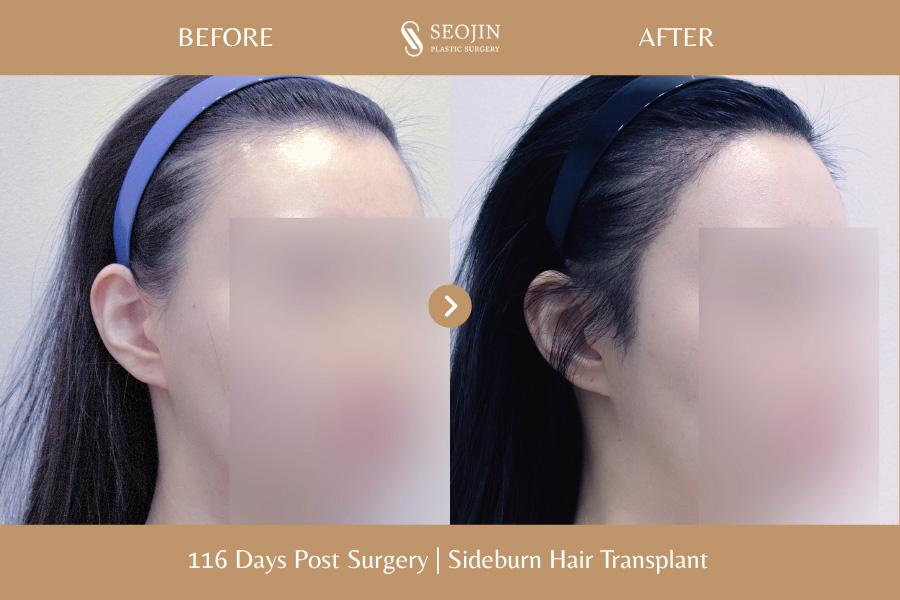
1. Seojin Plastic Surgery Clinic
You may consider Seojin Plastic Surgery Clinic for a sideburn transplant if you value a hair-transplant approach designed to emulate natural growth patterns, with care led end to end by Dr. Lee Hyungmin in a one-doctor clinic setting.
- URL: Seojin Plastic Surgery Clinic Website
- Location: Gangnam-gu, Seoul
- Hair transplant approach:
- Hair transplantation is a stated specialty, with designs intended to emulate natural hair-growth patterns.
- Personalized consultations are used to tailor aesthetic procedures to individual needs.
- Lead doctor:
- Dr. Lee Hyungmin provides comprehensive care throughout treatment in the clinic’s one-doctor model.
- The clinic states that Dr. Lee has more than 16 years of experience and was named among the 100 Good Doctors in Korea.
- Additional services: Hair-loss treatment and scalp micropigmentation are available alongside hair transplantation.
2. Maxwell Hair Clinic
You may consider Maxwell Hair Clinic for a sideburn transplant if you want a dedicated hair-restoration practice that can assess your hair pattern, create a personalized design, and select FUE, FUT, or a combined approach based on your needs.
- URL: Maxwell Hair Clinic Website
- Location: Gangnam-gu, Seoul
- Procedure planning:
- The process includes consultation, hair-loss assessment, and a personalized design intended to complement your facial features and planned density.
- Both FUE and FUT are offered, with combined techniques available when appropriate.
- Partial, minimal, and no-shaving surgical options are listed.
- Experience and follow-up:
- The clinic reports more than 60,000 hair transplants and over 500,000 treatment cases.
- Detailed post-surgical care guidance and customized aftercare are part of its stated care model.
- Revision surgery and scar laser treatment are available for prior transplant concerns.
- Clinical leadership: Founder Dr. Noh Yoon Woo is described as an executive member of the Korean Society of Hair Restoration.
- International support: International services include online consultations and assistance with travel and accommodation arrangements.
3. Dream Hairline Clinic
You can expect Dream Hairline Clinic to plan a facial-hair transplant around graft selection, placement, and follow-up care; its stated beard and mustache transplantation service is relevant when you are seeking added density and a natural-looking result in the sideburn area.
- URL: Dream Hairline Clinic Website
- Location: Gangnam-gu, Seoul
- Procedure options:
- Shaven FUE and non-shaven FUE are available; the non-shaven option is presented for people who need to return to work the next day.
- FUSS with KNP suture can maximize graft use for a larger single-session transplant.
- A hybrid FUSS-and-FUE technique combines higher-volume graft harvesting with precise placement.
- ARTAS robotic hair transplantation is also listed as an FUE option.
- Planning and care:
- You begin with a digital assessment and detailed consultation to create a personalized plan.
- The clinic states that grafts are selected according to your individual condition and implanted according to the agreed design.
- Post-operative support includes hair washing, disinfection, medication packages, and in-person or online follow-up.
- Facial hair services:
- Beard and mustache transplantation is offered to enhance facial-hair density.
- Eyebrow and eyelash transplantation are also listed.
- Research focus: The clinic describes ongoing research and scholarly work focused on hair-transplant treatment.
Sideburn Transplant From Start to Finish
- Remote inquiry and consultation — Send clear photos of the front, sides, donor scalp, and any scar in good lighting. Confirm whether an English consultation is available, discuss the desired sideburn outline, and disclose prior facelift, facial trauma, burns, hair procedures, medications, nicotine use, and medical conditions.
- In-person assessment and design — The surgeon examines donor density, hair caliber, scalp-hair-loss progression, scar quality and blood supply, facial asymmetry, and the direction and position of the opposite sideburn. Together, you mark the planned sideburn boundary, density gradient, and connection to temporal hair or beard hair.
- Medical review and planning — The clinic reviews allergies, previous anesthesia reactions, prescription and over-the-counter medicines, supplements, alcohol and nicotine use, and conditions such as diabetes, hypertension, or bleeding disorders. Follow any clinician-directed testing, medication changes, fasting plan, and sedation requirements.
- Anesthesia and donor preparation — The procedure is usually outpatient under local anesthesia. Some patients receive oral or IV sedation; this requires a safe escort and no driving after treatment. The donor area is prepared using the agreed FUE, non-shaven FUE, partial-shave FUE, or FUT plan.
- Follicle harvesting — With FUE, individual follicular units are removed through small punches. With FUT, the surgeon removes a donor strip and closes the linear donor incision. The team prepares suitable grafts, prioritizing single-hair units for a soft sideburn edge.
- Recipient-site creation and implantation — The surgeon makes tiny recipient sites at shallow, downward-facing angles and places grafts to follow the natural sideburn direction. Procedure length depends on graft count, donor method, scar quality, and whether one or both sideburns are being restored.
- Discharge and first days — Leave the clinic with written instructions for saline spray, washing, pain control, donor-site care, sleeping position, activity limits, and emergency contact. Avoid touching or compressing the grafts during transport and at accommodation.
- Early Korea review — Attend the planned review and first-wash teaching before travel home. The team checks for bleeding, swelling, infection signs, donor-site concerns, and graft-care technique.
- Overseas regrowth follow-up — Transplanted shafts commonly shed during weeks 2–8; this is expected and does not show final graft failure. New growth generally begins around month 3, and the result matures through months 9–12. Send scheduled photographs and seek local urgent care promptly for infection, bleeding, or systemic symptoms.
Alternatives to a Sideburn Transplant
A transplant creates growing hair but uses a finite donor supply, needs postoperative graft protection, and takes months to reveal its result. Non-surgical options avoid surgery but do not create living follicles. Larger scars or tissue-loss defects sometimes need reconstructive surgery rather than grafting alone.
Scalp Hair Transplant
- Best fit — Consider a broader hair transplant when scalp thinning and sideburn loss are both priorities and donor allocation needs a whole-scalp plan.
- Tradeoff — It can address wider hair-loss patterns, but using grafts for sideburns reduces the donor reserve available for the scalp.
Beard Hair Transplant
- Best fit — A beard hair transplant can be more appropriate when the desired result includes sideburns connected to beard growth or broader facial-hair masculinization.
- Tradeoff — Facial-hair planning must account for beard density, skin visibility, and the different direction and texture of scalp donor hair.
Hair Transplant on a Scar
- Best fit — Choose hair transplant on a scar evaluation for a mature scar from trauma, burns, or surgery.
- Tradeoff — Scar blood supply and thickness can reduce density and graft take; staged sessions are more likely than in healthy unscarred skin.
Hairline Correction
- Best fit — Hairline correction suits patients whose concern extends from the sideburn into the frontotemporal or temporal hairline.
- Tradeoff — A wider design uses more donor follicles and requires careful planning around future pattern hair loss.
Scalp Micropigmentation
- Best fit — Scalp micropigmentation can visually darken a sparse side-hairline or scar without surgery.
- Tradeoff — Pigment creates an appearance of density, not hair growth, texture, or trim-able sideburn length; touch-ups can be needed.
Scar Revision or Tissue Reconstruction
- Best fit — Scar revision, tissue expansion, or flap reconstruction can be considered for selected large, deep, poorly vascularized, or structurally distorted defects.
- Tradeoff — These are more invasive reconstructive options and can change scar position or create additional scars; a reconstructive surgeon must assess feasibility.
How Can I Prepare for a Sideburn Transplant?
- Medical disclosure — Provide the surgeon with a complete list of prescription medicines, over-the-counter products, vitamins, herbal supplements, allergies, previous anesthesia reactions, hair-loss history, prior facial surgery, and scar or keloid history.
- Anticoagulants and medical medicines — Do not independently stop aspirin, anticoagulants, antiplatelet drugs, blood-pressure medicines, or diabetes medicines. The prescribing clinician and surgeon must agree on any change.
- NSAIDs, supplements, and minoxidil — Ask for a written stop-or-continue plan for ibuprofen and other NSAIDs, fish oil, vitamin E, herbal supplements, and topical or oral minoxidil. Exact timing depends on bleeding risk, medical history, and the clinic protocol.
- Nicotine and alcohol — Stop smoking and vaping for the surgeon’s specified period before and after surgery. Avoid alcohol according to the clinic’s instructions because it can worsen bleeding, swelling, dehydration, and adherence to aftercare.
- Hair and skin preparation — Do not shave, wax, dye, or apply irritating products to the planned donor or sideburn areas unless the clinic instructs otherwise. Report any pimple, rash, dermatitis flare, folliculitis, or broken skin before travel.
- Fasting and sedation — Follow the clinic’s fasting instructions exactly if oral or IV sedation is planned. Local-anesthetic treatment without sedation has different requirements; do not assume a generic fasting rule applies.
- Travel logistics — Choose accommodation that allows a clean sleeping environment and easy clinic access. Arrange a companion or clinic-approved transport if sedation is planned, and book a changeable flight rather than departing before the early review.
- Sun and general health — Avoid sunburn in the donor and recipient areas before surgery. Tell the clinic promptly about fever, respiratory illness, active infection, or a change in health status.
Travel note: Bring medicines in original labeled containers and carry a concise medical summary in English. Confirm how to reach the clinic outside business hours and identify an accessible local emergency service near accommodation.
Confirm the treating doctor’s clinic-specific requirements; their instructions take precedence over general guidance.
Aftercare Advice
Protecting the newly placed grafts during the first 7–10 days is essential; do not treat the recipient area like normal skin or hair until the surgeon clears it.
- Washing and crust care — Follow the exact saline-spray and washing schedule provided by the clinic. Use only approved products and water pressure, and never pick, scratch, or manually remove crusts.
- Pressure, friction, and contact — Keep fingers, combs, towels, direct shower spray, tight hats, helmets, and eyewear that rubs the sideburn zone away from grafts. Sleep as instructed; head elevation for several nights is often used to limit facial swelling.
- Activity and heat — Avoid strenuous exercise, heavy sweating, swimming, saunas, hot baths, alcohol, nicotine, and activities that could strike or rub the grafts until cleared by the surgeon.
- Sun protection — Keep direct sun off the recipient and donor sites. Use shade and physical protection that does not touch grafts; apply SPF 50 only when the clinic confirms that topical sunscreen will not disturb the recipient area.
- Normal shedding and trimming — Expect many transplanted shafts to shed between weeks 2 and 8. New growth generally starts around month 3, while mature density and direction are judged at 9–12 months. Trim growing transplanted hairs regularly because scalp follicles continue to grow like scalp hair.
- Warning signs — Contact the clinic urgently for persistent or expanding bleeding, worsening pain, swelling or redness, pus, fever, spreading rash, black or gray skin change, fainting, chest symptoms, or a suspected medication reaction. Seek local in-person medical care for urgent symptoms rather than waiting for a remote reply.
Follow the treating doctor’s instructions over this general advice, attend scheduled photo or video reviews, and contact the clinic promptly whenever healing appears abnormal.
Frequently Asked Questions
Related Blogs
Eyebrow Thinning Solutions: Eyebrow Transplant Procedure in Korea for Natural Restoration
Discover effective solutions for eyebrow thinning in Korea, focusing on eyebrow transplantation procedures like FUE and FUT. This comprehensive guide explains causes such as aging and autoimmune conditions, highlights why Korea is a top destination for medical tourism, and outlines what to expect during and after your eyebrow transplant. With Korea’s advanced clinics and expert surgeons, patients
Updated: Nov 6, 2026

Genetic Sparse Beard Solutions: Beard Hair Transplant Procedures in Korea for Fuller Facial Hair
Discover how Korea offers expert solutions for genetic sparse beard through advanced beard hair transplant procedures like FUE, FUT, and DHI. This comprehensive guide highlights the causes of inherited facial hair thinning, details the transplant techniques, and explains what medical tourists can expect when choosing Korea for permanent, natural results. Benefit from Korea’s high-tech clinics, exp
Updated: Nov 6, 2026
Burn Scar Eyebrow Loss Solutions: Eyebrow Transplant Procedure in Korea for Natural Restoration
Discover how Korea leads in eyebrow transplant procedures for burn scar madarosis. Using advanced FUE technology, Korean clinics provide permanent, natural-looking eyebrows, restoring confidence and facial harmony. Ideal for burn victims, this minimally invasive procedure effectively transplants hair into scar tissue, offering remarkable results. With top-tier surgeons, affordable prices, and exce
Updated: Nov 5, 2026

Early Stage Thinning Solutions in Korea: Effective PRP Hair Loss Treatments for Hair Restoration
Discover how Korea leads in innovative hair loss treatments for early-stage thinning. This blog explores androgenetic alopecia, hair miniaturization, and how Platelet-Rich Plasma (PRP) therapy in Korea can revitalize dormant hair follicles. Learn about the procedure, costs, patient outcomes, and why Korea is a top destination for safe, effective, and affordable hair restoration. Whether you're exp
Updated: Nov 5, 2026
Clinics offering Sideburn Transplant

Seojin Plastic Surgery Clinic Korea: Pioneering Advanced Cosmetic Procedures for Personalized Aesthetic Transformation
Apgujeong
Maxwell Hair Clinic: Korea's Premier Destination for Advanced Hair Restoration and Transplant Services
Gangnam Station

Dream Hairline Clinic: Leading Hair Transplant Solutions in Korea for Natural-Looking Results
Apgujeong