
Medical Tourism Blog
Beard Hair Transplant in Korea: Methods, Recovery, Travel Planning, and Results Timeline
Table of contents
- Beard Hair Transplant at a Glance
- What Is a Beard Hair Transplant?
- Who Is a Good Candidate for a Beard Hair Transplant?
- How Is a Beard Hair Transplant Performed?
- Why Visit Korea for a Beard Hair Transplant?
- Key Information for International Patients
- Which Are the Best Clinics in Korea for Beard Hair Transplant?
- How Much Does a Beard Hair Transplant Cost in Korea?
- Beard Hair Transplant From Start to Finish
- Alternatives to a Beard Hair Transplant
- How Can I Prepare for a Beard Hair Transplant?
- Aftercare Advice
Considering treatment in Korea? Everything you need to know e.g. — how to avoid scams, visas, interpreters, recovery tips — in our Medical Tourism Master Guide. Plan with confidence in minutes, not weeks!
Last updated: September 2026
Beard Hair Transplant at a Glance
- What it does — An outpatient beard hair transplant moves follicular-unit grafts, usually from the back of the scalp, to the cheeks, jawline, moustache, goatee, sideburns, or a stable facial scar.
- Korea cost — Estimated pricing in Korea is ₩5,000,000–₩12,000,000 (about US$3,700–US$8,900); the final quote depends mainly on graft count, coverage area, border-detail work, harvesting method, and whether scarred skin needs staged treatment.
- Best candidates — Suitable candidates have stable sparse facial hair or a healed, well-vascularized scar, adequate scalp donor reserve, healthy facial skin, and realistic expectations; a full reconstruction may require roughly 2,000–2,500 grafts.
- Results timeline — Transplanted shafts commonly shed in the first weeks, new growth often begins around month 3, coverage improves through months 4–9, and results are best assessed at 9–12 months.
- Recovery and travel — Expect visible crusting, swelling, bruising, numbness, or pinpoint oozing during the first week; international patients should stay in Korea at least 5–7 days for an early wash and wound review, or 7–10 days for larger or scar cases.
- Natural-look priority — A convincing result relies on predominantly single-hair grafts at visible borders and very acute, zone-specific placement angles; poor direction, density, or angulation can look unnatural and is difficult to revise.
- Korea-specific check — Korea offers practical early in-person follow-up, but no strong evidence shows country-wide superior beard-transplant outcomes; verify the clinic’s foreign-patient registration and confirm exactly which licensed physician performs harvesting, recipient-site incisions, and implantation.
What Is a Beard Hair Transplant?
A beard hair transplant is a procedure that moves hair follicles, usually from the scalp, to sparse or hairless areas of the face. It aims to create fuller, more defined facial hair or restore hair growth in a stable scar. It is a surgical hair-restoration procedure, typically performed as an outpatient treatment under local anesthesia.
Who Is a Good Candidate for a Beard Hair Transplant?
- Sparse or absent facial hair — Good candidates want to add coverage to the cheeks, jawline, moustache, goatee, or sideburns and have stable facial-hair sparseness with adequate scalp donor hair.
- Stable facial scar — Beard restoration can place hair into a healed scar from trauma, burns, acne, infection, or previous surgery, provided the scar is stable and has sufficient blood supply.
- Realistic density goals — Candidates understand that a full reconstruction can require a substantial donor commitment; one review cites roughly 2,000–2,500 grafts for congenital beard hypotrichia or absence, although the correct number depends on existing coverage, hair caliber and curl, skin-to-hair contrast, donor reserve, and the planned zones.
- Prepared for grooming — Scalp follicles generally retain scalp-hair growth behavior after transfer, so transplanted beard hair commonly requires regular trimming or shaving.
- Able to complete follow-up — International patients need time in Korea for an early review and a practical plan for photo or video follow-up after returning home.
Active infection, acne, folliculitis, dermatitis, herpes, open wounds, uncontrolled diabetes or hypertension, significant bleeding risk, major immunosuppression, and inadequate donor reserve require treatment, optimization, or exclusion before elective surgery. Active or unstable alopecia areata and cicatricial or inflammatory hair-loss disorders need specialist assessment; published beard-reconstruction series excluded alopecia areata, while successful transplantation in inactive alopecia barbae is supported only by limited case-level evidence. Evaluate a history of hypertrophic or keloid scars carefully, particularly when FUT strip harvesting is considered. Facial-hair patterns still developing should not be rushed into permanent design; for transmasculine patients, a review recommends assessing residual need after at least one year of testosterone treatment, though evidence remains limited.
How Is a Beard Hair Transplant Performed?
The harvest method affects donor scarring and graft supply, while recipient-site design determines whether the beard looks natural at conversational distance. The surgeon must match graft size, angle, direction, and density to each facial zone.
- FUE (follicular unit excision) — Individual follicular units are removed through small circular donor-site incisions, usually from the occipital scalp. FUE avoids a linear scar and is commonly used for beard restoration, but it can still leave dot scars, cause temporary or persistent altered sensation or folliculitis, and thin the donor area if overharvested. A 20-patient FUE beard-reconstruction series documented progressive new growth over the first year.
- FUT (follicular unit transplantation or strip harvesting) — A narrow strip of scalp is removed and closed, then divided under magnification into follicular units. It can be appropriate when donor management favors a larger strip harvest, but it leaves a permanent linear donor scar. Donor supply, hairstyle, scar tendency, graft requirement, and surgeon experience guide the choice.
- Single-hair border work — Highly visible cheek, moustache, and goatee borders usually need predominantly single-hair grafts. This produces a softer transition instead of an abrupt, plug-like edge.
- Recipient-site incision and placement — Grafts are placed into pre-made slits or by stick-and-place implantation. Facial-hair transplantation guidance emphasizes very acute, region-specific angles and changing directions across the cheeks, jawline, chin, and moustache; incorrect angulation or distribution is difficult to revise.
- Scar reconstruction — Scarred skin has less predictable graft uptake because fibrosis and reduced vascularity can impair healing. A staged density session is sometimes considered only after the first result is clear, commonly at 9–12 months.
Why Visit Korea for a Beard Hair Transplant?
South Korea can be practical for patients who want an in-person early wash and wound review before flying home. The country itself does not predict a better beard-transplant outcome: no robust peer-reviewed Korea-specific comparison establishes superior graft survival, complication rates, revisions, or patient-reported results. Select a surgeon on beard-specific planning and documented work in comparable facial zones, hair texture, skin tone, and scar type—not generic scalp-transplant advertising.
- Foreign-patient verification — Use the Medical Korea registered-institution system to verify an institution’s foreign-patient registration. Registration is not proof that an individual physician has beard-transplant expertise.
- Clear allocation of surgical roles — Confirm the named physician’s licence and exactly who performs donor harvesting, recipient-site incision creation, and graft implantation. This matters because graft handling and facial angle control directly affect growth and appearance.
- Early in-person review — Remaining in Korea for the first postoperative review allows the operating team to assess crusting, swelling, donor wounds, bleeding, and early infection, and to teach the cleansing protocol before international travel.
- Evidence-based expectations — Beard-transplant literature is dominated by expert reviews, retrospective series, and case reports rather than randomized comparisons. The available evidence does not support country-wide claims of superiority, particularly for scar disorders, autoimmune facial-hair loss, diverse skin tones, or transmasculine patients.
Key Information for International Patients
- Minimum stay — Remain in Korea for at least 5–7 days after surgery for early review and washing or crust-care teaching. Plan 7–10 days for a large case, scarred recipient skin, substantial swelling, sedation, or when the surgeon requires in-person clearance.
- Flight timing — No high-quality evidence defines one universally safe commercial-flight interval after a beard transplant. Obtain written clearance from the operating surgeon after the early review; swelling, sedation exposure, bleeding risk, and the need for wound assessment determine timing.
- Procedure and discharge — Beard transplantation is usually an outpatient operation under local anesthesia, sometimes with clinician-directed sedation. Sedation requires a responsible adult and private transport after discharge, and affects travel plans that day.
- Itinerary impact — Expect visible crusting, pinpoint oozing, swelling, bruising, or numbness during the first week. Do not schedule strenuous sightseeing, saunas, swimming, contact sports, helmets, or activities that rub the face during this period.
- Remote follow-up — Arrange English-language written aftercare and a photo or video pathway before surgery. Typical review points are about 1–2 weeks, 3–4 months, 6 months, and 9–12 months, according to the surgeon’s protocol.
- Records to take home — Request the operative note, graft count by zone where available, medicine list, and emergency contact instructions in English. Bring translated medication and allergy lists, prior dermatology or operative records, and clear baseline photos of the beard and donor scalp.
Travel note: Book flexible return flights and accommodation that allows easy access to the clinic for the early review. Do not leave Korea solely because swelling appears minor on the day after surgery.
Which Are the Best Clinics in Korea for Beard Hair Transplant?
Listed below are some of the best clinics in Korea for beard hair transplant.
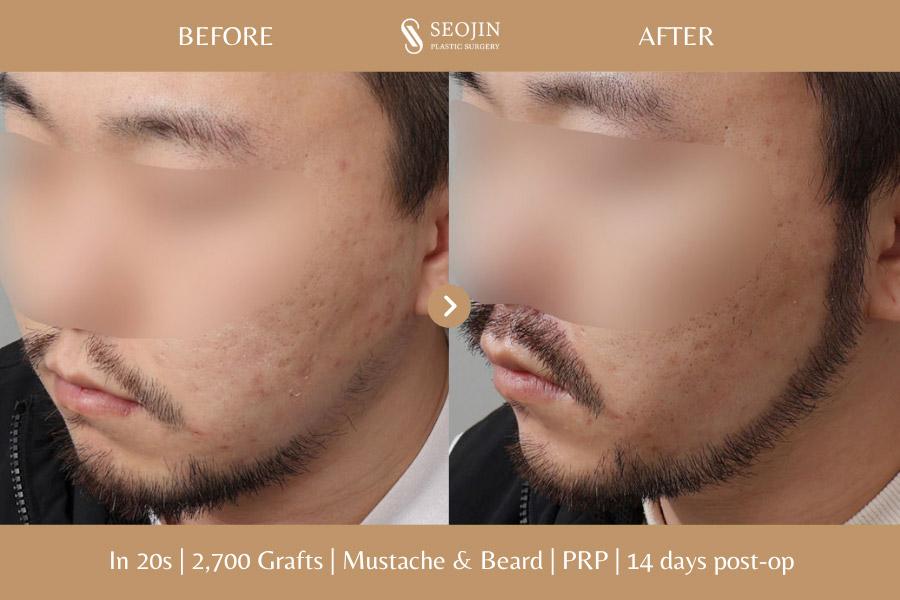
1. Seojin Plastic Surgery Clinic
For a beard hair transplant, Seojin Plastic Surgery Clinic offers beard transplantation within a hair-transplant practice that uses line-cut, no-cut, and mixed harvesting approaches. Your extraction and transplantation are performed by the head surgeon, with care provided in a one-doctor clinic model led by Dr. Lee Hyungmin.
- URL: Seojin Plastic Surgery Clinic Website
- Location: Gangnam-gu, Seoul
- Procedure approach:
- Beard transplantation is listed among the clinic’s special-area transplant services.
- The clinic offers line-cut, no-cut, and mixed approaches, allowing the method to be considered in relation to your donor supply and treatment plan.
- A cold follicle-separation room is used to preserve harvested follicles.
- The clinic describes techniques intended to reduce graft “popping,” in which previously placed hairs can be displaced during closely spaced implantation.
- Surgeon and experience:
- Dr. Lee Hyungmin provides end-to-end care in the clinic’s one-doctor model.
- The source states that Dr. Lee has more than 16 years of experience and was selected as one of Korea’s Top 100 Good Doctors in 2022.
- The clinic reports having performed more than 2,100 hair-transplant surgeries.
- Related hair services:
- Hairline gradation transplantation uses fine, medium, and thick hairs in sequence and designs placement around facial proportions.
- PRP hair transplantation combines follicles with PRP derived from your own blood; the clinic states this is intended to support graft survival and reduce inflammation.
- Eyebrow transplantation is also available, with customized eyebrow design created in collaboration with a semi-permanent tattoo designer.
2. Dream Hairline Clinic
For beard and mustache density enhancement, Dream Hairline Clinic offers facial-hair transplantation alongside several graft-harvesting options, including FUE, non-shaven FUE, strip surgery, and hybrid treatment. Your plan begins with assessment and consultation, then uses a design and graft count tailored to your goals.
- URL: Dream Hairline Clinic Website
- Location: Gangnam-gu, Seoul
- Procedure options:
- Shaven FUE harvests individual follicular units with a fine instrument; the clinic states that follicles containing one to four hairs are placed strategically for a natural-looking result.
- Non-shaven FUE leaves the donor area unshaven, which may suit you if you expect to return to work the following day.
- FUSS strip surgery with KNP suture is offered for higher graft requirements, while the hybrid technique combines FUSS volume with FUE placement precision.
- ARTAS robotic hair transplantation is also listed as an FUE-based option.
- Planning and treatment day:
- You receive a digital preliminary assessment followed by a detailed consultation and individualized treatment plan.
- You can work with the surgeon on the design and the number of grafts needed.
- The clinic describes local anesthesia, condition-based graft selection, and meticulous implantation according to the planned design.
- Aftercare and remote support:
- Post-procedure care includes hair washing and disinfection.
- The clinic provides medication packages that include hair-loss treatments and hair-growth nutrients.
- Follow-up support is available in person or online for local and international visitors.
- Video and phone consultations are available before travel.
3. Dana Plastic Surgery Clinic
Dana Plastic Surgery Clinic offers several hair-transplant harvesting approaches, particularly FUE, FUT, and non-shaven FUE, which may be relevant when you are discussing donor-hair options for a beard hair transplant. The provided information does not specifically confirm beard transplantation, so you should clarify whether the clinic performs facial-hair grafting and which technique suits your goals.
- URL: Dana Plastic Surgery Clinic Website
- Location: Gangnam-gu, Seoul
- Hair-transplant techniques:
- FUE extracts individual follicles from the donor area; the clinic describes it as minimally invasive with reduced scarring and recovery time.
- FUT uses a donor scalp strip that is divided into follicular units and is presented as an option for covering larger areas.
- Non-shaven FUE keeps the donor area unshaven, while long-hair non-shaven FUE is described as allowing grafts to be taken and implanted without shaving or trimming.
- Megasession treatment is listed at approximately 2,000 to 5,000 grafts in one session; a non-shaven FUE megasession is also offered.
- Related restoration services:
- Thin-hair laser treatment is offered to stimulate growth and improve hair thickness.
- Vellus-hair treatment is intended to encourage fine hairs to become thicker terminal hairs.
- Scalp micropigmentation is available for the appearance of hair density, including vertex-area treatment and scalp-scar camouflage.
- Care considerations:
- The clinic states that it provides comprehensive post-operative care and support.
- Ask specifically about facial-hair design, appropriate donor graft characteristics, expected healing, and aftercare if you are considering a beard procedure.
How Much Does a Beard Hair Transplant Cost in Korea?
A beard hair transplant is estimated at ₩5,000,000–₩12,000,000 (approximately US$3,700–US$8,900). Individual quotes vary because the surgical plan, graft requirement, and recipient-skin condition determine the work involved.
| Procedure Price | Korean Won (₩) | USD ($) |
|---|---|---|
| Low Price | ₩5,000,000 | $3,700 |
| High Price | ₩12,000,000 | $8,900 |
Exchange rate as of 2026-09-06: 1 KRW = 0.000741 USD.
What Affects the Price?
- Coverage area and graft requirement — Restoring a small goatee, moustache, sideburn, or patchy zone requires fewer grafts and recipient sites than building coverage across the cheeks, jawline, chin, and moustache. A larger design requires more donor harvesting, graft sorting, recipient-site creation, and implantation time; full-beard reconstruction can require a substantial donor commitment.
- Facial design and border placement — Highly visible beard borders typically require predominantly single-hair grafts placed at very acute, area-specific angles. Creating natural density gradients, symmetry, and changing directions across the cheeks, jawline, moustache, and chin increases the precision and time needed for recipient-site planning and implantation.
- FUE versus FUT harvesting — FUE removes follicular units individually through small donor-site incisions, requiring repeated extraction and graft handling. FUT removes a scalp strip that must be closed and microscopically divided into follicular units; it may suit selected larger harvests but requires strip excision, closure, and management of a permanent linear donor scar.
- Scarred recipient skin or staged density restoration — Transplanting into a healed facial scar requires assessment of scar stability and careful implantation into tissue with less predictable vascularity and graft uptake. Scarred areas may need a later density session after the first result matures, adding a separate surgical treatment rather than a routine cosmetic fill.
Cost tip: Request an itemized quote that states what is included, particularly the planned treatment areas, harvesting method, graft work, anesthesia or sedation plan, facility use, and early and remote follow-up.
The US$3,700–US$8,900 conversion is approximate, based on an exchange rate of 0.000741 on 2026-09-06. Check the exchange rate again when budgeting.
Beard Hair Transplant From Start to Finish
- Remote screening and English consultation — Send unfiltered photos of the front, oblique views, profiles, under-chin and jawline, plus the donor scalp. Disclose prior hair procedures, acne or folliculitis, keloid history, autoimmune disease, nicotine use, medicines, supplements, allergies, and previous facial scars. Confirm whether an English-speaking clinician or interpreter will be available.
- Travel and follow-up coordination — Agree on the planned arrival date, procedure date, early wash or review appointment, likely departure window, and remote follow-up schedule. Obtain the clinic’s policy on flight clearance and after-hours concerns in writing.
- In-person assessment and design — The surgeon examines donor density, scalp and facial skin, existing beard coverage, scar quality, hair caliber, and hair direction. Beard borders, density gradients, symmetry, and graft priorities are marked while upright. Dermoscopy and, when inflammatory or cicatricial disease is suspected, biopsy or dermatology assessment can be necessary.
- Medical review and consent — The team reviews bleeding risk, diabetes, blood pressure, allergies, current drugs, and prior procedures. Testing or medical clearance depends on health history, clinic policy, and whether sedation is planned. The consultation should address permanent donor scarring, uncertain graft yield in scars, grooming needs, and the possibility of a later density session.
- Anesthesia and donor harvest — Local anesthetic is injected into the donor and recipient areas; clinician-directed sedation is used only when planned. With FUE, individual follicular units are extracted through small punches. With FUT, a scalp strip is removed, the donor wound is closed, and the strip is dissected into grafts.
- Recipient-site creation and implantation — The surgeon creates tiny facial sites at acute, zone-specific angles, then places sorted grafts. Single-hair units are prioritized at visible borders. The operation is generally completed as an outpatient procedure, with same-day discharge after instructions and observation.
- Early recovery review in Korea — Return during the next several days for inspection of grafts, crusting, donor wounds, swelling, bleeding, and infection concerns. The team demonstrates the approved wash, moisturizing, and crust-care routine.
- Remote follow-up and result assessment — Send standardized photos after returning home. Implanted shafts commonly shed during early healing; new growth is often visible around month 3 and matures progressively through months 9–12. Discuss a second session only after the first result has declared, particularly in scarred skin.
Alternatives to a Beard Hair Transplant
The right alternative depends on the cause of hair absence. Surgery adds living follicles but commits limited scalp donor hair and requires months for growth; non-transplant reconstruction or medical treatment can be preferable when disease or scarring remains active.
Scalp Hair Transplant
- Best for — People who also have scalp hair loss and need a broader donor-reserve strategy.
- Tradeoff — Scalp hair transplantation treats scalp coverage rather than facial density. A surgeon must preserve enough donor reserve when both scalp and beard restoration are priorities.
Scar Hair Transplant
- Best for — A stable facial scar with sufficient blood supply that needs hair-bearing coverage.
- Tradeoff — Hair transplantation on a scar uses the same general principle but focuses on scar assessment and staged density. Evidence in cicatricial disorders is limited: a systematic review found only 15 reports involving 34 patients and warned of publication bias.
Sideburn Transplant
- Best for — Isolated sparse or absent sideburns rather than a full beard deficit.
- Tradeoff — A sideburn transplant requires fewer grafts and narrower design planning, but does not restore cheeks, jawline, moustache, or goatee.
Facial Masculinization Surgery
- Best for — Patients seeking broader skeletal or soft-tissue masculinization alongside, or instead of, facial-hair restoration.
- Tradeoff — Facial masculinization surgery changes facial structure; it does not create hair follicles. For transmasculine patients, assess beard transplantation after native facial-hair response to testosterone has had time to develop.
How Can I Prepare for a Beard Hair Transplant?
- Disclose every medicine and supplement — Provide prescriptions, over-the-counter products, injections, topical acne treatments, herbal products, vitamins, and allergies well before travel. Warfarin, apixaban, rivaroxaban, clopidogrel, aspirin, NSAIDs, isotretinoin, steroids, immunosuppressants, diabetes medicines, and blood-pressure medicines need an individualized plan. Never stop anticoagulant or antiplatelet medicine without agreement from the prescribing clinician and surgeon.
- Avoid nicotine under a clinician-approved plan — Tell the clinic about cigarettes, vaping, nicotine pouches, and nicotine replacement. Hair-transplant literature associates smoking with impaired healing and increased complications; follow the surgeon’s cessation timeframe rather than making an unplanned medication change.
- Protect the donor scalp and face — Avoid sunburn, tanning, facial waxing, aggressive exfoliation, and new or irritating skincare before surgery unless the clinic approves it. Report any acne flare, folliculitis, cold sore, rash, or open wound immediately; active infection requires postponement.
- Follow fasting instructions exactly — Local-anesthetic cases may have different rules from cases using sedation. If sedation is planned, comply with the clinic’s fasting instructions and do not drink alcohol or take unapproved sedating medicines.
- Arrange discharge support — Book private transportation and a responsible adult after sedation. Choose accommodation where head elevation, a clean pillowcase, and a short return trip for the early review are feasible.
- Plan travel conservatively — Arrive with time for the in-person consultation and reserve 5–7 postoperative days in Korea at minimum. Keep flights flexible because surgeon clearance, swelling, and early wound findings determine departure timing.
Travel note: Bring translated medication and allergy lists, dermatology or operative records, and beard and donor-scalp photographs from before hair loss or scarring when available.
Confirm the treating clinic’s specific fasting, medication, nicotine, skin-preparation, companion, and flight requirements; the operating doctor’s individualized instructions take precedence over general guidance.
Aftercare Advice
Protect implanted grafts from friction and follow the operating surgeon’s written cleansing protocol exactly during the first week.
- Days 0–2: prevent contact and swelling — Do not rub, scratch, press, or pick the recipient area. Avoid tight masks, helmet straps, clothing friction, and facial trauma. Sleep with the head elevated if instructed. Small amounts of oozing, swelling, bruising, numbness, and temporary discomfort with chewing can occur.
- Days 3–7: wash only as directed — Use only clinic-approved cleansing and moisturizing products, and do not remove crusts by picking. Published guidance has described keeping grafts moist for five days to reduce scabbing, but protocols differ between surgeons. Avoid strenuous exercise, heavy lifting, swimming, saunas, steam rooms, and alcohol while taking sedating medicine.
- Shaving and skin treatments — Do not shave, trim, dye, use chemical depilatories, undergo laser or light treatment, microneedle, peel, or apply irritating acne treatments over grafts until cleared. One review described shaving from around day 8, but this is not a universal rule.
- Sun and activity protection — Keep the face out of direct sun while it is inflamed or crusted. Once the surgeon permits routine skincare, use broad-spectrum SPF 50 on exposed healing skin and avoid contact sports until facial trauma no longer risks graft disturbance.
- Know the growth timeline — Implanted shafts often shed in the early weeks; this does not by itself mean graft failure. New growth often appears around month 3, coverage improves through months 4–9, and the most reliable result assessment is around months 9–12. Scars can require a later density session.
- Act on warning signs — Contact the operating team promptly for worsening pain, spreading redness or warmth, pus or foul drainage, fever, persistent bleeding, blisters, dark or gray skin, escalating donor-site pain, severe rash or allergy symptoms, or swelling that affects breathing or vision.
Follow the treating doctor’s instructions over these general timelines, attend scheduled reviews, and contact the clinic promptly when healing appears wrong.
Frequently Asked Questions
Related Blogs
Hairline Correction in Korea: Methods, Recovery, Travel Planning, and Risks
Hairline correction in Korea may use FUE or FUT transplantation, scalp advancement, or staged treatment to lower or reshape the hairline; costs range from ₩3,500,000–₩9,000,000 (about US$2,600–$6,700). The article covers candidate screening, clinic verification, minimum stays, recovery, aftercare, follow-up, and warning signs.
Updated: Sep 13, 2026
Hair Transplant in Korea: FUE vs FUT, Recovery, Travel Planning and Results
Hair transplantation uses FUE or FUT to redistribute donor follicles, with candidacy based on confirmed pattern loss, scalp health, donor supply, and realistic coverage goals. In Korea, prices are KRW 6,000,000–15,000,000; international patients can find guidance on stays, follow-up, recovery, and physician-role verification.
Updated: Sep 10, 2026
Hairline Correction in Korea: Methods, Recovery, Travel Planning, and Alternatives
Hairline correction uses FUE or FUT grafts to reshape the hairline or scalp advancement to lower the forehead immediately; candidacy depends on stable hair loss, donor supply, scalp laxity, and health assessment. In Korea, costs are KRW 3,500,000–9,000,000, with guidance on stay length, follow-up, recovery, clinic checks, and aftercare.
Updated: Sep 9, 2026
Hair Loss Treatment in Korea: Diagnosis, Medical Options, PRP, and Travel Planning
Hair loss treatment in Korea starts with scalp examination and trichoscopy, with medicines, PRP, LLLT, or testing selected according to the diagnosis. Costs are listed at ₩300,000–₩450,000 (about US$200–US$300); plan 1–3 business days and arrange local follow-up for ongoing care.
Updated: Sep 9, 2026
Clinics offering Beard Hair Transplant

Seojin Plastic Surgery Clinic Korea: Pioneering Advanced Cosmetic Procedures for Personalized Aesthetic Transformation
Apgujeong

Dream Hairline Clinic: Leading Hair Transplant Solutions in Korea for Natural-Looking Results
Apgujeong
Ok Hairline Hair Transplant Center Korea: 18 Years of Expertise in Natural Hairline Restoration and Hair Transplantation
Nonhyeon

Dana Plastic Surgery Clinic Korea: Advanced Hair Transplant and Restoration Techniques for Quality Results
Sinsa