
Medical Tourism Blog
Facial Botox in Korea: Types, Results, Safety, Recovery and Travel Planning

Table of contents
- Facial Botox at a Glance
- What Is Facial Botox?
- Who Is a Good Candidate for Facial Botox?
- What Are the Different Types of Facial Botox?
- Why Visit Korea for Facial Botox?
- Key Information for International Patients
- Which Are the Best Clinics in Korea for Chronic Migraine Relief?
- How Much Does Facial Botox Cost in Korea?
- Facial Botox From Start to Finish
- Alternatives to Facial Botox
- How Can I Prepare for Facial Botox?
- Aftercare Advice
Considering treatment in Korea? Everything you need to know e.g. — how to avoid scams, visas, interpreters, recovery tips — in our Medical Tourism Master Guide. Plan with confidence in minutes, not weeks!
Last updated: September 2026
Facial Botox at a Glance
- What it treats — Facial Botox is a non-surgical botulinum toxin type A injection that temporarily relaxes selected muscles, best suited to dynamic frown lines, forehead lines, and crow’s feet; it can also target selected lower-face muscles or true masseter enlargement.
- Korea cost — Facial Botox in Korea is listed at ₩100,000–₩750,000 (about US$100–$600), with pricing driven by the toxin product, total dose, number of areas, and whether masseter contouring or follow-up is included.
- Results and duration — Effects usually begin in 2–3 days and should be assessed at about 14 days; upper-face results commonly last 3–4 months. Masseter jawline contouring develops more slowly, often becoming clearest around 2–3 months.
- Recovery — There is usually no true downtime, although pinpoint redness, swelling, tenderness, or small bruises may last hours to a few days. Avoid rubbing treated areas, strenuous exercise, heat exposure, and heavy alcohol for about 24 hours.
- Travel and follow-up — One appointment day is generally sufficient, but international patients should ideally stay 1–2 days and arrange a photo or video review at 10–14 days. Same-day flying is physically possible if feeling well, though next-day departure is a conservative plan.
- Key suitability limit — Botox improves muscle-driven concerns, not deeply etched static lines, volume loss, major skin laxity, or jaw width caused by bone, fat, or salivary-gland bulk. Masseter treatment requires further dental or TMJ assessment when pain, clicking, locking, tooth wear, headaches, or severe clenching are present.
- Korea-specific check — Ask for the exact Korean prescription toxin brand, indication, lot or batch, total dose, and injection sites. “Botox” is often used generically, but units cannot be converted between brands, and some facial uses may be off-label in Korea.
What Is Facial Botox?
Facial Botox is a treatment using small injections of botulinum toxin to temporarily relax selected facial muscles. It softens expression-related lines and can reduce muscle-driven jaw width while preserving a natural range of movement when individualized. It is a non-surgical injectable procedure.
Who Is a Good Candidate for Facial Botox?
- Dynamic-line patients — Good candidates want temporary softening of expression lines in the glabella, forehead, or crow’s feet; lines that deepen with movement respond better than deeply etched lines visible at rest.
- Muscle-driven contour patients — Masseter Botox suits carefully assessed enlargement of the chewing muscle, not width caused by jawbone, parotid gland, buccal fat, or overall facial fat.
- Informed adults with follow-up access — Candidates accept a temporary result, can return or arrange a 10–14-day remote review, and understand that dose and injection points are individualized.
Facial Botox is elective treatment and should be deferred during pregnancy because human developmental-risk data are inadequate. Do not proceed with an infection, significant inflammation, or open lesion at an injection site; known allergy to the proposed toxin product; unexplained swallowing, speech, breathing, or generalized weakness; or a neuromuscular-junction disorder such as myasthenia gravis, Lambert-Eaton syndrome, or ALS without specialist and injector assessment. Baseline brow or eyelid droop, weak frontalis muscle, facial asymmetry, prior facial surgery, dry eye, bleeding disorders, and planned facial surgery require a tailored plan. For jaw-slimming requests with jaw locking, tooth wear, clicking, persistent pain, headaches, or severe clenching, obtain dental, TMJ, or orofacial-pain assessment rather than treating cosmetic contour alone.
What Are the Different Types of Facial Botox?
Facial botulinum toxin type A is selected by the target muscle and treatment goal. Several lower-face and neck uses are off-label depending on the exact product and Korean labeling.
- Upper-face wrinkle Botox — Glabellar frown-line treatment, forehead Botox, and crow’s-feet injections are the best-studied cosmetic targets. Results usually start in 2–3 days and are best assessed at about 14 days.
- Mid-face and nasal Botox — Small doses can address bunny lines, nasal flare, nasal-tip depression, and selected lower-eyelid lines. Conservative placement matters because expression and eye comfort can be affected.
- Lower-face expression Botox — Gummy-smile Botox, downturned mouth-corner treatment, chin-dimpling treatment, perioral lines, and selected asymmetries target specific overactive muscles. Overtreatment can alter smile symmetry, speech, straw use, or lip control.
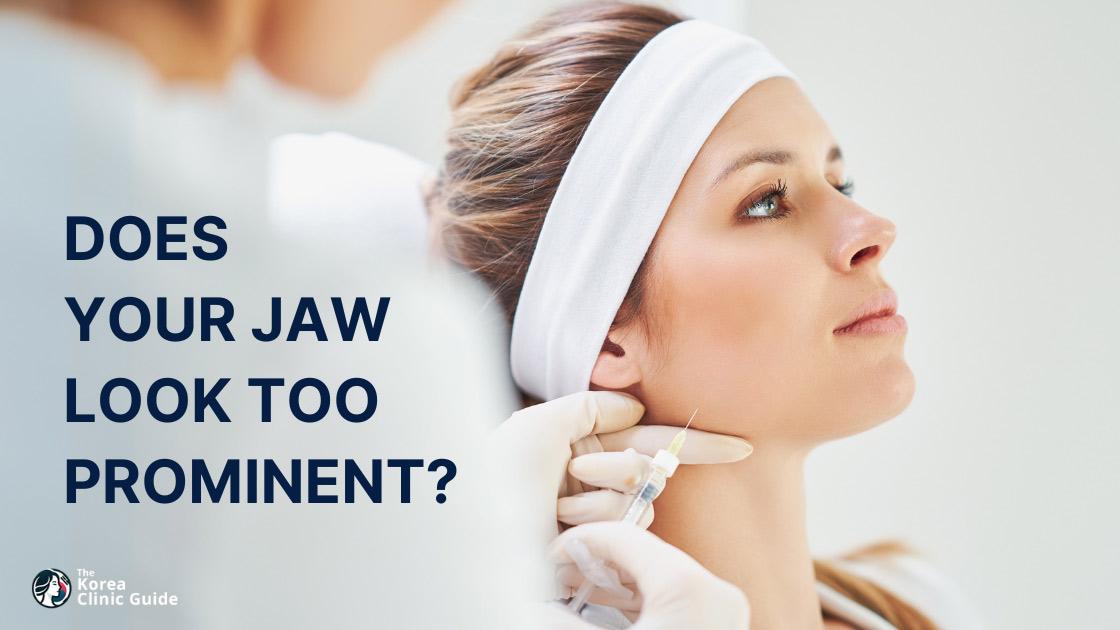
- Masseter Botox — Jawline-slimming injections reduce a true muscle contribution to lower-face width. Visible contour change is slower than wrinkle treatment and is often most evident around 2–3 months.
- Platysmal-band Botox — Neck injections address dynamic vertical platysmal bands, not loose skin or excess fat beneath the chin.
Why Visit Korea for Facial Botox?
Korea has an established international-patient market for aesthetic and medical care. This supports access and experience with overseas visitors, but it does not prove that a treatment in Korea is inherently safer or better than treatment elsewhere. Choose the injector and documented product, not the destination alone.
- Documented international-patient activity — Medical Korea/KHIDI reports approximately 1,170,467 foreign patients from 202 countries in 2024; dermatology accounted for 23% and plastic surgery for 12% of recorded most-visited departments. These are activity figures, not provider-quality measures.
- Named prescription products — The Korean MFDS English biologics listing identifies Neuronox, Innotox, and Coretox as prescription medicines and lists glabellar-wrinkle indications for specified adult age ranges.
- Product-level verification — “Botox” is frequently used as a generic term although it is a brand name. Ask for the exact brand, Korean indication, lot or batch, total dose, treatment sites, and date; toxin units are product-specific and cannot be converted across brands.
- Important limitation — The available English MFDS material does not provide a complete, current patient-friendly directory of every Korean toxin brand or every aesthetic indication. Confirm whether the proposed target is on-label or off-label with the treating clinician.
Key Information for International Patients
- Minimum stay — One day is generally enough for a straightforward facial injection appointment. Plan 1–2 days in Korea when feasible so early bruising, dizziness, asymmetry concerns, or an unexpected reaction can be discussed locally.
- Flight timing — No evidence-based aviation waiting period is defined for routine facial toxin injections. Flying later the same day is physically possible when feeling well; a next-day flight is a conservative itinerary.
- Appointment and review — Schedule a remote photo or video review at 10–14 days because the result cannot be judged immediately. Avoid booking a major touch-up immediately before departure.
- Recovery and itinerary impact — There is usually no true downtime. Pinpoint redness, swelling, tenderness, or small bruises can last hours to a few days, so plan around photos, weddings, business presentations, and strenuous activities.
- Masseter-specific planning — Lower-face contour change is often most evident around 2–3 months. Discuss chewing demands and repeat-treatment plans: small studies have measured temporary bite-force and muscle-function effects after masseter injections, while the long-term optimal dose and interval remain uncertain. One randomized study found functional adverse-effect signals after multiple treatments.
- Remote support — Leave with written aftercare, a direct clinic contact method, and a treatment record containing the product name, lot or batch, dose, and treated areas.
Travel note: A companion is not routinely required. Use a taxi or public transport instead of driving if anxiety, dizziness, blurred vision, weakness, or a sedating add-on medication affects you.
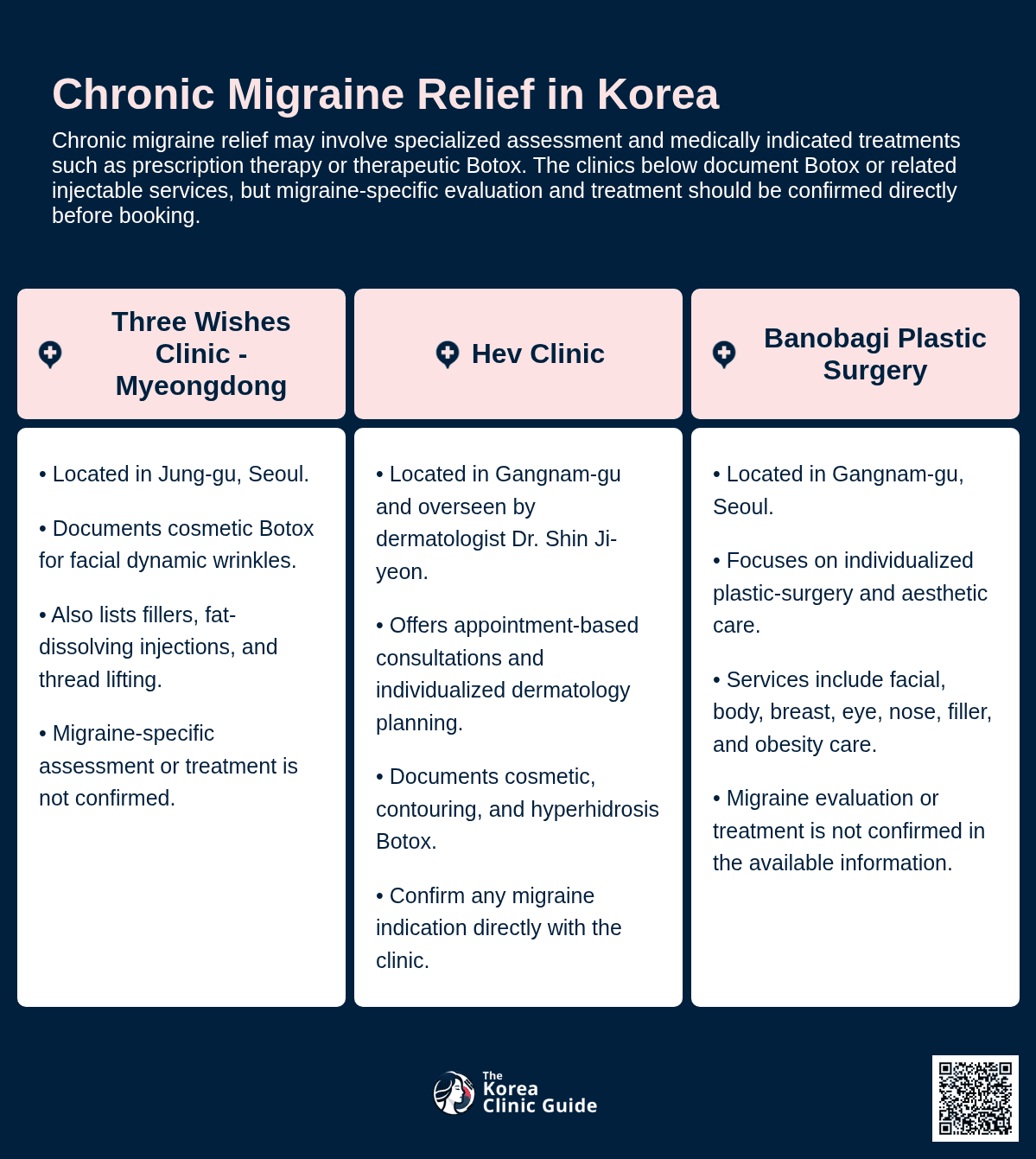
Which Are the Best Clinics in Korea for Chronic Migraine Relief?
Listed below are some of the best clinics in Korea for chronic migraine relief.
1. Three Wishes Clinic - Myeongdong
For chronic migraine relief, the available information does not confirm a migraine-specific evaluation or treatment program at this clinic. You can expect its documented injectable care to focus on cosmetic Botox for relaxing facial muscles and reducing dynamic wrinkles, rather than migraine management.
- URL: Three Wishes Clinic - Myeongdong Website
- Location: Jung-gu, Seoul
- Documented injectable service:
- Botox is described for cosmetic treatment of facial dynamic wrinkles, including crow’s feet and forehead lines, with minimal downtime.
- Other listed petite procedures include dermal fillers, fat-dissolving injections, and thread lifting.
2. Hev Clinic
For chronic migraine relief, the information provided does not establish a dedicated migraine treatment service at Hev Clinic. Its relevant documented option is Botox, which you may wish to discuss only to determine whether the clinic offers an appropriate medical indication beyond its described cosmetic wrinkle and contouring use.
- URL: Hev Clinic Website
- Location: Gangnam-gu, Seoul
- Clinician oversight:
- Board-certified dermatologist Dr. Shin Ji-yeon is described as overseeing consultation, procedures, and aftercare.
- The clinic uses an appointment-based private-care setting and AI-supported skin analysis for individualized dermatology planning.
- Documented Botox use:
- Botox is described as relaxing targeted facial muscles to soften dynamic wrinkles and refine facial contours.
- The clinic also lists sweat-control Botox for hyperhidrosis; neither description confirms chronic migraine treatment.
- Comfort approach:
- A non-sedation, pain-controlled anesthesia system is described as allowing real-time communication during injectable procedures.
- Cannula and needle techniques are described as intended to reduce discomfort associated with injections.
3. Banobagi Plastic Surgery
For chronic migraine relief, the available information does not confirm that Banobagi Plastic Surgery provides migraine evaluation or treatment. You may consider it only after confirming that it can address your specific needs, as its documented services are centered on individualized plastic-surgery care rather than headache medicine.
- URL: Banobagi Plastic Surgery Website
- Location: Gangnam-gu, Seoul
- Documented clinical focus:
- The clinic describes centers for facial contouring, body contouring, breast surgery, wrinkle surgery, eye surgery, nose surgery, filler and special surgery, and obesity care.
- It states that treatments are customized one-to-one and that unnecessary or excessive surgery is avoided.
How Much Does Facial Botox Cost in Korea?
Facial Botox is listed at ₩100,000–₩750,000 (approximately US$100–$600). Individual quotes vary because the treatment plan can range from a small upper-face wrinkle treatment to multi-area or masseter-focused injections requiring more product and injection planning.
| Procedure Price | Korean Won (₩) | USD ($) |
|---|---|---|
| Low Price | ₩100,000 | $100 |
| High Price | ₩750,000 | $600 |
Exchange rate as of 2026-09-06: 1 KRW = 0.000741 USD.
What Affects the Price?
- Treated facial areas — Treating one target such as glabellar frown lines requires fewer injection sites than a combined plan for the forehead, crow’s feet, bunny lines, chin, gummy smile, or platysmal bands. More anatomical areas require more assessment, placement work, and consumables.
- Masseter jaw-slimming treatment — Masseter Botox is a distinct muscle-contouring treatment rather than a routine wrinkle plan. It requires palpation and assessment of true masseter prominence, individualized bilateral injection planning, and discussion of chewing demands or jaw symptoms; it also commonly uses a greater treatment allocation than small expression-line targets.
- Product and total dose plan — The exact botulinum toxin brand/formulation and total dose are concrete parts of the prescription plan. Units are product-specific and cannot be converted across brands, so a quote should identify the product and the planned dose rather than presenting toxin units as interchangeable.
- Follow-up or touch-up planning — Results are normally assessed at about 10–14 days, not immediately after injection. A plan that includes an in-person or remote review, especially for multi-area treatment or asymmetry assessment, uses additional clinical follow-up resources.
Cost tip: Request an itemized quote stating what is included, including the exact toxin product, total dose, treated areas or injection map, consultation, and any scheduled 10–14-day review or touch-up policy.
The US$100–$600 conversion is approximate, based on the exchange rate dated 2026-09-06. Check the exchange rate again when budgeting.
Facial Botox From Start to Finish
- Remote inquiry and consultation — Send the requested unfiltered front, oblique, and side photographs at rest and during relevant expressions. State the exact goal, such as forehead lines, frown lines, crow’s feet, gummy smile, chin dimpling, or jaw slimming, and ask whether English or virtual consultation is available.
- Medical disclosure and travel planning — Report every previous toxin treatment, including brand and date if known; prior adverse reactions; facial operations; allergies; diagnoses; prescription and non-prescription medicines; and supplements. Arrange accommodation with reliable phone and internet access for follow-up.
- In-person facial assessment — The clinician evaluates facial movement, resting symmetry, brow and eyelid position, skin condition, and compensatory muscle activity. For masseter Botox, they palpate the muscle during clenching and distinguish muscle bulk from fat, gland, or bone-related jaw width.
- Product confirmation and consent — Confirm the exact toxin brand, intended indication, whether a target is off-label, anticipated benefits, limitations, risks, cost, and review plan. Baseline photographs are commonly taken; routine blood tests, imaging, and medical clearance are not usually required.
- Injection treatment — The skin is cleansed and a fine needle places toxin into selected facial muscles. Ice or topical anesthetic can be used; general anesthesia and routine sedation are not needed. Treatment duration depends on the number of areas but is generally brief.
- Discharge and first-day care — Leave shortly after treatment. Obtain the product name, lot or batch, total dose, injection map or treated areas, written aftercare, and clinic contact details. Do not massage treated areas or schedule demanding exercise and heat exposure that day.
- Settling period and follow-up — Effects usually begin in 2–3 days and should be assessed at around 14 days. Complete an in-person or secure remote review, rather than seeking automatic early additional injections; upper-face benefit commonly lasts about 3–4 months.
Alternatives to Facial Botox
The right alternative depends on the cause of the concern. Botox relaxes overactive muscle; it does not replace lost volume, resurface damaged skin, tighten substantial laxity, or reduce a bony square jaw. Surgical choices create more structural change but require longer recovery and carry different risks.
Facial Filler
- Best for — Volume loss, selected static folds, and contour deficits rather than muscle-driven lines.
- Tradeoff — Filler does not relax facial movement and has a distinct risk profile, including rare vascular occlusion. Read about facial filler.
HIFU or Ultrasound Lifting
- Best for — Selected mild skin laxity or soft-tissue descent.
- Tradeoff — HIFU does not stop frown-line muscle contraction and will not produce masseter-muscle reduction. See HIFU laser treatment or Ultherapy lifting.
Thread Lift
- Best for — Selected patients seeking non-surgical support for mild laxity.
- Tradeoff — Threads do not replace toxin for dynamic wrinkles and involve insertion-related recovery and risks. See thread lift.
Facelift or Brow Lift
- Best for — Substantial brow descent, excess skin, or facial tissue laxity.
- Tradeoff — Surgery provides structural repositioning but involves incisions, a longer recovery, and surgical risk. Explore a face lift.
Jaw-Contouring Surgery
- Best for — Lower-face width caused primarily by mandibular bone rather than enlarged masseter muscle.
- Tradeoff — This is major surgery, not a substitute for simple muscle relaxation. Consider face contouring only after anatomy-led surgical assessment.
How Can I Prepare for Facial Botox?
- Medicines and supplements — Bring a complete list and report toxin received within the previous four months, injected antibiotics, muscle relaxants, allergy or cold medicines, sleeping medicines, antiplatelets, anticoagulants, and supplements. Do not stop prescribed aspirin, clopidogrel, warfarin, apixaban, rivaroxaban, or other anticoagulant or antiplatelet medicine without instructions from the prescribing clinician and injector.
- Bruising discussion — Report NSAIDs, fish oil or omega-3, vitamin E, ginkgo, garlic supplements, alcohol use, and smoking. Many cosmetic-clinic avoidance rules have limited evidence; disclose products rather than independently stopping medically necessary treatment.
- Food and hydration — No fasting is normally required because ordinary facial Botox is performed without sedation. Eat normally and arrive hydrated unless another procedure is being combined.
- Skin condition — Reschedule for facial infection, open lesions, substantial rash, sunburn, or an active cold sore near a planned injection site.
- Expectations and records — Bring previous treatment records or photographs when possible. Ask the clinic to document the product, lot or batch, dose, injection sites, and plan for the 10–14-day review.
- Transport and accommodation — A companion is generally unnecessary. Book accommodation with dependable internet and avoid a fixed same-day flight when possible.
Travel note: Keep flights and important social events flexible until the early redness, bruising, and 10–14-day result review have passed.
Confirm the treating doctor’s clinic-specific requirements before treatment; individualized instructions take precedence over general guidance.
Aftercare Advice
Protect the injection sites, allow the result to settle, and contact the clinic promptly for symptoms that are more than mild and short-lived.
- First 24 hours — Keep sites clean and avoid rubbing, massage, gua sha, facials, and facial devices over treated areas for about 24 hours. Do not attempt to correct early unevenness with massage, extra toxin, or unverified products.
- Activity and heat — Postpone strenuous exercise, hot yoga, sauna or steam rooms, and heavy alcohol intake for approximately 24 hours. These are conservative clinic practices rather than universally proven toxin-spread prevention rules.
- Skin and bruising care — Apply makeup gently only after pinpoint bleeding has stopped and skin is clean. Use a cool compress for short-lived swelling or bruising; use daily broad-spectrum SPF 50 sunscreen to limit photoaging, while recognizing sunscreen does not extend toxin duration.
- Result timing — Do not judge the effect for about 14 days. Upper-face benefit commonly lasts 3–4 months; masseter contour change develops more slowly and is often clearest around 2–3 months.
- Urgent warning signs — Seek urgent medical care for trouble breathing, swallowing, or speaking; generalized weakness; hives, wheeze, face or throat swelling; major vision change; or rapidly worsening symptoms.
- Clinic-contact signs — Contact the injector promptly for significant eyelid droop, persistent eye pain or dryness, marked new asymmetry, infection signs, or meaningful mouth or chewing dysfunction.
Follow the treating doctor’s instructions over general advice and contact the clinic whenever something appears wrong.
Frequently Asked Questions
Related Blogs
Explore the Cost of Gummy Smile Botox: Why Korea Outshines the USA, Mexico, Turkey, and More
Discover the affordable world of Gummy Smile Botox treatments in Korea, where cutting-edge cosmetic procedures offer stunning results without breaking the bank. Learn about pricing, benefits, and what to expect from this increasingly popular smile-enhancing solution.
Updated: Sep 24, 2026
Mouth Corner Lift Botox in Korea: Candidacy, DAO Technique, Recovery, and Travel Planning
Mouth corner lift Botox uses targeted DAO injections, sometimes with platysma treatment, to temporarily soften muscle-driven downward mouth corners. The article covers candidacy, procedure steps, travel planning for Korea, aftercare, follow-up, risks, and alternatives for fixed folds or skin laxity.
Updated: Sep 23, 2026

Chin Botox in Korea: Mentalis Treatment, Recovery, Risks, and Travel Planning
Chin Botox uses individualized intramuscular injections into the mentalis muscles to soften dynamic chin dimpling, with effects assessed at 10–14 days and commonly fading after 3–4 months. The article covers candidate screening, Korea clinic and product verification, travel timing, preparation, aftercare, follow-up, and alternatives for structural chin concerns.
Updated: Sep 23, 2026
Masseter Botox in Korea: Candidacy, Results, Recovery and Travel Planning
Masseter Botox uses several fine-needle injections into the clenching masseter muscle to temporarily reduce muscle-led lower-face width, with contour results assessed at 8–12 weeks and typically fading in 3–6 months. The article covers candidate screening, Korea travel planning, preparation, aftercare, follow-up records, risks, and alternatives for dental, TMJ, fat, skin, or bone-related concerns.
Updated: Sep 23, 2026
Clinics offering Facial Botox

365mc Hospital: Korea's Leading Liposuction and Body Contouring Clinic with Innovative AI Technologies and Comprehensive Patient Care
Gyodae

THEPLUS Plastic Surgery Korea | Eye, Nose, Face & Body Surgery
Sinsa

Haru Clinic Korea | Seoul Facelift, Threads, Botox & Fillers
Sinsa

Hev Clinic Korea | Sinsa Skin, Laser & Injectables
Sinsa