
Medical Tourism Blog
Anal Bleaching in Korea: Methods, Safety, Recovery and Travel Planning
Table of contents
- Anal Bleaching at a Glance
- What Is Anal Bleaching?
- Who Is a Good Candidate for Anal Bleaching?
- How Is Anal Bleaching Performed?
- Why Visit Korea for Anal Bleaching?
- Key Information for International Patients
- Which Are the Best Clinics in Korea for Anal Bleaching?
- Anal Bleaching From Start to Finish
- Alternatives to Anal Bleaching
- How Can I Prepare for Anal Bleaching?
- Aftercare Advice
Considering treatment in Korea? Everything you need to know e.g. — how to avoid scams, visas, interpreters, recovery tips — in our Medical Tourism Master Guide. Plan with confidence in minutes, not weeks!
Last updated: September 2026
Anal Bleaching at a Glance
- What it treats — Anal bleaching is elective cosmetic lightening for intact external perianal skin only; it never treats the anal canal or rectal mucosa and aims for partial tone blending, not removal of natural pigment.
- Evidence gap — There is no validated anal-bleaching protocol, high-quality perianal-specific trial, or established standard for topical strengths, peel timing, laser settings, treatment intervals, or expected longevity.
- Who may be suitable — Potential candidates are adults with stable, even external darkening, intact skin, realistic expectations, and the ability to stop friction or irritating products while a clinician evaluates possible causes such as dermatitis, itching, moisture, or bowel leakage.
- Recovery and results — Topical plans have no procedural downtime but can irritate skin in the first days, with fading assessed over weeks to months; superficial peels or laser may cause redness, tenderness, swelling, dryness, or peeling for several days, with pigment changes taking weeks to judge.
- Key risk — Irritation can worsen pigmentation or cause patchy lightening, fissures, erosions, infection, burns, or scarring; peel and laser risks are particularly important on this thin, moist, friction-prone area and for people prone to post-inflammatory dark marks.
- Korea travel planning — Allow 1–2 days for a topical-only assessment, or 3–5 days for a peel or energy-based treatment so a 24–72-hour review can rule out early blistering, swelling, infection, or burns before departure.
- Korea distinction — Korea offers registered international-patient institutions with malpractice-insurance requirements, but no evidence shows Korean anal bleaching is safer or more effective; verify registration and obtain English documentation of ingredients, concentrations or device settings, and aftercare.
What Is Anal Bleaching?
Anal bleaching is an elective cosmetic approach to lighten or blend darker pigment on intact external skin around the anus. It addresses appearance concerns about uneven perianal tone, not itching, pain, bleeding, bowel symptoms, or conditions affecting the anal canal. Treatment is usually non-surgical with topical products, while selected cases use minimally invasive superficial peels or energy-based treatment.
Who Is a Good Candidate for Anal Bleaching?
- Stable external pigmentation — Good candidates are adults with longstanding, even-toned darkening on intact skin around the anus who want a modest cosmetic blending effect rather than complete removal of natural pigment.
- Cause assessed first — Suitable patients can pause irritating grooming and products while a clinician checks for friction, moisture, itching, bowel leakage, dermatitis, or another cause of post-inflammatory hyperpigmentation.
- Realistic expectations — Candidates accept that anal bleaching is a consumer term rather than a standardized medical procedure, that improvement is gradual and partial, and that perianal-specific clinical evidence is lacking.
- Reliable aftercare access — International patients need a private, hygienic recovery setting and a plan for in-person care at home if pain, blistering, infection, or a serious rash develops.
Do not treat new, changing, asymmetric, rapidly spreading, painful, ulcerated, bleeding, or itchy pigmentation as a cosmetic concern until it has been examined; dermoscopy, swabs, patch testing, or biopsy can be appropriate when findings are atypical. Active eczema, psoriasis, lichen sclerosus, fissures, bleeding hemorrhoids, infection, open skin, diarrhea, fecal leakage, and recent shaving or waxing require treatment and barrier recovery first. Postpone elective lightening during pregnancy, attempts to conceive, or breastfeeding unless the prescriber specifically confirms that the proposed treatment is appropriate; do not self-start hydroquinone, tretinoin, retinoids, or peels. A history of dark marks after inflammation, light patches, abnormal scarring, or a darker Fitzpatrick phototype calls for particularly conservative counseling because irritation can worsen pigment. Immunosuppression, poorly controlled diabetes, impaired healing, and anticoagulant-related bleeding concerns require medical assessment before a peel or energy-based procedure.
How Is Anal Bleaching Performed?
There is no validated anal-bleaching protocol. Methods differ substantially in risk, and all treatment is limited to intact external perianal skin—never the anal canal or rectal mucosa.
- Cause control and observation — This is the lowest-risk starting point. The clinician addresses friction, moisture, tight clothing, fragranced wipes, irritating hemorrhoid products, grooming injury, itch, dermatitis, infection, or bowel leakage that can sustain pigmentation.
- Clinician-directed topical regimen — Depending on the diagnosis, a doctor may consider limited use of hydroquinone, tretinoin or another retinoid, azelaic acid, kojic acid, arbutin, or niacinamide. Evidence for several agents comes mainly from pigment conditions at other body sites, not from perianal skin; there is no evidence-based concentration, frequency, or maximum treatment duration for this area.
- Conservative superficial peel — A clinician may selectively use a brief, superficial chemical exfoliation on intact external skin. Facial peel formulas and timing cannot be transferred to thin, moist, occluded perianal skin, where a burn or erosion can lead to prolonged pigment change.
- Laser or energy-based pigment treatment — This is not a routine first-line approach. A systematic review of post-inflammatory hyperpigmentation treatment in skin of color found variable outcomes and laser-related worsening in some cases; its evidence was mainly facial and does not establish safe perianal device settings, wavelengths, or session intervals.
Why Visit Korea for Anal Bleaching?
Korea offers an established international-patient pathway, but no research shows that anal bleaching performed in Korea produces better results or fewer complications than treatment elsewhere. The practical value is access to an in-person assessment and coordinated records rather than a proven Korean-specific protocol. Given the evidence gap, choose clinical scrutiny over package claims.
- International-patient registration framework — Medical Korea’s registered-institution system states that registered institutions accepting international patients are subject to registration requirements and medical-malpractice liability insurance requirements. Verify the facility’s status independently.
- In-person external examination — Travel allows a physician to determine whether pigmentation is confined to external skin and whether dermatitis, infection, fissures, hemorrhoids, or a suspicious lesion should be addressed before cosmetic treatment.
- Written treatment documentation — Request an English record listing the assessment, product names, active ingredients and concentrations, or device settings, as well as aftercare and an urgent-contact route. This is especially important because there is no standardized perianal regimen.
- Evidence limitation — No high-quality randomized trials, professional-society guidance, or validated protocols specifically support elective external perianal lightening. Broader pigment research cannot confirm safety or effectiveness on this anatomical site.
Key Information for International Patients
- Minimum stay — Plan 1–2 days for a topical-only assessment, provided the doctor can examine the external skin and give written instructions before departure. For a peel or energy-based treatment, plan 3–5 days so an early review can exclude blistering, marked swelling, infection, or an evolving burn.
- Repeat visits — Do not book repeat sessions in advance solely because a package includes them. Topical response unfolds over weeks to months; any repeat peel or laser depends on tolerance, pigment response, and whether irritation has recurred.
- Flying home — After topical-only care, flying is generally reasonable once instructions are understood and no early reaction appears, often the same or following day. After a peel or laser, remain in Korea for review at 24–72 hours and postpone travel for severe pain, erosions, drainage, fever, blistering, marked swelling, or worsening pigment.
- Itinerary impact — Topical treatment has no procedural downtime, but irritation can emerge over the following days. Peels and laser can cause several days of redness, tenderness, swelling, dryness, or peeling; avoid planning long walks, cycling, spas, swimming, or intimate activity immediately afterward.
- Remote follow-up — Confirm who will respond after departure, how photographs can be sent securely, and where to obtain local in-person care. Coordinator contact does not replace a local clinician for a complication.
- Medication return rules — U.S. travelers should declare medicines, keep them in original packaging, carry a prescription or clinician’s note, and limit quantities to personal use. A foreign prescription does not guarantee that a product will be admitted into the United States.
Travel note: Arrange flexible flights and identify a doctor at home before any peel or laser. An adverse reaction in this friction-prone area is difficult to assess and manage remotely.
Which Are the Best Clinics in Korea for Anal Bleaching?
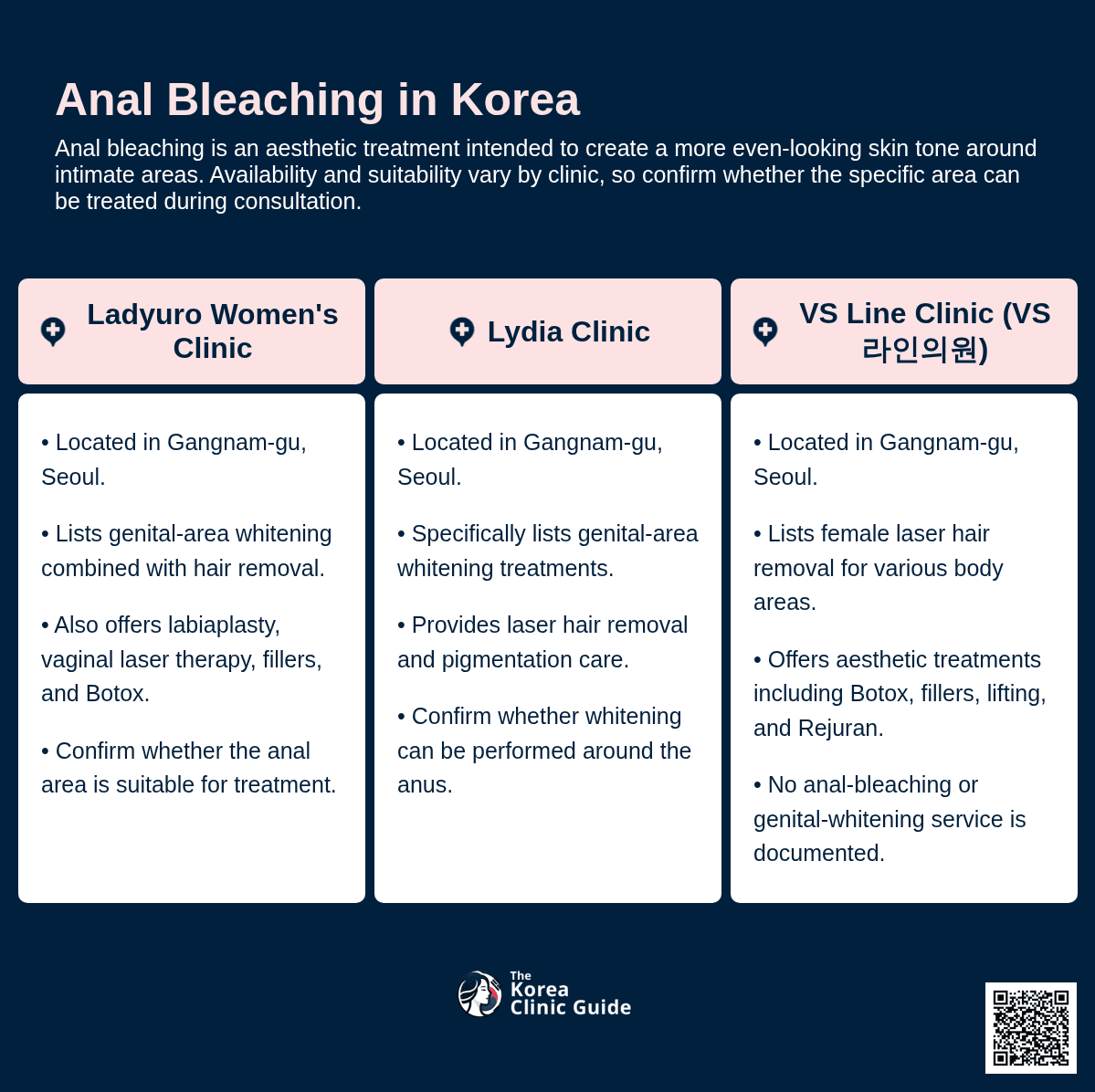
Listed below are some of the best clinics in Korea for anal bleaching.
1. Ladyuro Women's Clinic
You may consider Ladyuro Women's Clinic if you are seeking aesthetic care for intimate areas, as its listed whitening/depilation service combines genital-area skin whitening with hair removal to support a smoother appearance and more even-looking skin tone. The available information does not specifically confirm an anal-bleaching protocol, so you would need to verify treatment suitability for that area.
- URL: Ladyuro Women's Clinic Website
- Location: Gangnam-gu, Seoul
- Relevant intimate-area services:
- Whitening/depilation combines skin-whitening and hair-removal treatments for the genital area.
- Labiaplasty, vaginal laser therapy, vaginal filler, and Botox are also listed among the clinic’s aesthetic services.
- Additional considerations: The clinic also lists STD and comprehensive AIDS testing, cervical cancer screening and HPV vaccination, and treatment for vaginitis or bladder inflammation.
2. Lydia Clinic
You may consider Lydia Clinic for pigmentation-focused intimate-area care because it specifically lists genital-area whitening among its whitening and pigmentation treatments. While the source does not state that anal bleaching is offered, the clinic’s genital whitening service is the most relevant listed option, and you would need to confirm whether the intended area can be treated.
- URL: Lydia Clinic Website
- Location: Gangnam-gu, Seoul
- Whitening and pigmentation services:
- Genital-area whitening is listed alongside areola/nipple, underarm, and elbow whitening treatments.
- Mole and wart removal is also listed within the clinic’s pigmentation-related services.
- Related aesthetic services:
- Laser hair removal is available for unwanted hair on various body areas.
- The clinic also lists labiaplasty, clitoral hood reduction, and multiple vaginal-tightening options.
3. VS Line Clinic (VS라인의원)
You may want to contact VS Line Clinic to confirm whether it provides anal bleaching before choosing it for this procedure: the supplied service list focuses on facial aesthetic treatments, skin rejuvenation, lifting, and female laser hair removal, and it does not identify anal or genital whitening as an offered treatment.
- URL: VS Line Clinic (VS라인의원) Website
- Location: Gangnam-gu, Seoul
- Listed services relevant to grooming: Female laser hair removal is listed, using Clarity II and Apogee Plus lasers across various body areas.
- What is documented:
- The clinic’s listed treatments include Botox, ultrasound and radiofrequency skin-tightening treatments, fillers, thread lifting, and Rejuran skin rejuvenation.
- No anal-bleaching or genital-whitening treatment is specified in the available information.
Anal Bleaching From Start to Finish
- First contact and virtual screening — Ask whether an English or virtual consultation is available. Send unedited, well-lit photographs only through a secure medical channel, and ask which physician will examine the area, the proposed method, exact ingredients or device, likely number of visits, and complication plan.
- Medical history review — Disclose the duration and change in pigment; itching, pain, bleeding, discharge, bowel leakage, or bowel symptoms; allergies; shaving or waxing; fragranced products; prior bleaching; pregnancy possibility; medicines; supplements; diabetes; immune conditions; and prior pigment or scar problems.
- In-person examination — The physician examines the external perianal skin to confirm that it is intact and to exclude active dermatitis, infection, fissures, hemorrhoidal bleeding, or suspicious lesions. Atypical findings can require swabs, patch testing, dermoscopy, biopsy, or referral instead of cosmetic treatment.
- Method selection or test area — For suitable skin, the doctor may recommend trigger control alone, a cautious topical plan, or, less commonly, a superficial peel or energy-based treatment. A limited topical tolerance test or conservative test spot with delayed reassessment can be sensible, but neither is a validated perianal protocol.
- Treatment day — External skin is cleansed and surrounding tissue protected. Topical treatment is prescribed or applied, while a peel or device treatment is brief and deliberately conservative; topical anesthetic, sedation, and fasting are generally unnecessary unless a clinic has a specific reason to use them. The anal canal is not treated.
- Discharge and early review — Leave with written instructions, product details, warning signs, and a contact method. After a peel or laser, attend the planned early review before flying.
- Remote follow-up — Report persistent burning, cracking, sores, swelling, or pigment worsening promptly. Share secure photographs only when requested, and seek local in-person assessment for severe symptoms rather than waiting for an overseas reply.
Alternatives to Anal Bleaching
The safest alternative is often to leave normal anogenital color unchanged or address what is driving the darkening. Compared with lightening procedures, cause-focused treatment has a clearer medical purpose and avoids exposing sensitive perianal skin to pigment-active chemicals, acids, or heat.
Cause-focused dermatology care
- Confirmed dermatitis or itch — Treat contact dermatitis, eczema, psoriasis, lichen sclerosus, infection, grooming injury, or pruritus before reconsidering appearance concerns.
- Moisture and friction control — Address fecal leakage, sweating, tight clothing, harsh cleansing, and irritating wipes or topical products that can perpetuate inflammation and post-inflammatory darkening.
Observation and cosmetic camouflage
- Natural variation — A darker perianal ring is often benign. Choosing no treatment eliminates procedure-related risks such as burns, scarring, patchy lightening, and worsening pigmentation.
- Temporary coverage — Cosmetic camouflage changes appearance without altering the skin, but do not apply products to irritated, broken, or mucosal skin.
Dermatologist-supervised pigment treatment elsewhere
- Different anatomical site — For pigment concerns on less sensitive skin, pigmentation treatment, chemical peeling, or laser toning can be discussed separately. Evidence from those sites does not validate their use around the anus.
- Related intimate-area concerns — Labia majora whitening concerns different anatomy and should receive its own examination and risk assessment.
How Can I Prepare for Anal Bleaching?
- Stop self-directed whitening products — Do not use online “intimate whitening” kits before travel. Bring photographs or packaging of every product already used; the FDA warns that unregulated lighteners can contain mercury or hydroquinone, with reported harms including rash, swelling, and potentially permanent ochronosis.
- Calm the treatment area — Avoid fragranced wipes, soaps, deodorant sprays, scrubs, depilatories, benzoyl peroxide, strong acids, retinoids, abrasive exfoliation, and unprescribed bleaching products. Do not shave, wax, or undergo hair removal near the area until the skin is calm and the treating clinician provides a schedule.
- Disclose medicines and supplements — Give complete names and doses of anticoagulants, antiplatelet drugs, diabetes medicines, immunosuppressants, acne medicines, herbal supplements, and prior topical treatments. Do not stop prescribed medication independently; the clinician decides whether topical retinoids, hydroquinone, acids, or exfoliants need a temporary pause before a peel or laser.
- Fasting, alcohol, and nicotine — Topical care, superficial peels, and most pigment-device sessions do not require fasting unless sedation is planned. Follow clinic alcohol instructions, and avoid smoking, vaping, and nicotine because delayed healing and inflammation can worsen pigment outcomes.
- Plan recovery logistics — Book accommodation with a private bathroom, gentle bathing access, and laundry. A companion is usually unnecessary for topical-only care but is sensible for sedation, severe anxiety, limited mobility, or a more painful procedure.
- Keep travel flexible — Schedule no peel or laser at the end of the trip. Retain time for an early review and delay departure if there is pain, marked swelling, blistering, or drainage.
Travel note: Ask for the exact active ingredients and concentrations, or the device name and intended settings, in writing before committing to treatment.
Confirm all medication pauses, grooming restrictions, fasting instructions, and travel timing with the treating doctor; individualized instructions take precedence over general guidance.
Aftercare Advice
Protect the skin barrier and stop irritation early; pushing through burning or peeling can turn a cosmetic treatment into prolonged post-inflammatory pigment change.
- Clean gently — Use only clinician-approved products. Clean with lukewarm water or an approved non-irritating cleanser, then pat dry rather than rubbing; wear loose, breathable underwear.
- Use prescribed products exactly — Apply only the directed amount to external intact skin. Do not add acids, retinoids, hydroquinone, exfoliants, fragranced products, or over-the-counter intimate-lightening products unless the treating doctor explicitly approves them.
- Avoid friction and heat — Avoid cycling, strenuous lower-body exercise, prolonged sweating, hot baths, saunas, swimming, shaving, waxing, and sexual activity including anal intercourse until tenderness, peeling, or skin breakdown has fully resolved and the clinician approves resumption.
- Protect exposed surrounding skin — Use SPF 50 on any treated skin that could be exposed to sunlight. Do not apply sunscreen inside the anal area or onto irritated or broken skin.
- Know when to seek help — Stop a topical product and contact the clinic for persistent burning, marked redness, swelling, cracking, sores, or darkening. Seek urgent in-person assessment for escalating pain, extensive blistering, pus, fever, spreading redness, ulceration, difficulty passing stool or urine, significant bleeding, or allergic symptoms.
- Judge results slowly — Topical fading takes weeks to months. Redness, dryness, tenderness, swelling, or peeling after a superficial peel or laser can last several days, and pigment change takes weeks to declare; no validated anal-bleaching recovery timetable or guaranteed endpoint exists.
Follow the treating doctor’s instructions over this general advice, and contact the clinic promptly when healing appears abnormal.
Frequently Asked Questions
Related Blogs
Effective Acne Treatment for Back Acne in Korea: Clear Skin Solutions
Discover how Korea leads in advanced back acne (bacne) treatment with innovative procedures like laser therapy, chemical peels, microneedling, and IPL. This comprehensive guide explores treatment options, costs, and what medical tourists can expect when seeking acne care in Korea. Learn about personalized plans from top Korean dermatology clinics, the benefits of affordable, high-tech solutions, a
Updated: Nov 1, 2026
Effective Acne Treatment for Active Acne Breakouts in Korea: Clear Skin Solutions
Discover how Korea leads in effective, affordable treatment for active acne, including inflamed papules and pustules. This comprehensive guide explores advanced procedures like laser therapy, chemical peels, and topical and oral medications, highlighting Korea’s top dermatology clinics specializing in acne vulgaris. Learn how medical tourism in Korea offers patients expert care, cutting-edge techn
Updated: Nov 1, 2026
Effective Skin Whitening Treatment for Postpartum Pigmentation in Korea: Restore Your Radiant Skin Today
Discover effective solutions for postpartum pigmentation in Korea, including laser therapies, chemical peels, microneedling, and glutathione injections. This comprehensive guide highlights Korean expertise in skin whitening procedures, safe treatment options, costs, and patient outcomes. Whether addressing melasma, darkened areolas, or linea nigra, Korea offers advanced, affordable treatments mana
Updated: Oct 31, 2026

Effective Peeling Treatments for T-Zone Blackheads in Korea: Clear Skin Solutions
Discover how Korea leads in treating T-zone blackheads and clogged nose comedones through advanced peeling procedures like chemical peels, microdermabrasion, and laser treatments. This comprehensive guide highlights the benefits of professional skincare in Korea, detailing costs, patient experiences, and the medical tourism process. Learn why Korea is top destination for effective, affordable blac
Updated: Oct 31, 2026
Clinics offering Anal Bleaching

Ladyuro Women's Clinic in Korea: Premier Destination for Vaginal Rejuvenation and Aesthetic Enhancements
Sinsa

Lydia Clinic Korea: Leading Enhancement of Women's Health and Beauty with Specialized Medical Procedures
Gangnam Station
Lalian Cheongdam Clinic Korea | Premium Dermatology & Aesthetic Treatments
Cheongdam

VS Line Clinic (VS라인의원) in Korea: Offering Personalized Cosmetic Treatments for Wrinkles, Skin Rejuvenation, and More
Apgujeong