Medical Tourism Blog
Discover Acupuncture Costs Abroad: How Korea Stacks Up Against the USA, Mexico, Turkey, and Thailand
Table of contents
- Best Clinics in Korea for Acupuncture
- Cost of Acupuncture in Korea
- What Is Usually Included in Cost of Acupuncture in Korea
- Factors Influencing the Cost of Acupuncture in Korea
- Comparing the Cost of Acupuncture: Korea vs the Rest of the World
- Cost of Coming To Korea for Acupuncture
Considering treatment in Korea? Everything you need to know e.g. — how to avoid scams, visas, interpreters, recovery tips — in our Medical Tourism Master Guide. Plan with confidence in minutes, not weeks!
Have you ever wondered how much it would cost to experience one of the world's oldest healing practices in a modern setting like Korea? Acupuncture, deeply rooted in tradition yet widely accessible in contemporary clinics across Korea, offers a range of treatments that are both effective and affordable. Whether you’re drawn by the allure of holistic health care or simply curious about trying alternative medicine, understanding the costs involved helps in making informed decisions. From basic sessions starting at just a few dollars to more specialized treatments, Korea provides diverse options for both locals and international visitors.
Best Clinics in Korea for Acupuncture
Listed below are the best clinics in Korea for acupuncture:
| Clinic Name | Key Features | Special Techniques |
|---|---|---|
| Plus Minus Oriental Clinic | Best-suited for Cost Acupuncture because treatments are designed around individual needs, reducing unnecessary sessions and focusing on targeted outcomes. Strong weight-management focus, including High-Concentration Hwanggeumhwan to support metabolism and appetite control, plus bespoke herbal formulas tailored to specific goals. Postpartum weight loss programs that prioritize safe recovery with customized herbal medicine and dietary guidance, ideal for structured, budget-conscious care. Anti-edema herbal medicine and detox programs that support circulation, reduce water retention, and promote overall balance—often paired effectively with acupuncture. High-demand aesthetic correction options, including facial asymmetry correction and facial contouring correction using non-surgical techniques that may incorporate acupuncture and specialized herbal support. Home facial training guidance to help patients maintain results between visits, improving efficiency and long-term value. Broader care coverage beyond aesthetics, including treatment for facial flushing, energy and stamina boosting, and female hair loss treatment with customized acupuncture and herbal plans. Consistently holistic approach, integrating acupuncture, herbal medicine, and lifestyle guidance to support sustainable results rather than short-term fixes. | Acupuncture and herbal medicine tailored to body type, goals, and lifestyle; includes High-Concentration Hwanggeumhwan for weight management; postpartum weight loss with customized herbal medicine and dietary guidance; anti-edema herbal medicine and detox programs; non-surgical facial correction and contouring; home facial training guidance; holistic care covering facial flushing, energy and stamina, and hair loss; integrated lifestyle guidance for sustainable results. |
| Teo Korean Medicine Clinic - Gangnam Website | Comprehensive traditional Korean medical care including cost acupuncture; acupuncture and Chuna therapy; musculoskeletal and pain-focused care; treats digestive disorders (functional dyspepsia, gastroesophageal reflux), women’s health (menopause management, infertility), special conditions (shingles, rheumatoid arthritis), and skin conditions (wart and corn removal, atopic dermatitis, psoriasis); individualized constitutional improvement and dietary treatment programs available; online booking available. | Chuna therapy for spinal and joint alignment; disc-focused programs; acupotomy for releasing adhesions and scar tissue; treatment options for straight neck and turtle neck, frozen shoulder, rotator cuff injuries, tennis/golf elbow, plantar fasciitis; dietary treatment; constitution-based care; online booking. |
| Teo Korean Medicine Clinic - Bundang Website | Teo Korean Medicine Clinic – Bundang Branch is a Korean medicine clinic where patients seeking Cost Acupuncture can also access a broad spectrum of holistic, specialized care designed to address both pain and underlying functional imbalances. The clinic’s musculoskeletal services include Chuna Therapy for gentle manual correction and improved mobility, acupotomy for releasing adhesions and scar tissue, and disc-focused programs aimed at relieving spinal pain and restoring function. Patients with modern posture-related concerns can find targeted care for straight neck and turtle neck, as well as treatment options for frozen shoulder, rotator cuff injuries, tennis/golf elbow, and plantar fasciitis. Beyond pain care, the Bundang clinic provides integrative programs for digestive conditions such as functional dyspepsia, GERD, and IBS, along with women’s health support for menopausal disorders, infertility, and PCOS. It also offers treatment pathways for shingles, rheumatoid arthritis (including pain management), post-traffic accident recovery, and chronic skin concerns such as warts, corns, atopic dermatitis, and psoriasis. With additional services for body shape correction and customized diet plans for weight and health goals, Teo Korean Medicine Clinic – Bundang Branch positions Cost Acupuncture within a comprehensive, whole-person approach that combines traditional Korean medicine with modern therapeutic techniques. | Chuna Therapy for manual correction and mobility; acupotomy for adhesions and scar tissue; disc-focused programs for spinal pain; straight neck and turtle neck; treatment options for frozen shoulder, rotator cuff injuries, tennis/golf elbow, and plantar fasciitis; integrative programs for digestive conditions (functional dyspepsia, GERD, IBS) and women’s health (menopausal disorders, infertility, PCOS); shingles, rheumatoid arthritis; post-traffic accident recovery; chronic skin concerns (warts, corns, atopic dermatitis, psoriasis); body shape correction and customized diet plans; whole-person approach. |
Plus Minus Oriental Clinic
Plus Minus Oriental Clinic in Seocho is a specialized Korean medicine clinic known for delivering highly personalized, results-focused care that aligns perfectly with what patients look for in Cost Acupuncture: efficient treatment plans without compromising on precision. With a broad menu of health and aesthetic programs—from weight management and postpartum recovery to facial asymmetry correction and skin-related concerns—the clinic is built around tailoring acupuncture and herbal medicine to each individual’s body type, goals, and lifestyle. This depth of customization, combined with its holistic approach rooted in traditional Oriental medicine, makes Plus Minus Oriental Clinic a top choice for anyone seeking Cost Acupuncture in Korea with clear direction, careful planning, and comprehensive support.
- Best-suited for Cost Acupuncture because treatments are designed around individual needs, reducing unnecessary sessions and focusing on targeted outcomes.
- Strong weight-management focus, including High-Concentration Hwanggeumhwan to support metabolism and appetite control, plus bespoke herbal formulas tailored to specific goals.
- Postpartum weight loss programs that prioritize safe recovery with customized herbal medicine and dietary guidance, ideal for structured, budget-conscious care.
- Anti-edema herbal medicine and detox programs that support circulation, reduce water retention, and promote overall balance—often paired effectively with acupuncture.
- High-demand aesthetic correction options, including facial asymmetry correction and facial contouring correction using non-surgical techniques that may incorporate acupuncture and specialized herbal support.
- Home facial training guidance to help patients maintain results between visits, improving efficiency and long-term value.
- Broader care coverage beyond aesthetics, including treatment for facial flushing, energy and stamina boosting, and female hair loss treatment with customized acupuncture and herbal plans.
- Consistently holistic approach, integrating acupuncture, herbal medicine, and lifestyle guidance to support sustainable results rather than short-term fixes.
Find more about this clinic here: Plus Minus Oriental Clinic Website
Teo Korean Medicine Clinic - Gangnam
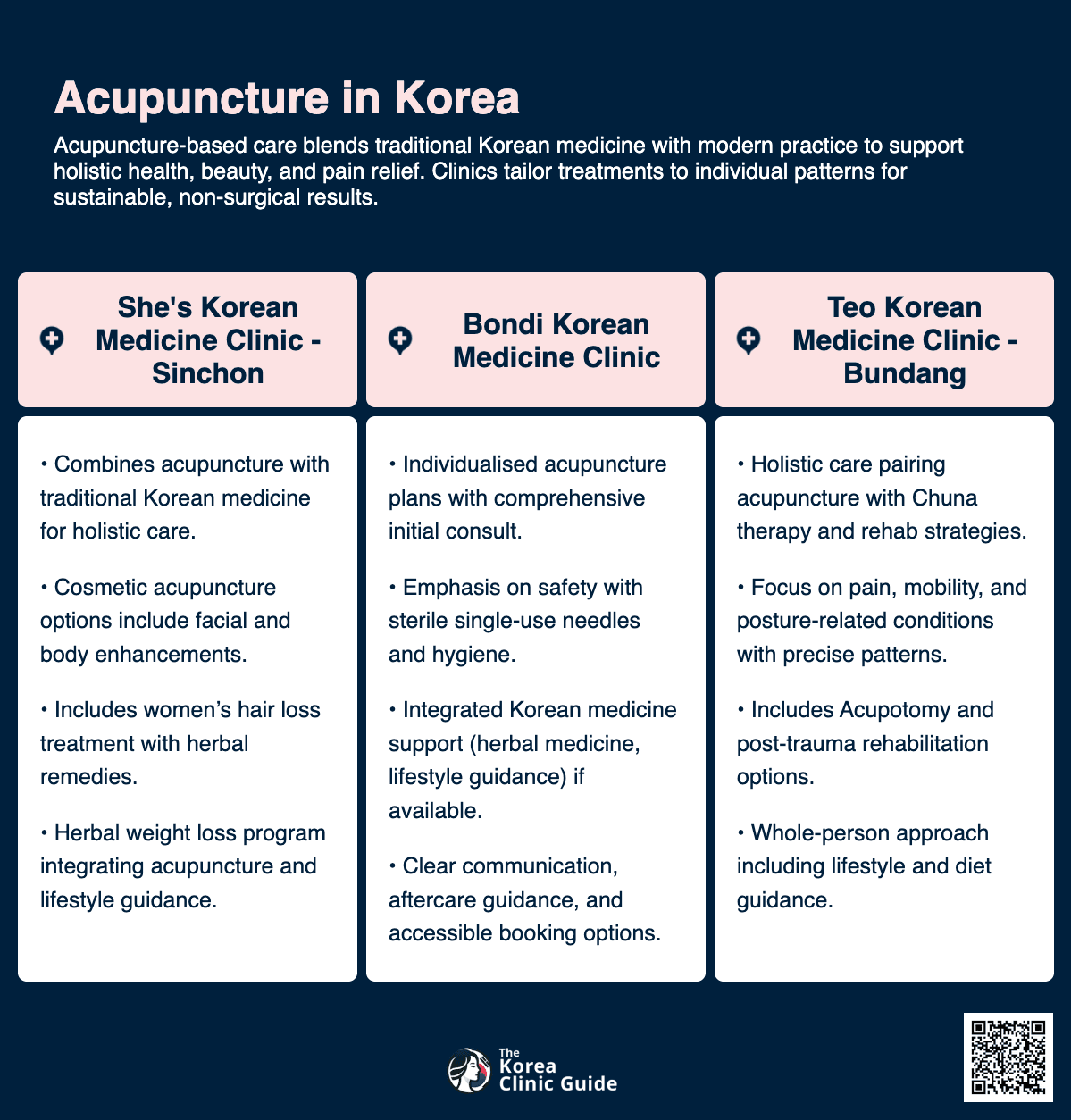
Teo Korean Medicine Clinic – Gangnam Branch, located near Gangnam Station, provides comprehensive traditional Korean medical care focused on holistic well-being. The clinic offers cost acupuncture alongside established treatments such as acupuncture and Chuna therapy, a hands-on approach designed to correct spinal and joint alignment to relieve pain and support overall function.
In addition to musculoskeletal and pain-focused care—including disc-related discomfort, shoulder impingement syndrome, and post-traffic accident rehabilitation—the clinic treats a wide range of concerns with traditional Korean medicine. Services also cover digestive disorders (functional dyspepsia, gastroesophageal reflux), women’s health (menopause management, infertility support), special conditions (shingles, rheumatoid arthritis), and skin conditions (wart and corn removal, atopic dermatitis, psoriasis), with individualized constitutional improvement and dietary treatment programs available. Appointments can be scheduled conveniently through online booking on the clinic’s website.
Find more about this clinic here: Teo Korean Medicine Clinic - Gangnam Website
Teo Korean Medicine Clinic - Bundang
Teo Korean Medicine Clinic – Bundang Branch is a Korean medicine clinic where patients seeking Cost Acupuncture can also access a broad spectrum of holistic, specialized care designed to address both pain and underlying functional imbalances. The clinic’s musculoskeletal services include Chuna Therapy for gentle manual correction and improved mobility, acupotomy for releasing adhesions and scar tissue, and disc-focused programs aimed at relieving spinal pain and restoring function. Patients with modern posture-related concerns can find targeted care for straight neck and turtle neck, as well as treatment options for frozen shoulder, rotator cuff injuries, tennis/golf elbow, and plantar fasciitis.
Beyond pain care, the Bundang clinic provides integrative programs for digestive conditions such as functional dyspepsia, GERD, and IBS, along with women’s health support for menopausal disorders, infertility, and PCOS. It also offers treatment pathways for shingles, rheumatoid arthritis (including pain management), post-traffic accident recovery, and chronic skin concerns such as warts, corns, atopic dermatitis, and psoriasis. With additional services for body shape correction and customized diet plans for weight and health goals, Teo Korean Medicine Clinic – Bundang Branch positions Cost Acupuncture within a comprehensive, whole-person approach that combines traditional Korean medicine with modern therapeutic techniques.
Find more about this clinic here: Teo Korean Medicine Clinic - Bundang Website
Cost of Acupuncture in Korea
When considering acupuncture treatments in Korea, understanding the cost involved is crucial for planning. Here's a breakdown of the typical expenses associated with common acupuncture procedures:
-
Basic Acupuncture Session: The cost ranges from 7,500 KRW to 10,000 KRW, which is approximately $5 to $7 USD.
-
Cupping: A standard session costs around 3,500 KRW, equating to roughly $2.50 USD.
-
Adjustment (Chuna): This procedure is priced at 15,000 KRW, translating to approximately $10 USD.
-
Medicine Needle (Yakchim): This treatment is available for 5,000 KRW, which is about $3.50 USD.
-
Korean Herbal Medicine (Han-Yak): Depending on the type and quantity, prices range significantly from 300,000 KRW to 700,000 KRW, equivalent to $207 to $482 USD.
-
General Acupuncture: Fees vary, falling between 10,000 KRW and 115 USD. This converts to $7 to $115 USD, depending on the clinic and practitioner.
-
Moxibustion or Cupping Therapy: These therapies are priced between 10,000 KRW and 20,000 KRW, equating to $7 to $14 USD.
-
Acupuncturist Consultation: Typically, a consultation costs between 29,791 KRW and 40,000 KRW, which approximates to $20 to $28 USD.
-
Acupuncture Treatment Sessions: The cost for regular treatments ranges from 15,000 KRW to 15,171 KRW, approximately $10 to $10.50 USD.
It's important to note that securing your procedure in Korea usually requires a 10% upfront deposit. This ensures your appointment is booked and ready for your scheduled visit, allowing clinics to maintain their high-quality service standards.
What Is Usually Included in Cost of Acupuncture in Korea
When considering acupuncture in Korea, it's important to understand the various components that contribute to the overall cost of the procedure. Here's a breakdown of what is usually included:
-
Basic Acupuncture Session:
- Initial Consultation and Health Assessment: First-time visitors typically incur an additional fee for this initial evaluation. It is crucial as it helps the practitioner assess your condition and customize the treatment plan.
- Base Fee: The standard session fee may vary depending on additional treatment services provided during the visit, which can increase the overall cost.
-
Cupping:
- Additional Cups: Generally, the cost structure offers slight discounts for subsequent cups applied in a single session. This practice ensures that more comprehensive treatment remains accessible.
-
Adjustment (Chuna):
- Discounted Packages: Some clinics may offer discounted packages, making multiple sessions more affordable compared to paying individually per session.
-
Medicine Needle (Yakchim):
- Variable Costs: The cost can vary significantly based on the type of medicine used and the number of injections required during treatment.
-
Korean Herbal Medicine (Han-Yak):
- Ingredient and Quantity Dependent Costs: Similar to Yakchim, prices fluctuate depending on the specific ingredients prescribed and the quantity supplied for the treatment duration.
-
Acupuncture:
- Overnight Stay Not Required: Unlike some other medical treatments, acupuncture sessions do not typically necessitate overnight stays, offering a cost-saving advantage.
- Insurance and Additional Costs: While insurance coverage can significantly reduce expenses, patients might encounter extra costs for herbal supplements or follow-up sessions.
-
Moxibustion or Cupping Therapy:
- Insurance Benefits: Insurance coverage, when applicable, can also substantially lower the costs associated with these therapies.
-
Acupuncturist Consultation:
- The consultation costs usually accompany the session costs unless specified otherwise. These are separate from the treatment procedures and may be bundled in certain clinics.
Understanding these cost considerations helps in preparing for the financial aspects of undergoing acupuncture therapy in Korea. Each treatment is tailored to the patient's needs, and costs will reflect the individualized approach to holistic health care.
Factors Influencing the Cost of Acupuncture in Korea
In Korea, the cost of acupuncture and related treatments can vary significantly based on several factors. One of the primary influencers is the clinic location, with areas like Gangnam typically commanding higher prices due to the premium associated with the locale. Additionally, the experience and reputation of the practitioner can impact the cost, as more seasoned or renowned acupuncturists may charge more for their services.
The type and frequency of treatments are also crucial cost determinants. For procedures like Basic Acupuncture Sessions and Chuna (Adjustment), the cost could increase with the number of sessions required. For treatments like Medicine Needle (Yakchim) or Korean Herbal Medicine (Han-Yak), factors such as the type of medicine used and the quantity needed play a significant role in the overall expense.
Some other elements, such as the specific techniques or additional therapies employed during acupuncture, the availability of interpreters, and the necessity of ingredients for specialized treatments, also contribute to the price variances observed across different clinics and regions in Korea.
Comparing the Cost of Acupuncture: Korea vs the Rest of the World
Cost of Procedure in USA
In the United States, acupuncture costs can vary widely depending on the location, the practitioner's expertise, and whether insurance covers part of the cost. Generally, an acupuncture session ranges from $70 to $150 USD. The initial consultation fee is separate and typically ranges from $100 to $300 USD. Insurance may cover some costs, but it's advisable to check your specific plan. Subsequent sessions often range between $50 and $90 USD.
Cost of Procedure in Mexico
In Mexico, acupuncture fees for follow-up sessions range from approximately $30 to $70 USD, with initial consultations costing around $35 USD. Some practitioners offer packages of multiple sessions at discounted rates. While generally considered safe, potential dangers in Mexico can include non-licensed practitioners and varying equipment sterilization standards, so it’s important to choose qualified and reputable practitioners.
Cost of Procedure in Turkey
While specific pricing data for Turkey is limited, other medical procedures such as fertility acupuncture and electro-acupuncture are available, with costs ranging based on the specific service. It's crucial to consider factors like the number of sessions required and if additional therapies such as cupping or moxibustion are part of the treatment. Given Turkey's healthcare system, foreign patients may face challenges such as limited English-speaking practitioners and differing medical standards.
Cost of Procedure in Thailand
Acupuncture in Thailand is moderately priced, with treatments ranging from roughly 1,100 to 1,300 THB, which equates to approximately $36 to $46 USD. It’s important to ensure the use of sterile needles and qualified practitioners. Thailand is known for its integrative approach, where acupuncture is often paired with other traditional therapies. Potential dangers may include language barriers and differing medical practices, emphasizing the need for verified and reputable clinics.
Cost of Coming To Korea for Acupuncture
When considering a trip to Korea for acupuncture, it's essential to plan for the various travel expenses that will contribute to the overall cost of your medical journey. Here's a breakdown of the key travel costs:
1. Airfare
The price of airfare can vary significantly based on your point of departure, the time of year, and how far in advance you book your tickets. Typically, flights to South Korea from North America or Europe can range from $500 to $1,200 for economy class, while premium options may cost considerably more. Utilizing flight search engines and setting up price alerts can help you snag a better deal. Additionally, traveling during off-peak seasons might reduce costs.
2. Accommodation
South Korea offers a wide range of accommodation options to suit different budgets. Budget travelers can find hostels or guesthouses ranging from $20 to $50 per night, while mid-range hotels may cost between $70 and $150 per night. For those seeking luxury, high-end hotels can exceed $200 per night. It’s worth exploring extended-stay discounts or considering a stay in a traditional Korean "hanok" for a cultural experience.
3. Transportation
Once in Korea, getting around is relatively affordable. The country boasts an efficient and expansive public transportation system, including subways, buses, and trains. A single subway or bus fare typically costs around $1 to $1.50. If you plan to explore beyond Seoul, Korea's KTX high-speed trains offer quick access to other cities, with prices ranging from $30 to $60 depending on the distance.
4. Meals
Dining costs in Korea can also be quite variable but generally reasonable. Street food and meals at casual eateries might cost as little as $5 to $10. Dining at mid-range restaurants may range from $15 to $30 per person. Should you choose to indulge in fine dining, expect prices to start at $50 and upward.
5. Travel Insurance
It's advisable to purchase travel insurance that covers medical procedures and emergencies abroad. Costs for travel insurance can vary based on coverage options but generally range from $50 to $200 for a short-term trip.
6. Miscellaneous Expenses
Finally, it's important to set aside a budget for miscellaneous expenses such as shopping, souvenirs, tips, and other personal needs. This can vary widely depending on personal preferences, but a daily allocation of $20 to $50 could be a reasonable guideline.
By considering these factors and planning ahead, you can better manage the expenses associated with traveling to Korea for acupuncture while also enjoying the rich cultural experiences the country offers.