Medical Tourism Blog
Vaginal Implant in Korea: Dreamcore Evidence, Safety, Recovery, and Alternatives
Table of contents
- Vaginal Implant at a Glance
- What Is a Vaginal Implant?
- Who Is a Good Candidate for a Vaginal Implant?
- How Is a Vaginal Implant Performed?
- Why Visit Korea for a Vaginal Implant?
- Key Information for International Patients
- Which Are the Best Clinics in Korea for Vaginal Implant?
- Vaginal Implant From Start to Finish
- Alternatives to a Vaginal Implant
- How Can I Prepare for a Vaginal Implant?
- Aftercare Advice
Considering treatment in Korea? Everything you need to know e.g. — how to avoid scams, visas, interpreters, recovery tips — in our Medical Tourism Master Guide. Plan with confidence in minutes, not weeks!
Last updated: September 2026
Vaginal Implant at a Glance
- Novel permanent implant — Dreamcore is a proposed transvaginal procedure that places a permanent, flexible silicone band through pelvic fascia to support uterine or pelvic-organ prolapse; it is not standard prolapse mesh, a sling, vaginoplasty, or a vaginal-tightening treatment.
- Evidence is limited to one case — Direct evidence is one 2025 case report of a 67-year-old who also had mesh prolapse repair and a continence sling, so Dreamcore’s independent benefits, complication rate, durability, sexual outcomes, and removal options remain unknown.
- For confirmed symptomatic prolapse — Assessment may be appropriate for bothersome, objectively documented uterine or apical prolapse with pelvic-floor symptoms; dryness, cosmetic tightness concerns, recurrent infection, sexual concerns alone, or unexplained pelvic pain are not established indications.
- Recovery: about 6 weeks in one case — In the sole report, vaginal sutures had healed or absorbed by 5–6 weeks and normal activity resumed at 6 weeks; until surgeon clearance, avoid intercourse, tampons, swimming, strenuous exercise, heavy lifting, and straining.
- Plan 2–3 weeks in Korea — No device-specific travel timeline exists, but international patients should conservatively plan 2–3 weeks for in-person evaluation, surgery, bladder or wound review, and individualized clearance before a long-haul flight.
- Korean availability must be verified — The only published case originated in Korea, but no publicly accessible record independently confirms Dreamcore’s MFDS authorization, approved indication, labeling, or current availability; obtain official device documents, an implant card, and a written revision plan before travel.
- Permanent-implant risks — Potential complications include infection, erosion or exposure, foreign-body reaction, pelvic pain, painful intercourse, urinary retention, recurrent prolapse, and possible revision or removal, for which Dreamcore-specific long-term pathways have not been established.
What Is a Vaginal Implant?
A vaginal implant is a proposed procedure that places a permanent silicone support band through the vagina for pelvic-organ or uterine prolapse with laxity. It aims to support descended pelvic organs and reduce bothersome bulge or pressure symptoms, though its independent benefits remain unproven. It is a surgical procedure performed through vaginal incisions, not a non-surgical tightening treatment.
Who Is a Good Candidate for a Vaginal Implant?
- Documented prolapse symptoms — Candidates for assessment have a bothersome vaginal bulge, pressure, uterine or apical descent, or bladder/bowel symptoms with a confirmed pelvic-organ prolapse diagnosis and POP-Q examination.
- Clinically meaningful laxity with a reconstructive indication — Evaluation can be considered when laxity occurs alongside documented prolapse or a defined pelvic-floor problem, not as a stand-alone cosmetic claim.
- Able to accept permanent-implant uncertainty — Anyone considering Dreamcore must understand that it is permanent foreign material with no established long-term removal pathway, comparative outcomes, or validated selection criteria.
- Suitable for surgical assessment — A urogynecology or gynecology review should address prior births and pelvic operations, urinary leakage or retention, bowel symptoms, diabetes, anesthesia risk, clotting history, smoking, medicines, and ability to arrange follow-up at home.
Current vaginal, urinary, pelvic, or systemic infection requires diagnosis and treatment before elective implantation. Pregnancy, plans for near-term pregnancy, and early postpartum status are unsuitable because pregnancy after prolapse repair can increase recurrence risk and Dreamcore-specific pregnancy data do not exist. Undiagnosed bleeding, a pelvic mass, urinary retention, malignancy, pelvic pain without a diagnosis, mild or symptom-free prolapse, dryness, recurrent infection, or sexual concerns alone are not established indications; prolapse surgery requires an individualized assessment of symptoms and anatomy. Poorly controlled diabetes, immunosuppression, chronic systemic steroids, prior pelvic radiation, nicotine exposure, uncontrolled constipation or chronic cough, previous foreign-body complications, and major cardiopulmonary or clotting risk need specialist review and often favor delay or a nonimplant option.
How Is a Vaginal Implant Performed?

“Vaginal implant” is not a standardized operation. In this listing it means Dreamcore, a proposed transvaginal silicone-band implant; it is materially different from prolapse mesh, a sling, vaginoplasty, fillers, or energy-based vaginal treatment.
- Dreamcore silicone-band implantation — The only published description uses a flexible, permanent medical-grade silicone band approximately 9 mm wide and 1 mm thick. Through anterior and posterior vaginal-wall incisions, the surgeon passes it through deep pelvic fascia near the arcus tendineus fascia, adjusts and connects it into a ring-like support band, then trims the material. The stated goals are pelvic support, reduced uterine descent, and lower vaginal volume; the uterus is preserved and the abdomen is not entered in the reported technique.
- Concurrent prolapse or continence surgery — In the sole published case, Dreamcore was not a stand-alone operation: the patient also had a mesh prolapse repair and a single-incision sling for stress urinary incontinence. A sling treats stress leakage; it is not an apical-prolapse or vaginal-laxity implant.
- Anesthesia and operative duration — Spinal anesthesia or local anesthesia with sedation was described as possible. The reported case took about 30–60 minutes with estimated blood loss of about 150 mL, but these are not standardized expectations for anesthesia, surgical time, blood loss, catheter use, discharge, or safety. The underlying report is a single 2025 case report.
Why Visit Korea for a Vaginal Implant?

The published Dreamcore case report originated in Korea, and the product is described as coming from Violetdream Inc. That connection does not establish that the operation is proven, routinely available, or appropriately regulated for an individual patient. No evidence supports a Korea-specific clinical advantage over established prolapse care.
- Korean-origin clinical report — The only direct publication describes one 67-year-old with POP-Q stage IV uterine prolapse, cystocele, urinary incontinence, and laxity. At six weeks, the authors reported improvement from POP-Q stage IV to 0; vaginal volume was reported as 94.6 mL before surgery and 64.6 mL afterward, maintained at one year. Because the patient also received mesh repair and a sling, these observations cannot show Dreamcore’s independent effect or serve as a success rate.
- Company presence is not device authorization — Violetdream maintains a Korean corporate website and identifies its online operation as a licensed medical-device seller. However, publicly accessible evidence does not independently verify Dreamcore’s MFDS authorization number, classification, approved indication, labeling, or current implant availability.
- Essential pre-consent documentation — Request the exact device name, manufacturer, material specification, Korean authorization or registration documents, implant card, English operative plan, surgeon qualifications, and written removal/revision and home-country follow-up plans. Do not treat a company website or a clinic statement as a substitute for device-specific documentation.
- Important U.S. distinction — Dreamcore is not transvaginal mesh for pelvic-organ prolapse. Still, patients from the United States should know that the FDA ordered manufacturers to stop selling transvaginal POP mesh there in 2019 after reasonable assurance of safety and effectiveness was not demonstrated; that action does not determine Dreamcore’s Korean regulatory status.
Key Information for International Patients
- Minimum stay — No evidence-based Dreamcore-specific stay exists. Plan conservatively for 2–3 weeks in Korea for in-person assessment, surgery and discharge, bladder-emptying or wound review, and individual clearance before a long-haul flight.
- Repeat visits — Schedule at least an early postoperative review before departure. Arrange a named urogynecologist or gynecologist at home before traveling, because a permanent implant can require assessment long after the initial wound has healed.
- Flight timing — Do not book a nonrefundable early return. Recent surgery and long-distance travel both increase venous-thromboembolism risk, especially with reduced mobility, prior clotting events, thrombophilia, obesity, estrogen exposure, cancer, pregnancy/postpartum status, or cardiopulmonary disease. CDC travel guidance identifies recent surgery as a VTE risk factor; the operating team must set flight timing and determine whether stockings or anticoagulant prevention are appropriate.
- Itinerary impact — Expect several weeks of restricted lifting, strenuous exercise, swimming, vaginal intercourse, tampons, douching, and straining. Avoid carrying luggage and plan accommodation near the treating facility, flexible transport, and help with bags and daily tasks.
- Remote follow-up — Obtain an English operative report, implant card, discharge summary, medication list, and direct after-hours contact before leaving Korea. Remote review cannot replace an urgent in-person examination for urinary retention, bleeding, infection, a recurrent bulge, or possible implant exposure.
Travel note: Normal activity at six weeks was reported in one case only. It is not a validated Dreamcore recovery timetable or a guarantee that long-haul travel is safe at that point.
Which Are the Best Clinics in Korea for Vaginal Implant?
Listed below are some of the best clinics in Korea for vaginal implant.
1. SH Clinic
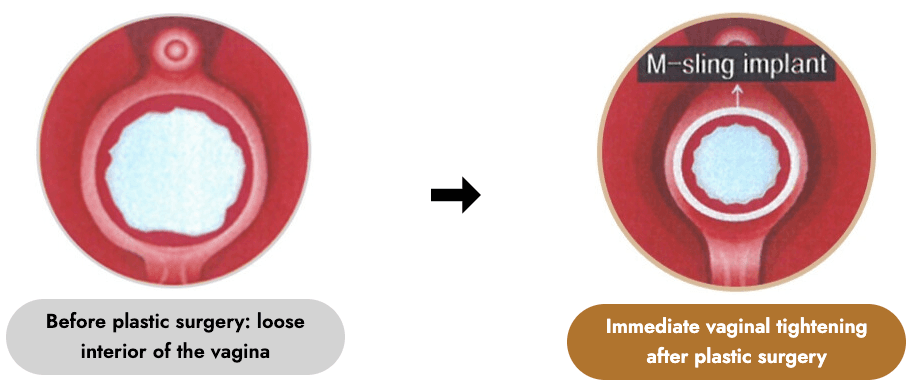
At SH Clinic, you can discuss vaginal implant vaginoplasty with a board-certified gynecologist who performs procedures directly. The clinic describes options using a high-elasticity implant or human-derived dermal graft placed in the vaginal wall, with the aim of improving vaginal tightness, internal friction, and sexual sensitivity.
- URL: SH Clinic Website
- Location: Seocho-gu, Seoul
- Procedure details:
- The M-sling implant is intended to support pelvic muscles and maintain contraction and elasticity without extensive tissue incision.
- The clinic describes minimal bleeding and discomfort, and notes that an implant can be removed if needed.
- This approach may be considered if you are planning future childbirth, according to the clinic.
- Gynecologic care:
- Your procedure is performed directly by an experienced, board-certified gynecologist who has received a commendation from the Minister of Health and Welfare.
- Related vaginal-rejuvenation options include vaginal fillers, stem-cell injections, vaginal HIFU treatments, and vaginoplasty.
- The gynecology clinic also provides general gynecologic care, cancer screening, and urinary-incontinence treatment.
Vaginal Implant From Start to Finish
- Records and virtual contact — Send prior urogynecology notes, POP-Q findings, urine cultures, imaging or urodynamics if available, obstetric and operative history, allergies, medication and supplement list, smoking/nicotine status, diabetes history, clotting history, and prior mesh or implant records. Ask whether English-language virtual consultation is available, but do not accept remote review as a final diagnosis.
- In-person diagnosis and consent — Attend a pelvic examination in Korea. The clinician should document prolapse with POP-Q when relevant, assess vaginal tissue and infection risk, review urinary and bowel symptoms, and clarify whether a sling, mesh repair, hysterectomy, posterior repair, or perineal repair is also proposed.
- Testing and surgical planning — Urinalysis, urine culture, post-void residual measurement, urodynamics, imaging, cystoscopy, and anesthesia testing are selected according to symptoms and planned concurrent procedures. Confirm the precise device, regulatory documentation, permanent-material risks, alternatives, expected costs of revision, and local/home-country follow-up plan before consenting.
- Day of surgery — Follow the clinic’s fasting and medication instructions. The published technique describes spinal anesthesia or local anesthesia with sedation as possible, but the anesthetic plan depends on health status and whether other pelvic operations are added.
- Implant placement — The reported approach uses anterior and posterior vaginal-wall incisions to pass a silicone band through pelvic fascia, then adjust, connect, and trim it into a support ring. In the one published case, the procedure was combined with mesh prolapse repair and a single-incision sling rather than performed alone.
- Immediate recovery and discharge — The team monitors pain, vaginal bleeding, mobility, nausea, and bladder emptying. Discharge timing, catheter management, antibiotics, and voiding-trial requirements have not been standardized for Dreamcore and depend on the actual operation performed.
- Local postoperative review — Remain in Korea until wound status, bleeding, pain control, and urination have been reviewed and the surgeon provides individualized travel clearance. Report fever, foul discharge, inability to urinate, worsening pelvic pain, heavy bleeding, or calf and chest symptoms immediately.
- Overseas follow-up — Keep scheduled video reviews and establish in-person care at home. Share the operative report and implant documentation with local clinicians; seek prompt examination for implant exposure, persistent pain, painful intercourse, repeat infections, urinary problems, or recurrent prolapse.
Alternatives to a Vaginal Implant
For prolapse, established nonimplant and reconstructive options have a clearer role than this novel silicone-band procedure. The correct choice depends on the compartment and severity of prolapse, uterus-preservation preferences, sexual goals, urinary symptoms, medical fitness, and willingness to accept foreign material—not on vaginal tightness alone.
Pessary
- What it does — A fitted removable vaginal device supports pelvic organs without surgery.
- Best tradeoff — It avoids anesthesia and permanent implantation but requires fitting, regular care, and ongoing review.
Native-Tissue Prolapse Repair
- What it does — Uterosacral-ligament suspension, sacrospinous fixation, hysteropexy, anterior or posterior colporrhaphy, and perineorrhaphy use sutures and the patient’s own tissue rather than a permanent vaginal implant.
- Best tradeoff — This is an established reconstructive pathway, though recurrence and surgery-related risks remain. ACOG outlines surgical and nonsurgical prolapse options.
Sacrocolpopexy or Sacrohysteropexy
- What it does — An abdominal, laparoscopic, or robotic operation attaches mesh to support the vaginal apex or uterus.
- Best tradeoff — It uses a different route and evidence base from a transvaginal implant, but involves abdominal surgery and mesh-specific considerations.
Colpocleisis
- What it does — This operation closes the vaginal canal to treat prolapse.
- Best tradeoff — It can be effective for selected patients who are certain they do not want future vaginal intercourse; it is not reversible in practical sexual-function terms.
Stress-Incontinence Treatment
- What it does — Pelvic-floor treatment, continence devices, or a mid-urethral sling target stress urinary leakage after appropriate evaluation.
- Best tradeoff — A continence treatment does not correct every form of prolapse or vaginal laxity. See female incontinence treatment for the separate treatment pathway.
Vaginoplasty or Perineoplasty
- What it does — These operations address selected vaginal-caliber or perineal concerns after a separate examination.
- Best tradeoff — They are not automatic substitutes for uterine or apical prolapse repair. See vaginoplasty and perineoplasty.
How Can I Prepare for a Vaginal Implant?

- Confirm the diagnosis first — Obtain an in-person urogynecologic assessment and ensure the operative plan identifies each proposed component, including any mesh repair, sling, hysterectomy, or perineal repair. Do not consent to a permanent implant for uninvestigated pain, dryness, recurrent infection, or cosmetic concerns alone.
- Request device records — Before paying or traveling, obtain the exact device name, manufacturer, silicone specification, Korean authorization or registration documentation, approved indication, implant card, English consent form, operative plan, and written removal/revision strategy.
- Disclose medicines and supplements — Give the team a complete list of prescription drugs, over-the-counter pain medicines, aspirin, anticoagulants, antiplatelet drugs, hormones, diabetes medicines, vitamins, and herbal products. Do not stop warfarin, apixaban, rivaroxaban, clopidogrel, aspirin, or other prescribed medicine without instructions from the prescribing clinician and surgeon; perioperative plans must balance bleeding and clotting risk.
- Treat infection and optimize health — Report urinary burning, abnormal discharge, fever, skin infection, uncontrolled blood sugar, constipation, chronic cough, and nicotine use. Stop smoking and nicotine only on the timeline set by the treating team, and follow any bowel-regimen plan to reduce postoperative straining.
- Follow fasting instructions — Use the clinic’s written eating, drinking, and medication timetable if anesthesia or sedation is planned. Individual anesthesia instructions take precedence over general preoperative guidance.
- Plan recovery logistics — Book flexible flights, accessible accommodation, and transport that does not require lifting bags. Arrange a companion or local support person if sedation, limited mobility, language barriers, or combined surgery makes independent recovery impractical.
Travel note: Build in 2–3 weeks, not a fixed discharge-to-flight promise. The treating surgeon must clear long-haul travel after reviewing mobility, bleeding, wound healing, bladder function, and clot-risk factors.
Confirm every medication change, fasting rule, testing requirement, arrival date, and companion requirement with the treating doctor and anesthesia team.
Aftercare Advice
Protect the vaginal wounds and monitor bladder function closely; permanent-implant complications require prompt examination rather than self-treatment.
- Activity and lifting — Walk gently as cleared to maintain circulation, but avoid lifting luggage or heavy objects, high-impact exercise, strenuous activity, and activities that cause pelvic pressure or straining until the surgeon clears them. The only published case reported normal activity at about six weeks, which is not a general recovery guarantee.
- Nothing in the vagina — Avoid intercourse, tampons, douching, and swimming until the operating surgeon confirms that vaginal incisions have healed. The published case reported absorption or healing of Vicryl sutures at about 5–6 weeks.
- Bowel and bladder care — Take prescribed pain medicine and stool-softening or bowel-regimen medicines as directed. Prevent constipation and contact the clinic promptly for inability to urinate, escalating urinary difficulty, recurrent urinary infections, or severe straining.
- Wound and infection monitoring — Follow the clinic’s instructions for washing, pads, discharge, and prescribed antibiotics. Seek urgent local care for fever or chills, foul-smelling discharge, heavy bleeding, worsening abdominal or pelvic pain, persistent vomiting, or wound separation.
- Clot and implant warning signs — Seek emergency care for chest pain, shortness of breath, fainting, calf pain, or one-sided leg swelling. Obtain urgent pelvic assessment for exposed or palpable implant material, a new vaginal bulge, persistent pelvic or groin pain, or painful intercourse; these can signal infection, recurrent prolapse, or foreign-material complications.
- Follow-up and final assessment — Attend the Korean postoperative review before flying, then keep remote and local follow-up. Long-term durability, sexual-function outcomes, recurrence rates, and removal outcomes for Dreamcore are unknown because the direct evidence is one case report with one-year follow-up and concurrent procedures.
Follow the treating doctor’s individualized instructions over this general guidance, and contact the clinic or seek local urgent care when anything appears wrong.
Frequently Asked Questions
Related Blogs
Discovering the Costs: Premarital Check-Up Prices in Korea vs. Global Alternatives
Discover the costs and benefits of premarital check-ups in Korea, an essential step for couples planning to tie the knot. Understand what tests are typically included and how these screenings can support a healthy start to married life.
Updated: Oct 21, 2026
Adenomyosis in Korea: Diagnosis, Fertility Decisions, and Treatment Options
Adenomyosis care begins with gynecologic assessment, ultrasound or MRI, and treatment selection based on symptoms, anatomy, anemia, and fertility goals. Options include medication, LNG-IUS, HIFU, UAE, adenomyomectomy, or hysterectomy, with travel-stay guidance, recovery planning, warning signs, and follow-up information for international patients.
Updated: Oct 21, 2026
Uterine Fibroids Treatment in Korea: Options, Recovery, Fertility, and Travel Planning
Uterine fibroid treatment includes medication, myomectomy, uterine artery embolization, focused ultrasound or radiofrequency ablation, and hysterectomy based on symptoms, fibroid mapping, and fertility goals. The article outlines candidacy, imaging and travel planning in Korea, recovery timelines, preparation, follow-up, and urgent warning signs.
Updated: Oct 21, 2026
Premarital Check-up in Korea: Tests, Fertility Screening, Travel Planning, and Results
A premarital check-up in Korea is a tailored outpatient consultation with selected preconception, STI, reproductive, and genetic tests based on each partner’s history and plans. Listed at KRW 1,600,000 (about USD 1,200), it typically requires one full day, with translated reports and remote results review to confirm before booking.
Updated: Oct 21, 2026