Medical Tourism Blog
Sweat Gland Removal in Korea: Methods, Recovery, Results, and Travel Planning

Table of contents
- Sweat Gland Removal at a Glance
- What Is Sweat Gland Removal?
- Who Is a Good Candidate for Sweat Gland Removal?
- How Is Sweat Gland Removal Performed?
- Why Visit Korea for Sweat Gland Removal?
- Key Information for International Patients
- Which Are the Best Clinics in Korea for Sweat Gland Removal?
- Sweat Gland Removal From Start to Finish
- Alternatives to Sweat Gland Removal
- How Can I Prepare for Sweat Gland Removal?
- Aftercare Advice
Considering treatment in Korea? Everything you need to know e.g. — how to avoid scams, visas, interpreters, recovery tips — in our Medical Tourism Master Guide. Plan with confidence in minutes, not weeks!
Last updated: October 2026
Sweat Gland Removal at a Glance
- What it treats — Sweat gland removal is usually an outpatient underarm procedure that removes or damages gland-bearing tissue to reduce focal axillary sweating, persistent underarm odor, or both; it does not treat whole-body sweating.
- Best candidates — It is generally considered for documented primary underarm hyperhidrosis or bromhidrosis when antiperspirants, medicines, injections, or energy-based treatments have not worked well, are poorly tolerated, or are not wanted.
- Technique trade-off — Small-incision suction-curettage, subdermal shaving, or laser-assisted methods usually leave smaller scars but can leave functioning glands behind, while wider excision may lower odor recurrence at the cost of more scarring, wound issues, and possible shoulder tightness.
- Results take time — Improvement is variable rather than guaranteed permanent dryness: reported liposuction series often show 80%–90% improvement at six months, and maximum sweat reduction after liposuction may take about 8 months to assess.
- Recovery limits — Desk work may be possible within several days after a small-incision procedure, but soreness, swelling, bruising, numbness, and limited comfortable overhead movement can last 1–3 weeks; heavy upper-body activity, swimming, and sauna use are often restricted for 2–4 weeks.
- Korea travel plan — For an uncomplicated minimally invasive procedure in Korea, plan 5–7 days for consultation, treatment, and an early wound review; allow 10–14 days if drains, nonabsorbable sutures, larger excision, or delayed healing require local care.
- Korea-specific consideration — Korean clinical literature documents subdermal excision, suction-curettage, and laser-assisted approaches for axillary odor surgery, but this demonstrates availability of technique options—not proven superior outcomes versus other countries or methods.
What Is Sweat Gland Removal?
Sweat gland removal is a local underarm procedure that removes or damages sweat- and odor-producing glands. It aims to reduce persistent underarm wetness, odor, or both when simpler treatments have not provided enough relief. It is a surgical procedure, although some methods use small incisions and are minimally invasive.
Who Is a Good Candidate for Sweat Gland Removal?
- Focal underarm symptoms — Good candidates have documented, bothersome primary axillary hyperhidrosis, persistent underarm odor from bromhidrosis/osmidrosis, or both. The treatment targets sweat- and odor-producing gland-bearing tissue in the underarm, not whole-body sweating.
- Previous treatment experience — Consider surgery when antiperspirants, medicines, injections, or energy-based treatment have been inadequate, poorly tolerated, impractical, or not desired. Axillary surgery is generally an additional option rather than routine first-line treatment for hyperhidrosis.
- Realistic endpoint — Suitable candidates accept a meaningful reduction in wetness or odor rather than guaranteed permanent dryness, and understand that residual glands can continue to function.
- Local anatomy and healing capacity — Candidates need healthy underarm skin, adequate shoulder mobility, and the ability to follow compression, dressing, and activity restrictions during healing.
Generalized, new-onset, or night-time sweating needs medical assessment before an irreversible local procedure, because it can reflect a medicine-related or medical cause rather than primary focal hyperhidrosis. Sweat gland removal is principally an axillary operation and is not standard treatment for palmar, plantar, facial, trunk, or generalized sweating. Defer elective surgery for active dermatitis, folliculitis, hidradenitis flare, open wounds, or infection. Bleeding disorders, uncontrolled diabetes, substantial immunosuppression, poor wound healing, pregnancy or breastfeeding, and use of anticoagulants or antiplatelet medicines require individualized assessment; never stop prescribed medicines independently. Local surgical procedure guidance also stresses that the procedure does not remove normal thermoregulatory sweating elsewhere in the body.
How Is Sweat Gland Removal Performed?
The planned technique determines scar length, recovery burden, likelihood of residual glands, and risk of skin or shoulder-mobility complications. Confirm whether the goal is sweat reduction, odor reduction, hair reduction, or a combination before consenting.
- Suction-curettage / liposuction-curettage — Through small incisions, the surgeon infiltrates tumescent local anesthetic, then uses suction and mechanical scraping to disrupt and remove gland-bearing tissue. This approach usually limits scarring, but some deep dermal glands can remain.
- Curettage or subdermal shaving — A scraping or shaving instrument removes tissue from the underside of the dermis. It can be performed alone or combined with suction and is used for axillary hyperhidrosis or osmidrosis.
- Laser-assisted ablation — Laser energy is used to damage targeted underarm tissue, sometimes followed by liposuction. Korean clinical literature documents experience with laser-plus-liposuction and other axillary osmidrosis technique families, without proving that one approach is universally superior.
- Limited excision with curettage — A central area of skin may be excised while surrounding gland-bearing tissue is curetted. This creates a more visible scar than a small-incision technique.
- Wider skin-and-gland excision — More extensive open removal can reduce recurrence more effectively in odor-focused studies, but carries greater scar, wound, and shoulder-range-of-motion concerns. Complete axillary excision is not routinely recommended because scars can restrict arm movement.
For axillary osmidrosis, a meta-analysis comparing open excision and closed suction-curettage found fewer acute adverse events with closed suction-curettage but lower recurrence or ineffectiveness with open excision. Those results concern odor-focused surgery and do not directly predict outcomes for every hyperhidrosis patient or technique.
Why Visit Korea for Sweat Gland Removal?
South Korea has published clinical experience across several underarm osmidrosis surgery methods, including subdermal excision, suction-curettage, and laser-assisted approaches. This can make it practical to discuss different technique families during consultation. It does not establish that Korea, a specific device, or an individual surgeon achieves superior outcomes.
- Documented local technique experience — A Korean clinical publication describes treatment of axillary osmidrosis using conventional subdermal excision, suction-curettage, and laser-assisted approaches, supporting the availability of these established method categories in the Korean clinical literature.
- Method-specific consultation — The important decision is not the country label but whether the clinician can explain the planned tissue-removal or ablation method, incision pattern, scar trade-off, and plan for residual sweating or odor.
- Candid evidence limits — Comparative hyperhidrosis evidence is limited by small studies, inconsistent techniques and indications, and uneven follow-up. A systematic evidence review found much of the broader evidence base to be low or very low quality, so country-versus-country outcome claims are not justified.
Key Information for International Patients
- Minimum stay — Plan about 5–7 days for an uncomplicated small-incision underarm procedure: consultation, treatment, and an early dressing or wound review. Plan 10–14 days when drains, nonabsorbable sutures, larger excision, delayed healing, or a complication requires local care.
- Flight planning — No authoritative procedure-specific rule sets a minimum flight interval after axillary gland surgery. Schedule flights only after the treating surgeon reviews the wounds and travel plan; surgery and prolonged air travel can both increase thromboembolic risk.
- Activity and itinerary — Desk work can be possible within several days after a small-incision procedure when pain is controlled. Do not schedule lifting-heavy luggage, gym sessions, swimming, saunas, steam rooms, or physically demanding tours during the initial healing period.
- Documents before departure — Obtain written English consent, the operative report, anesthesia or sedation record, medication list, dressing instructions, emergency contact details, and a clear plan for complications after returning home.
- Remote follow-up — Arrange photo or video follow-up before leaving Korea. Identify a doctor or urgent-care option at home in case redness, drainage, wound opening, fever, or significant swelling develops.
Travel note: The 5–7-day stay is a practical planning estimate, not a universal flight-clearance rule. The CDC's medical-tourism guidance advises individualized planning because postoperative complications and continuity-of-care gaps can become more difficult after international departure.
Which Are the Best Clinics in Korea for Sweat Gland Removal?
Listed below are some of the best clinics in Korea for sweat gland removal.
1. Evita Clinic
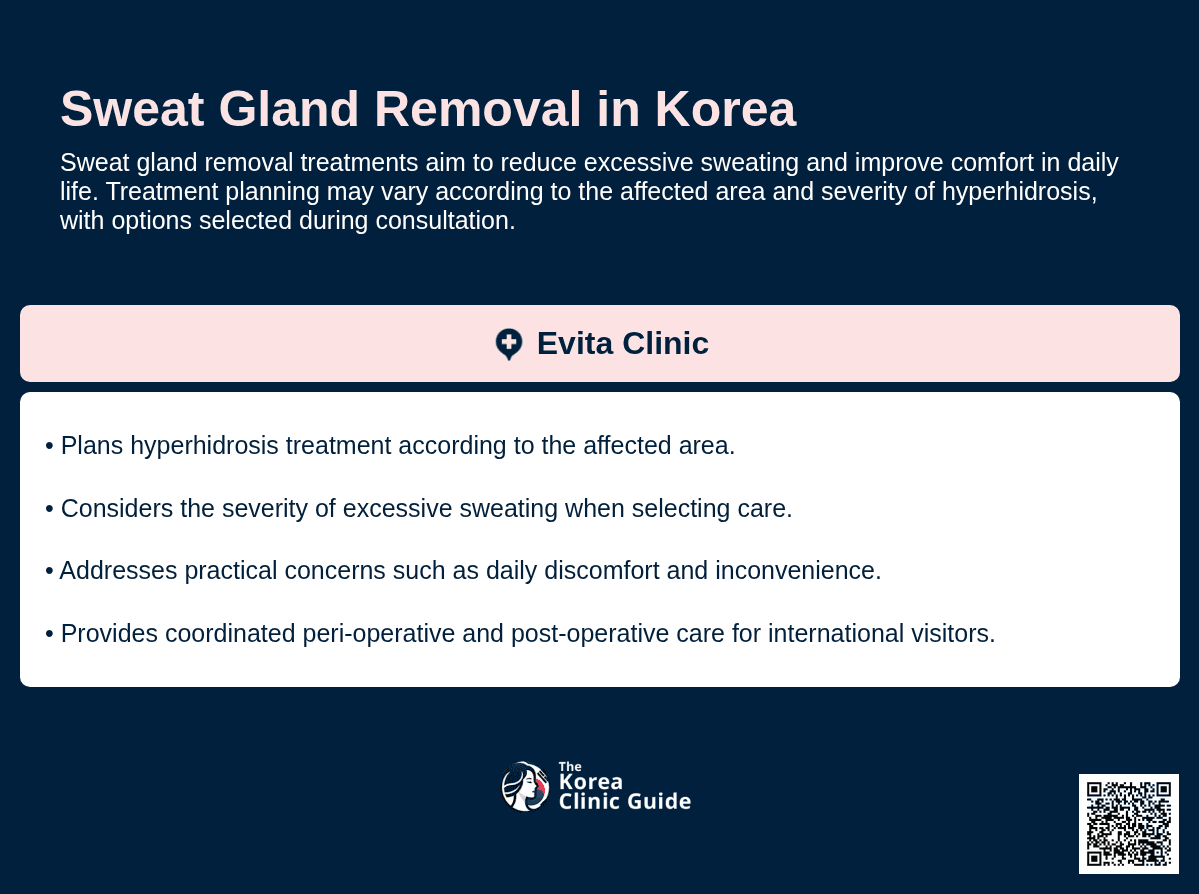
You may consider Evita Clinic for excessive-sweating concerns because it offers hyperhidrosis treatment planned around the affected area, such as the underarms, and the severity of your symptoms. While the available information does not specify a sweat-gland removal technique, the clinic’s treatment selection process can help determine an appropriate approach for improving daily comfort and reducing clothing or social inconvenience.
- URL: Evita Clinic Website
- Location: 5F, 815, Nonhyun-ro, Gangnam-gu, Seoul, South Korea
- Hyperhidrosis treatment:
- Treatment options are selected according to the area affected and the severity of excessive sweating.
- Care is intended to address the practical impact of sweating, including daily discomfort and inconvenience.
- Care coordination: The clinic describes coordinated peri-operative and post-operative care for international visitors.
Sweat Gland Removal From Start to Finish
- Remote screening — Send a symptom history, photographs only if requested, prior treatment records, medication list, allergies, relevant medical conditions, smoking or nicotine use, and history of scars or delayed healing. Ask whether English-language or virtual consultation is available and whether the clinic can provide written English records.
- In-person assessment — The clinician confirms whether sweating or odor is focal and axillary, reviews onset, triggers, night sweats, medicines, and prior treatment, and examines the underarm skin. A Minor starch-iodine test can map actively sweating areas before treatment.
- Technique and consent — Discuss suction-curettage, subdermal shaving, laser-assisted treatment, or excision as applicable. Confirm the intended result, incision or scar pattern, possibility of residual sweating or odor, recurrence, hair reduction, numbness, pigmentation change, fibrosis, and revision options.
- Pre-procedure preparation — The underarms are cleaned and marked. Small-incision procedures commonly use tumescent local anesthesia; follow the clinic's fasting instructions when oral, intravenous, or general sedation is planned.
- Gland treatment — The surgeon uses the agreed technique to mechanically remove, scrape, shave, suction, thermally damage, or excise targeted gland-bearing tissue. Procedure duration depends on the method and whether both underarms require treatment.
- Dressing and discharge — The area is dressed and often compressed. Most patients leave the facility the same day with pain-control, wound-care, and activity instructions.
- Early local review — Return for dressing assessment, wound review, and drain or suture management when used. Confirm fitness for travel rather than relying on a pre-booked flight date.
- Overseas follow-up — Send scheduled wound photographs and report changes promptly after returning home. Final sweat reduction takes months to assess; the International Hyperhidrosis Society notes that maximum reduction after liposuction can take about eight months.
Alternatives to Sweat Gland Removal
Non-surgical options avoid incisions and surgical scarring but often require repeat treatment or ongoing use. Surgery can offer longer-lasting local reduction, but it is irreversible and brings wound, scar, sensation, and recurrence risks.
Prescription antiperspirants and medicines
- Topical antiperspirants — Aluminum chloride or aluminum-zirconium products are non-invasive first steps for axillary sweating, but irritation and incomplete control are common limitations.
- Topical or oral anticholinergics — Glycopyrronium cloths, sofpironium gel where available, or oral anticholinergic medicines reduce sweating without surgery. Systemic medicines can cause dry mouth, blurred vision, constipation, or urinary symptoms and need medical review.
Botulinum toxin A
- Temporary sweat reduction — Hyperhidrosis Botox blocks nerve signals to sweat glands and avoids incisions. Results require repeat injections, unlike gland removal.
- Appropriate goal — This option suits people who want a reversible approach, need symptom control while investigating causes, or are not ready to accept surgical scars and recovery.
Microwave or laser energy treatment
- Microwave thermolysis — miraDry uses microwave energy to reduce underarm sweat glands without excision. Swelling and altered sensation can still occur, and treatment availability and session plans differ by clinic.
- Laser approach — Hyperhidrosis laser treatment aims to damage underarm gland tissue through energy delivery rather than open excision. Ask how the device, treatment depth, and expected repeat sessions compare with surgical suction-curettage.
Bromhidrosis-focused care
- Odor-focused evaluation — Bromhidrosis treatment addresses persistent underarm odor, which can involve apocrine secretions, bacteria, hair, skin conditions, and sweating. Confirm whether the dominant concern is odor, wetness, or both before choosing an intervention.
Endoscopic thoracic sympathectomy
- Different operation, different risk profile — This chest operation interrupts sympathetic nerves and is not a local sweat-gland-removal method. It is generally reserved for carefully selected refractory cases because compensatory sweating and other distinct surgical risks can be significant.
How Can I Prepare for Sweat Gland Removal?
- Medical disclosure — Provide the surgeon with a complete list of medicines, allergies, previous underarm procedures, medical conditions, smoking or nicotine use, and history of abnormal scars, bleeding, infection, or slow healing.
- Blood-thinning medicines and supplements — Report warfarin, apixaban, rivaroxaban, clopidogrel, aspirin, NSAIDs, fish oil/omega-3, vitamin E, ginkgo, garlic, ginseng, and St John's wort well before surgery. Do not stop or alter prescribed anticoagulants or antiplatelets unless the prescribing clinician and surgeon give a specific plan.
- Other medicines — Discuss diabetes medicines, corticosteroids, isotretinoin, hormonal medicines, and any injectable weight-loss or metabolic medicine. The surgeon and anesthetic clinician must specify what to continue, hold, or adjust.
- Underarm skin — Do not shave, wax, use depilatory cream, exfoliating acids, retinoids, bleaching products, or irritating deodorants immediately before treatment unless the clinic specifically instructs otherwise. Report rashes, boils, drainage, or broken skin promptly.
- Nicotine, alcohol, and fasting — Stop nicotine and avoid heavy alcohol for the period specified by the surgical team. Follow fasting instructions exactly when oral, intravenous, or general sedation is planned; local anesthesia alone does not always require the same restrictions.
- Travel logistics — Arrange loose, breathable tops, accommodation close enough for the early review, and help with luggage if arm movement will be limited. Keep flights flexible until the wound review is complete.
Travel note: Do not plan treatment immediately before long-haul flights or a luggage-heavy itinerary. Build in time for an early wound check and the possibility that the surgeon delays travel clearance.
Confirm the treating doctor's clinic-specific medication, fasting, skin-preparation, and travel requirements, which take precedence over general guidance.
Aftercare Advice
Protect the healing underarm skin and follow the surgeon's dressing plan exactly; early overuse, heat, friction, or unapproved products can disrupt recovery.
- Dressings and compression — Keep dressings clean, dry, and intact for the period instructed. Wear compression only as directed, and do not remove drains, strips, or sutures yourself.
- Movement and exercise — Limit repetitive shoulder motion and avoid heavy lifting, strenuous upper-body exercise, swimming, sauna, and steam exposure until the wounds are sealed and the surgeon clears activity, often around 2–4 weeks. Comfortable overhead arm movement can remain limited for 1–3 weeks.
- Skin products and hair removal — Wear loose breathable clothing and minimize friction. Do not restart antiperspirants, fragranced deodorants, exfoliating acids, retinoids, bleaching products, shaving, waxing, or depilatory treatments on healing skin without clearance.
- Expected changes and results — Soreness, swelling, bruising, firmness, and temporary numbness or altered sensation are common. Sweat and odor reduction are variable; reported liposuction series often show 80%–90% improvement at six months, while some curettage series show more modest or less durable reduction. Final assessment takes months rather than days.
- Warning signs — Seek urgent assessment for fever, worsening pain, spreading redness or warmth, pus or foul drainage, persistent bleeding, rapidly enlarging swelling, black or gray skin, wound opening, or new marked arm weakness or numbness. Reported complications include hematoma, infection, partial skin necrosis, dysesthesia, fibrosis, pigmentation change, scarring, residual sweating, and recurrence.
Follow the treating doctor's individualized instructions and contact the clinic promptly when healing appears abnormal, especially after returning home.
Frequently Asked Questions
Related Blogs
Discover the Global Lip Reduction Cost: How Korea Competes with the USA, Turkey, and More
Explore the costs and factors influencing lip reduction surgery in Korea, a popular destination for cosmetic procedures. Discover what to expect in terms of pricing, quality, and the overall experience of undergoing this transformative surgery abroad.
Updated: Oct 21, 2026

Discover Why Protruding Ear Surgery in Korea Offers Unmatched Value Compared to Global Alternatives
Discover the cost and benefits of protruding ear surgery in Korea, where skilled surgeons offer advanced techniques at competitive prices. This article breaks down the expenses, procedure details, and why Korea is a sought-after destination for this cosmetic enhancement.
Updated: Oct 21, 2026

Korea's Competitive Edge: Comparing Global Costs and Care Standards for Cleft Lip Surgery
Discover the affordability and quality of cleft lip surgery in Korea, a leading destination for medical tourists seeking advanced healthcare solutions. Explore how competitive pricing and expert medical care make it an attractive option for international patients.
Updated: Oct 21, 2026
Navigating Bromidrosis Treatment Costs: A Global Perspective with a Focus on Korea's Advanced Options
Bromidrosis, a condition causing unpleasant body odor, is becoming a costly health concern in Korea. Explore the economic impacts and treatment options available to manage this growing issue in the region.
Updated: Oct 21, 2026