
Medical Tourism Blog
Korea Nasolabial Angle Adjustment: Solutions for an Overly Obtuse Nasolabial Angle
Table of contents
- Medical Procedures for Nasolabial Angle Adjustment
- The Patient Journey: Nasolabial Angle Adjustment in South Korea
- Which Are the Best Clinics in Korea for Nasolabial Angle Too Obtuse?
- Costs Associated with Nasolabial Angle Adjustment in South Korea
- Patient Outcomes and Satisfaction
- Conclusion
- References
Considering treatment in Korea? Everything you need to know e.g. — how to avoid scams, visas, interpreters, recovery tips — in our Medical Tourism Master Guide. Plan with confidence in minutes, not weeks!
The nasolabial angle, at the junction where your nose meets your upper lip, dramatically impacts facial aesthetics by affecting your overall profile balance and harmony. Many people seek "nasolabial angle adjustment"—especially when this angle is described as "too obtuse"—to achieve their ideal look. Here, we break down what this means, explore available procedures (with special focus on South Korea), look at costs, and cover what to expect from treatment and results.
Definition and Aesthetic Importance
The nasolabial angle is measured between a line through the midpoint of the nostril opening and another meeting the subnasale (where the columella meets the upper lip), or more simply, it’s the profile angle between the nasal columella and upper lip. Nose shape and facial symmetry often hinge on this angle, but there’s no universal "ideal": it varies by gender, ethnicity, and personal aesthetic.
Typically, literature cites ranges from 90 to 120 degrees overall. For men, ideals trend from 90-95 degrees, with precise studies often noting 93.4-98.5 degrees or 93.9-97.3 degrees. For women, the preferred range is generally 95-115 degrees, with a narrower target of 100-105 degrees being common, and research pointing to 95.5-100.1 degrees or 96.8-100.2 degrees. Contemporary data even suggest the "ideal" female angle may be less obtuse than previously described, meaning the gap between male and female preferences is narrower than once believed.
One thing is clear: the ideal nasolabial angle isn’t one set point. It’s highly nuanced, shaped by factors like culture, race, age, and gender. What matters most for patients is a personalized outcome that fits their unique facial features and aesthetic goals, not a rigid target number. Surgeons must tailor techniques for each individual, understanding the varied conceptions of beauty.
Common Descriptions and Related Terms
An "obtuse nasolabial angle" means the nasal tip points up more than desired, creating a wide angle between nose and lip. You might hear this called:
- Upturned Nose / Over-rotated Tip: The nasal tip appears rotated upward.
- Pig-Nose Deformity: A colloquial term for an extremely upturned or over-rotated nose, with very visible nostrils.
- Excessive Nostril Show: Prominent nostrils in the frontal or profile view.
- Pointy Tip: While not identical, a pointy tip often coincides with an obtuse nasolabial angle.
- Hanging Columella: While more often linked to droopy tips (acute angles), a high columella can also make nostril show worse for some.
Causes of an Obtuse Nasolabial Angle
Several factors may contribute:
- Natural Anatomy/Genetics: Your facial structure or “excessive vertical maxillary growth” can set the stage.
- Aging: Weakening cartilage or smoothing lips as you age may shift the angle.
- Orthodontic Issues: Jaw and bite problems can impact the nasolabial relationship.
- Previous Rhinoplasty: Excessive cartilage removal, aggressive suturing, or healing scar contracture after prior nose jobs are frequent surgical culprits.
Often, an obtuse nasolabial angle is less an isolated problem and more a manifestation of deeper structural or past surgical issues. Diagnosing the issue thoroughly, including your skeletal and nasal cartilage condition and any previous procedures, is key.
Table 1: Ideal Nasolabial Angle Ranges by Gender and Source
| Gender | Angle Range (Degrees) | Source/Context |
|---|---|---|
| General | 90-120 | Arbitrary Literature Range |
| Male | 90-95 | General Aesthetic Consensus |
| Male | 93.4-98.5 | Objective Study (Mean ± SD) |
| Male | 93.9-97.3 | Expert Rhinoplasty Surgeons' Preference |
| Male | 90.7-103.3 | General Population Perception |
| Female | 95-115 | General Aesthetic Consensus |
| Female | 100-105 | Cosmetically Appealing Target |
| Female | 95.5-100.1 | Objective Study (Mean ± SD) |
| Female | 96.8-100.2 | Expert Rhinoplasty Surgeons' Preference |
| Female | 100.9-108.9 | General Population Perception |
Medical Procedures for Nasolabial Angle Adjustment
Surgical and Non-Surgical Options
A "nasolabial angle adjustment" changes the angle between the upper lip and nose’s base to harmonize your profile. There are two common routes:
- Surgical Adjustment: Rhinoplasty is the permanent solution for significant corrections, focusing on repositioning nasal tip cartilage and structure.
- Non-Surgical Options: For minor tweaks, fillers can provide subtle enhancement, and Botox can temporarily relax specific nasal muscles. Be aware: these are short-term fixes, generally lasting only a few months.
Non-surgical methods offer only fine-tuning and aren't suitable for major shape changes—especially for genuinely obtuse angles where deeper correction is needed.
Surgical Techniques for an Obtuse Angle
The main surgical goal is to "de-rotate" the nasal tip (tilting it down) and often lengthen the nose or columella to reduce nostril show.
Surgical Approaches:
- Open Rhinoplasty: Involves a small incision on the columella for full visibility and access—ideal for complex revisions and when cartilage grafting is needed. While it leaves a tiny external scar, skilled surgeons make this almost undetectable.
- Closed Rhinoplasty: Uses incisions inside the nostrils, so there’s no visible scar and typically a quicker recovery. However, it’s less suitable for tricky or revisional cases.
Specific Techniques:
- Cartilage Grafts: Sourced from your septum, ear, or rib, they reinforce, reshape, and support nasal structure. Sometimes, synthetic materials like Gore-Tex are used.
- Septal Extension Grafts: Lengthen and support nasal tip, crucial for enduring, stable changes.
- Columellar Strut Grafts: Offer added tip support, helpful in lengthening or in revision surgeries.
- Shield Grafts: Shape definition and nostril proportion refinement.
- Rim Grafts / Medial Crura Overlay: Address rim/columella relationships or nostril show.
- Careful Cartilage Trimming: Only minimal trimming is done to avoid future instability.
- Advanced Suturing: Holds cartilage in optimal position and improves tip definition.
- Soft-Tissue Management: Especially important in revisions—scar release and, if appropriate, careful thinning in thick-skinned patients enhances outcomes.
Additional Rhinoplasty Procedures
Nasolabial angle adjustments often accompany:
- Nasal Tip Refinement (Tip-plasty): Tailoring bulbous tips, nostril rebalancing, or flare reduction.
- Dorsal Augmentation: Enhances nose bridge with implants or cartilage.
- Alar Reduction: Narrows nostrils for symmetry.
- Septoplasty: Corrects septal deviation for improved look and breathing.
The Patient Journey: Nasolabial Angle Adjustment in South Korea
South Korea is renowned for cosmetic surgery, offering advanced, natural-looking results and seamless care, attracting patients from around the world.
Consultation and Treatment Planning
Care often starts with an online consultation, where surgeons evaluate your facial structure and discuss expectations. Advanced imaging (like 3D-CT) enables precise, individualized planning before you even board a plane.
Once ready, you’ll receive a personalized plan covering costs, recovery, procedure details, and post-op care. Pre-arrival, tests like CT scans may refine surgical decisions (e.g., where to harvest cartilage).
Travel and Pre-Procedure Preparation
With your plan set, you’ll coordinate your trip. Reputable clinics—often through dedicated facilitators—help international visitors with visas, accommodations, and airport transfers. Patients are advised to bring all necessary documents (passport, medical records, proof of funds, insurance, visa receipts) and rest up before surgery.
Surgery and Anesthesia
On procedure day, you'll typically receive local (and sometimes general) anesthesia. Open or closed rhinoplasty incisions provide access to reshape and support the nasal framework—often with grafts—to achieve the desired angle.
Post-Operative Care and Recovery
Incisions are closed with care, and you leave with detailed instructions for aftercare and follow-ups. Swelling and bruising resolve over several weeks, and you can normally return home after 1-2 weeks. Korean clinics excel in aftercare, offering programs for scar and skin recovery. Expect the final nasal shape to refine for up to a year, with some swelling (especially at the tip) lingering for months. During healing, avoid nose-blowing, use saline, sneeze with your mouth open, and don’t wear glasses until cleared.
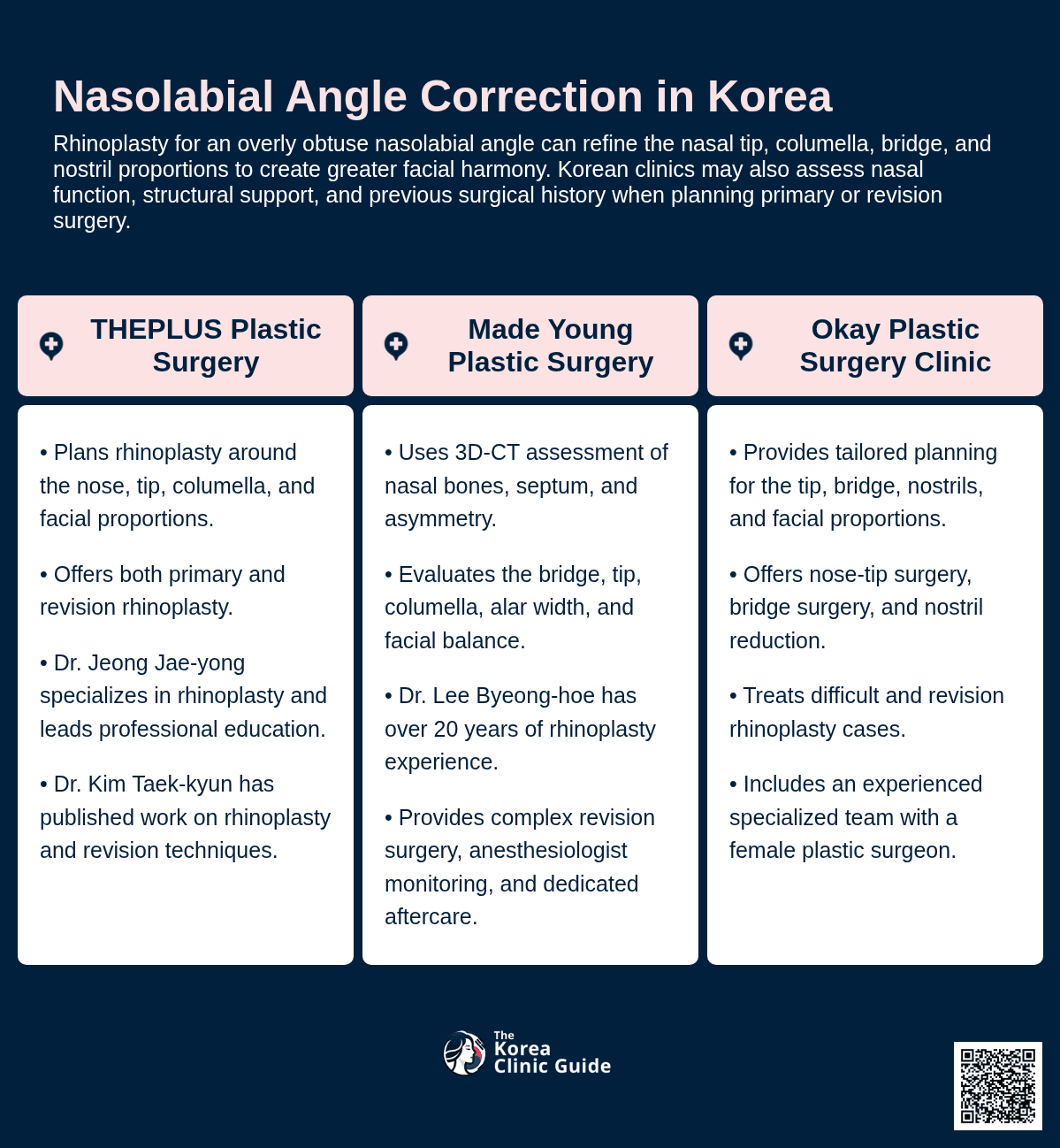
Which Are the Best Clinics in Korea for Nasolabial Angle Too Obtuse?
Listed below are some of the best clinics in Korea for nasolabial angle too obtuse.
1. THEPLUS Plastic Surgery
For an overly obtuse nasolabial angle, you can expect rhinoplasty planning centered on bringing the nose, tip, columella, and surrounding facial proportions into better harmony while considering both appearance and nasal function. THE PLUS offers primary and revision rhinoplasty led by surgeons with extensive academic and teaching involvement in the specialty.
- URL: THEPLUS Plastic Surgery Website
- Location: Gangnam-gu, Seoul
- Rhinoplasty approach:
- Rhinoplasty is described as addressing nasal appearance and structural harmony, with an emphasis on aesthetics and function.
- Revision rhinoplasty is available when you are seeking correction after a previous nose procedure.
- Surgeon expertise:
- Dr. Jeong Jae-yong specializes in rhinoplasty, is President of the Korean Society of Plastic Surgeons, and authored Rebuilding Nose: Rhinoplasty for Asians.
- Dr. Kim Taek-kyun is a board-certified plastic surgeon whose published work includes rhinoplasty and revision rhinoplasty chapters in The 18 Masters of Korean Aesthetic Surgery.
- Both surgeons contribute to rhinoplasty education and present research and techniques at professional meetings including the Seoul Rhinoplasty Forum, KSPRS, and IFAAS.

2. Made Young Plastic Surgery
For an overly obtuse nasolabial angle, you can expect individualized rhinoplasty planning that assesses the bridge, tip, columella, alar width, and overall facial proportions. Made Young uses 3D-CT assessment of the nasal bones, septum, and asymmetry, with techniques intended to build a stable internal nasal structure and maintain tip support over time.
- URL: Made Young Plastic Surgery Website
- Location: Seocho-gu, Seoul
- Procedure planning:
- 3D-CT analysis is used to evaluate nasal bones, the septum, and asymmetry for surgical planning.
- Planning considers nasal bridge and tip shape, columella, alar width, and your facial proportions.
- The clinic describes structural techniques intended to prevent tip drooping and support lasting nasal shape.
- Rhinoplasty expertise:
- Dr. Lee Byeong-hoe has more than 20 years of exclusive rhinoplasty experience.
- Complex reconstruction and revision rhinoplasty are available, including challenging multiple-revision cases.
- The clinic describes advanced osteotomy and autologous rib graft techniques for dorsal hump correction and nasal-tip refinement.
- Safety and aftercare:
- Full-time board-certified anesthesiologists are on site, with one-to-one anesthesiologist monitoring during procedures.
- A cross-check system involves multiple anesthesiologists in emergency assessment and response.
- A dedicated aftercare center provides post-procedure care.
3. Okay Plastic Surgery Clinic
For an overly obtuse nasolabial angle, you can discuss a tailored rhinoplasty plan that may address nasal-tip shape, bridge proportions, and nostril balance. Okay Plastic Surgery Clinic also offers care for difficult and revision rhinoplasty cases, which may be relevant if you have had prior nasal surgery.
- URL: Okay Plastic Surgery Clinic Website
- Location: Gangnam-gu, Seoul
- Nasal procedures:
- Available rhinoplasty services include nose-tip surgery, nose-bridge surgery, nostril reduction, and revision surgery.
- Difficult rhinoplasty cases and revision rhinoplasty are available.
- Planning considerations:
- The clinic describes an individualized treatment approach intended to match your specific needs and goals.
- A specialized team includes a female plastic surgeon with extensive experience.
Costs Associated with Nasolabial Angle Adjustment in South Korea
Typical Cost Range
South Korea delivers high-level medical expertise at competitive prices. Nasolabial angle adjustment generally costs $2,000 to $4,000 USD (about 2,900,000 to 5,800,000 KRW). Tip rhinoplasty specifically runs $2,100 to $3,000 USD on average, sometimes including additional services like consults or accommodation.
Full rhinoplasty prices range between $2,200 and $7,200 USD, with an average cost around $3,600 USD. Fees rise with the surgeon's experience and clinic reputation.
International Price Comparison
- USA: Rhinoplasty (nasolabial adjustment often included) costs $7,000–$10,000 USD, averaging around $7,500 USD.
- UK: Similar, at $7,000–$10,000 USD, average $8,200 USD.
- Turkey: $2,600–$2,944 USD
- Thailand: $1,292–$2,900 USD
- Mexico: ~$2,800 USD
- France/Germany: ~$7,000 USD
- Iran: $1,700 USD
While some countries, like Thailand or Iran, may have lower base rates, South Korea's combination of cost, advanced techniques, natural outcomes, and high safety standards is hard to beat for medical tourists.
Extra Financial Considerations
A 10% deposit is usually required to confirm surgery dates in Korea. Some packages bundle consults and accommodation, but you’ll need to budget for travel and lodging. Clinics are transparent on pricing and may offer financing.
Patient Outcomes and Satisfaction
Typical Issues and Results
Most patients interested in nasolabial angle adjustment want to address an "over-rotated" or "upturned" tip and reduce nostril visibility. The focus is on de-rotating and lengthening the tip for a harmonious look.
Reviews and studies consistently report strong results. Examples include teenagers and adults noting dramatic improvements even months or a year after surgery, from better nasal projection and balance to enhanced tip definition and a more youthful profile.
Objective studies back up these reports, with increases in the nasolabial angle of up to 8.6 degrees and noticeable aesthetic improvements documented in clinical data.
Satisfaction and Long-Term Considerations
Patient satisfaction is generally high, with many stating they’d happily undergo the procedure again. Key to this is surgeon understanding of patient goals and personalization of every detail. Even concerns like tip movement when smiling can be addressed through advanced techniques.
Patience is needed, as it can take up to a year for all swelling to subside and your new nasal shape to settle. Complex revision cases, especially after previous rhinoplasty, add technical difficulty and require a true expert for best results. The stability and satisfaction reported years later highlight the transformative impact of skillful surgical care.
Conclusion
The nasolabial angle is essential for facial harmony, but there is no single ideal—preferences vary by gender, ethnicity, and personal taste. Correction usually requires surgical rhinoplasty with precise de-rotation and support, especially in revision cases or where significant structural change is needed. South Korea’s skilled surgeons and patient-focused process make it a great option for both quality and value. Most patients achieve lasting, natural-looking results with high satisfaction, provided they receive individualized care and have realistic expectations about healing timelines.
References
1, 2, 3, 4, 5, 6, 7, 8, 9, 10, 11, 12, 13, 14, 15, 16, 17, 18, 19, 20, 21, 22, 23, 24, 25, 26, 27, 28, 29, 30, 31, 32, 33, 34, 35, 36
Frequently Asked Questions
Related Blogs
Korea vs. Global Standards: A Comprehensive Cost Analysis of Cleft Rhinoplasty in Medical Tourism Destinations
Explore the cost of cleft rhinoplasty in Korea, a popular destination for medical tourism due to its advanced surgical techniques and competitive pricing. Discover factors influencing the overall expense, from hospital fees to post-operative care, and what makes Korea a top choice for this specialized procedure.
Updated: Oct 21, 2026
Philtrum Reduction Costs: Choosing Korea Over the USA, Mexico, Turkey & More for Expert Care
Discover the affordability and benefits of Philtrum Reduction Surgery in Korea, a popular destination for high-quality cosmetic procedures. Explore cost factors, surgeon expertise, and why Korea is a top choice for those considering this transformative surgery.
Updated: Oct 21, 2026
Discovering the True Value: Sinus Surgery Costs in Korea Compared to Global Options
Discover the affordable options for sinus surgery in Korea, a leading destination for medical tourists seeking quality care. Learn about the factors influencing costs and what patients can expect from their experience in this highly advanced healthcare system.
Updated: Oct 21, 2026
Non-Implant Rhinoplasty in Korea: Cartilage Grafts, Recovery, Travel Planning, and Alternatives
Non-implant rhinoplasty reshapes the nose using septal, ear, or rib cartilage, with surgical or injectable and open or closed approaches and possible septal or nasal-valve correction. International patients can find guidance on candidate screening, material-specific consent, Korea stays of 10–21 days, travel timing, recovery, and follow-up.
Updated: Oct 16, 2026
Clinics offering Nasolabial Angle Adjustment

THEPLUS Plastic Surgery Korea | Eye, Nose, Face & Body Surgery
Sinsa

Made Young Plastic Surgery: Rejuvenating Aesthetic Excellence in Korea for Face Lifts, Contouring and More
Gangnam Station

Okay Plastic Surgery Clinic in Korea: Comprehensive Aesthetic Procedures with Sincerity and Care
Cheongdam
ID Hospital - Main Branch in Korea: Specializing in Safe & Customized Facial Plastic Surgery and Post-Care Services
Sinsa