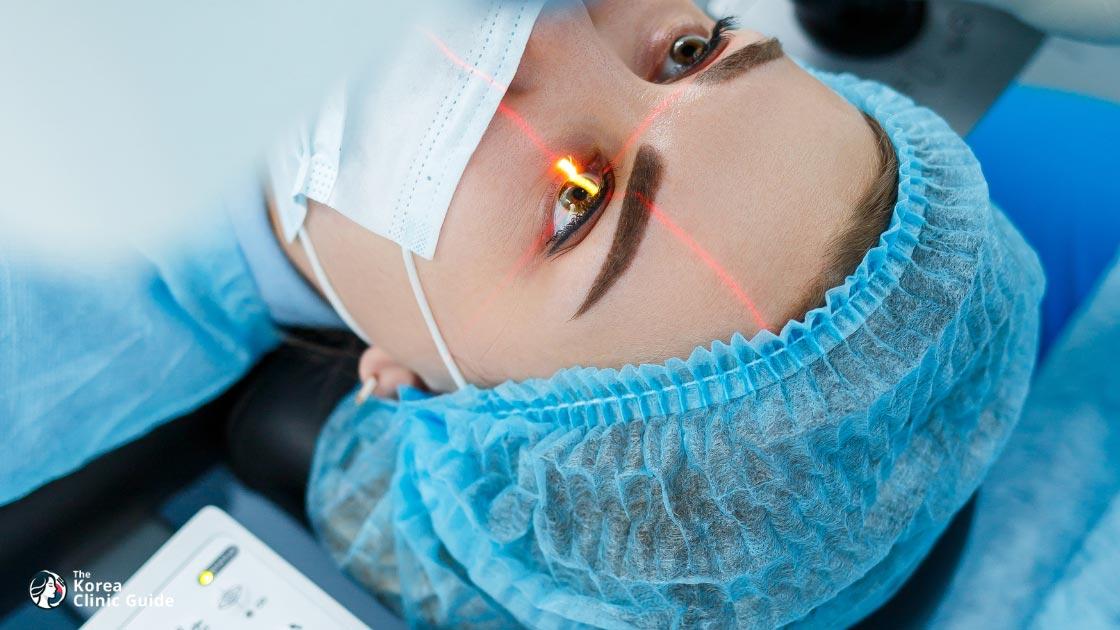
Compare presbyopia options in Korea, including glasses, contacts, drops, corneal laser correction, and IOL-based lens surgery. Prices range from ₩2,730,000 to ₩8,000,000, with eligibility testing, recovery timelines, travel planning, and follow-up guidance for international patients.
Updated: Sep 13, 2026
SMILE uses a femtosecond laser to create and remove a corneal lenticule through a small incision; candidacy requires stable myopia, healthy corneas, and detailed in-person screening. In Korea, costs range from ₩2,800,000–₩6,000,000, with international patients advised to stay 3–5 nights for day-1 review and follow-up planning.
Updated: Sep 12, 2026
LASEK is an outpatient surface-ablation procedure that reshapes the cornea without a LASIK flap; candidates need stable myopia or myopic astigmatism, healthy corneas, and treated ocular-surface conditions. In Korea, costs are ₩1,300,000–₩2,000,000 (about US$1,000–US$1,500), with a recommended 7–10-day stay for healing checks and bandage-lens removal.
Vaginoplasty creates vulvar anatomy with either a penetrable vaginal canal requiring long-term dilation or a zero-depth option without a canal. The article covers candidate assessment, techniques, Korean travel and aftercare planning, and costs of KRW 8,000,000–23,000,000.
LASIK creates a corneal flap and uses an excimer laser to reshape the cornea; candidacy requires stable adult vision, healthy corneas, and a detailed in-person assessment. In Korea, LASIK costs ₩1,700,000–₩2,500,000 (about US$1,300–$1,900), with a 3–5-day minimum stay, early postoperative review, and follow-up planning needed.
Vision correction in Korea includes LASIK, surface ablation, SMILE, and phakic ICL after detailed eye screening, with follow-up and travel planning for international patients. Costs are ₩3,000,000–₩5,000,000 (about US$2,200–$3,700), varying by method, assessment, and postoperative monitoring.
Rezūm is an incision-free BPH treatment that uses cystoscope-guided, approximately 9-second water-vapor injections to treat lateral or median-lobe prostate obstruction, often with a temporary catheter. International patients in Korea should plan a 7–10 day stay for catheter removal and voiding assessment, then arrange home-urologist follow-up within 1–3 months.
Penile implant surgery is a permanent treatment for persistent erectile dysfunction when medications, injections, or vacuum devices are ineffective or unsuitable, with inflatable and malleable device options based on anatomy and hand function. The article covers candidacy, surgery steps, recovery, international travel planning in Korea, follow-up, risks, preparation, and alternatives.
Testicle implant surgery in Korea places a saline-filled or silicone-based prosthesis to restore scrotal contour after testicular loss or reconstruction, without restoring hormones or fertility. The article covers candidacy, a ₩4,000,000–₩6,000,000 estimated cost, 10–14-day stay, recovery restrictions, device verification, and follow-up planning.
Join our trusted platform to effortlessly enhance your online visibility among those seeking top-quality medical care in Korea from abroad.