
Medical Tourism Blog
Rezum Treatment in Korea: Candidacy, Recovery, Travel Planning, and Alternatives

Table of contents
- Rezum Treatment at a Glance
- What Is Rezūm Treatment?
- Who Is a Good Candidate for Rezūm Treatment?
- How Is Rezūm Treatment Performed?
- Why Visit Korea for Rezūm Treatment?
- Key Information for International Patients
- Which Are the Best Clinics in Korea for Rezum Treatment?
- Rezum Treatment From Start to Finish
- Alternatives to Rezūm Treatment
- How Can I Prepare for Rezūm Treatment?
- Aftercare Advice
Considering treatment in Korea? Everything you need to know e.g. — how to avoid scams, visas, interpreters, recovery tips — in our Medical Tourism Master Guide. Plan with confidence in minutes, not weeks!
Last updated: September 2026
Rezum Treatment at a Glance
- What it is — Rezūm is an incision-free, outpatient BPH treatment in which a device passed through the urethra delivers roughly 9-second water-vapor injections to shrink obstructing prostate tissue over time.
- Best candidates — It is generally suited to men with bothersome, confirmed BPH symptoms who value preserving erectile and ejaculatory function; lateral-lobe and obstructing median-lobe tissue can be treated, with the strongest long-term evidence for prostates measuring 30–80 cc.
- Recovery timeline — Same-day discharge is typical, but a Foley catheter commonly remains for 3–10 days and urinary burning, urgency, blood in urine, or temporarily worse flow can occur; improvement may start around 2 weeks and maximum benefit commonly takes about 3 months.
- Long-term results — In the pivotal 5-year study, symptom scores improved 48%, urinary flow improved 44%, and surgical retreatment was 4.4%, although results are less certain for very large prostates and chronic catheter-dependent retention.
- Travel planning — International patients should plan to stay in Korea at least 7–10 days to complete catheter removal and a documented voiding trial; no evidence-based long-haul flight interval exists, so travel requires the treating urologist’s clearance.
- Key limitation — Rezūm is not appropriate with an active urinary infection, unexplained obstruction, or inadequately evaluated prostate-cancer concern, and it does not reliably address symptoms caused by stricture, stones, neurogenic bladder, or poor bladder function.
- Korea distinction — Rezūm is clinically available in South Korea, but access and operator experience vary; a Korean prospective registry is recruiting 300 patients through 2028 and has not yet posted local effectiveness, complication, or retreatment results.
What Is Rezūm Treatment?
Rezūm treatment uses controlled water vapor to reduce enlarged prostate tissue causing benign prostatic hyperplasia (BPH). It aims to improve urine flow and ease symptoms such as weak stream, frequent urination, urgency, and nighttime urination. Rezūm is a minimally invasive treatment performed through the urethra without external incisions.
Who Is a Good Candidate for Rezūm Treatment?
- Bothersome BPH symptoms — Good candidates have objectively evaluated lower urinary tract symptoms from benign prostatic hyperplasia (BPH), such as a weak or intermittent stream, hesitancy, straining, incomplete emptying, urgency, frequency, or nocturia.
- Preference for an incision-free option — Rezūm suits patients who want transurethral treatment without skin incisions and accept that urinary symptoms often worsen temporarily before improving.
- Sexual-function priorities — It is a reasonable option for patients who place value on preserving erectile and ejaculatory function, while understanding that sexual changes can still occur.
- Suitable prostate anatomy — Lateral-lobe obstruction and an obstructing median lobe can be treated. The pivotal evidence enrolled men over 50 with IPSS scores of at least 13, low urinary flow, and prostates measuring 30–80 cc; evidence for larger glands is supportive but less certain over the long term.5-year Rezūm evidence
- Retention assessed individually — Selected BPH-related urinary retention can be treated, but catheter dependence, bladder function, prostate size, and the cause of retention require detailed urological assessment.
Rezūm is not appropriate during an active or suspected urinary tract infection, with an implanted urinary sphincter or penile prosthesis, or when prostate cancer has not been adequately evaluated. Urethral stricture, bladder-neck contracture, bladder stones, neurogenic bladder, and other non-BPH causes of obstruction must be investigated rather than assumed to respond to steam treatment. Do not independently stop aspirin, clopidogrel, warfarin, apixaban, rivaroxaban, dabigatran, or other antithrombotic medicines; the urologist and prescribing clinician must agree on an individualized plan. Assessment generally includes symptom scoring, urinalysis and culture when indicated, PSA interpreted in clinical context, prostate sizing, uroflowmetry, and post-void residual measurement.
How Is Rezūm Treatment Performed?
There are no patient-facing “types” of Rezūm. The meaningful difference is the injection plan, which the urologist designs around the anatomy causing obstruction.
- Lateral-lobe treatment — Water-vapor injections target enlarged transition-zone tissue on one or both sides of the prostatic urethra.
- Median-lobe or central-zone treatment — An obstructing median lobe, including tissue protruding toward the bladder, can be included in the plan rather than automatically requiring a different BPH procedure.
- Extended plan for a larger gland — Selected prostates above 80 cc require more extensive treatment planning. Long-term evidence is less established than it is for the 30–80 cc pivotal-study population.Evidence limitations by prostate size
- Transurethral steam delivery — A cystoscope-guided device passes through the urethra. A retractable needle delivers targeted water-vapor injections, each lasting about 9 seconds; steam condenses in the tissue, releases heat, and produces focal tissue death that the body gradually absorbs.
- Anesthesia approach — Local anesthetic with or without sedation, spinal anesthesia, or general anesthesia can be used. The choice depends on anatomy, treatment extent, medical history, anxiety, and local hospital protocol.
Why Visit Korea for Rezūm Treatment?
Rezūm has documented clinical availability in South Korea. It should not be assumed that every Korean hospital offers it or that operator experience is uniform. Confirm device availability, the urologist’s experience with median lobes and retention, anesthesia options, and catheter-removal arrangements before booking travel.
- Documented local availability — A Korean prospective registry states that Ministry of Health and Welfare approval enabled use of water-vapor thermal therapy in South Korean patients.Korean Rezūm registry
- Prospective outcome collection — The registry follows symptom scores, urinary flow, residual urine, prostate size, PSA, sexual function, and complications, which are clinically relevant measures for BPH treatment.
- Important evidence limitation — The registry is still recruiting, targets 300 participants, has estimated completion in October 2028, and listed no posted results. Korean effectiveness, complication, retreatment, and international-patient outcomes are therefore not yet publicly available.Registry status and absence of results
- Anatomy-led treatment selection — A Korean urology consultation can determine whether steam therapy is appropriate or whether a more definitive deobstructing procedure is better for gland size, median-lobe anatomy, retention, or impaired bladder function.
Key Information for International Patients
- Minimum stay — Plan to remain in Korea for at least 7–10 days after treatment. This is a practical safety allowance for catheter removal, a trial of voiding, and review for retention, infection, or significant bleeding—not an evidence-based rule for flying.
- Catheter and repeat review — A temporary Foley catheter is common and usually remains for 3–10 days. Duration depends on prostate size, injection extent, baseline retention, and recovery after catheter removal.Catheter-management consensus
- Flight timing — No high-quality Rezūm-specific study defines a safe long-haul-flight interval. Do not depart after same-day discharge; leave only after the treating urologist has confirmed satisfactory voiding and cleared travel.
- Itinerary impact — Same-day discharge is feasible for most patients, but a catheter, urinary urgency, burning, blood in the urine, and a potentially weak stream can make sightseeing and long transfers impractical during the first several days.
- Support after sedation or anesthesia — Arrange a responsible adult, private transport, and accommodation with easy toilet access if sedation, spinal anesthesia, or general anesthesia is used. Do not drive or travel alone immediately after discharge.
- Remote follow-up — Before leaving Korea, obtain the operative note, catheter details, medication list, baseline test results, and discharge summary. Arrange a home-urologist review at about 1–3 months for symptoms, flow rate, and residual urine.
Travel note: Patients needing recatheterization, those with chronic catheter-dependent retention, or anyone with infection, heavy bleeding, or poor emptying need a longer Korean stay and should keep flights flexible.
Which Are the Best Clinics in Korea for Rezum Treatment?
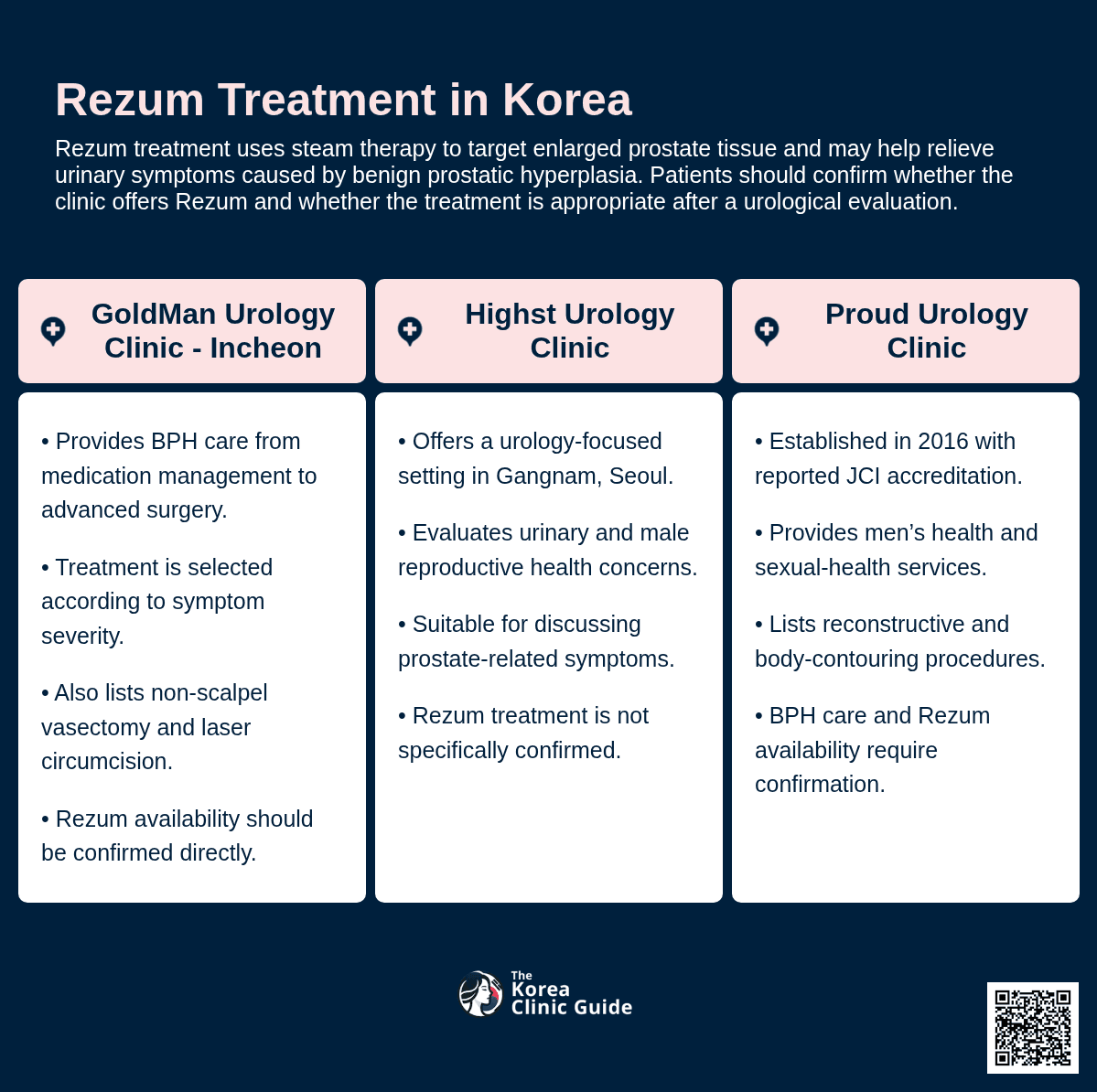
Listed below are some of the best clinics in Korea for rezum treatment.
1. GoldMan Urology Clinic - Incheon
If you are exploring Rezum treatment for urinary symptoms related to benign prostate enlargement, GoldMan Urology Clinic - Incheon reports providing BPH care ranging from medication management to advanced surgical procedures based on symptom severity. The available information does not specifically confirm that Rezum is offered, so you should verify whether this treatment is available and appropriate for your prostate condition.
- URL: GoldMan Urology Clinic - Incheon Website
- Location: Gyeonggi
- BPH care: The clinic describes treatment for benign prostatic hyperplasia (BPH), with options ranging from medication management to advanced surgery depending on severity.
- Other urology services: Listed services include non-scalpel vasectomy and laser circumcision, alongside several penile augmentation procedures.
2. Highst Urology Clinic
You may consider Highst Urology Clinic if you want a urology-focused setting for evaluation and treatment of urinary and male reproductive health in Korea. However, the available information does not confirm that the clinic performs Rezum treatment, so you should confirm its availability and whether it fits your urinary symptoms and prostate evaluation.
- URL: Highst Urology Clinic Website
- Location: 14, 15F, 655 Seolleung-ro, Gangnam-gu, Seoul, Republic of Korea
3. Proud Urology Clinic
Proud Urology Clinic provides men’s health, reconstructive, body-contouring, and sexual-health services, with information noting that it was established in 2016 and has JCI accreditation. The supplied clinic details do not list BPH care or Rezum treatment, so you should confirm whether the clinic evaluates enlarged-prostate symptoms or offers Rezum before considering it for this procedure.
- URL: Proud Urology Clinic Website
- Location: Seoul
- Men’s health services:
- Listed services include erectile-dysfunction surgery, premature-ejaculation treatment, circumcision, and vasectomy or vasectomy reversal.
- The clinic also lists STD/STI testing and treatment and HPV vaccination.
- Reconstructive care: Penile-curvature correction, removal of injected foreign substances such as Vaseline, and scrotal reconstruction are listed services.
Rezum Treatment From Start to Finish
- Remote consultation and records review — Ask whether English-language or virtual consultation is available. Send prior PSA values, prostate ultrasound or imaging, IPSS questionnaire results, medication and allergy lists, catheter or retention history, and prior cystoscopy or urodynamic reports.
- In-person BPH assessment — The urologist confirms that obstruction is caused by BPH rather than infection, cancer concern, urethral narrowing, stones, or major bladder dysfunction. Evaluation commonly includes urinalysis, urine culture when indicated, prostate sizing, uroflowmetry, and post-void residual; cystoscopy or urodynamics is selective.
- Treatment and travel planning — Resolve bacteriuria or urinary tract infection before treatment. Agree on antithrombotic management with the prescribing clinician, receive written fasting and anesthesia instructions, and schedule catheter removal and voiding assessment before departure.
- Anesthesia and access — On treatment day, the team uses local anesthetic with or without sedation, or selected spinal or general anesthesia. The urologist passes the delivery device through the urethra, so there are no external incisions.
- Steam injections — Under cystoscopic guidance, a retractable needle delivers approximately 9-second water-vapor injections into obstructing transition-zone tissue. Injection number and placement reflect prostatic-urethral length, lateral or median-lobe obstruction, intravesical protrusion, gland size, and retention history.
- Discharge with catheter care — A Foley catheter is commonly placed. Most patients leave the same day with written instructions on catheter drainage, prescribed medicines, hydration, pain control, bowel care, and emergency contact arrangements.Same-day discharge and protocol evidence
- Korean recovery check — Return for catheter removal and a documented trial of voiding within several days and generally within one week. Recatheterization or further assessment is necessary if bladder emptying is inadequate.
- Overseas follow-up — Share the procedural and discharge records with a home urologist. Reassess IPSS, urinary flow, and residual urine at approximately 1–3 months, with PSA, urinalysis, and sexual-function review when clinically indicated.
Alternatives to Rezūm Treatment
The best alternative depends on prostate size and shape, median-lobe obstruction, retention, bleeding and antithrombotic issues, bladder function, anesthesia fitness, desired speed of relief, and priorities around ejaculation. Rezūm is less invasive and usually outpatient-based, but it has a delayed treatment effect and commonly requires a temporary catheter; resective or enucleation procedures can provide more immediate and sometimes stronger deobstruction, with different recovery and sexual-function trade-offs.European BPH treatment guidance
Medication therapy
- Alpha-blockers and 5-alpha-reductase inhibitors — Drug treatment can reduce symptoms or prostate progression without a procedure. It does not remove obstruction immediately and can cause dizziness, blood-pressure effects, libido changes, erectile dysfunction, or ejaculatory changes depending on the medicine.
UroLift
- Implant-based opening of the urethra — UroLift places implants to retract obstructing lateral-lobe tissue. It offers faster mechanical opening for selected anatomy but is not suitable for every median lobe or prostate configuration.
Aquablation
- Robotically planned waterjet resection — Aquablation removes prostate tissue using a high-pressure waterjet under anesthesia. It is a more intensive intervention than steam therapy and can be considered when anatomy or gland size calls for more tissue removal.
TURP or GreenLight PVP
- Transurethral resection or vaporization — TURP removes tissue electrically; GreenLight photoselective vaporization uses laser energy. Both are established surgical options for obstruction but carry anesthesia, bleeding, catheter, and ejaculation trade-offs different from Rezūm.
HoLEP or ThuLEP
- Laser enucleation — Holmium or thulium laser enucleation removes the obstructing adenoma more completely and is often considered for large glands or substantial obstruction. It is more invasive than Rezūm and demands specialized surgical expertise.
Other BPH pathways
- Assessment before intervention — Mild symptoms can be observed, while non-BPH causes such as stricture, stones, neurogenic bladder, or prostate cancer require their own treatment pathway rather than steam ablation. Read more about BPH.
How Can I Prepare for Rezūm Treatment?
- Send complete records early — Provide PSA trends, prostate imaging, prior cystoscopy or urodynamics, IPSS results, catheter and retention history, medication list, allergies, and sleep-apnea history before travel.
- Exclude and treat infection — Complete urinalysis and urine culture when the urologist considers them indicated. Treat an active urinary tract infection or bacteriuria according to the treatment plan before the procedure.
- Manage blood-thinning medicines formally — Tell the clinic why each antiplatelet or anticoagulant medicine was prescribed. Do not stop aspirin, clopidogrel, warfarin, apixaban, rivaroxaban, dabigatran, or similar medicines without agreement between the urologist and prescribing clinician; evidence does not support one universal Rezūm protocol.Antithrombotic evidence limitations
- Review pain medicines and supplements — Report NSAIDs, aspirin-containing products, herbal products, and supplements that can affect bleeding. Do not self-start them around treatment without clinician approval.
- Follow fasting instructions exactly — The fasting period depends on whether local anesthesia, sedation, spinal anesthesia, or general anesthesia is planned. Obtain the hospital’s written instructions rather than relying on a standard fasting schedule.
- Avoid alcohol and smoking as instructed — Disclose alcohol use, nicotine use, and any recreational substances to the anesthesia team. Follow the clinic’s specific restrictions, especially when sedation or general anesthesia is planned.
- Arrange recovery logistics — Book accommodation with private bathroom access, arrange an adult escort and private transport after sedation or anesthesia, and keep return flights flexible until catheter removal and successful voiding are documented.
Travel note: Ask for catheter-care instructions and an after-hours contact number in English before treatment. Confirm where urgent care should be sought if a problem develops after clinic hours.
The treating doctor’s individualized instructions take precedence over this general guidance; confirm all clinic-specific tests, medicine changes, fasting, and travel requirements in writing.
Aftercare Advice
Early urinary irritation is expected after Rezūm, but inability to drain urine, infection symptoms, or heavy bleeding require urgent medical review.
- Manage the catheter correctly — Keep the drainage system secured and follow the written instructions for emptying, hygiene, and troubleshooting. Seek urgent help for a blocked catheter, leakage with bladder pain, displacement, or no urine drainage.
- Expect temporary symptom worsening — Burning with urination, urgency, frequency, pelvic discomfort, a weak or split stream, blood in urine or semen, and temporary retention can occur as treated tissue heals. Improvement can begin at about 2 weeks, while maximal benefit commonly takes around 3 months.Recovery and 5-year outcomes
- Take only prescribed or approved medicines — Use prescribed pain relief, alpha-blockers, bladder medicines, and antibiotics only as directed. Do not add NSAIDs, aspirin, herbal products, or supplements that affect bleeding without approval.
- Protect bladder recovery — Maintain hydration as instructed, avoid constipation, and follow the clinic’s restrictions on strenuous activity and sexual activity until cleared. Activity limits depend on bleeding, catheter status, treatment extent, and urinary symptoms.
- Know the warning signs — Contact the clinic urgently for fever, chills, systemic illness, severe or increasing pelvic or abdominal pain, inability to urinate after catheter removal, heavy bleeding or clots, testicular swelling or pain, or a suspected medication reaction.
- Complete follow-up before flying — Attend catheter removal and a documented voiding trial before international departure. Continue with home-urologist follow-up at approximately 1–3 months to assess symptoms, flow, and bladder emptying.
Follow the treating doctor’s instructions over general advice, and contact the clinic promptly when recovery appears to be worsening rather than gradually settling.
Frequently Asked Questions
Related Blogs
Ligamentolysis in Korea: Candidacy, Surgical Methods, Recovery, and Travel Planning
Ligamentolysis releases the penile suspensory ligament to increase visible shaft projection, with assessment, possible combined procedures, traction, and risks including altered erection angle or stability. International patients should plan 7–14 days in Korea after uncomplicated standalone surgery, obtain in-person wound review and fit-to-fly clearance, and arrange follow-up after returning home.
Updated: Oct 13, 2026
BPH(Benign Prostatic Hyperplasia) in Korea: Diagnosis, Treatment Options, Recovery, and Travel Planning
BPH treatment ranges from monitoring and medication to transurethral procedures such as TURP, HoLEP, Aquablation, UroLift, and Rezūm, selected by prostate anatomy, symptoms, complications, and ejaculation priorities. International patients can find guidance on testing, catheter recovery, Korea stay planning, flight clearance, records, and follow-up.
Updated: Oct 13, 2026
Male Menopause Treatment in Korea: Testing, Testosterone Therapy, Fertility, and Travel Planning
Male hypogonadism treatment in Korea requires symptoms plus repeat early-morning low testosterone tests, cause and safety assessment, and consideration of fertility plans. International patients should plan 3–5 business days for testing and review, then arrange home-country monitoring and medicine-travel documentation.
Updated: Oct 13, 2026
Prostatitis Treatment in Korea: Diagnosis, Treatment Pathways, Travel Planning, and Follow-Up
Prostatitis evaluation uses urine cultures, symptom assessment, and selective imaging or localization testing to distinguish infection, pelvic pain, obstruction, and complications. Stable international patients visiting Korea should allow 2–5 days, arrange record review and follow-up, and seek local urgent care instead for fever, retention, sepsis symptoms, or suspected abscess.
Updated: Oct 13, 2026
Clinics offering Rezum Treatment
GoldMan Urology Clinic - Incheon, Korea: Expert Urological Treatments, Penile Augmentation & Laser Circumcision Services
Incheon
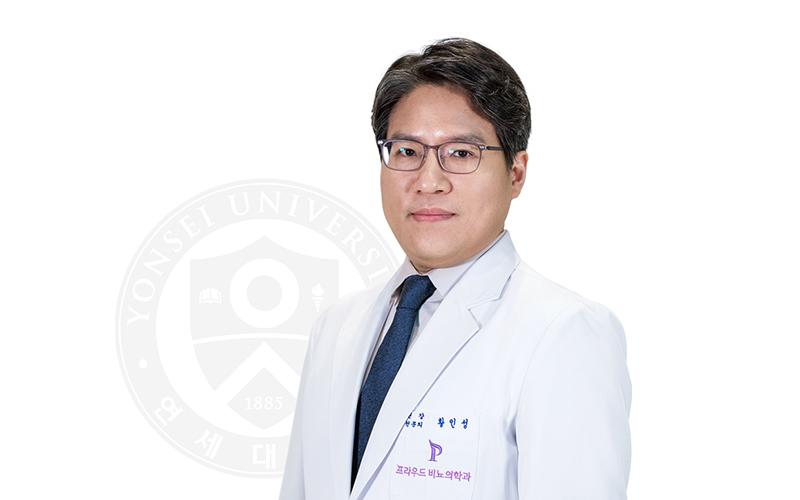
Proud Urology Clinic: Leading Provider of Men Enhancement and Body Sculpting Services in Korea
Nonhyeon
GoldMan Urology Clinic - Gangnam, Korea: Pioneering Advanced Urological Procedures for Optimal Patient Satisfaction
Yangjae

Highst Urology Clinic Korea | Urology Evaluation & Treatment for Urinary and Male Reproductive Health in Nonhyeon
Nonhyeon