Medical Tourism Blog
Varicose Vein Treatment in Korea: Methods, Recovery, Travel Planning and Safety
Table of contents
- Varicose Vein Treatment at a Glance
- What Is Varicose Vein Treatment?
- Who Is a Good Candidate for Varicose Vein Treatment?
- How Is Varicose Vein Treatment Performed?
- Why Visit Korea for Varicose Vein Treatment?
- Key Information for International Patients
- Which Are the Best Clinics in Korea for Varicose Veins Treatment?
- Varicose Vein Treatment From Start to Finish
- Alternatives to Varicose Vein Treatment
- How Can I Prepare for Varicose Vein Treatment?
- Aftercare Advice
Considering treatment in Korea? Everything you need to know e.g. — how to avoid scams, visas, interpreters, recovery tips — in our Medical Tourism Master Guide. Plan with confidence in minutes, not weeks!
Last updated: September 2026
Varicose Vein Treatment at a Glance
- What it treats — Treatment closes or removes refluxing superficial leg veins while preserving the deep veins; a duplex ultrasound map, not appearance alone, determines the source of symptoms and the appropriate method.
- Best candidates — Candidates typically have duplex-confirmed venous reflux with aching, heaviness, swelling, itching, cramps, troublesome bulging veins, skin changes, bleeding veins, recurrent phlebitis, or venous ulcers.
- Treatment options — Outpatient options include laser or radiofrequency ablation, medical adhesive closure, mechanochemical ablation, foam sclerotherapy, and phlebectomy; open stripping is reserved for anatomy or recurrent cases not well suited to catheter treatment.
- Recovery and results — Walking is encouraged immediately, with light activity often possible the same day or next day; tenderness, bruising, tightness, and firm cords commonly last 1–2 weeks, while visible veins may take several weeks to fade.
- Possible repeat treatment — Residual bulging tributaries, persistent symptoms, or recurrence can require staged phlebectomy or foam sclerotherapy, so reassessment at about 3 months is useful when tributary treatment was deferred.
- Korea travel planning — International patients should plan about 7–10 days in Korea for in-person duplex assessment, outpatient treatment, recovery, and any early review; long-haul flight clearance must be individualized because recent procedures and flights over 4 hours raise clot risk.
- Korea-specific distinction — Korean use of endovenous treatment increased from an estimated 290 thermal ablations in 2011 to 12,126 in 2020, but national volume does not demonstrate a specific clinic’s outcomes; verify foreign-patient registration, the clinician performing duplex and treatment, and the follow-up plan.
What Is Varicose Vein Treatment?
Varicose vein treatment uses methods to close or remove faulty superficial leg veins that allow blood to pool. It aims to relieve aching, heaviness, swelling, skin problems, or troublesome visible veins while improving circulation in the affected veins. Treatment is usually minimally invasive, though open surgery is occasionally used for selected cases.
Who Is a Good Candidate for Varicose Vein Treatment?
- Symptomatic venous reflux — Suitable candidates have duplex-ultrasound-confirmed superficial venous reflux with aching, heaviness, throbbing, itching, swelling, night cramps, or troublesome visible varicose veins.
- Skin or vein complications — Assessment is important for skin pigmentation, venous eczema, recurrent superficial thrombophlebitis, bleeding varicosities, or an active or healed venous leg ulcer.
- Appearance concerns with mapped disease — Cosmetic concerns are valid, but treatment should follow a venous duplex map rather than an examination or photographs alone.
- Able to mobilize after treatment — Most endovenous plans require walking soon after discharge; arrange extra support when mobility is limited.
Elective intervention is generally deferred during pregnancy; compression can be used for symptom relief where clinically appropriate. Suspected or confirmed DVT, pulmonary embolism, acute superficial thrombophlebitis, serious infection or cellulitis require urgent assessment before superficial-vein treatment. Significant peripheral arterial disease needs specialist assessment because compression can be unsafe when leg arterial inflow is severely impaired. Duplex imaging can also reveal deep-vein obstruction, post-thrombotic disease, pelvic venous disease, or a non-venous explanation for leg symptoms, each requiring an individualized plan rather than routine treatment. Do not independently stop warfarin, apixaban, rivaroxaban, dabigatran, aspirin, or clopidogrel; bleeding risk and anticoagulant management must be coordinated by the treating clinician and original prescriber.
How Is Varicose Vein Treatment Performed?
Treatment closes or removes refluxing superficial veins while preserving the deep venous system, which carries most blood back to the heart. Duplex-ultrasound assessment and treatment planning determine which method fits the affected vein, its depth and tortuosity, skin and nerve proximity, allergy history, clotting risk, and need to treat surface tributaries.
- Endovenous laser ablation (EVLA) — An ultrasound-guided catheter delivers laser heat inside a refluxing great saphenous, small saphenous, or accessory saphenous vein. Tumescent local anesthetic is injected around the vein to protect surrounding tissue and allow thermal closure.
- Radiofrequency ablation (RFA) — A catheter uses controlled radiofrequency heat to close the diseased vein under ultrasound guidance. Like EVLA, it commonly uses tumescent local anesthetic and is usually outpatient.
- Cyanoacrylate closure — Medical adhesive seals the vein without thermal energy or tumescent anesthesia. A prior adhesive hypersensitivity can rule out this approach.
- Mechanochemical ablation (MOCA) — A catheter mechanically disrupts the vein lining while delivering sclerosant. It avoids heat but still depends on suitable anatomy and careful consideration of sclerosant allergy and thrombotic history.
- Ultrasound-guided foam sclerotherapy — Foam, often made with polidocanol, is injected to damage the vein lining and make it scar closed. It is useful for selected refluxing veins and residual or recurrent tributaries, but long-term closure durability can be less favorable than EVLA, RFA, or surgery when recurrence prevention is the priority.
- Ambulatory phlebectomy — Bulging surface tributaries are removed through tiny skin openings, either alongside truncal ablation or as a staged procedure after the main refluxing vein is treated.
- Ligation and stripping — Open surgery ties and removes the diseased vein through incisions. It remains relevant when anatomy prevents catheter treatment or in selected complex or recurrent cases, but recovery is more involved than with minimally invasive approaches.
Why Visit Korea for Varicose Vein Treatment?
Korea has documented adoption of modern endovenous varicose-vein techniques. A treatment plan still needs to be judged by the clinician’s duplex assessment, follow-up protocol, and ability to manage complications—not national procedure trends alone. International patients should verify the facility’s foreign-patient registration and obtain complete records before departure.
- Contemporary endovenous uptake — A nationwide Korean procedure-trend study reported that conventional operations fell from 32,384 in 2010 to 21,792 in 2020, while estimated endovenous thermal ablation procedures rose from 290 in 2011 to 12,126 in 2020.
- Range of documented methods — The same Korean study documented radiofrequency ablation, cyanoacrylate closure, and mechanochemical ablation as well as thermal treatment, supporting availability of several contemporary approaches.
- Foreign-patient verification — Use Korea’s registered medical-institution system to check eligibility to attract foreign patients where applicable, then confirm who will perform the duplex scan and intervention.
- Evidence limitation — Korean national volume data show adoption, not individual clinician quality, complication rates, vein-closure rates, reintervention rates, or superiority over treatment elsewhere. Ask for the planned ultrasound follow-up and a written procedure record rather than relying on volume claims.
Key Information for International Patients
- Minimum stay — Plan 7–10 days in Korea for in-person duplex assessment, outpatient treatment, walking recovery, and a clinician-directed early review when needed. This is a practical travel estimate, not a universal medical rule.
- Repeat treatment — Residual bulging tributaries, persistent symptoms, or recurrent disease can require staged phlebectomy or foam sclerotherapy. Reassessment at about 3 months is particularly useful when tributary treatment was deferred.
- Flying home — Do not book a fixed long-haul return date until the treating clinician gives individualized clearance. Long-distance travel over 4 hours and recent procedures both increase VTE risk, especially with prior DVT/PE, thrombophilia, cancer, obesity, estrogen exposure, pregnancy or postpartum status, reduced mobility, or anticoagulant use.
- Itinerary impact — Walk immediately after most endovenous procedures and resume ordinary light activity the same day or next day. Expect tenderness, bruising, tightness, and firm cord-like areas for about 1–2 weeks; bruising and visible tributaries can take several weeks to settle.
- Escort and transport — Local or tumescent-anesthesia-only treatment usually does not require a companion. Arrange an adult escort and non-driving transport after oral or IV sedation, general anesthesia, extensive bilateral phlebectomy, or when mobility, language, or travel logistics are limiting.
- Records and remote follow-up — Before leaving, obtain the duplex report and vein map, procedure report, medication and compression instructions, fit-to-fly advice, and a named contact for overseas follow-up.
Travel note: If cleared to fly, walk when safe, perform ankle and calf exercises while seated, avoid prolonged immobility, and take prescribed medicines exactly as directed. Do not self-start aspirin or anticoagulants solely for a flight.
Which Are the Best Clinics in Korea for Varicose Veins Treatment?
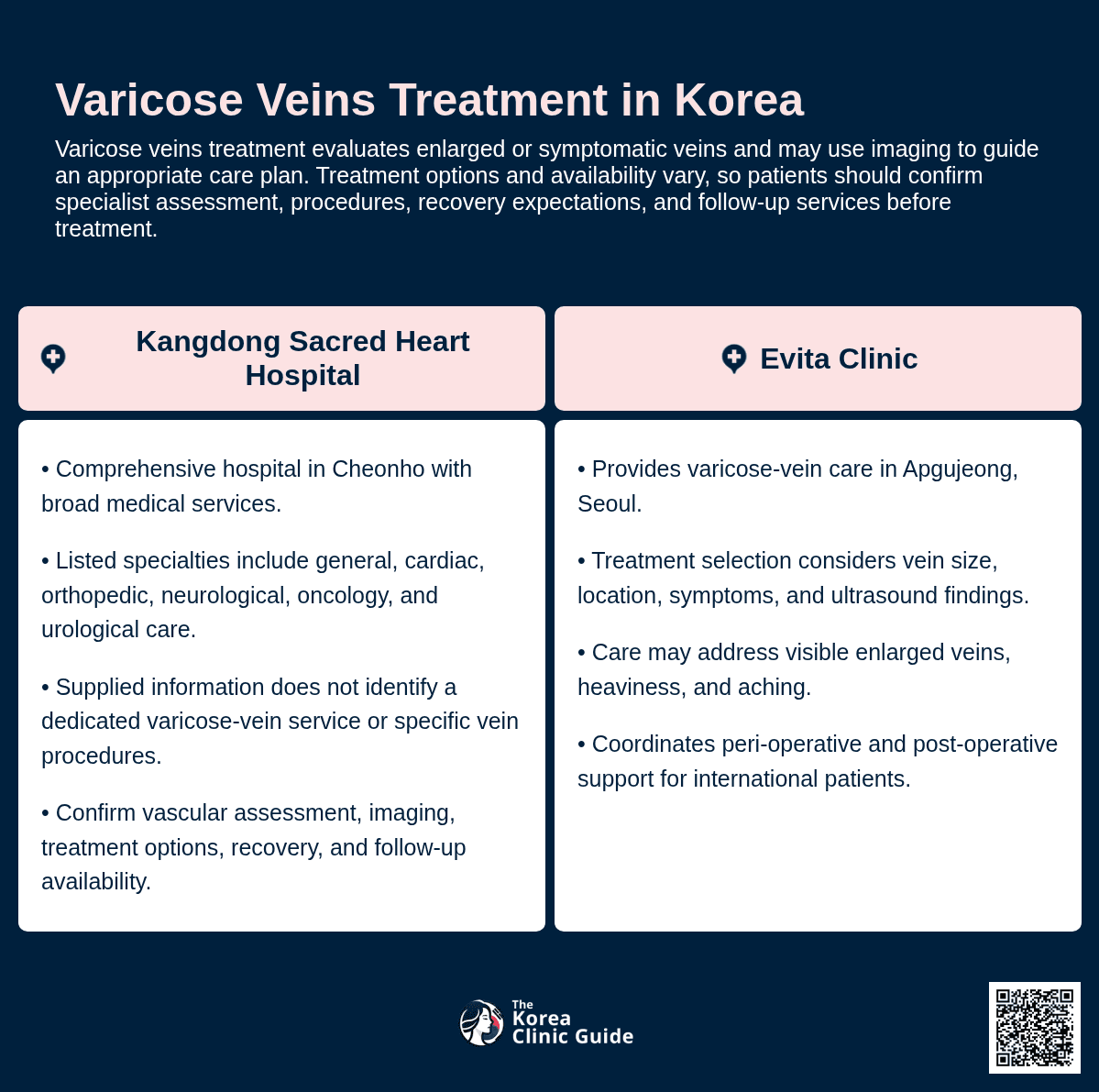
Listed below are some of the best clinics in Korea for varicose veins treatment.
1. Kangdong Sacred Heart Hospital
Kangdong Sacred Heart Hospital is a comprehensive hospital in Cheonho with services spanning general, orthopedic, neurological, cardiac, oncology, urology, gastroenterology, and nephrology care. The supplied information does not identify a dedicated varicose-vein service, specific vein procedures, or vein-care specialists, so you should confirm whether evaluation and treatment for varicose veins are available.
- URL: Kangdong Sacred Heart Hospital Website
- Location: Seoul
- Hospital services:
- General surgery services listed include appendectomy and cholecystectomy.
- Cardiac procedures listed include coronary artery bypass grafting and angioplasty.
- The hospital also lists knee and hip replacement, craniotomy, spinal fusion, mastectomy, lobectomy, prostatectomy, colonoscopy, ERCP, and dialysis.
- For your vein-care planning:
- Ask whether the hospital offers a vascular assessment for visible or symptomatic veins and which treatment options may be appropriate for your condition.
- Confirm whether imaging, procedure details, expected recovery, and follow-up care can be arranged before treatment.
2. Evita Clinic
At Evita Clinic in Apgujeong, your varicose-vein treatment can be selected according to the size and location of your veins and findings from an ultrasound evaluation, with the aim of addressing visible enlarged veins and symptoms such as heaviness or aching. The clinic also describes coordinated peri-operative and post-operative care for international visitors.
- URL: Evita Clinic Website
- Location: 5F, 815, Nonhyun-ro, Gangnam-gu, Seoul, South Korea
- Varicose vein treatment:
- Treatment is intended to address enlarged, visible veins as well as symptoms including leg heaviness or aching.
- Your treatment method is chosen based on vein size, vein location, and ultrasound evaluation.
- Care considerations:
- An ultrasound assessment is part of determining the appropriate approach described by the clinic.
- If you are traveling internationally, the clinic states that it coordinates peri-operative and post-operative care.
- Other listed services:
- The clinic provides body and facial liposuction, tummy tuck, arm lift, and thigh lift procedures.
- Breast augmentation, lift, and reduction are listed, along with gender-affirming chest surgery.
- Other treatments listed include hyperhidrosis treatment, fat grafting, and face contouring.
Varicose Vein Treatment From Start to Finish
- Remote inquiry and preliminary review — Send symptom history, previous procedure details, medication lists, and photographs if requested. English-language or virtual consultation can clarify logistics, but photographs cannot replace in-person assessment or duplex mapping.
- In-person consultation and duplex ultrasound — The clinician reviews symptoms, DVT/PE history, thrombophilia, pregnancy possibility, cancer, diabetes, arterial disease, allergies, and medicines, examines pulses and skin, and maps refluxing superficial and deep veins. A visual examination alone is not a sufficient procedural plan.
- Additional testing and treatment decision — Blood count, coagulation tests, pregnancy testing, ECG, or anesthesia review are selected according to medical history, anticoagulant use, and whether sedation or surgery is planned. The clinician confirms whether EVLA, RFA, adhesive closure, MOCA, foam sclerotherapy, phlebectomy, or surgery fits the anatomy.
- Treatment-day anesthesia and intervention — EVLA and RFA generally use ultrasound guidance and tumescent local anesthetic. Adhesive closure, MOCA, and foam treatment avoid thermal energy; extensive phlebectomy, stripping, or bilateral treatment can change anesthesia, observation, and escort requirements.
- Discharge and early walking — Most endovenous procedures are outpatient. Walk shortly after treatment, receive written instructions for pain relief, compression when prescribed, wound care after phlebectomy, and any anticoagulant plan.
- Early review and travel clearance — Attend the clinician-directed wound or ultrasound review if scheduled. Clearance for a long-distance flight depends on procedure extent, mobility, current symptoms, VTE history, and other risk factors—not simply the number of days since treatment.
- Remote follow-up and later reassessment — Contact the Korean team promptly about worsening symptoms and share records with a local clinician if needed. A review at around 3 months helps determine whether remaining symptomatic or visible tributaries need staged treatment.
Alternatives to Varicose Vein Treatment
The main tradeoff is between minimally invasive vein closure, removal of surface tributaries, and open surgery for anatomy that cannot be managed with a catheter. The best alternative depends on the reflux source, vein size and route, skin and nerve proximity, allergy and clotting risks, recovery constraints, and whether durable truncal-vein closure or rapid treatment of visible tributaries is the main goal.
Conservative management
- Compression and symptom control — Clinician-prescribed graduated compression, regular walking, leg elevation for comfort, and avoidance of prolonged sitting or standing can reduce symptoms for some people but do not remove the underlying reflux.
- Arterial assessment first — Do not use compression without specialist guidance when significant peripheral arterial disease or critical limb ischemia is suspected.
Alternative endovenous closure
- EVLA or RFA — Thermal ablation offers catheter-based closure for suitable straight refluxing truncal veins, with tumescent anesthesia required.
- Cyanoacrylate or MOCA — Nonthermal methods avoid heat and may avoid tumescent anesthesia, but adhesive or sclerosant allergy and vein anatomy can limit their use.
- Foam sclerotherapy — Useful for selected veins, residual tributaries, and some recurrent disease, with a durability tradeoff when long-term truncal closure is the priority.
Phlebectomy or vein stripping
- Ambulatory phlebectomy — Removes prominent surface tributaries through very small openings; it can be combined with ablation or staged after it.
- Ligation and stripping — Open removal remains an option for unsuitable catheter anatomy or selected complex and recurrent disease, with more involved recovery.
How Can I Prepare for Varicose Vein Treatment?
- Medical disclosure — Give the clinic a complete history of DVT/PE, thrombophilia, previous vein treatment, cancer, heart or lung disease, diabetes, arterial disease, infection, allergies, pregnancy possibility, and ability to walk after treatment.
- Medicines and supplements — Provide every prescription and non-prescription product, including warfarin, apixaban, rivaroxaban, dabigatran, aspirin, clopidogrel, NSAIDs, hormone therapy or combined oral contraceptives, diabetes or weight-loss medicines, fish oil, vitamin E, ginkgo, garlic, and ginseng. The treating clinician and original prescriber must decide whether any medicine is continued, paused, or adjusted; never stop anticoagulants independently.
- Fasting and alcohol — Local or tumescent-only treatment does not always require prolonged fasting. IV sedation or general anesthesia commonly requires fasting and an adult escort; follow the facility’s exact fasting and alcohol instructions.
- Clothing and treatment area — Wear loose trousers or a skirt and stable walking shoes. Keep leg skin clean, report cuts, rashes, or infection before treatment, and bring compression stockings only when the clinic instructs you to do so.
- Smoking and mobility — Avoid smoking as instructed and plan regular walking rather than prolonged bed rest, vehicle travel, or sightseeing without breaks in the first days after treatment.
- Accommodation and transport — Stay near the facility for the first nights, arrange non-driving transport after sedatives, and keep return flights flexible until the clinician confirms fitness to travel.
Travel note: Bring digital and printed copies of ultrasound reports, medication lists, and prior DVT/PE or thrombophilia records. These details directly affect both treatment selection and flight-risk planning.
Confirm the treating clinic’s individualized requirements, which take precedence over general guidance.
Aftercare Advice
Walking and avoiding prolonged immobility are the core priorities after varicose-vein treatment, but the treating clinician’s compression, wound-care, medicine, and flight instructions determine the exact plan.
- Walking and activity — Walk regularly from the day of treatment and resume light daily activity the same day or next day when comfortable. Avoid strenuous exercise for several days to 2 weeks, depending on the method and whether phlebectomy was performed.
- Compression and dressings — Wear compression stockings and keep any phlebectomy dressings in place only for the duration prescribed. Compression protocols differ by treatment type, arterial status, and clinician practice.
- Expected recovery effects — Bruising, tenderness, tightness or pulling, firm tender cords, and temporary numbness or tingling can occur. These effects often settle over 1–2 weeks, while bruising and remaining visible tributaries can take several weeks.
- Pain medicines and anticoagulants — Use only the medicines specified in the discharge plan. Do not restart, stop, or change anticoagulants, antiplatelets, or pain medicines without instruction.
- Urgent warning signs — Seek emergency care for chest pain, new or worsening shortness of breath, coughing blood, fainting, or severe calf pain or swelling. Contact the treating team promptly for fever, spreading redness, pus, uncontrolled bleeding, rapidly worsening pain, marked one-sided swelling, a cold or pale foot, allergic rash, or new neurologic or visual symptoms; these can signal complications including DVT or pulmonary embolism.
- Result timing and follow-up — The treated truncal vein can close promptly on ultrasound, but visible improvement is gradual and complete disappearance of every vein cannot be guaranteed. Attend planned ultrasound follow-up, and arrange reassessment around 3 months if residual veins or symptoms remain.
Follow the treating doctor’s individualized instructions and contact the clinic promptly when anything appears wrong.
Frequently Asked Questions
Related Blogs
Comparing Costs: Why Korea Is a Top Destination for Foreign Body Removal vs Global Alternatives
Discover the costs and procedures involved in Foreign Body Removal in Korea, a popular destination for affordable and high-quality medical care. Learn about the factors influencing prices and how Korea's healthcare system ensures safe and efficient treatments for overseas patients.
Updated: Sep 26, 2026
Discover the Global Spectrum of Scar Removal Surgery Costs and Why Korea Leads the Way
Discover how much scar removal surgery costs in Korea, a popular destination for affordable cosmetic procedures. Explore factors influencing the pricing and what to expect during your medical journey in this comprehensive guide.
Updated: Sep 25, 2026
Otoplasty in Korea: Methods, Recovery, Risks and Travel Planning
Otoplasty reshapes or repositions outer-ear cartilage for prominent ears, asymmetry, and selected congenital or revision concerns, usually as a 1–3 hour outpatient procedure using sutures, cartilage modification, or both. International patients planning treatment in Korea should allow 10–14 days for assessment, early wound review and possible suture removal, follow activity and dressing restrictio
Updated: Sep 21, 2026
Varicose Vein Treatment in Korea: Methods, Recovery, Travel Planning, and Safety
Varicose vein treatment begins with standing duplex ultrasound mapping and may use laser or radiofrequency ablation, vein glue, mechanochemical ablation, foam sclerotherapy, phlebectomy, or surgery based on anatomy and risk factors. The article covers candidacy, recovery, compression and walking guidance, follow-up, warning symptoms, and travel planning including flight restrictions after treatmen
Updated: Sep 19, 2026