
Medical Tourism Blog
Stem Cell IV Therapy in Korea: Regulation, Safety, Travel Planning, and Evidence Limits
Table of contents
- Stem Cell IV Therapy at a Glance
- What Is Stem Cell IV Therapy?
- Who Is a Good Candidate for Stem Cell IV Therapy?
- What Are the Different Types of Stem Cell IV Therapy?
- Why Visit Korea for Stem Cell IV Therapy?
- Key Information for International Patients
- Which Are the Best Clinics in Korea for Stem Cell Iv Therapy?
- Stem Cell IV Therapy From Start to Finish
- Alternatives to Stem Cell IV Therapy
- How Can I Prepare for Stem Cell IV Therapy?
- Aftercare Advice
Considering treatment in Korea? Everything you need to know e.g. — how to avoid scams, visas, interpreters, recovery tips — in our Medical Tourism Master Guide. Plan with confidence in minutes, not weeks!
Last updated: September 2026
Stem Cell IV Therapy at a Glance
- Not one standard treatment — Stem Cell IV Therapy is an umbrella term for intravenous cell products that can differ in cell source, dose, manufacturing, diagnosis, and regulatory status; it is not an established general wellness or anti-aging infusion.
- Eligibility requires a diagnosis — Appropriate candidates have a clearly diagnosed condition and meet criteria for an indication-specific authorized product, an approved Korean treatment plan, or a properly approved clinical study—not fatigue, detox, immune-boosting, or broad rejuvenation goals.
- No universal cost or schedule — No standard price, number of doses, recovery period, results timeline, or maintenance schedule can be assigned because these depend on the exact product and protocol; routine monthly or annual infusions are not evidence-based.
- Monitoring still matters — An uncomplicated infusion has no incision recovery, but observation, laboratory testing, later visits, and potentially long-term follow-up may be required; fever has occurred more often with intravascular MSCs in randomized-study reviews.
- Verify Korea’s treatment pathway — In Korea, regulated advanced-regenerative treatment must be provided at a Ministry of Health and Welfare-designated institution under an approved treatment plan, but designation alone does not prove that a specific IV product is appropriate or effective for a traveler’s diagnosis.
- Plan travel around clearance — There is no fixed minimum stay or safe flight date; do not take a long-haul flight until the treating clinician confirms stability after considering reactions, clotting risk, oxygen needs, underlying illness, and scheduled safety checks.
- Unverified products carry real risk — Avoid commercial infusions that promise to treat many unrelated diseases or wellness concerns without verifiable authorization or trial oversight; poorly controlled cell products can cause immune reactions, infection or contamination, neurologic events, unintended tissue growth, and delays in effective care.
What Is Stem Cell IV Therapy?
Stem Cell IV Therapy is the intravenous infusion of living cells, but the term covers different products rather than one standard treatment. It is considered only for a clearly diagnosed condition within an authorized, regulated treatment plan or approved clinical study, not for general wellness, anti-aging, or fatigue. It is a minimally invasive infusion procedure, though the cell therapy itself is often investigational.
Who Is a Good Candidate for Stem Cell IV Therapy?
- Potential candidates — People with a clearly diagnosed condition who meet eligibility criteria for an indication-specific authorized cell product, an approved advanced-regenerative-medicine treatment plan, or a properly approved clinical study.
- Specialist-led assessment — Candidates need review by the relevant disease specialist, not assessment based on fatigue, appearance, or broad wellness goals.
- Monitoring-capable travelers — International patients must be able to complete the required observation, laboratory testing, subsequent visits, and overseas follow-up specified by the exact protocol.
There is no legitimate generic candidate profile for a commercial “stem cell IV” package. People seeking treatment solely for anti-aging, fatigue, “detox,” immune enhancement, or broad multi-disease promises are not appropriate candidates unless the exact product and indication have verifiable authorization or are being studied in an approved trial; the FDA cautions that regenerative-medicine therapies are not approved for many of these uses. Active infection, serious allergy to a proposed infusion component, current or relevant prior cancer, thrombosis or coagulation disorders, pregnancy or breastfeeding, unstable cardiopulmonary disease, and severe organ dysfunction require protocol- and specialist-specific review. Do not stop anticoagulants, antiplatelet medicines, corticosteroids, immunosuppressants, diabetes medicines, or blood-pressure medicines to qualify for treatment; the treating team and home clinician must direct any change.
What Are the Different Types of Stem Cell IV Therapy?
“Stem cell IV therapy” is an umbrella term, not one standardized treatment. Ask for the exact cell source, product name, dose, manufacturing and release-testing information, diagnosis, and regulatory basis before considering travel.
- Autologous IV-cell therapy — Cells are collected from the patient, processed, and reinfused. Collection and processing can require separate appointments; using a patient’s own cells does not prove benefit or remove safety risks.
- Allogeneic IV-cell therapy — Donor-derived cells, often described as umbilical-cord-, bone-marrow-, or adipose-derived mesenchymal stromal/stem cells (MSCs), are prepared for another person. Donor screening, manufacturing controls, product-release testing, and regulatory status are essential.
- Authorized indication-specific product — A regulated cell product used for a narrowly defined diagnosis. It is not interchangeable with a generic wellness IV or a treatment marketed for unrelated illnesses.
- Investigational IV-cell therapy — A defined product, diagnosis, dose, route, and follow-up schedule studied under an approved research protocol. Participation does not guarantee benefit or future approval.
- Unproven commercial infusion — A product offered without verifiable indication-specific authorization or an approved clinical study, particularly one promoted for many unrelated diseases or wellness goals. Avoid these offerings.
Why Visit Korea for Stem Cell IV Therapy?
Korea has a regulatory framework for advanced regenerative medicine, including clinical research and regulated patient treatment. This framework is relevant only when an institution documents an applicable approved treatment plan or controlled study for the specific diagnosis. It does not establish that a generic IV infusion is proven for anti-aging, fatigue, cosmetic goals, or every chronic illness.
- Designated-institution requirement — Advanced-regenerative-medicine treatment in Korea must be delivered at a Ministry of Health and Welfare-designated regenerative medical institution under an approved treatment plan with safety monitoring and inspection.
- Regulated treatment pathway — Korea’s amended framework, effective from February 2025, permits regulated patient treatment as well as clinical research; travelers still need confirmation that the proposed IV product and diagnosis fit an applicable pathway.
- Initial due diligence resource — The Regenerative Medicine Advanced Foundation posts status notices on designated institutions and approved clinical research. These listings are only a starting point: designation or research approval does not prove that a particular product, IV route, diagnosis, or international follow-up plan is appropriate.
- Evidence remains product-specific — Randomized-trial reviews of intravascular MSCs identify fever as a short-term safety signal, but their heterogeneous products and patient populations do not establish efficacy or long-term safety for another clinic’s protocol, as shown in a 2020 meta-analysis of 55 studies and 2,696 participants and a newer review of adult umbilical-cord-MSC trials.
Key Information for International Patients
- Minimum stay — No evidence-based number of days in Korea applies to a generic stem cell IV package. Travel only after the institution provides its written infusion, observation, testing, adverse-event, and follow-up plan.
- Repeat visits — There is no evidence-based universal maintenance schedule. Repeat dosing must be justified for the exact product and diagnosis and specified in the approved treatment plan or trial protocol.
- Flights — Do not take a long-haul flight until the treating clinician confirms clinical stability in writing. Clearance depends on immediate reactions, the underlying disease, venous-thromboembolism risk, oxygen needs, and scheduled safety checks.
- Recovery and activities — An uncomplicated IV infusion has no incision-recovery timetable, but observation and medical monitoring can still be necessary. Fever occurred more often than control treatment in randomized intravascular-MSC evidence; activity restrictions must follow the individual protocol.
- Remote follow-up — Arrange a named Korean contact, a home clinician willing to receive records, and a plan for required blood tests, imaging, symptom review, and emergency escalation after departure.
- Itinerary impact — Keep the period after infusion flexible. Do not schedule a long-haul departure, remote travel, or activities that prevent prompt medical review until the treating team clears them.
Travel note: Carry the product and batch details, discharge summary, medication list, emergency contact numbers, and follow-up schedule in English, and share them with the clinician who will oversee care at home.
Which Are the Best Clinics in Korea for Stem Cell Iv Therapy?
Listed below are some of the best clinics in Korea for stem cell iv therapy.
1. Cellinique Clinic
You may consider Cellinique Clinic if you want a personalized regenerative-medicine consultation centered on its NovaStem approach, which uses concentrated autologous blood with the stated aim of supporting tissue regeneration, skin elasticity, and overall health. Its care is led through a one-doctor model and combines stem-cell-focused treatments with selected complementary options when appropriate to your goals.
- URL: Cellinique Clinic Website
- Location: Gangnam-gu, Seoul
- Procedure details:
- NovaStem uses concentrated autologous blood and is presented as a minimally manipulated cell biotechnology.
- The clinic describes stem-cell therapy as supporting damaged-tissue repair, metabolic function, and overall health.
- Clinical focus:
- Dr. Chris Gunwoo Kim has lectured on blood stem cells, high-concentration blood cell zones, and SDF-1alpha injection at aesthetic-medicine events.
- In 2025, Dr. Kim presented the clinic’s NovaStem Kit at the Korean Obesity and Aesthetic Treatment Society spring conference.
- Related services:
- Available complementary treatments include PRP, blood purification, NK-cell therapy, exosomes, Radiesse, and stem-cell fat grafting.
- The clinic also provides facial rejuvenation, laser treatments, and hair-restoration options, including non-incision hair transplantation and stem-cell hair-loss injections.
2. SH Clinic
You may consider SH Clinic if you want a stem-cell program shaped by an in-person consultation and examination, with its Wellness & Anti-aging program designed around individualized treatment planning. The clinic’s stem-cell center addresses regenerative and anti-aging goals while also offering programs for selected health concerns, so your suitability and treatment plan can be discussed in person.
- URL: SH Clinic Website
- Location: Seocho-gu, Seoul
- Treatment scope:
- The clinic lists stem-cell programs for hair loss, skin and cosmetic rejuvenation, arthritis and disc disease, autoimmune disease, cerebral infarction and dementia, and female or male sexual function.
- BMAC stem-cell knee injections are offered for arthritic knees; the clinic describes this as delivery of concentrated bone-marrow cells into the knee.
- Personalized assessment:
- SH Clinic states that experienced medical staff provide personalized treatment after an in-person consultation and examination.
- Its Wellness & Anti-aging program is based on the clinic’s clinical experience with personalized stem-cell treatments.
- Related services:
- The center combines stem-cell therapy with gynecology, including vaginal rejuvenation options such as stem-cell injections, vaginal HIFU, fillers, tightening, and implant surgery.
- Aesthetic dermatology, facial procedures, and hair-transplant services are also available.
3. THEPLUS Plastic Surgery
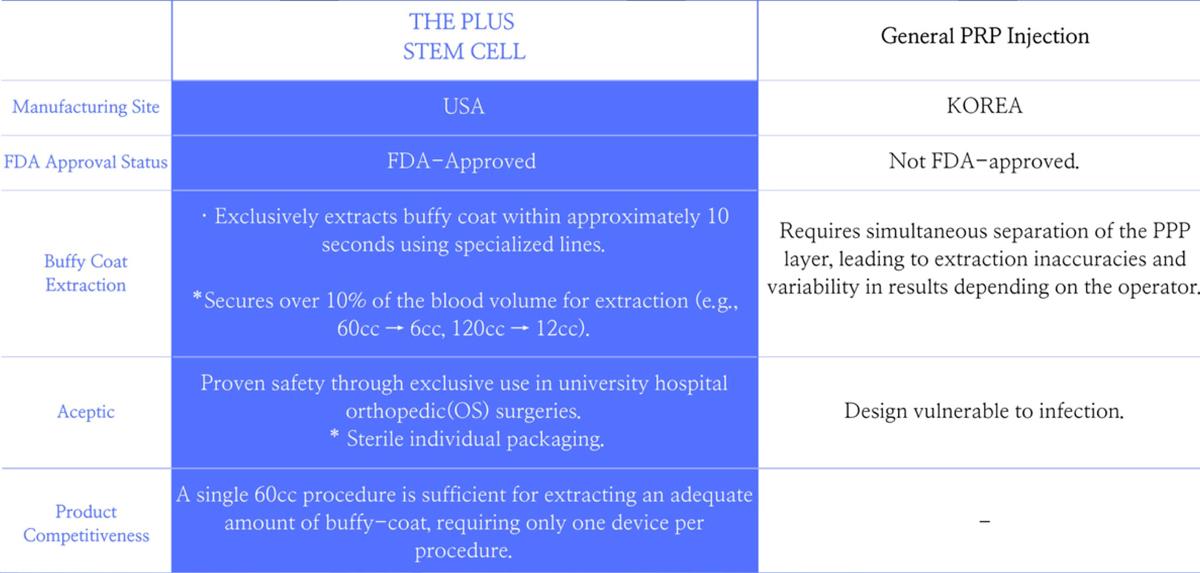
You may consider THEPLUS Plastic Surgery if you are interested in a blood-derived regenerative treatment using its specialized Buffy Coat extraction system. The clinic states that this system can obtain a concentrated Buffy Coat layer from a 60cc blood sample for a single application, positioning stem-cell treatment within its aesthetic and post-procedure care services.
- URL: THEPLUS Plastic Surgery Website
- Location: Gangnam-gu, Seoul
- Procedure details:
- THEPLUS describes extracting only the Buffy Coat layer and securing more than 10% of the sampled blood for a higher-concentration treatment component.
- The clinic states that 60cc of blood is sufficient for a complete single-application treatment with its system.
- Its kits are described as individually sterilized and packaged and as including a 30ml anticoagulant.
- Clinic context:
- Stem-cell treatment is offered as part of a broader aesthetic and post-procedure care approach focused on tissue quality and recovery.
- The clinic also provides facial fat grafting, thread lifts, facelifts, rhinoplasty, facial contouring, breast surgery, and liposuction.
- Surgical team:
- The clinic describes Dr. Kim as a board-certified plastic surgeon with research recognition related to 3D implants and expertise in rhinoplasty and facial contouring.
- Dr. Jeong is described as President of the Korean Society of Plastic Surgeons and as a rhinoplasty educator and conference speaker.
- Dr. Lee is described as a board-certified plastic surgeon specializing in breast augmentation, with prior experience as a surgery specialist at Seoul National University Hospital.
Stem Cell IV Therapy From Start to Finish
- Remote record review — Send the institution the confirmed diagnosis, specialist notes, treatment history, imaging, laboratory results, medication and allergy list, infection history, clotting history, cancer history, and contact details for the home clinician. Request an English virtual consultation or written clinical review before booking travel.
- Regulatory and evidence verification — Obtain the exact product name, cell type, donor or patient source, tissue source, dose, viability and release testing, culture and cryopreservation information, infusion rate, number of doses, and regulatory category. Confirm whether it is an authorized product for the proposed indication, an approved Korean treatment plan, or a properly approved clinical study.
- Written travel and safety plan — Receive the planned dates, expected observation, monitoring tests, resuscitation capability, adverse-event process, compensation arrangements, and cross-border follow-up plan. Do not rely on testimonials, case series, or broad claims that the same cells treat many unrelated conditions.
- In-person assessment and testing — The team performs disease- and protocol-specific evaluation. This can include examination, vital signs, blood count, kidney and liver tests, coagulation tests, infection screening, pregnancy testing where relevant, and disease-specific imaging or specialist review.
- Informed consent — Review the intended goal, uncertainty of benefit, standard-care alternatives, foreseeable risks, stopping rules, privacy and data handling, and mandatory follow-up. Ask questions through an interpreter or English-speaking clinician until the consent is clear.
- Infusion and observation — A peripheral IV is used when specified by the plan. The verified cell product is infused at the documented dose and rate with monitoring and capacity to manage allergic, febrile, respiratory, or circulatory reactions; no universal infusion or observation duration can be assigned.
- Discharge and local monitoring — Leave only after the treating team considers the patient clinically stable. Obtain written red-flag instructions, all product documentation, prescribed medicines, local emergency contacts, and clear flight guidance.
- Overseas follow-up — Complete the scheduled remote reviews and any required laboratory or imaging surveillance. Send new symptoms and results promptly to both the Korean team and home clinician.
Alternatives to Stem Cell IV Therapy
The appropriate alternative depends on the actual diagnosis, not the label “stem cell IV therapy.” Established diagnosis-specific care generally has clearer evidence and monitoring standards; investigational treatment should be considered only within an appropriately approved and controlled trial.
Diagnosis-Specific Standard Care
- Medical and procedural treatment — Use relevant specialist care, including disease-modifying medicines, surgery, devices, rehabilitation, supportive treatment, or palliative care when indicated.
- Tradeoff — Standard care can be less appealing than a broad regenerative claim, but it has diagnosis-specific indications, known monitoring requirements, and a clearer evidence base.
Controlled Clinical Trial
- Protocol-based access — A registered, properly approved study defines eligibility, product handling, dose, adverse-event reporting, and follow-up rather than offering an open-ended wellness package.
- Tradeoff — Participation does not guarantee benefit, and travel can be impractical when frequent visits or long-term monitoring are required.
Hematopoietic Stem-Cell Transplantation
- Established transplant specialty care — For selected blood, marrow, and immune disorders, conventional hematopoietic stem-cell transplantation can be appropriate. It is fundamentally different from an outpatient IV MSC infusion and requires transplant-specialist evaluation.
- Tradeoff — This intensive treatment has substantial risks and monitoring requirements, but it should not be replaced by a generic commercial IV offer. For disease-focused context, see stem cell disease therapy.
How Can I Prepare for Stem Cell IV Therapy?
- Verify the indication first — Obtain the diagnosis, therapeutic goal, product identity, cell source, dose, route, regulatory basis, and protocol summary in English before booking flights or paying for treatment.
- Send complete records — Provide specialist reports, imaging, laboratory results, medication and supplement lists, allergies, infection history, thrombosis history, cancer history, pregnancy status where relevant, and emergency contacts.
- Review medicines safely — Do not independently stop anticoagulants, antiplatelets, corticosteroids, immunosuppressants, diabetes medicines, blood-pressure medicines, or other prescriptions. Ask the treating team and home clinician for written, coordinated instructions.
- Follow protocol-specific fasting rules — There is no universal fasting, supplement-stop, alcohol, smoking, sun-exposure, or skincare rule for this umbrella procedure. Follow only the written directions for the exact product and protocol.
- Plan flexible travel — Choose changeable flights and accommodation close enough for required monitoring. Arrange a companion when the underlying illness, sedation for another procedure, disability, language barrier, or protocol makes independent travel unsafe.
- Prepare continuity of care — Identify a home clinician before departure and bring digital and printed copies of all medical records.
Travel note: Do not schedule a long-haul flight immediately after an infusion. The treating clinician must assess stability, clotting risk, oxygen needs, reactions, and required safety checks before clearing travel.
Confirm the treating institution’s written, protocol-specific requirements; those instructions take precedence over general guidance.
Aftercare Advice
Treat new symptoms after an IV-cell infusion as a medical issue, not as expected “detox” or healing.
- Observation and activity — Complete the observation and activity plan provided by the treating team. Keep local travel flexible until the team confirms stability.
- Medicines — Continue prescribed medicines unless the treating and home clinicians direct otherwise. Do not self-treat a possible reaction with steroids, antihistamines, antibiotics, anticoagulants, or anti-inflammatory medicines.
- Warning signs — Seek urgent medical evaluation for trouble breathing, wheeze, chest pain, fainting, facial, lip, or tongue swelling, new confusion, focal neurologic symptoms, high fever or shaking chills, rapidly worsening weakness, severe rash, or one-sided leg swelling or pain.
- Documentation — Keep the product and batch details, discharge summary, medication list, emergency contacts, and planned testing schedule available for any clinician who evaluates a new symptom.
- Results and repeat treatment — Do not expect a universal results timeline or arrange routine monthly or annual “maintenance” infusions. Benefit and repeat dosing must be supported for the exact product and diagnosis within the authorized plan or study protocol.
Follow the treating doctor’s instructions and contact the clinic promptly when something appears wrong; seek local emergency care immediately for severe symptoms.
Frequently Asked Questions
Related Blogs
Effective Peyronie’s Disease Treatments in Korea: Stem Cell Therapy for Sexual Performance
Discover how Korea leads in stem cell treatments for Peyronie's disease and erectile dysfunction. This comprehensive guide highlights innovative procedures like stem cell therapy, the benefits of medical tourism in Korea, costs, and patient outcomes. Learn how Korea's advanced healthcare system and regulatory environment make it a top choice for restoring sexual health. Explore treatment options,
Updated: Oct 30, 2026

Korea Osteopenia Treatment with Stem Cell Injection: Innovative Solutions for Bone Health
Explore how Korea leads in stem cell injections for osteopenia, a precursor to osteoporosis. Learn about advanced autologous stem cell therapies available in Korea that aim to promote bone regeneration using Mesenchymal Stem Cells (MSCs). Discover why Korea’s reliable, regulated clinics offer cost-effective, safe options compared to global markets. Understand current research, the benefits, and th
Updated: Oct 30, 2026
Discover Effective Acne-Prone Skin Solutions in Korea with Stem Cell Facial Procedures
Explore how Korea leads in regenerative treatments for acne-prone skin with innovative Stem Cell Facials. This article covers the causes of Acne Vulgaris, details of the procedure, and benefits for acne scars. Discover why South Korea is a top medical tourism destination, the costs involved, and patient outcomes. Learn how stem cells or their derivatives can rejuvenate skin, improve scars, and add
Updated: Oct 28, 2026

Korea's Edge in Autologous Stem Cell Therapy: A Cost Comparison with the USA, Mexico, and Turkey
Discover the costs and benefits of autologous stem cell therapy in Korea, a leading destination for cutting-edge medical treatments. Explore how competitive pricing and advanced healthcare facilities are making Korea a popular choice for patients seeking innovative regenerative therapies.
Updated: Oct 27, 2026
Clinics offering Stem Cell IV Therapy
BongBong Plastic Surgery Dermatology Korea | Body, Breast & Aesthetic Treatments
Nonhyeon

SH Clinic: Comprehensive Women's, Men's & Couples' Health Services in Korea
Sinsa

THEPLUS Plastic Surgery Korea | Eye, Nose, Face & Body Surgery
Sinsa

Made Young Plastic Surgery: Rejuvenating Aesthetic Excellence in Korea for Face Lifts, Contouring and More
Gangnam Station