Medical Tourism Blog
Varicose Vein Treatment in Korea: Methods, Recovery, Flight Planning, and Aftercare
Table of contents
- Varicose Vein Treatment at a Glance
- What Is Varicose Vein Treatment?
- Who Is a Good Candidate for Varicose Vein Treatment?
- How Is Varicose Vein Treatment Performed?
- Why Visit Korea for Varicose Vein Treatment?
- Key Information for International Patients
- Which Are the Best Clinics in Korea for Spider Veins Treatment?
- Varicose Vein Treatment From Start to Finish
- Alternatives to Varicose Vein Treatment
- How Can I Prepare for Varicose Vein Treatment?
- Aftercare Advice
Considering treatment in Korea? Everything you need to know e.g. — how to avoid scams, visas, interpreters, recovery tips — in our Medical Tourism Master Guide. Plan with confidence in minutes, not weeks!
Last updated: September 2026
Varicose Vein Treatment at a Glance
- What it treats — Varicose vein treatment closes or removes faulty superficial leg veins causing duplex-confirmed venous reflux, which can lead to aching, heaviness, swelling, bulging veins, skin changes, bleeding, or ulcers.
- Ultrasound determines the plan — A standing examination and venous duplex ultrasound are essential before treatment to identify the reflux source and deep-vein status; photographs alone cannot determine whether visible branch veins need treatment.
- Several outpatient methods — Most treatment is same-day and ultrasound-guided, using radiofrequency or laser heat ablation, medical adhesive, mechanochemical ablation, foam sclerotherapy, or microphlebectomy; open stripping is reserved for selected cases.
- Recovery and visible results — Walking starts the treatment day, and many people resume light activity within days, but bruising and tenderness can last weeks; small sclerotherapy-treated veins fade in 3–6 weeks, while larger veins may take 3–4 months and sometimes need another session.
- Long-haul travel may delay return — Do not schedule a next-day or same-week long-haul flight without written clearance: one RFA protocol advises waiting 6 weeks for long-haul travel, although the safe interval must be individualized for clot risk, procedure extent, and follow-up findings.
- Key safety limitation — Elective treatment is generally postponed during pregnancy and requires individualized clot management rather than routine intervention for acute DVT, pulmonary embolism, or significant superficial venous thrombosis.
- Korea-specific consideration — Korean clinical experience includes RFA, vein glue, mechanochemical ablation, and stripping in a 2,866-patient cohort, but no high-quality evidence shows Korea produces superior outcomes; confirm the exact device, protocol, and English-language follow-up with the facility.
What Is Varicose Vein Treatment?
Varicose vein treatment uses procedures to close, remove, or shrink faulty superficial leg veins that allow blood to pool. It aims to relieve aching, heaviness, swelling, itching, bulging veins, and skin complications while improving leg comfort and function. Most options are minimally invasive outpatient procedures, though some cases require non-surgical injections or surgical vein removal.
Who Is a Good Candidate for Varicose Vein Treatment?
- Symptomatic venous reflux — Good candidates have duplex-confirmed reflux causing aching, heaviness, itching, throbbing, swelling, night cramps, or prominent bulging veins.
- Vein-related complications — Recurrent varicose veins, bleeding from a vein, superficial thrombophlebitis, skin pigmentation or eczema, and healed or active venous ulcers warrant vascular assessment.
- Persistent visible tributaries — People seeking treatment for branch veins can be candidates, but the clinician must first determine whether great saphenous, small saphenous, or accessory-vein reflux is feeding them.
- Appropriate procedural fitness — Candidates can walk after treatment, can use compression when prescribed, and can follow an individualized thrombosis and medication plan.
Pregnancy generally postpones elective intervention; compression and symptom management are used unless an exceptional clinical indication exists. Acute DVT, pulmonary embolism, or significant acute superficial venous thrombosis requires a clot-management plan rather than routine elective treatment. Severe peripheral arterial disease, inability to walk, uncontrolled cardiopulmonary illness, active cellulitis or infected ulcer, uncontrolled bleeding risk, and serious allergy to sclerosant, cyanoacrylate adhesive, local anesthetic, or dressings require individualized assessment or postponement. A standing examination and venous duplex ultrasound assessment are essential; photographs alone cannot show the reflux source, deep-vein status, vein depth, or anatomy-related thermal nerve/burn risk.
How Is Varicose Vein Treatment Performed?
Varicose vein treatment is not one operation. The method is selected after ultrasound maps superficial reflux, tributaries, perforators, and the deep venous system.
- Radiofrequency ablation (RFA) — An ultrasound-guided catheter delivers heat to close an incompetent great or small saphenous vein. Tumescent local anesthetic is injected around the vein to numb and protect surrounding tissue.
- Endovenous laser ablation (EVLA/EVLT) — A laser fiber closes the refluxing truncal vein under ultrasound guidance and tumescent anesthetic. Like RFA, it is an outpatient endothermal option favored over traditional stripping for suitable symptomatic truncal reflux in current venous guidelines.
- Cyanoacrylate closure — Medical adhesive, often called vein glue, seals the target vein without heat or tumescent anesthesia. Adhesive allergy and the facility's available device and approved indication must be checked in advance.
- Mechanochemical ablation (MOCA) — A rotating catheter disrupts the vein lining while delivering sclerosant. This nonthermal approach can be useful where avoidance of heat-related nerve injury is important.
- Ultrasound-guided foam sclerotherapy — Foamed polidocanol or sodium tetradecyl sulfate is injected into a refluxing, recurrent, or tortuous vein that is difficult to treat with a catheter. It is also used for residual tributaries; repeat sessions are sometimes needed.
- Ambulatory phlebectomy — Bulging surface tributaries are removed through tiny punctures under local anesthetic, either alongside truncal ablation or later. Reassessment at 3 months or later can establish whether ablation alone has left symptomatic branches needing treatment.
- High ligation and stripping — The incompetent vein is tied and removed surgically. It remains an option when endovenous methods are unsuitable, unavailable, or declined, but recovery is typically more invasive.
Why Visit Korea for Varicose Vein Treatment?
Korea has documented clinical use of thermal, nonthermal, and surgical varicose-vein methods. A Korean visit still requires the same fundamentals as treatment elsewhere: vascular assessment, duplex mapping, a written complication plan, and realistic long-haul travel planning. No high-quality evidence shows that outcomes in Korea are superior to those in other countries.
- Documented multi-method experience — A Korean retrospective cohort included 2,866 patients treated between 2012 and June 2023 with RFA, cyanoacrylate closure, MOCA, or stripping, demonstrating local clinical use of these approaches. The cohort report does not prove that one technique or destination is best for an individual.
- Comparative local evidence with limits — A Korean observational study reported similar long-term target-vein closure and quality-of-life improvement across RFA, cyanoacrylate closure, MOCA, and stripping groups. Because it was not a randomized comparison, its findings cannot establish superiority.
- Device oversight — The Ministry of Food and Drug Safety regulates medical devices in the Republic of Korea. Confirm the exact device, indication, and facility protocol directly, as MFDS regulatory information does not confirm availability at a particular provider.
- Method selection rather than device marketing — Established EVLA and RFA have high closure rates, while long-term comparative evidence for some nonthermal methods remains less mature. Choose according to ultrasound anatomy, allergy history, clot risk, skin condition, and clinician experience—not a brand name.
Key Information for International Patients
- Minimum stay — Do not treat this as a quick cosmetic appointment. An early clinical or duplex review can occur within days, but a 7–10-day visit is not automatically adequate after truncal ablation, foam treatment, or phlebectomy.
- Return flights — Do not book next-day or same-week long-haul travel without written clearance. One hospital RFA protocol advises waiting 4 weeks for short-haul and 6 weeks for long-haul flights, although flight restrictions are not universal. Previous DVT/PE, thrombophilia, cancer, estrogen exposure, pregnancy or postpartum status, mobility, procedure extent, and post-treatment duplex findings change the decision.
- Walking and itinerary — Walking is encouraged immediately after most endovenous procedures. Plan low-demand days rather than tours requiring prolonged sitting, standing, steep walking, sauna visits, swimming, or heavy exercise.
- Repeat treatment — Small veins treated with sclerotherapy often fade over 3–6 weeks; larger veins can take 3–4 months and sometimes need another foam session or staged phlebectomy. Do not schedule a repeat session around a short return visit unless the clinician has reviewed the result.
- Records for home care — Obtain an English-language duplex report, procedure record, medication list, compression instructions, emergency contact details, and a plan for assessment after returning home.
- Remote follow-up — Confirm before booking who will review wound photographs, symptoms, and overseas ultrasound results, and where to seek urgent care if calf swelling or breathing symptoms develop after departure.
Travel note: Long-distance travel over 4 hours, recent surgery, and varicose veins are all relevant VTE-risk factors. Keep travel dates flexible until the treating vascular clinician provides individualized written flight clearance.
Which Are the Best Clinics in Korea for Spider Veins Treatment?
Listed below are some of the best clinics in Korea for spider veins treatment.
1. Evita Clinic
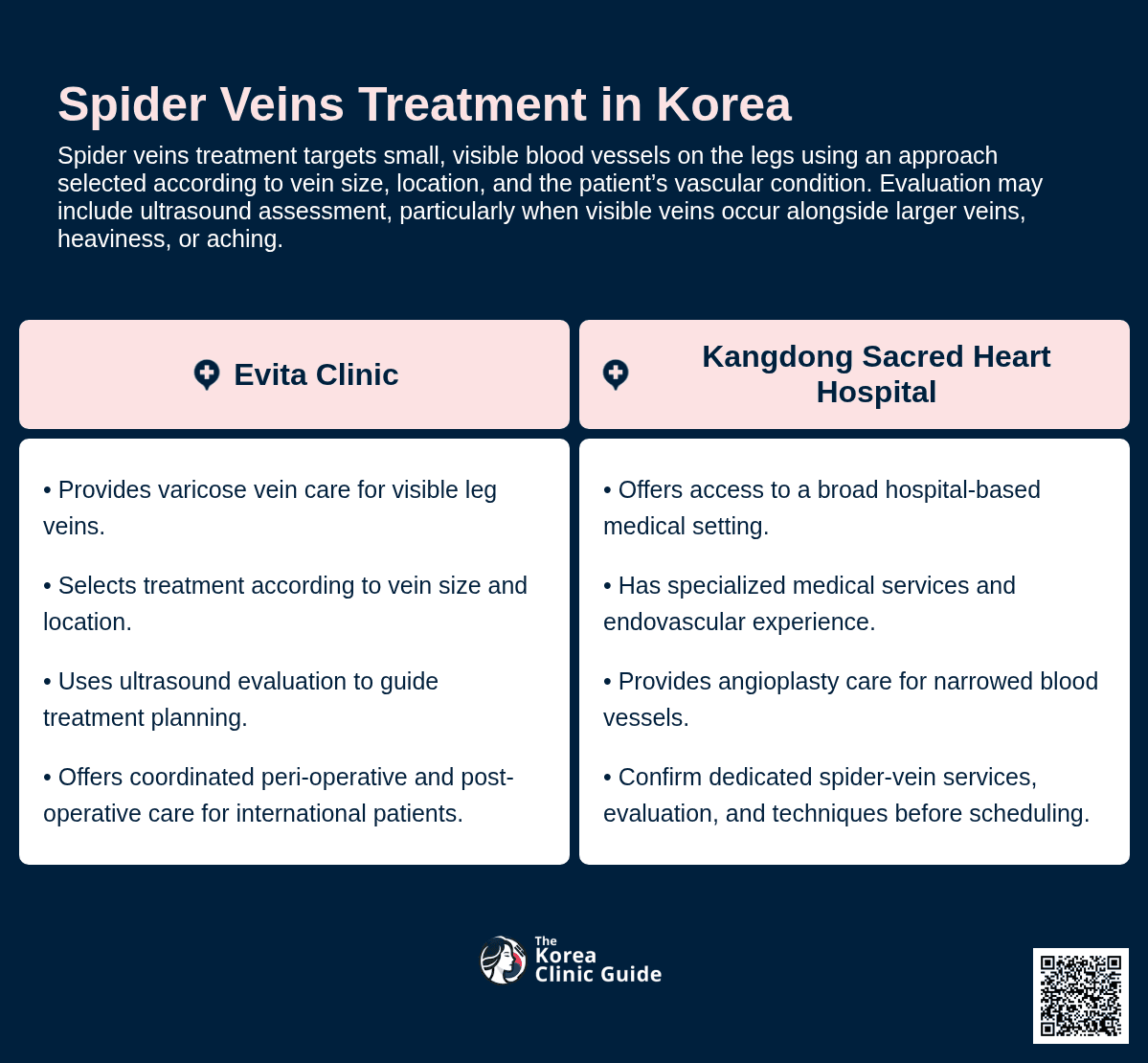
At Evita Clinic, you can discuss treatment for visible leg veins within a clinic that lists varicose vein care as part of its services. Your treatment approach is selected according to the vein size and location, with ultrasound evaluation used to guide planning; this may be relevant when spider veins occur alongside larger visible veins or symptoms such as heaviness or aching.
- URL: Evita Clinic Website
- Location: 5F, 815, Nonhyun-ro, Gangnam-gu, Seoul, South Korea
- Vein-care planning:
- Treatment selection is based on the size and location of the visible veins.
- Ultrasound evaluation is used to assess veins before choosing a treatment approach.
- The clinic notes care for enlarged visible veins as well as associated heaviness or aching.
- Care coordination: The clinic describes coordinated peri-operative and post-operative care for international patients.
2. Kangdong Sacred Heart Hospital
You may consider Kangdong Sacred Heart Hospital if you value access to a broad hospital setting with specialized medical services and endovascular experience, including angioplasty for narrowed blood vessels. However, the available information does not specify a dedicated spider-vein treatment service, evaluation process, or treatment technique, so you would need to confirm whether it offers the vein care you need.
- URL: Kangdong Sacred Heart Hospital Website
- Location: Seoul
Varicose Vein Treatment From Start to Finish
- Remote enquiry and records review — Send prior duplex reports, treatment history, DVT/PE history, medication and allergy lists, and requested leg photographs. Ask whether English-language or virtual consultation is available. Photographs help planning but do not replace ultrasound.
- In-person vascular evaluation — The clinician reviews symptoms, prior clots, bleeding, ulcer history, pregnancy status, mobility, arterial disease, and medicines. A standing leg examination is performed where possible.
- Duplex mapping and treatment plan — Venous Doppler/duplex ultrasound identifies reflux in the great saphenous, small saphenous, or accessory veins; maps tributaries; and assesses the deep system. The clinician then decides whether to use RFA, EVLA, glue, MOCA, foam, phlebectomy, or staged treatment.
- Risk and travel planning — Confirm whether one or both legs will be treated, whether phlebectomy or foam is included, the compression plan, early review date, sedation policy, escort needs, and written flying restrictions. Blood tests, ECG, pregnancy testing, or anesthetic assessment are ordered only when indicated by history or planned anesthesia.
- Treatment-day anesthesia and access — Most endovenous treatments use local anesthesia. RFA and EVLA generally require tumescent local anesthetic around the vein; glue, MOCA, and foam can avoid tumescent injections. Sedation or general anesthesia is more relevant for selected extensive procedures.
- Ultrasound-guided vein closure or removal — The clinician inserts a catheter or needle under ultrasound, closes the refluxing vein with heat, adhesive, mechanical-chemical treatment, or foam, and may remove bulging tributaries through micro-incisions. Treatment time depends on the number of veins, both-leg treatment, and whether phlebectomy is added.
- Same-day discharge and early mobility — Dressings and compression are applied as prescribed. Walk soon after treatment, arrange an escort after sedation or extensive phlebectomy, and do not drive after sedating medication or general anesthesia.
- Early review and overseas follow-up — Attend the planned wound or duplex check before travel when required. After returning home, send requested updates and arrange local vascular review promptly for new swelling, persistent symptoms, or suspected recurrence.
Alternatives to Varicose Vein Treatment
The choice is not simply surgical versus non-surgical. Endovenous ablation treats the reflux source with less invasive recovery than stripping, while foam and phlebectomy target anatomy that may be tortuous, residual, or branch-dominant. Conservative care can relieve symptoms but does not close a refluxing vein.
Graduated Compression
- Role — Compression stockings can reduce symptoms and are appropriate when intervention is unsuitable, deferred, or declined.
- Tradeoff — They manage symptoms rather than eliminate reflux. For appropriate patients with symptomatic axial reflux, guidelines favor intervention over indefinite compression alone.
Ultrasound-Guided Foam Sclerotherapy
- Best suited to — Tortuous veins, recurrent varicosities, tributaries, or patients for whom catheter-based thermal treatment is unsuitable.
- Tradeoff — It avoids incisions and thermal energy but can require further sessions and is generally placed after endothermal ablation for many cases of truncal reflux.
Ambulatory Phlebectomy
- Best suited to — Prominent symptomatic surface tributaries, often combined with or staged after treatment of the refluxing truncal vein.
- Tradeoff — It physically removes visible branches but does not replace treatment of an underlying great or small saphenous reflux source.
High Ligation and Stripping
- Best suited to — Anatomy or circumstances where endovenous therapy is not feasible, available, or preferred.
- Tradeoff — It is a surgical option with a more invasive recovery profile than catheter-based ablation.
How Can I Prepare for Varicose Vein Treatment?
- Duplex and medical records — Send existing venous duplex reports, prior procedure records, and an up-to-date medication list before travel. Expect repeat standing examination and ultrasound when clinically needed.
- Clot and bleeding disclosure — Report any DVT, pulmonary embolism, thrombophilia, cancer, superficial thrombophlebitis, venous ulcer, bleeding episode, pregnancy, hormone use, mobility limitation, arterial disease, and prior vein treatment.
- Medicines and supplements — Do not independently stop anticoagulants, antiplatelets, NSAIDs, hormone therapy, or prescribed medicines. Give the clinic and original prescriber time to agree on a safe plan; disclose aspirin, warfarin, direct oral anticoagulants, clopidogrel, fish oil, vitamin E, herbal products, and all supplements.
- Allergy disclosure — Identify prior reactions to polidocanol, sodium tetradecyl sulfate, cyanoacrylate adhesive, local anesthetics, antibiotics, latex, skin cleansers, and dressings before a method is selected.
- Fasting and transport — Local-anesthetic procedures often do not require the same fasting rules as sedation or general anesthesia. Follow the clinic's exact instructions, and arrange an escort and no-driving plan when sedation, bilateral treatment, or extensive phlebectomy is planned.
- Leg preparation — Keep the treatment area clean, avoid applying lotion or oil on the day, and tell the clinic about cuts, rash, cellulitis, or other infection. Do not shave if it will irritate or break the skin.
- Travel logistics — Book accommodation that permits daily walking and easy return for review. Avoid a fixed long-haul departure date until written flight advice is issued.
Travel note: Bring roomy clothing, the prescribed compression garments if instructed, and a translated medication list. Keep copies of all reports for follow-up at home.
The treating doctor's individualized instructions take precedence. Confirm the clinic's medication, fasting, compression, escort, follow-up, and flight requirements before finalizing travel.
Aftercare Advice
Protect mobility and follow-up after vein treatment as carefully as the procedure itself; a closed target vein does not remove the risk of clot, infection, or later venous disease progression.
- Walk regularly — Start walking on the treatment day and avoid long uninterrupted sitting or standing. Resume gentle daily activity as tolerated; postpone strenuous exercise until the treating clinician approves it.
- Compression — Wear stockings or bandages exactly as prescribed. Venous guidelines suggest at least 1 week of compression after thermal ablation, with or without phlebectomy, to reduce pain, but the final duration depends on treatment and clinical factors.
- Puncture sites and heat exposure — Keep sites clean and dry as directed. Avoid swimming, hot baths, saunas, and soaking until punctures are dry and healed; avoid rubbing or forceful massage over treated veins unless specifically instructed.
- Expected changes — Bruising, tenderness, pulling or tightness along the closed vein, temporary lumps, mild numbness or tingling, phlebitis, and brown pigmentation can occur. Small sclerotherapy-treated veins often fade over 3–6 weeks; larger veins can take 3–4 months.
- Urgent warning signs — Seek urgent medical care for chest pain, shortness of breath, coughing blood, fainting, marked new one-sided leg swelling, worsening calf pain, uncontrolled bleeding, fever, spreading redness, pus, severe allergic symptoms, or persistent new visual or neurologic symptoms.
- Results and surveillance — Attend scheduled wound or duplex review. Contact the clinic if visible tributaries persist or symptoms return; recurrence can reflect residual tributaries, recanalization, progression of venous disease, or reflux in another vein.
Follow the treating doctor's instructions over general guidance and contact the clinic promptly when pain, swelling, skin changes, or wound appearance seems wrong.
Frequently Asked Questions
Related Blogs
Otoplasty in Korea: Methods, Recovery, Risks and Travel Planning
Otoplasty reshapes or repositions outer-ear cartilage for prominent ears, asymmetry, and selected congenital or revision concerns, usually as a 1–3 hour outpatient procedure using sutures, cartilage modification, or both. International patients planning treatment in Korea should allow 10–14 days for assessment, early wound review and possible suture removal, follow activity and dressing restrictio
Updated: Sep 21, 2026
Varicose Vein Treatment in Korea: Methods, Recovery, Travel Planning, and Safety
Varicose vein treatment begins with standing duplex ultrasound mapping and may use laser or radiofrequency ablation, vein glue, mechanochemical ablation, foam sclerotherapy, phlebectomy, or surgery based on anatomy and risk factors. The article covers candidacy, recovery, compression and walking guidance, follow-up, warning symptoms, and travel planning including flight restrictions after treatmen
Updated: Sep 19, 2026
Hyperhidrosis Laser in Korea: Methods, Recovery, Results, and Travel Planning
Laser treatment for primary axillary hyperhidrosis uses subdermal fiber ablation through tiny incisions or surface laser sessions to reduce underarm sweating, with repeat treatment sometimes needed. The article covers candidacy, Korea travel planning, preparation, recovery, warning signs, follow-up, and alternatives such as antiperspirants, Botox, microwave thermolysis, and gland removal.
Updated: Sep 18, 2026
Hyperhidrosis Surgery in Korea: ETS Methods, Risks, Recovery, and Travel Planning
Endoscopic thoracic sympathectomy (ETS) uses small chest ports under general anesthesia to permanently interrupt the sympathetic chain for severe primary palmar sweating after non-surgical treatments have failed or are not tolerated. International patients should plan 7–10 postoperative days in Korea, attend follow-up before flying, obtain flight clearance if pleural air is a concern, and arrange
Updated: Sep 18, 2026