Medical Tourism Blog
NK Cell Therapy in Korea: Eligibility, Treatment Methods, Risks, and Travel Planning
Table of contents
- NK Cell Therapy at a Glance
- What Is NK Cell Therapy?
- Who Is a Good Candidate for NK Cell Therapy?
- How Is NK Cell Therapy Performed?
- Why Visit Korea for NK Cell Therapy?
- Key Information for International Patients
- Which Are the Best Clinics in Korea for Nk Cell Thraphy?
- NK Cell Therapy From Start to Finish
- Alternatives to NK Cell Therapy
- How Can I Prepare for NK Cell Therapy?
- Aftercare Advice
Considering treatment in Korea? Everything you need to know e.g. — how to avoid scams, visas, interpreters, recovery tips — in our Medical Tourism Master Guide. Plan with confidence in minutes, not weeks!
Last updated: September 2026
NK Cell Therapy at a Glance
- What it is — NK-cell therapy is a protocol-dependent cancer immunotherapy that infuses natural killer cells, usually intravenously, to pursue tumor control, remission, residual-disease reduction, or relapse prevention in a specific cancer setting.
- Who may qualify — Candidates typically have a defined cancer with an available disease-specific protocol or trial—often relapsed, refractory, high-relapse-risk, or post-transplant disease—and adequate blood counts, organ function, performance status, and infection control.
- Not a standard cure — Most NK-cell approaches, including CAR-NK and donor-derived products, remain investigational and are commonly combined with chemotherapy, cytokines, antibodies, or transplantation; an NK-cell test alone cannot predict benefit.
- Recovery and risks — A simple infusion may involve hours of observation, but preconditioning chemotherapy can cause fatigue, nausea, low blood counts, infection risk, bleeding, transfusion needs, or hospitalization; fever, breathing symptoms, swelling, confusion, or significant bleeding require urgent assessment.
- Stay and repeat visits — Do not plan a short fixed trip: treatment may require 2–3 weeks or longer for preconditioning, cytokine injections, laboratory monitoring, or inpatient care, and some protocols repeat every 21–28 days.
- When results are assessed — Cancer response is not judged by energy level or peripheral NK-cell counts; imaging, marrow testing, tumor markers, or formal response criteria usually assess outcomes over weeks to months, often around day 28–42 or later.
- Korea-specific check — Korea’s advanced-regenerative-medicine pathway, effective February 21, 2025, is not the same as product market authorization; obtain written evidence for the exact NK product’s authorization, approved treatment plan, or clinical-trial status before traveling.
What Is NK Cell Therapy?
NK-cell therapy is a cancer immunotherapy that gives natural killer immune cells, usually by intravenous infusion, under a defined treatment protocol. It aims to control cancer, reduce residual disease, support remission, or lower relapse risk in selected patients, rather than provide a guaranteed cure. It is a minimally invasive cell-based treatment, although accompanying chemotherapy or other medicines can make the overall regimen more intensive.
Who Is a Good Candidate for NK Cell Therapy?
- Defined cancer setting — Potential candidates have a specific malignancy and a documented NK-cell protocol or disease-specific clinical trial, often in relapsed, refractory, high-relapse-risk, or post-transplant care.
- Oncology-led assessment — Candidates can provide pathology, staging scans, treatment history, molecular reports when relevant, current medicines, and contact details for their home oncologist.
- Adequate clinical reserve — Treatment requires acceptable performance status, organ function, blood counts, and infection screening for the proposed regimen.
- Realistic treatment goal — Suitable patients understand that the aim may be tumor control, remission, reduction of residual disease, or relapse prevention in a defined setting—not a guaranteed cure or general immune enhancement.
NK-cell level testing alone does not establish candidacy or predict benefit; active studies enroll patients with narrowly defined cancers, including AML/MDS, lymphoma, sarcoma, and selected solid tumors. NCI trial listings describe these products as investigational in specific malignancies. Active or uncontrolled bacterial, viral, or fungal infection, pregnancy or breastfeeding when chemotherapy or cytokines are planned, uncontrolled autoimmune disease, significant immunodeficiency, systemic immunosuppression, unstable organ disease, poor functional status, or inadequate recovery from prior treatment can exclude treatment. Active central-nervous-system disease, a second active cancer, and incomplete protocol washout periods also require case-by-case review. Do not replace indicated surgery, radiation, systemic treatment, transplantation, or an approved cellular therapy with an NK-cell infusion without review by the treating cancer specialist.
How Is NK Cell Therapy Performed?
NK-cell therapy is not one standard procedure. The cell source, activation method, genetic engineering, conditioning chemotherapy, cytokine support, dose, and accompanying cancer treatment determine the likely benefit, risk, monitoring, and travel requirements.
- Autologous expanded NK cells — The clinic collects, activates, and expands the patient’s own NK cells before reinfusion. This avoids donor selection, but prior cancer treatment and the cancer itself can reduce NK-cell number or function.
- Allogeneic donor-derived NK cells — Cells come from a healthy related, haploidentical, unrelated, or selected donor. This approach can support more standardized manufacturing but needs a product-specific donor-recipient safety strategy.
- Cord-blood or iPSC-derived NK cells — Cryopreserved, scalable “off-the-shelf” products derived from cord blood or induced pluripotent stem cells. They remain product- and protocol-specific, not interchangeable standard treatments.
- Cytokine-induced memory-like NK cells — NK cells are activated before infusion to increase responsiveness. Current research includes post-transplant and relapsed/refractory AML/MDS protocols, often alongside IL-2 or other anti-cancer treatment. NCI’s CIML NK-cell study information illustrates this disease-specific approach.
- CAR-NK cells — NK cells engineered with a chimeric antigen receptor targeting a tumor antigen. CAR-NK differs from conventional NK infusion and remains principally a clinical-trial approach.
- Combination regimens — Lymphodepleting chemotherapy such as fludarabine/cyclophosphamide, IL-2 (aldesleukin) or IL-15-based support, tumor-targeting antibodies, checkpoint inhibitors, chemotherapy, or transplantation may be part of the plan. Assess the whole regimen, not the NK-cell infusion alone.
Why Visit Korea for NK Cell Therapy?
South Korea has a legal framework for advanced regenerative medicine and active cell-therapy development. That framework does not prove that every NK-cell product is authorized, effective, or appropriate for international patients. Request written evidence for the exact product and regulatory route before committing to travel.
- Regulated treatment-plan pathway — Under the amended framework effective February 21, 2025, designated institutions can submit advanced-regenerative-medicine treatment plans for review, subject to statutory conditions including prior same-purpose clinical study requirements. Korea’s advanced regenerative medicine law is distinct from routine market authorization.
- Consent requirements — The law requires disclosure of alternative treatments and the expected time required at each treatment stage, important protections for patients considering complex cancer care abroad. Korean consent provisions support this distinction.
- Product-level regulatory review — The MFDS evaluates cell therapies for quality, safety, and efficacy in product authorization. MFDS cell and gene therapy responsibilities do not establish authorization for a proposed NK product.
- Important evidence limit — A targeted official-source review did not identify a publicly confirmable MFDS-authorized NK-cell therapeutic product with a clearly published indication. Obtain written product-specific authorization evidence, approved treatment-plan documentation, or trial documentation; do not rely on marketing claims.
- Do not confuse different cell therapies — Korea’s first reported advanced-regenerative-medicine treatment in April 2026 used autologous EBV-antigen-specific T cells for EBV-positive extranodal NK/T-cell lymphoma in complete remission. The MFDS report was not an approval or efficacy finding for general NK-cell infusion.
- No demonstrated outcome advantage — NK-cell development is internationally active but remains heavily early-phase and combination-based. Recent global trial mapping does not show superior NK-cell outcomes in Korea versus other countries.
Key Information for International Patients
- Minimum stay — Do not plan a short, fixed medical-tourism trip. A straightforward IV infusion can involve several hours of observation, while preconditioning, cytokine injections, serial laboratory testing, repeat doses, or inpatient care can extend treatment over 2–3 weeks or longer.
- Repeat visits and cycles — Some protocols repeat treatment in 21–28-day cycles. Confirm whether every dose, blood test, cytokine injection, scan, and response assessment must occur in Korea.
- Flight timing — There is no universal safe-to-fly interval. Fly only after oncologist clearance based on symptoms, vital signs, oxygen needs, blood counts, infection risk, bleeding or thrombosis risk, transfusions, and required monitoring.
- Activity and itinerary — An uncomplicated infusion does not have a cosmetic-style recovery timeline. Conditioning chemotherapy can cause fatigue, nausea, mucositis, anemia, thrombocytopenia, neutropenia, and infection risk; keep the itinerary flexible and avoid activities that limit access to emergency oncology care.
- Remote follow-up — Arrange a named home oncologist before travel. Obtain an English discharge summary listing the product and source, doses and dates, conditioning, supportive medicines, transfusions, adverse events, current laboratory values, follow-up schedule, and urgent contacts.
- Companion and accommodation — A companion is strongly practical during chemotherapy, cytokine support, sedating premedication, or frequent monitoring. Stay close enough to the treating center for urgent reassessment.
Travel note: Do not fly while febrile, neutropenic, clinically unstable, or during a period requiring closely timed cytokine injections or laboratory surveillance.
Which Are the Best Clinics in Korea for Nk Cell Thraphy?
Listed below are some of the best clinics in Korea for nk cell thraphy.
1. Cellinique Clinic
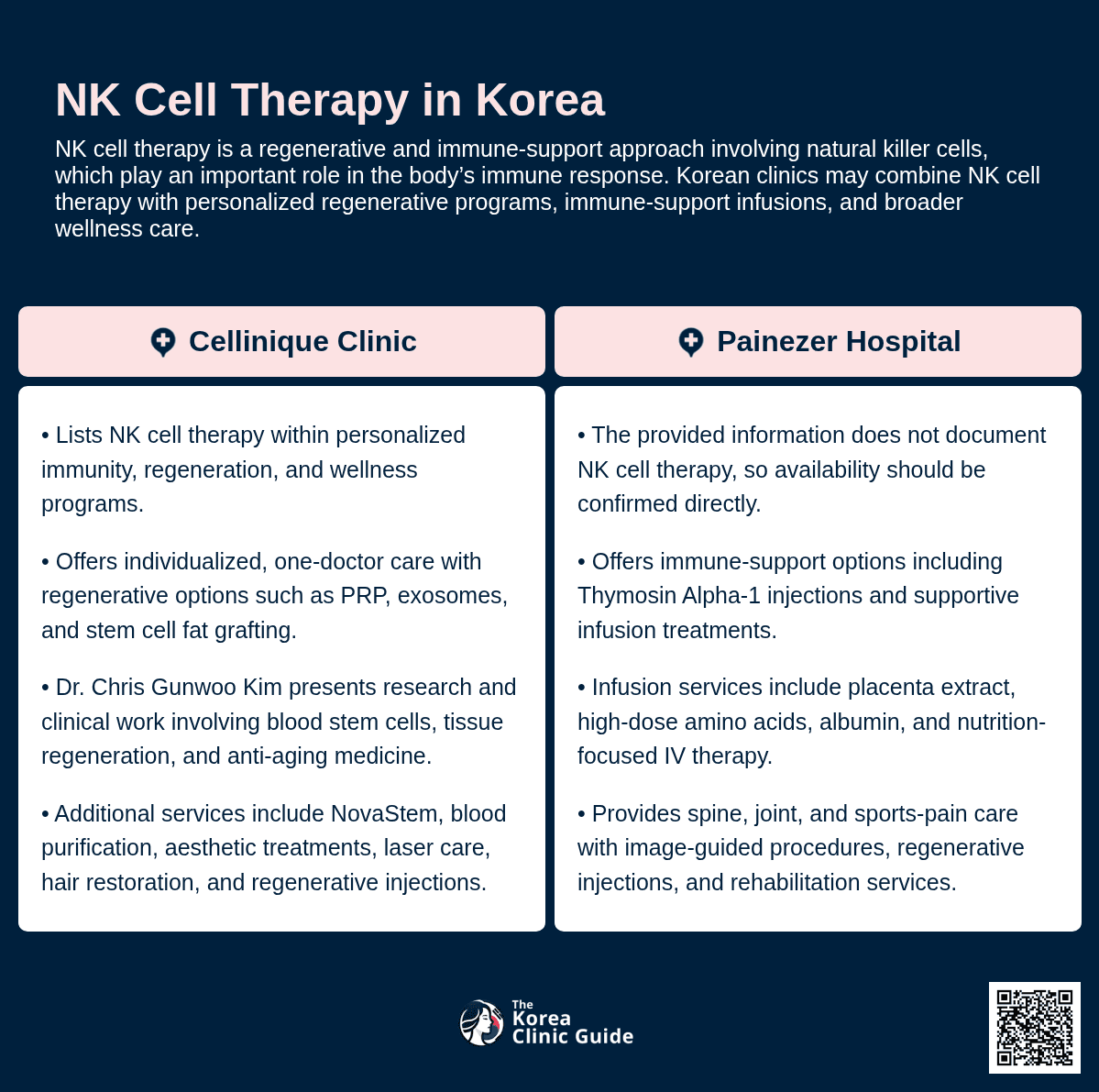
If you are considering NK cell therapy, Cellinique Clinic lists it within a personalized program centered on immunity, regeneration, and overall health. Your care is described as one-doctor, individualized treatment, with NK cell therapy available alongside regenerative and supportive options selected according to your consultation.
- URL: Cellinique Clinic Website
- Location: Gangnam-gu, Seoul
- Regenerative focus:
- NK cell therapy is listed among the clinic’s complementary treatments alongside PRP, blood purification, exosomes, and stem cell fat grafting.
- NovaStem uses concentrated autologous blood in a regenerative-treatment approach intended to support skin health and damaged-tissue recovery.
- Clinical background:
- Dr. Chris Gunwoo Kim has presented on blood stem cells, tissue regeneration, and anti-aging topics at Korean and international medical meetings.
- In 2025, Dr. Kim presented the clinic’s NovaStem Kit, described as a minimally manipulated cell biotechnology, at the Korean Obesity and Aesthetic Treatment Society spring conference.
- Additional services:
- Blood purification (ABC BMT) is offered as a health-management treatment using ultraviolet rays, magnetic fields, and ionized oxygen.
- The clinic also provides aesthetic, laser, hair-restoration, and regenerative injection services.
2. Painezer hospital
Painezer Hospital may be relevant if you want supportive immune or infusion care alongside non-surgical treatment for spine, joint, or sports-related pain, but the provided information does not document NK cell therapy. You should confirm whether NK cell therapy is available and whether it is appropriate for your needs before relying on this clinic for that procedure.
- URL: Painezer hospital Website
- Location: #502,#503, 5th Floor, Parkrio A complex, Olympicro 37 gil 130, Sonngpa-gu, Seoul, Korea
- Immune and infusion options:
- Thymosin Alpha-1 injection is listed as an immune-support treatment.
- Placenta extract injection, high-dose amino acid IV therapy, albumin infusion, and TPN-style nutrition IV are included in the clinic’s supportive infusion menu.
- Musculoskeletal care:
- Image-guided options include selective nerve root blocks and epidural adhesiolysis for selected spine-related pain patterns.
- The clinic offers prolotherapy, PDRN regenerative injections, collagen injections, steroid injections, and knee joint injections.
- Rehabilitation services include manual therapy, therapeutic exercise, Schroth-method exercises, and focused extracorporeal shockwave therapy.
NK Cell Therapy From Start to Finish
- Remote record triage — Send English or Korean translations of pathology, molecular and genomic reports where relevant, imaging files and reports, operative and treatment summaries, medication and allergy lists, transfusion history, infection and vaccination records, and home-oncologist details. Ask whether English-language virtual consultation is available.
- Oncology consultation — Confirm the diagnosis, disease stage, treatment intent, standard-care alternatives, exact product name, cell source, manufacturing location, regulatory route, expected benefits, known risks, dose schedule, co-treatments, and emergency plan. Clinical-trial consent is normally separate from clinical-care consent.
- Eligibility work-up — The team reviews pathology and staging and performs or validates blood counts, kidney/liver and metabolic tests, infectious-disease screening, pregnancy testing where applicable, medication reconciliation, and performance-status assessment. Heart, lung, marrow, or other testing depends on the cancer and regimen.
- Preconditioning when prescribed — Some protocols administer lymphodepleting chemotherapy, often fludarabine/cyclophosphamide, over several days before infusion. This step can drive low blood counts, infection risk, transfusion needs, hospitalization, and the required length of stay.
- NK-cell infusion — NK cells are generally given intravenously with vital-sign monitoring. Premedication, infusion time, and post-infusion observation depend on the product and prior reaction history.
- Adjunct treatment and monitoring — IL-2, IL-15-based support, antibodies, chemotherapy, or further NK-cell doses can follow over days or in repeat cycles. The team monitors symptoms, blood counts, organ function, infection signs, and treatment-specific adverse effects.
- Discharge decision — Discharge follows clinical stability, symptom control, vital signs, blood counts, infection risk, medicine access, and a credible plan for emergency oncology care. Same-day discharge after an uncomplicated infusion does not apply automatically after chemotherapy-based protocols.
- Response assessment and overseas handoff — Cancer response is assessed over weeks to months using disease-appropriate imaging, marrow studies, tumor markers, and formal response criteria—often around day 28–42 or later. Continue planned remote follow-up with the Korean team and local oncology follow-up after returning home.
Alternatives to NK Cell Therapy
Alternatives depend on cancer type, stage, biomarkers, previous treatment, organ function, and goals of care. Standard cancer treatment or a disease-specific trial often has a clearer evidence base than an NK-cell protocol; non-surgical cell-therapy marketing should not be treated as equivalent to evidence-based oncology care.
Standard Cancer Treatment
- Surgery, radiation, and systemic therapy — Surgery, radiation therapy, chemotherapy, targeted therapy, endocrine therapy, immune-checkpoint inhibitors, and monoclonal antibodies can be the indicated treatment depending on the disease.
- Tradeoff — These options have established roles for defined cancers but carry modality-specific toxicities and logistical demands. The treating oncology team should explain why an investigational NK-cell approach is being considered instead of, or alongside, standard care.
Cellular and Transplant Options
- Hematopoietic-cell transplantation — Stem-cell transplantation is established in selected blood cancers but requires intensive eligibility assessment, donor planning when applicable, and prolonged infection monitoring.
- Approved CAR-T or tumor-infiltrating lymphocyte therapy — These can be relevant for specific eligible hematologic cancers or solid-tumor indications, but are not interchangeable with CAR-NK or conventional NK-cell infusion.
- Tradeoff — Cellular therapies differ in indication, manufacturing, conditioning, toxicity, and follow-up needs. A product studied in another cancer cannot predict benefit for an individual case.
Clinical Trial or Supportive Care
- Disease-specific trial — Enrollment in a properly documented trial can provide protocol-defined eligibility, safety monitoring, and endpoint-based response evaluation. Confirm location, regulatory oversight, costs, withdrawal provisions, and post-trial care.
- Palliative and supportive care — Symptom control, nutrition support, pain management, transfusions, and psychosocial care can be combined with active cancer treatment at any stage.
NK-Cell Testing
- Purpose — An NK-cell test can be discussed with an oncology team but cannot establish that NK-cell infusion is needed or likely to work.
- Limit — Do not use a peripheral NK-cell result as a substitute for pathology, staging, biomarker evaluation, or formal cancer response assessment.
Broad Stem-Cell Treatments
- Scope — Autologous stem-cell therapy and stem-cell disease therapy are broad categories, not clinically proven substitutes for a defined NK-cell protocol.
- Tradeoff — Require the same product-specific evidence, regulatory documentation, cancer rationale, and safety plan as any other cell-based intervention.
How Can I Prepare for NK Cell Therapy?
- Submit complete records early — Send original pathology, scans, treatment summaries, molecular reports, current medication and allergy lists, transfusion history, vaccination and infection records, and home-oncologist contact details. Arrange certified English or Korean translations when requested.
- Verify the exact intervention — Request the product name, cell source, manufacturing location, intended cancer indication, dose, schedule, preconditioning, cytokine or other co-treatments, regulatory route, safety oversight, adverse-event escalation plan, and written estimate of required time in Korea.
- Reconcile every medicine — List prescription medicines, anticoagulants, antiplatelets, corticosteroids, immunosuppressants, anticonvulsants, diabetes medicines, prescribed cancer drugs, herbs, mushroom products, vitamins, antioxidants, and CBD/cannabis products. Do not independently stop any medicine; corticosteroids and other immunosuppressants can be especially relevant to immune-cell protocols.
- Complete protocol testing — Attend required blood tests, infectious screening, pregnancy testing, imaging, marrow assessment, cardiac or pulmonary testing, and treatment washout periods. Eligibility is protocol-specific.
- Fasting and hydration — Do not fast for a simple IV infusion unless the center instructs otherwise. Fasting is generally relevant only for a sedated procedure, biopsy, or central-line placement.
- Plan infection protection — Report fever, cough, new shortness of breath, diarrhea, urinary symptoms, recent infection exposure, or antibiotic use before travel and before every treatment step. Follow the center’s food-safety, vaccine, dental-care, and hydration instructions.
- Arrange practical support — Book flexible flights and accommodation near the treatment center. Bring a companion for chemotherapy, cytokine support, sedating premedication, frequent visits, weakness, or language support.
Travel note: Do not book a return flight based on the date of an infusion. Blood counts, infection risk, adverse effects, and the next required treatment step determine when travel is appropriate.
Confirm the treating doctor’s clinic-specific medicine, testing, fasting, accommodation, and travel requirements; individualized oncology instructions take precedence over general guidance.
Aftercare Advice
The critical aftercare period is determined by the complete cancer regimen, especially chemotherapy-related blood-count suppression and infection risk—not by the IV infusion site alone.
- Monitor acute reactions — Report fever at the threshold given by the oncology team, shaking chills, rash, facial or throat swelling, shortness of breath, chest pain, dizziness, fainting, severe headache, confusion, or other neurologic symptoms immediately.
- Protect against infection and bleeding — Follow instructions on sick contacts, food safety, hand hygiene, line care, laboratory monitoring, and medicines. Avoid contact sports and injury-prone activity when platelets are low, fatigue or dizziness is significant, or a central line is present.
- Manage treatment effects promptly — Contact the center for persistent vomiting or diarrhea, inability to drink, markedly reduced urine, jaundice, worsening fatigue, new bruising or bleeding, black stools, or rapidly worsening rash. Cytokines and combination drugs have their own toxicities.
- Keep follow-up appointments — Attend scheduled blood counts, chemistry tests, infection checks, cytokine injections, repeat infusions, and disease assessments. Do not judge response by energy level, wellness scores, or a peripheral NK-cell test.
- Delay long-haul travel until cleared — Do not fly with fever, neutropenia, clinical instability, oxygen needs, recent uncontrolled infusion reaction, or a need for closely timed laboratory monitoring. Obtain the written overseas handoff before leaving Korea.
Follow the treating doctor’s instructions and contact the clinic or seek urgent local emergency care when something appears wrong; do not wait for an overseas teleconsultation during a potentially serious acute event.
Frequently Asked Questions
Related Blogs
Discovering the True Cost of Keloid Ear Surgery: Korea vs. Global Alternatives
Discover the cost of keloid ear surgery in Korea, where advanced medical techniques combine with affordability to offer effective treatment options. Learn about factors influencing prices and why many choose Korea for their cosmetic and reconstructive surgery needs.
Updated: Sep 27, 2026
Comparing Costs: Why Korea Is a Top Destination for Foreign Body Removal vs Global Alternatives
Discover the costs and procedures involved in Foreign Body Removal in Korea, a popular destination for affordable and high-quality medical care. Learn about the factors influencing prices and how Korea's healthcare system ensures safe and efficient treatments for overseas patients.
Updated: Sep 26, 2026
Discover the Global Spectrum of Scar Removal Surgery Costs and Why Korea Leads the Way
Discover how much scar removal surgery costs in Korea, a popular destination for affordable cosmetic procedures. Explore factors influencing the pricing and what to expect during your medical journey in this comprehensive guide.
Updated: Sep 25, 2026
Otoplasty in Korea: Methods, Recovery, Risks and Travel Planning
Otoplasty reshapes or repositions outer-ear cartilage for prominent ears, asymmetry, and selected congenital or revision concerns, usually as a 1–3 hour outpatient procedure using sutures, cartilage modification, or both. International patients planning treatment in Korea should allow 10–14 days for assessment, early wound review and possible suture removal, follow activity and dressing restrictio
Updated: Sep 21, 2026