
Medical Tourism Blog
Upper vs Lower Blepharoplasty in Korea | Which One Do You Need? with Dr. Park
Table of contents
- Upper vs Lower Blepharoplasty in Korea
- A Clearer Way to Understand Eyelid Surgery
- What Upper Blepharoplasty Is Designed to Improve
- What Lower Blepharoplasty Treats Under the Eyes
- Case One: When Both Upper and Lower Blepharoplasty Are Needed
- Case Two: When Upper Blepharoplasty Alone Is Not Enough
- Why Personalization Matters in Middle-Aged Eyelid Surgery
- A More Youthful Look Starts With the Right Procedure
- More about Made Young Plastic Surgery
Considering treatment in Korea? Everything you need to know e.g. — how to avoid scams, visas, interpreters, recovery tips — in our Medical Tourism Master Guide. Plan with confidence in minutes, not weeks!
Disclaimer: The following is a guest post. The information and opinions expressed are not of koreaclinicguide.com but of Made Young Plastic Surgery
Upper vs Lower Blepharoplasty in Korea
A Clearer Way to Understand Eyelid Surgery
Eyelid surgery can make a remarkable difference in how refreshed, bright, and youthful the face appears, but the right approach depends on identifying exactly what is causing the tired look in the first place. According to Dr. Byung-Chan Park of Made Young Plastic Surgery, middle-aged eyelid surgery is not simply about removing extra skin. It requires a careful clinical assessment of skin laxity, muscle support, fat position, eyelid symmetry, and even functional issues such as ptosis or forehead compensation. When these factors are evaluated properly, upper and lower blepharoplasty can be used in a highly tailored way to restore a more natural, rested appearance around the eyes.
What Upper Blepharoplasty Is Designed to Improve
Upper blepharoplasty is typically recommended when the upper eyelids begin to look heavy, droopy, or uneven. In many middle-aged patients, the original double-eyelid crease becomes less visible as the skin loosens and starts to fold over the line. This can make the eyes look smaller, more fatigued, and older than they feel. In some cases, asymmetry also develops because one eyelid droops more than the other, or because mild ptosis affects the balance of the eyes.
Dr. Park explains that upper blepharoplasty is not limited to skin removal alone. The procedure may also involve refining or recreating the eyelid crease and correcting ptosis when needed. The goal is to restore a cleaner, more defined upper eyelid contour while preserving a natural look. For patients without severe brow drooping, this approach alone may be enough to lift the heaviness and improve symmetry without needing a brow procedure.
What Lower Blepharoplasty Treats Under the Eyes
Lower blepharoplasty focuses on the under-eye area, where aging often shows up as puffiness, shadows, wrinkles, and loss of firmness. As skin elasticity decreases, the tissues that support under-eye fat can weaken, allowing the area to bulge or sag. At the same time, the muscle structure related to the under-eye fullness often called the aegyo-sal may lose support, which can make the lower lids look hollow in some places and puffy in others.
Rather than treating this as a single issue, Dr. Park approaches lower blepharoplasty as a structural repair. The procedure may include removing loose skin, repositioning weakened fat-supporting tissues, and reinforcing the sagging under-eye muscle to improve firmness and smoothness. When done carefully, the result is not an over-tightened look, but a brighter and more youthful under-eye area that appears supported again.
Case One: When Both Upper and Lower Blepharoplasty Are Needed
In one of Dr. Park’s real patient cases, the main concern was a constant tired, older-looking impression. On the upper eyelids, the patient already had a natural double-eyelid crease, but it had become faint as loose skin began to cover it. Her upper lids looked droopy, and there was noticeable asymmetry. Because brow drooping was not severe, Dr. Park determined that upper blepharoplasty would be sufficient. He removed the excess skin, re-defined the crease, and corrected left-sided ptosis to improve balance between the eyes.
The lower eyelids required a different strategy. The patient had decreased skin elasticity, more visible wrinkles, and significant sagging of the orbicularis oculi muscle associated with the aegyo-sal. The under-eye fat and its support structures had also weakened, creating puffiness and shadowing. For this reason, Dr. Park performed lower blepharoplasty, removed the necessary loose skin, repositioned and reinforced the weakened tissues, and re-secured the sagging muscle for better support.
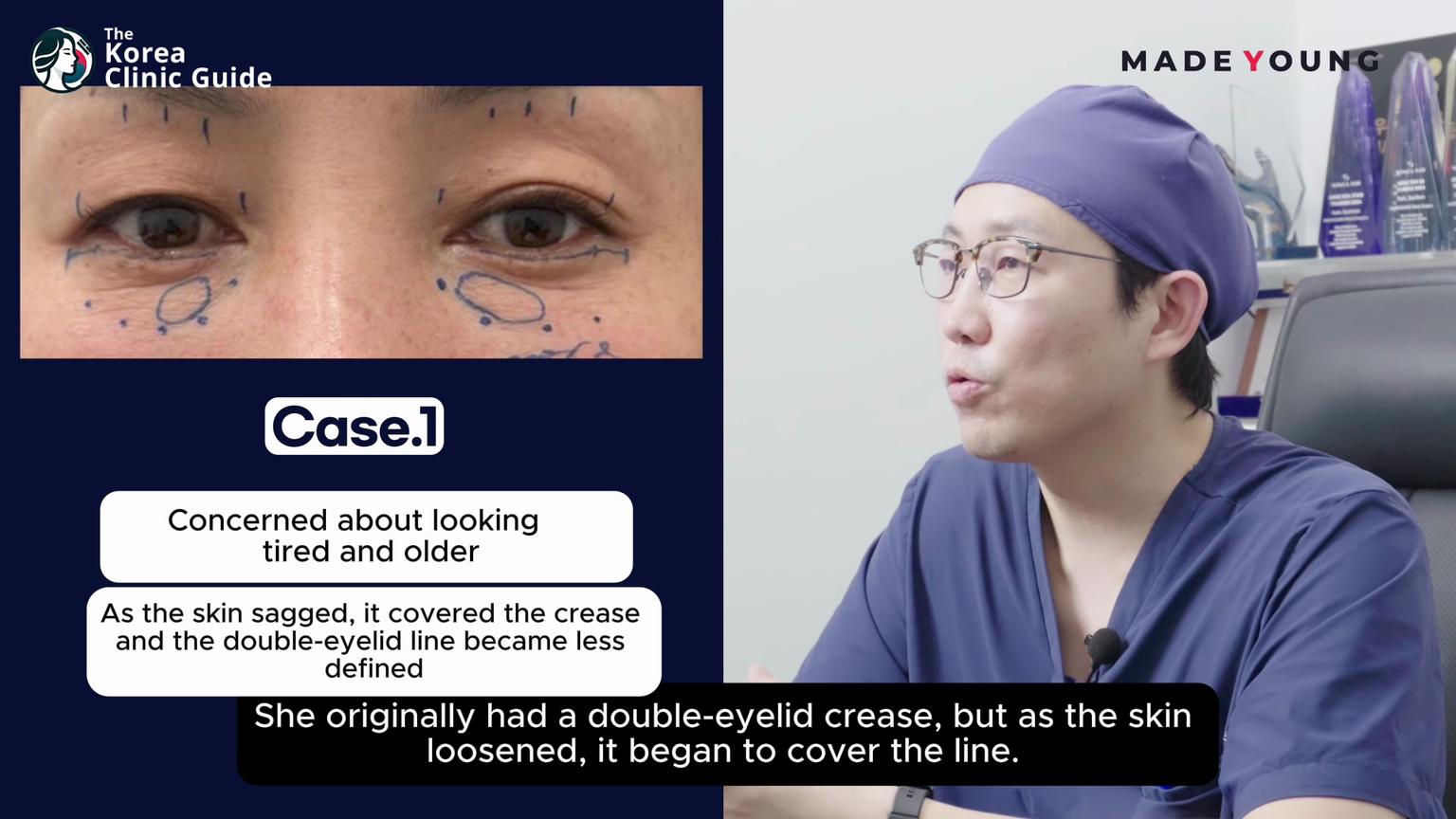
One month after surgery, the changes were already clear. The double-eyelid line had become visible again, the upper lid laxity had improved, and the asymmetry was corrected. Under the eyes, the muscle and fat support looked firmer, the aegyo-sal appeared more defined, and the overall area looked smoother and brighter. The result was not a dramatic change in identity, but a fresher, younger expression.
Case Two: When Upper Blepharoplasty Alone Is Not Enough
A second case showed why a more comprehensive plan is sometimes necessary. During consultation, this patient showed significant forehead compensation, along with thick skin, thick muscle, and substantial eyelid sagging. She also had a broad, strong epicanthal fold at the inner corners of the eyes, which made the eyes appear more closed-in.
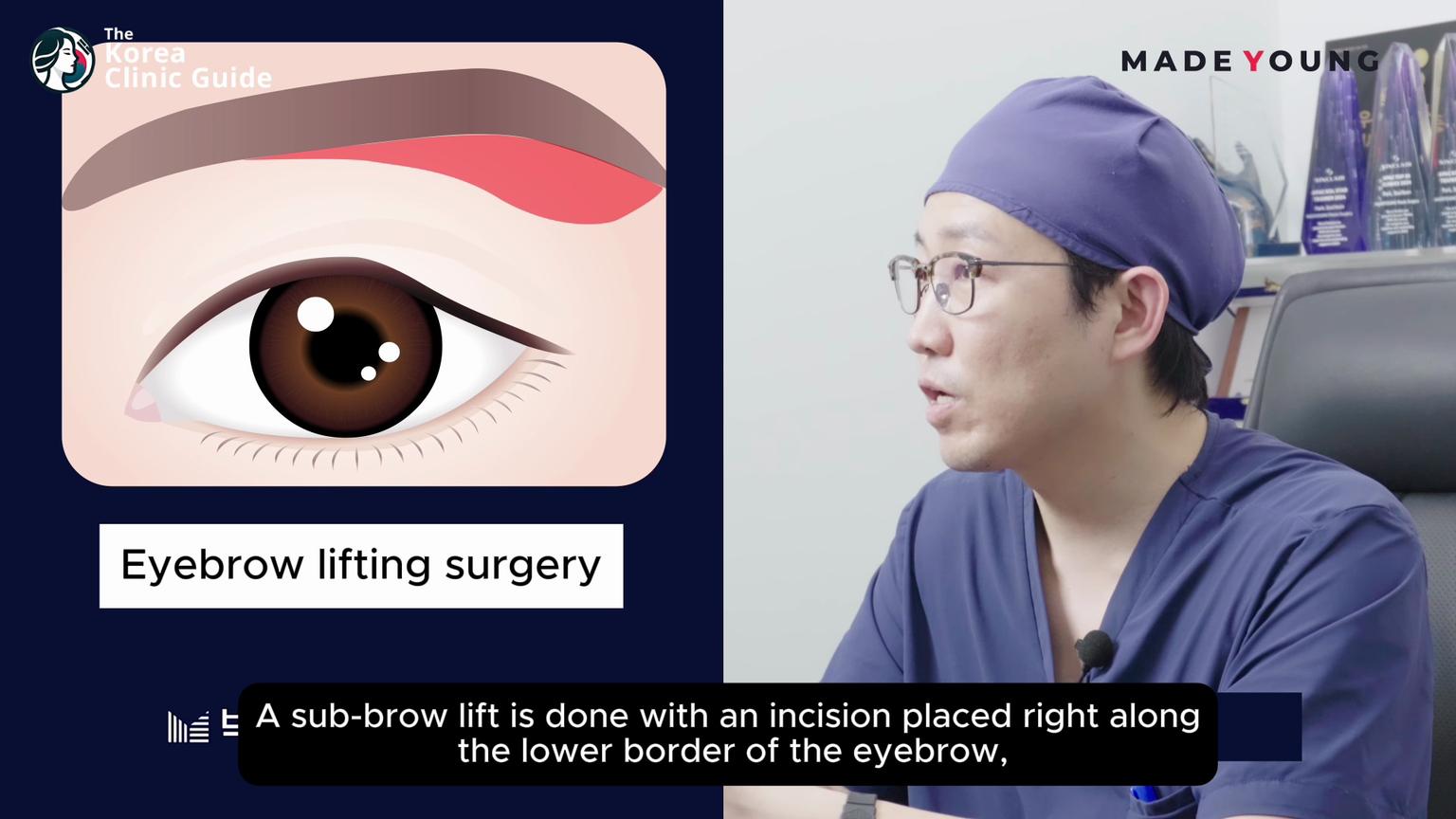
In this situation, Dr. Park determined that standard upper blepharoplasty alone would not fully solve the problem. Simply making a crease and removing skin would leave too much heaviness because the eyelids had considerable thickness and volume. To address that, he combined the surgery with a sub-brow lift, using an incision along the lower border of the eyebrow to remove drooping skin and muscle while closing the area in a way that helps minimize visible scarring.
He also adjusted the amount of skin removal and the crease design carefully because the patient’s natural anatomy tended to bury the crease. In addition, medial epicanthoplasty and lateral canthoplasty were performed to open the inner and outer corners of the eyes. Since the epicanthal fold was especially wide and strong, the inner corner needed to be opened enough to prevent a residual folded appearance.
Even with some early swelling after surgery, the patient’s eyes looked clearer, more open, and better balanced. The crease appeared as planned, and the eye shape looked longer because the inner corners had been sufficiently released. This case highlights an important point: for some middle-aged patients, successful eyelid surgery depends on combining procedures strategically rather than relying on a single technique.
Why Personalization Matters in Middle-Aged Eyelid Surgery
Dr. Park emphasizes that the best results in middle-aged eyelid surgery come from identifying the real structural causes behind an aged or tired look. That may include loose skin, but it can also involve brow descent, eyelid thickness, muscle sagging, ptosis, fat displacement, or compensatory forehead movement. Two patients may both say they want brighter eyes, yet require very different operations to achieve that outcome naturally.
This is why functional concerns matter just as much as cosmetic ones. An eye area that looks heavy may not only appear older but may also reflect deeper support issues that affect how the lids open and rest. A thoughtful, individualized approach allows the surgeon to improve both appearance and eyelid function while avoiding a one-size-fits-all result.
A More Youthful Look Starts With the Right Procedure
Choosing between upper and lower blepharoplasty is not really about selecting the more popular procedure. It is about understanding whether the problem lies in the upper lids, the lower lids, or both, and whether additional corrections such as ptosis repair, a sub-brow lift, or corner surgery are needed. Dr. Park’s case examples show that when the anatomy is assessed precisely and the surgical plan is matched to the patient, eyelid surgery can soften a tired appearance and restore a naturally youthful expression.
For anyone considering blepharoplasty in Korea, the most important step is not rushing into treatment but finding the approach that fits the eye structure, aging pattern, and goals of the individual. When that happens, the results can be subtle in the best possible way: clearer eyes, better balance, and a face that looks more awake and refreshed.
More about Made Young Plastic Surgery
For patients deciding between upper or lower eyelid surgery in Korea, Made Young Plastic Surgery in Gangnam stands out as a premium clinic focused on facial and anti-aging procedures, combining refined aesthetic judgment with a strong commitment to safety and personalized care. Whether you are considering upper blepharoplasty to address drooping lids or lower blepharoplasty for under-eye bags and skin laxity, Made Young offers direct consultation and diagnosis by a verified medical team of highly skilled doctors with an average of more than 15 years of experience, helping each patient choose the most suitable approach based on their anatomy and goals. The clinic’s differentiators include a comprehensive safety system with full-time board-certified anesthesiologists on site, a 1:1 dedicated monitoring system, a cross-check emergency response system involving multiple anesthesiologists, and full CCTV coverage for transparency, along with a separate dedicated aftercare center that supports systematic recovery. Backed by recognitions such as the 2022 Korea No.1 Award, 2022 Korea Customer Satisfaction 1st Place, Outstanding Member selection by the Korean Society of Plastic and Reconstructive Surgeons, and certification by the Minimally Invasive Aesthetic Surgery Society, Made Young presents a trusted option for those seeking expert eyelid surgery with both precision and peace of mind.
Find more about this clinic here: Made Young Plastic Surgery
Frequently Asked Questions
Related Blogs
Uneven Eyelids: Canthoplasty, Laser Canthoplasty, and Revision Eye Surgery Solutions in Korea
Updated: Aug 18, 2026
Korea Lumps and Bumps: Revision Eye Surgery Solutions for Safe and Effective Treatment
Updated: Aug 18, 2026

Revise Your Vision: Addressing Aging Process After Initial Surgery with Revision Eye Surgery in Korea
Updated: Aug 16, 2026
Correcting Entropion & Ectropion: Revision Eye Surgery Options in Korea for Restored Eye Comfort
Updated: Aug 16, 2026
Clinics offering Upper Blepharoplasty
RINE Plastic Surgery Clinic | Facelift and Eye Rejuvenation Surgery
Nonhyeon

SH Clinic: Comprehensive Women's, Men's & Couples' Health Services in Korea
Sinsa

THEPLUS Plastic Surgery Korea | Eye, Nose, Face & Body Surgery
Sinsa

Made Young Plastic Surgery: Rejuvenating Aesthetic Excellence in Korea for Face Lifts, Contouring and More
Gangnam Station