
Medical Tourism Blog
Acne Scar Treatment in Korea: Methods, Recovery, Risks and Travel Planning
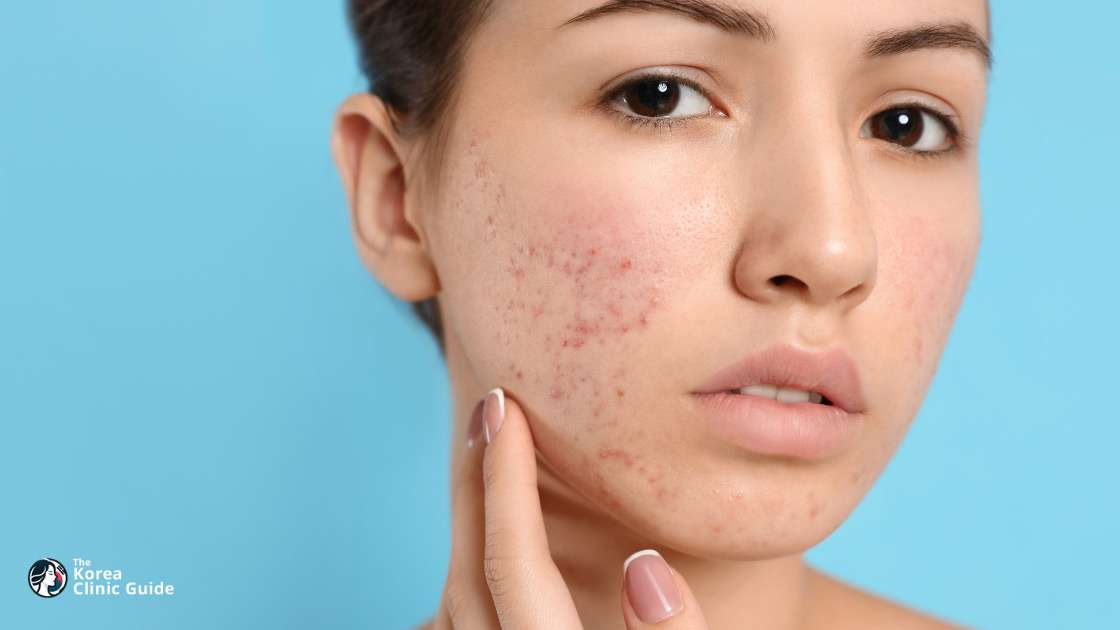
Table of contents
- Acne Scar Treatment at a Glance
- What Is Acne Scar Treatment?
- Who Is a Good Candidate for Acne Scar Treatment?
- What Are the Different Types of Acne Scar Treatment?
- Why Visit Korea for Acne Scar Treatment?
- Key Information for International Patients
- Which Are the Best Clinics in Korea for Acne Scar Treatment?
- Acne Scar Treatment From Start to Finish
- Alternatives to Acne Scar Treatment
- How Can I Prepare for Acne Scar Treatment?
- Aftercare Advice
Considering treatment in Korea? Everything you need to know e.g. — how to avoid scams, visas, interpreters, recovery tips — in our Medical Tourism Master Guide. Plan with confidence in minutes, not weeks!
Last updated: August 2026
Acne Scar Treatment at a Glance
- Scar-specific treatment — Acne scar treatment is a personalized plan—not one procedure—that may combine subcision, TCA CROSS, laser resurfacing, microneedling, filler, or punch techniques according to scar shape, depth, tethering, and pigment risk.
- Match treatment to scar type — Rolling scars may need subcision to release fibrous tethers; narrow ice-pick scars often need focal TCA CROSS or punch treatment, while diffuse shallow texture may suit microneedling or fractional laser.
- Recovery varies widely — Low-downtime peels, non-ablative laser, and RF microneedling often cause brief redness, while subcision can bruise and fractional CO2 or Er:YAG laser commonly needs about 5–10+ days before social activities feel comfortable.
- Results take time — Stable improvement is judged over several months as collagen remodels; early swelling can temporarily make scars look better, and a full plan commonly requires repeat sessions spaced weeks apart.
- Best candidates — Active acne should be controlled before scar revision. Treatment improves scar visibility and texture but does not reliably erase every scar.
- Pigment risk — Post-inflammatory hyperpigmentation can persist or worsen after energy-based treatment, particularly in people prone to dark marks or with darker skin tones; device selection, settings, and strict sun protection are important.
- Korea travel planning — For Korea travel, allow 1–3 days for a low-downtime session, 5–7 days after subcision, TCA CROSS, or fractional ablative laser, and 7–10 days for aggressive full-face resurfacing; Korea offers multimodal care but no robust evidence of superior national outcomes.
What Is Acne Scar Treatment?
Acne scar treatment is a personalized approach that uses skin-remodeling, scar-release, focal, or selected surgical methods to improve acne-related scarring. It aims to make depressed scars, uneven texture, and lingering discoloration less noticeable while helping skin appear smoother and more even. Treatment can be non-surgical, minimally invasive, or occasionally minor surgical, depending on the scars being treated.
Who Is a Good Candidate for Acne Scar Treatment?
- Depressed-scar candidates — People with ice-pick, boxcar, or rolling atrophic scars who want less visible pits, softer edges, and more even texture under ordinary lighting.
- Tethered rolling scars — Candidates whose scars pull inward when the face moves or is side-lit may be assessed for subcision, with or without filler or later surface treatment.
- Focal deep pits — Ice-pick scars or sharply edged boxcar scars can be candidates for focal TCA CROSS, punch techniques, or a staged plan rather than broad resurfacing alone.
- Texture and color concerns — People with diffuse shallow textural scars, flat red post-acne erythema, or brown post-inflammatory hyperpigmentation need assessment to separate color change from structural scarring.
- Realistic planners — Good candidates accept that treatment improves scar visibility but does not reliably erase every scar, and can complete wound care, sun avoidance, and follow-up.
Active inflammatory acne should be controlled first because new breakouts can create new scars. A current tan, sunburn, facial infection, open wounds, recurrent cold sores without an antiviral plan, poor wound healing, uncontrolled diabetes, immune suppression, bleeding disorders, anticoagulant or antiplatelet treatment, and a strong keloid history all require individualized assessment and can rule out specific methods. Pregnancy or breastfeeding can require postponing certain peels, medicines, anesthetic approaches, and adjuncts; the restriction depends on the planned treatment. Recent isotretinoin use is not an automatic exclusion from every modality, but the clinician must review dose history, skin type, and healing risk before selecting fractional laser, microneedling, RF microneedling, or more aggressive resurfacing. Pigment risk also matters: post-inflammatory hyperpigmentation is more frequent in darker skin tones and energy-based treatment can worsen it in some patients, so device choice and settings need careful planning based on current evidence.
What Are the Different Types of Acne Scar Treatment?
Acne-scar treatment is a tailored plan, not one standard procedure. Scar shape, depth, tethering, active acne, skin phototype, pigment history, and available recovery time determine the sequence.
- TCA CROSS — High-strength trichloroacetic acid is placed precisely into individual narrow, deep ice-pick scars to stimulate focal remodeling. It creates small crusts and is not a broad treatment for rolling scars.
- Subcision — A needle or cannula releases fibrous bands beneath tethered rolling scars and selected boxcar scars. Bruising, swelling, soreness, and temporary irregularity are common; filler is sometimes used for volume support.
- Fractional ablative laser — Fractional CO2 or Er:YAG resurfacing treats surface texture and scar edges through controlled skin injury. It usually produces more visible downtime and pigment risk than non-ablative approaches; a recent meta-analysis found higher PIH risk with fractional CO2 laser than standard microneedling, while scar-reduction comparisons remained highly heterogeneous in the available studies.
- Non-ablative fractional or picosecond fractional laser — These devices aim to remodel collagen with less surface disruption and shorter redness than ablative resurfacing, but often require a course of sessions.
- Microneedling and RF microneedling — Fine needles, with radiofrequency energy in RF systems, target diffuse shallow scars and texture. These methods generally have shorter visible recovery than aggressive ablative resurfacing.
- Punch excision or punch elevation — Minor surgical techniques remove or elevate selected deep ice-pick or sharply defined boxcar scars. Local anesthetic is typical, and small sutures or focal wound care can be required.
- Filler for selected scars — Temporary filler can support certain rolling scars or volume-deficient areas, usually after tethering is addressed. It does not remove narrow ice-pick scars.
- Raised-scar treatment — Hypertrophic and keloid acne scars need a different pathway, often using intralesional medication, laser, cryotherapy, and carefully selected surgery rather than treatments designed for depressed scars.
Why Visit Korea for Acne Scar Treatment?
Korea offers access to dermatology and aesthetic clinics that commonly provide multimodal acne-scar care, including laser, microneedling, subcision, peels, and focal procedures. The practical advantage is access to a treatment-planning consultation and several modalities in one destination, not proof that Korean outcomes are inherently superior. Published research does not provide robust country-level evidence that acne-scar results in Korea exceed appropriately delivered care elsewhere as acknowledged by the evidence gap.
- Local research activity — Korean clinicians and institutions have contributed studies of laser, subcision, and emerging regenerative approaches, including a small 2025 Seoul split-face trial of stromal vascular fraction injection. That study had only 10 weeks of follow-up, so it does not establish durable benefit or superiority of commercial “stem-cell” add-ons over established scar revision.
- Multimodal planning — Combining scar release, focal treatment, and resurfacing can be clinically appropriate when different scar morphologies coexist. Evidence supports individualized care, but no universal best device, combination, setting, or session number has been established across scar types and phototypes.
- International-patient registration — Verify that the institution is registered to treat foreign patients through the Medical Korea registered-institution system. Registration and malpractice-insurance requirements are administrative safeguards, not evidence that a particular clinic or clinician delivers superior acne-scar outcomes.
- Evidence limits on marketed regenerative add-ons — Do not treat exosome, conditioned-medium, or stem-cell-derived products as proven routine scar therapy. A 2025 review found only six human studies and 99 participants across several indications, with small samples, varied protocols, and limited follow-up for mesenchymal-stem-cell-derived exosomes.
Key Information for International Patients
- Minimum stay — Allow 1–3 days for a consultation plus a low-downtime peel, non-ablative laser, or RF microneedling session. Plan 5–7 days when subcision, TCA CROSS, or fractional ablative laser is performed so early healing can be reviewed; aggressive full-face ablative resurfacing is better planned with 7–10 days.
- Repeat-session reality — A complete plan usually cannot fit into one short trip. Collagen treatments are commonly staged weeks apart, and the clinician should set the sequence after evaluating scar type and healing response.
- Flight timing — Get explicit clearance before a long-haul flight. Do not fly while there is uncontrolled bleeding, marked swelling, significant pain, blistering, an active cold-sore outbreak, or concern for infection; flight timing depends on treatment intensity, sedation, wound status, and the clinician’s review.
- Itinerary impact — Mild redness or swelling after non-ablative laser, peels, and RF microneedling is often brief. Subcision can leave visible bruising, TCA CROSS creates focal crusts, and fractional CO2 or Er:YAG resurfacing can require about 5–10 or more days before public activities feel comfortable. Persistent redness or pigment change can last weeks to months.
- Companion and transport — A companion is usually unnecessary for topical anesthetic, routine laser, microneedling, or peels. Arrange a companion and private transport after oral sedatives, strong pain medication, extensive subcision, or punch surgery; do not drive or navigate alone while impaired.
- Written records and remote follow-up — Before departure, obtain an English procedure record listing scar diagnosis, procedures, laser/device and settings where relevant, injected or topical products, anesthetic, prescribed medicines, aftercare, and an emergency contact. Agree on photo or video follow-up and clarify who will manage complications once home.
Travel note: Build flexibility into flights and accommodation. Early swelling can temporarily make scars look better, while final collagen remodeling is assessed over several months—not in the first week.
Which Are the Best Clinics in Korea for Acne Scar Treatment?
Listed below are some of the best clinics in Korea for acne scar treatment.
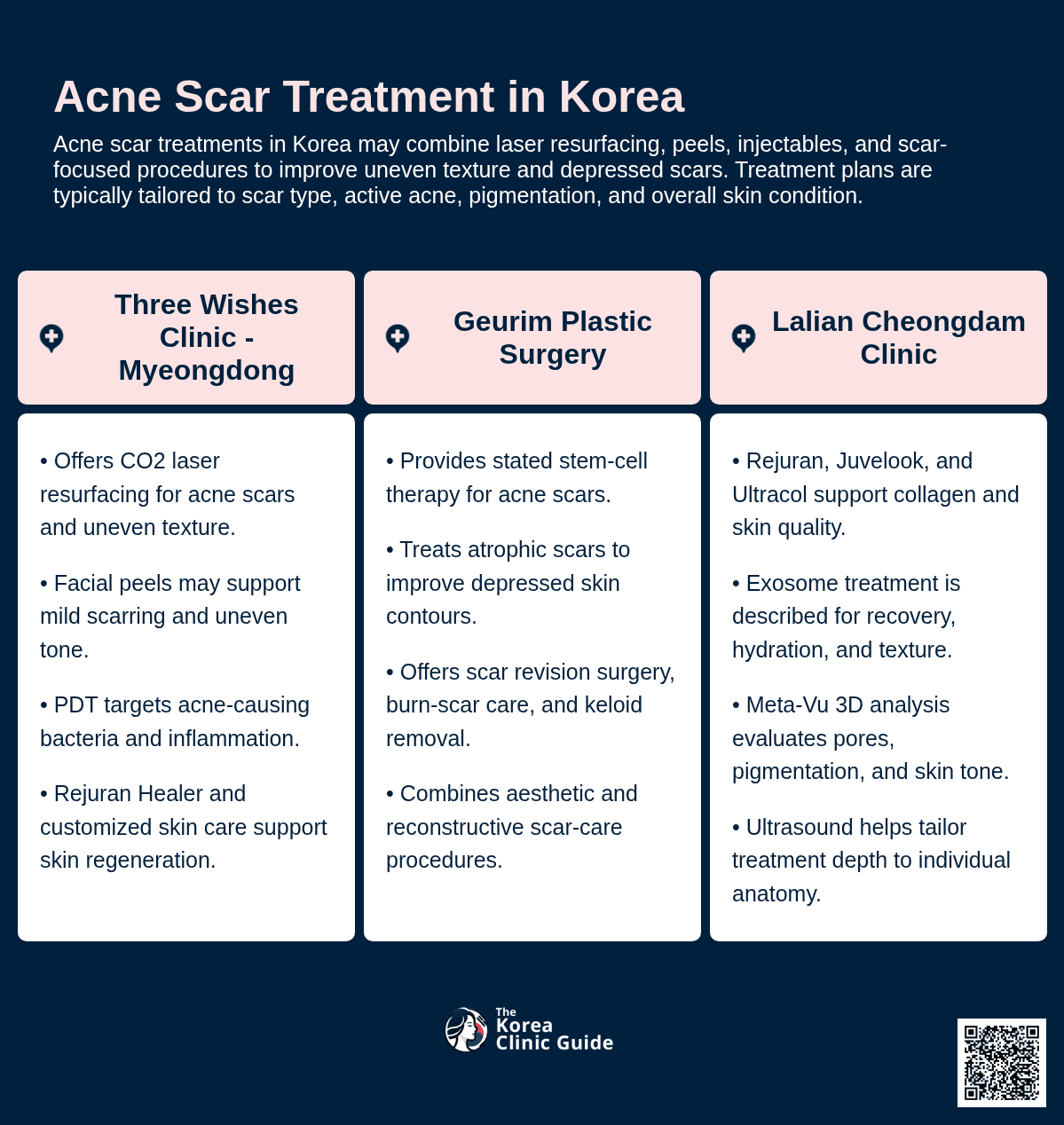
1. Three Wishes Clinic - Myeongdong
For acne-scar concerns, you can consider CO2 laser resurfacing at Three Wishes Clinic - Myeongdong, which removes damaged skin layers and stimulates collagen production to improve scar appearance and overall texture. Your plan may also incorporate treatments suited to related concerns such as active acne, uneven tone, or milder scarring.
- URL: Three Wishes Clinic - Myeongdong Website
- Location: Jung-gu, Seoul
- Acne scar options:
- CO2 laser resurfacing is listed for acne scars, wrinkles, and skin-texture improvement.
- Facial peels exfoliate damaged outer layers and may be used for mild scars and uneven tone.
- PDT acne treatment targets acne-causing bacteria and inflammation, which may be relevant if breakouts remain active.
- Skin-quality support:
- Rejuran Healer is a polynucleotide injection intended to support skin regeneration, texture, and elasticity.
- Customized skin-care treatments include cleansing, hydration, and maintenance-focused care.
2. Geurim Plastic Surgery
You may consider Geurim Plastic Surgery for its stated stem-cell acne-scar therapy and its broader scar-care offering, including treatment for atrophic scars and scar revision surgery. This range may be relevant when you want an assessment that distinguishes depressed acne scars from other types of scar concerns.
- URL: Geurim Plastic Surgery Website
- Location: Seoul
- Scar-focused services:
- Stem-cell acne-scar therapy is listed among the clinic’s specialized procedures.
- Atrophic scar treatment is intended to level depressed scars with the surrounding skin.
- The clinic also lists scar revision surgery, burn-scar treatment, and keloid removal.
- Related reconstructive care:
- Hair transplantation on scars is available to help mask scar tissue in hair-bearing areas.
- The clinic offers both aesthetic and reconstructive procedures.
3. Lalian Cheongdam Clinic
Lalian Cheongdam Clinic may be worth considering when acne scarring is accompanied by uneven texture, visible pores, or reduced skin resilience: its listed skin-repair and collagen-stimulating injectables are oriented toward gradual texture and skin-quality improvement. You can expect individualized planning supported by 3D skin analysis and ultrasound evaluation of soft-tissue layers.
- URL: Lalian Cheongdam Clinic Website
- Location: 2nd floor, Dosan-daero 59-gil, 9, Gangnam-gu, Seoul, South Korea
- Texture and collagen support:
- Rejuran Healer is a PN skin-repair injection used for skin regeneration, texture, pores, and resilience.
- Juvelook combines PDLLA and hyaluronic acid to support gradual improvement in pores, fine lines, and uneven texture.
- Ultracol is a PDO-based collagen booster used to support elasticity and skin density over time.
- Exosome (ASCE+) is described by the clinic as supporting skin recovery, hydration, texture, and irritated-looking skin.
- Treatment planning:
- Meta-Vu 3D skin analysis assesses pores, wrinkles, pigmentation, and skin tone to help plan and track care.
- Ultrasound examination evaluates fat and muscle depth to help tailor treatment depth and approach to your anatomy.
Acne Scar Treatment From Start to Finish
- Remote inquiry and consultation — Send clear makeup-free photographs in consistent front and side lighting, a list of concerns, past procedures, acne medicines, isotretinoin history, allergies, medical conditions, and pigment or keloid history. Ask whether an English-language or virtual consultation is available and request a provisional plan rather than a guaranteed outcome.
- In-person scar assessment — The clinician examines ice-pick, boxcar, rolling, hypertrophic, and keloid scars; checks tethering and volume loss; distinguishes contour scars from red or brown marks; records skin phototype and prior PIH; and takes standardized photographs.
- Treatment design and consent — The plan identifies which scars need focal treatment, release, volume support, resurfacing, or acne control first. Discuss realistic improvement, number and spacing of sessions, downtime, pigment risk, cold-sore prevention where relevant, costs, and what will happen if a complication develops after return home.
- Pre-treatment checks — Staff review medicines and supplements, active acne, sun exposure, pregnancy or breastfeeding status, bleeding risk, infection, and anesthetic or sedation needs. Aggressive treatment should be deferred when the skin is tanned, sunburned, infected, or actively breaking out.
- Anesthesia and skin preparation — The skin is cleansed and photographed if needed. Topical anesthetic is common for microneedling, TCA CROSS, and many laser procedures; injected local anesthetic is common for subcision and punch procedures. Oral sedation is not routine for every case and requires discharge planning.
- Scar-directed treatment — The clinician performs the agreed technique: focal acid placement for TCA CROSS; needle or cannula release for subcision; controlled laser passes for fractional resurfacing; needle or RF-needle passes for microneedling; or focal punch excision/elevation for selected deep scars. More modalities in one visit are not automatically safer or more effective.
- Immediate recovery and discharge — Staff apply clinician-selected ointment, moisturizer, dressing, or sun protection and explain cleansing, pain control, crust care, makeup restrictions, activity limits, and when to return. Outpatient discharge is typical once pain, bleeding, and sedation recovery are satisfactory.
- Early review in Korea — Attend the scheduled review before departure, particularly after subcision, TCA CROSS, punch procedures, or ablative resurfacing. The clinician checks for infection, prolonged swelling, wound problems, and unexpected pigment change.
- Overseas follow-up and result assessment — Send agreed photographs after returning home and arrange local medical care if urgent assessment is needed. Judge stable improvement only after healing and collagen remodeling over several months; repeated treatment is often planned weeks apart.
Alternatives to Acne Scar Treatment
Alternatives depend on the actual problem. Non-surgical options generally involve less downtime but require repeated sessions and do not correct every deep or tethered scar; focal surgery can better address selected deep scars but creates wounds, sutures, and more recovery responsibility.
Atrophic Scar Treatment
For people with depressed scars who need a scar-subtype-specific plan rather than a broad acne-scar label, see atrophic scar treatment.
- Best fit — Predominantly ice-pick, boxcar, or rolling scars.
- Tradeoff — Still commonly uses combinations such as subcision, resurfacing, focal reconstruction, or filler; it is not one single treatment.
Fractional CO2 Laser
Fractional CO2 laser is a resurfacing-focused option for texture and scar edges.
- Best fit — Selected diffuse textural scars and boxcar-scar edges when the skin is suitable for ablative treatment.
- Tradeoff — Stronger resurfacing comes with more pain, visible healing, and pigment risk than lower-downtime approaches. Evidence comparing modalities remains variable, although ablative lasers showed stronger ratings and non-ablative lasers fewer adverse effects in a 2025 meta-analysis of included studies.
RF Microneedling
RF microneedling is a lower-surface-injury collagen-remodeling option.
- Best fit — Diffuse shallow textural scars and patients prioritizing shorter visible recovery.
- Tradeoff — A series is commonly needed, and it does not reliably release tethered rolling scars or remove deep ice-pick scars.
Hypertrophic Scar Treatment
Raised, firm, or keloid-type scars require a different treatment strategy; see hypertrophic scar treatment.
- Best fit — Raised acne scars rather than depressed pits.
- Tradeoff — Intralesional medication, cryotherapy, laser, and carefully selected surgery target excess scar tissue, not volume loss.
Active Acne Treatment
When breakouts are continuing, prioritize acne treatment before extensive scar revision.
- Best fit — Active inflammatory acne, recurring cysts, or ongoing new scar formation.
- Tradeoff — Controlling acne prevents additional scars but does not by itself restore established depressed scars.
How Can I Prepare for Acne Scar Treatment?
- Send a complete medical history — Disclose active acne, prior isotretinoin exposure, cold sores, allergies, diabetes, immune conditions, bleeding or clotting history, past PIH, keloids, pregnancy or breastfeeding, and every prior scar procedure.
- List medicines and supplements — Provide prescription drugs, anticoagulants, antiplatelet medicines, aspirin, NSAIDs, herbal products, fish oil, vitamin E, and acne topicals before booking. Do not independently stop prescribed anticoagulants or antiplatelet medicines; the treating clinician and prescribing doctor must decide whether any change is safe.
- Control acne and protect skin — Arrive without a sunburn, tan, open wound, or active skin infection in the treatment area. Follow the clinic’s instructions on pausing retinoids, benzoyl peroxide, exfoliating acids, and other irritating products; the hold period depends on the procedure and product.
- Plan cold-sore prevention — Report any history of herpes simplex around the lips or face before facial resurfacing. Obtain the clinician’s antiviral prevention plan when indicated.
- Follow fasting instructions exactly — Topical anesthetic treatments often do not require fasting, but oral sedation or a more invasive procedure can. Confirm food, drink, alcohol, and nicotine restrictions in writing.
- Avoid smoking and alcohol — Stop or reduce smoking and avoid alcohol according to the clinician’s schedule because they can complicate healing, bruising, and post-procedure care.
- Arrange recovery logistics — Book accommodation with easy access to the clinic, gentle skincare supplies, and a private place for redness, crusting, or swelling. Schedule flexible travel after ablative laser, subcision, or punch procedures.
- Organize a companion when needed — Bring a responsible adult if oral sedatives, strong pain medicine, extensive subcision, or surgery is planned.
Travel note: Ask for the planned scar diagnosis, exact procedure names, device details where applicable, products, anesthesia plan, and written English aftercare before committing to flights.
Confirm clinic-specific medication holds, fasting, skin preparation, and travel requirements with the treating doctor; individualized instructions take precedence over general guidance.
Aftercare Advice
Protect the healing skin and treat increasing pain, spreading redness, or unexpected swelling as a reason to contact the clinic promptly.
- Cleanse and moisturize as instructed — Use only clinician-approved gentle cleanser, moisturizer, ointment, or dressing. After ablative laser, TCA CROSS, or punch procedures, follow the wound-care schedule exactly and do not scrub.
- Do not pick or exfoliate — Leave TCA CROSS crusts, peeling skin, and healing micro-wounds alone. Restart retinoids, benzoyl peroxide, exfoliating acids, scrubs, and other irritating acne products only when the clinician directs.
- Avoid heat, friction, and intense activity — Follow the treatment-specific restriction on strenuous exercise, sauna, steam rooms, swimming, alcohol, makeup, masks, and helmet friction. These restrictions depend on wound status, injection depth, and treatment intensity.
- Use strict sun protection — Avoid tanning and direct sun. Use broad-spectrum SPF 50 when the clinician says sunscreen is appropriate, plus a hat and shade; this is especially important for preventing or limiting PIH.
- Know urgent warning signs — Seek prompt medical assessment for increasing pain, spreading redness, warmth, pus, fever, blistering, persistent bleeding, a cold-sore outbreak, or marked swelling. Contact the clinic first when possible and use local urgent care if symptoms are severe or rapidly worsening.
- Keep follow-up and judge results slowly — Attend the early review before leaving Korea when scheduled, then send consistent photographs for remote follow-up. Redness and pigment changes can last weeks to months; assess stable contour improvement after healing and collagen remodeling over several months, not during early swelling.
Follow the treating doctor’s instructions over general advice and contact the clinic promptly when anything appears wrong.
Frequently Asked Questions
Related Blogs
Nuviju in Korea: Treatment Process, Recovery, Safety, and Travel Planning
Nuviju is a prescription cholic-acid injection for adults with moderate-to-severe pinchable fat beneath the chin, delivered in a mapped series of preplatysmal-fat injections at least one month apart. The article covers candidacy screening, Korea travel planning, recovery reactions and warning signs, aftercare, and alternatives such as liposuction, neck lift, and deoxycholic acid.
Updated: Oct 13, 2026
Juveacell in Korea: Types, Safety, Recovery, and Travel Planning
Juveacell is a donor-derived hADM skin booster for gradual improvement in hydration, texture, fine lines, pores, elasticity, and dermal density, with 3% and 8% formulations documented by the manufacturer. Learn about candidate screening, injection steps, recovery, aftercare, product verification, and travel planning for treatment in Korea.
Updated: Oct 13, 2026
PRF Injection in Korea: Uses, Evidence, Recovery, and Travel Planning
PRF injections use a patient’s processed blood for facial skin or scalp treatment, typically through a series of superficial injections with short-term redness, swelling, or bruising. International patients should plan 2–3 days in Korea, arrange next-day and remote follow-up, verify the clinic’s processing protocol, and obtain English treatment records and emergency contact details.
Updated: Oct 13, 2026
Milia Under Eyes Treatment: Milia Removal Procedures in Korea for Clearer, Smoother Skin
Discover how Korea leads in safe, effective Milia removal techniques such as manual extraction, electrosurgery, and laser ablation. This blog explores the benefits of choosing Korea for milia treatment, offering advanced technology, skilled dermatologists, and affordable pricing. Perfect for medical tourists seeking quick, professional solutions to benign keratin cysts beneath the eyes and on the
Updated: Oct 12, 2026
Clinics offering Acne Scar Treatment

Cellinique Clinic Korea: Advanced Stem Cell and Laser Treatments for Health, Beauty, and Rejuvenation in Gangnam
Apgujeong

Secret Clinic: Unveiling Advanced Skin and Body Treatments in Seongnam, Korea
Sinnonhyeon Station

Smile Dermatology Clinic in Korea: Personalized Skin Care, Anti-Aging Treatments, and Scar Solutions

Louis Clinic Korea: Premier Aesthetic and Dermatological Solutions in Pangyo
Pangyo