Medical Tourism Blog
Vacuum Therapy in Korea: Methods, Safety, Recovery, and Travel Planning
Table of contents
- Vacuum Therapy at a Glance
- What Is Vacuum Therapy?
- Who Is a Good Candidate for Vacuum Therapy?
- How Is Vacuum Therapy Performed?
- Why Visit Korea for Vacuum Therapy?
- Key Information for International Patients
- Which Are the Best Clinics in Korea for Vacuum Therapy?
- Vacuum Therapy From Start to Finish
- Alternatives to Vacuum Therapy
- How Can I Prepare for Vacuum Therapy?
- Aftercare Advice
Considering treatment in Korea? Everything you need to know e.g. — how to avoid scams, visas, interpreters, recovery tips — in our Medical Tourism Master Guide. Plan with confidence in minutes, not weeks!
Last updated: October 2026
Vacuum Therapy at a Glance
- What it is — External vacuum therapy uses suction, sometimes with motorized rollers, to mobilize skin and superficial tissue for a temporary improvement in cellulite appearance or puffiness; it is not fat removal or weight-loss treatment.
- Best candidates — It may suit adults with mild-to-moderate cellulite or temporary puffiness who want a noninvasive session without incisions, anesthesia, or formal downtime and accept subtle, variable results.
- Results are temporary — Any smoothing or de-puffing can be short-lived, and repeated sessions are commonly proposed; evidence does not establish permanent cellulite removal, reliable inch loss, or durable fat reduction.
- Immediate recovery — Normal walking and routine activity are usually possible right away, but redness, tenderness, swelling, pinpoint bruising, or larger bruises can last from hours to several days.
- Korea travel time — One day is generally enough for an uncomplicated mechanical-only session, but a full course usually requires repeat visits because session number, spacing, and maintenance schedules are not standardized.
- Important safety check — Do not treat unexplained one-sided leg swelling, suspected blood clots, active skin infection, rash, sunburn, or open skin; severe pain, rapidly increasing swelling, chest pain, or shortness of breath needs prompt medical assessment.
- Confirm the exact device — In Korea, ask for the manufacturer, model, MFDS status, added technologies, and operator because “Vacuum Therapy” can mean simple suction massage or a combination with RF, light, cooling, or invasive tissue release, each with different risks and recovery.
What Is Vacuum Therapy?
Vacuum therapy is an external suction massage that lifts and mobilizes skin and superficial tissue, sometimes using rollers. It aims to temporarily smooth the appearance of cellulite or reduce puffiness, rather than remove fat or cause weight loss. It is a non-surgical, noninvasive treatment without incisions or anesthesia.
Who Is a Good Candidate for Vacuum Therapy?
- Mild cellulite or temporary puffiness — Reasonable candidates are adults seeking a subtle, noninvasive change in the appearance of mild-to-moderate thigh, buttock, abdominal, hip, flank, or arm texture.
- Minimal-interruption goal — Standalone external vacuum massage suits people who want no incision, anesthesia, or formal downtime and accept that repeated sessions are often proposed.
- Realistic expectations — The goal is temporary smoothing or de-puffing, not weight loss, permanent fat removal, reliable measurement reduction, or correction of deep fixed dimples.
Avoid treatment over active infection, rash, sunburn, open wounds, ulcers, or inflamed skin. Do not use cosmetic suction massage for unexplained one-sided leg swelling, suspected deep-vein thrombosis, thrombophlebitis, or painful venous disease; these need medical assessment. Pregnancy is a reason to defer elective treatment of the abdomen, pelvis, lower back, and body-contouring areas unless both the obstetric clinician and treating provider approve a limited indication. People with pressure- or vibration-induced urticaria should not have mechanical massage/vibration treatment, and patients with bleeding risk, serious circulatory disease, edema from cardiac or renal disease, impaired sensation, uncontrolled diabetes, active cancer treatment, or recent surgery need an individualized medical review.
How Is Vacuum Therapy Performed?
“Vacuum Therapy” is not one standardized procedure. Confirm the exact manufacturer and model, whether the session is mechanical only or combined with another technology, and the intended use before booking.
- Standalone vacuum or vacuum-roller massage — A negative-pressure handpiece, sometimes with motorized rollers, lifts and mobilizes skin and superficial tissue. This has the least recovery burden, but evidence does not establish durable cellulite correction.
- Vacuum with RF or infrared/light — Combination handpieces add heating or light energy to suction. They are not equivalent to ordinary vacuum massage and introduce energy-related risks including pain, swelling, blisters, burns, pigment change, and scarring, as outlined in FDA guidance on noninvasive body-contouring technologies.
- Vacuum with cooling — Suction can pull tissue into a cryolipolysis applicator. This is fat freezing, not vacuum massage, with a different risk profile and treatment plan.
- Vacuum-assisted tissue release — Some minimally invasive cellulite procedures use vacuum to stabilize tissue while fibrous septae are released beneath selected dimples. This is subcision-type treatment requiring anesthesia, incisions, bruising recovery, and separate travel planning; it should never be presented as a stronger massage.
Why Visit Korea for Vacuum Therapy?
Korea is a practical destination for a standalone external vacuum-massage appointment because it normally does not require sedation, admission, or a prolonged stay. It is not, however, possible to claim that Korean vacuum therapy produces superior results: no reliable Korea-specific comparative trials or registries establish better efficacy, safety, or durability than treatment elsewhere.
- Administrative verification route — For a medical institution serving foreign patients, check registration through Medical Korea’s registered-institution system. Medical Korea states that registered institutions must carry medical-malpractice liability insurance; this is an administrative safeguard, not evidence of superior clinical outcomes.
- Device transparency matters — Ask for the exact device model, its Korean MFDS status and labeled indication, whether energy is added, who performs the session, and who assesses complications. The name “Vacuum Therapy” can cover simple suction massage, roller massage, or multi-modality equipment.
- Evidence-aware treatment selection — FDA guidance describes mechanical massage/vibration as a temporary cellulite-appearance treatment, not fat removal or obesity treatment. A systematic review of 24 randomized cellulite-treatment trials found that no modality was definitively established, with short follow-up and substantial variation between interventions.
Key Information for International Patients
- Minimum stay — One day is generally enough for an uncomplicated standalone external vacuum-massage session without sedation, energy delivery, injections, subcision, or surgery.
- Course planning — A full cosmetic course is unlikely to fit into a short visit because session number, spacing, suction settings, and maintenance schedules are not standardized. Do not prepay for a package based on promises of permanent inch loss, fat loss, or “detoxification.”
- Flights — There is no standardized flight restriction for mechanical vacuum massage alone. Fly when feeling well, but tenderness or bruising can make compression garments, tight clothing, and long-haul sitting uncomfortable.
- Itinerary impact — Normal walking and routine daily activity are usually possible immediately. Redness, tenderness, swelling, pinpoint bruising, or larger bruises can last from hours to several days.
- Added-treatment caution — RF, infrared/light, cooling, ultrasound, injections, subcision, and surgery have separate contraindications, recovery needs, and flight advice. Obtain a revised travel plan when any of these is included.
- Remote follow-up — Leave Korea with the device name, treatment areas, consent, photographs, written aftercare, and a direct contact route for complications. Arrange remote photo review only if the provider offers it.
Travel note: Schedule this treatment before the final part of the trip rather than immediately before a beach, spa, or tightly scheduled long-haul flight, especially when bruising would be inconvenient.
Which Are the Best Clinics in Korea for Vacuum Therapy?
Listed below are some of the best clinics in Korea for vacuum therapy.
1. BongBong Plastic Surgery Dermatology
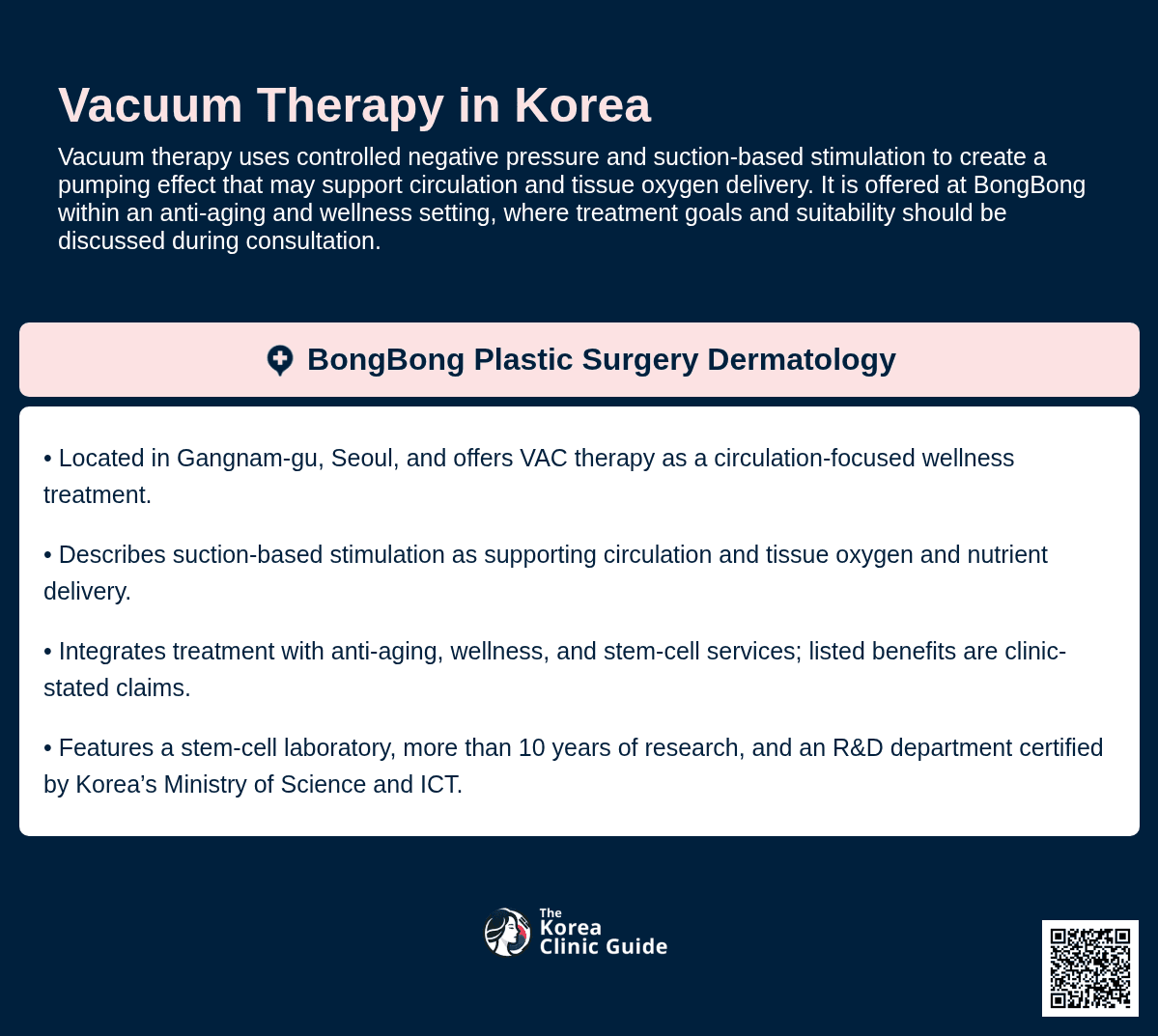
You may consider BongBong Plastic Surgery Dermatology for VAC therapy if you want negative-pressure treatment positioned within an anti-aging and wellness program, particularly alongside the clinic’s stem-cell offerings. The clinic uses VAC therapy to promote circulation through a suction-based pumping effect and states that it can support the circulation of stem cells; ask what outcomes are appropriate for your needs, as wellness and regenerative claims should be discussed in consultation.
- URL: BongBong Plastic Surgery Dermatology Website
- Location: Gangnam-gu, Seoul
- Procedure details:
- VAC therapy is negative-pressure therapy, also called NPWT in wound-care settings; here it is offered as a circulation-focused wellness treatment.
- The clinic describes suction-based stimulation as creating a pumping effect intended to support circulation and tissue oxygen and nutrient delivery.
- The clinic lists anti-aging, cell-regeneration, detoxification, collagen, immunity, and fatigue-related benefits; these are clinic-stated claims rather than guaranteed results.
- Stem-cell setting:
- The clinic has its own stem-cell laboratory and reports more than 10 years of stem-cell research.
- Its R&D department is certified by the Korean Ministry of Science and ICT.
- Dr. Sung Soo Park, a board-certified plastic surgeon, directs the clinic’s Basic Cell Research Institute.
- Additional notes:
- Dr. Jongmin Lee directs the Anti-Aging & Immune Center and is a board-certified rehabilitation medicine specialist and team doctor for Korean national athletes.
- The available information does not confirm which clinician performs VAC therapy, so verify your treating doctor, treatment plan, and whether VAC therapy is being recommended with any stem-cell service.
Vacuum Therapy From Start to Finish
- Send a precise inquiry — Ask whether English communication or a virtual consultation is available. Provide the target area, clear unfiltered photographs only when requested, prior procedures, medical history, allergies, pregnancy status, and a complete medicine and supplement list.
- Confirm what is being booked — Obtain the manufacturer and model, whether the handpiece is suction/rollers only or includes RF, infrared/light, cooling, or another technology, the proposed endpoint, session plan, total cost, and written cancellation terms.
- Attend the in-person assessment — The provider inspects the skin and distinguishes cellulite from localized fat, loose skin, venous disease, lymphedema, postoperative swelling, or another medical issue. Healthy patients undergoing simple external massage do not routinely need laboratory testing; clotting risk, systemic illness, vascular symptoms, recent surgery, or unexplained swelling can require medical clearance.
- Review consent and photographs — Discuss the expected temporary and variable effect, bruising risk, alternatives, and warning signs. Take standardized baseline photographs in consistent lighting and posture when objective comparison is planned.
- Undergo treatment — No anesthesia, fasting, or sedation is normally needed for standalone mechanical treatment. The handpiece passes over the planned area, sometimes over a hygienic body suit; pulling, rolling, pressure, warmth, and discomfort are common sensations. Duration and settings are device- and area-specific rather than internationally standardized.
- Leave after immediate assessment — Standalone treatment usually permits walking out immediately without admission, prescription medicine, or an escort. This changes completely if an injectable, energy device, sedation, subcision, or surgery is added.
- Monitor and document recovery — Follow the clinic’s device-specific instructions, photograph bruising or other changes if requested, and avoid booking additional treatment to manage unexpected pain or swelling.
- Complete remote follow-up — Contact the clinic through its stated route for planned review or concerning symptoms. Seek local in-person care rather than waiting for remote advice when symptoms are severe, escalating, or suggest a vascular emergency.
Alternatives to Vacuum Therapy
The right alternative depends on whether the main concern is temporary puffiness, localized fat, loose skin, or fixed cellulite dimples. Noninvasive options generally involve less recovery but less predictable or durable change; invasive procedures can target selected structural problems more directly but require meaningful recovery and travel time.
Lymphatic Drainage Massage
- Best fit — Consider lymphatic drainage massage for short-term comfort or de-puffing rather than durable correction of structural cellulite.
- Tradeoff — It does not release the fibrous septae that create many cellulite dimples.
Shock-Wave Therapy
- Best fit — Shockwave therapy for fat dissolving is a noninvasive discussion option for cellulite appearance or body-contour concerns.
- Tradeoff — Some trials support acoustic-wave approaches, but protocols and durability remain variable.
Cryolipolysis
- Best fit — CoolSculpting targets selected localized fat bulges rather than temporary fluid-related texture changes.
- Tradeoff — Fat volume and cellulite tethering are different problems; reducing fat does not reliably remove fixed dimples.
Fat-Dissolving Injections
- Best fit — Fat-dissolving injection can be discussed for selected localized-fat concerns.
- Tradeoff — It is not an established treatment for cellulite tethering and has injection-specific swelling and complication risks.
Liposuction or Tissue Release
- Best fit — Thigh liposuction treats localized fat volume, while subcision-type tissue release can be more relevant for selected dimples visible at rest.
- Tradeoff — Both are invasive choices with different risks, recovery, and travel restrictions. Vacuum massage is not a substitute for either procedure.
How Can I Prepare for Vacuum Therapy?
- Identify the device first — Confirm whether the treatment is mechanical suction/rollers only or includes RF, infrared/light, cooling, ultrasound, injections, or an invasive add-on. Each additional modality changes preparation requirements.
- Disclose medicines and supplements — Provide all prescriptions, over-the-counter medicines, vitamins, and supplements. Specifically list anticoagulants, antiplatelet drugs, NSAIDs, systemic corticosteroids, fish oil/omega-3, vitamin E, garlic, ginkgo, and any history of easy bruising or bleeding.
- Do not stop prescribed medication independently — The prescribing clinician, not a cosmetic provider alone, must decide whether any anticoagulant or antiplatelet change is safe.
- Eat normally for mechanical-only treatment — Fasting is not normally required without sedation. Eat and hydrate as usual unless the clinic gives a device-specific instruction.
- Protect the treatment area — Arrive with clean, intact skin. Postpone treatment for sunburn, irritated tanning, rash, infection, open skin, severe exfoliant irritation, or a recent procedure unless the treating clinician clears the area.
- Plan comfortable transport — Wear loose clothing and avoid a tightly compressed garment over an area likely to feel tender or bruised. Arrange flexible travel if a combination treatment could produce visible bruising or discomfort.
- Avoid alcohol and smoking when instructed — Mechanical-only treatment has no universal alcohol or smoking stop period, but follow the clinic’s instructions, especially when energy treatment, injections, subcision, or surgery is planned.
Travel note: Do not schedule a standalone session immediately before a long-haul flight if bruising, tenderness, or tight clothing would be difficult to manage.
Confirm the clinic’s exact device-specific requirements and follow the treating doctor’s individualized instructions over general guidance.
Aftercare Advice
Protect the treated area from further trauma and treat unexpected symptoms as a medical issue, not a reason for more cosmetic massage.
- Normal activity — Walk and resume routine daily activity immediately after uncomplicated mechanical treatment. Avoid strenuous exercise while the area is painful or bruised.
- Avoid pressure and aggressive treatments — Do not use cupping, aggressive massage, abrasive body treatments, or other high-pressure contact on a tender or bruised area until comfortable, unless the treating clinician gives different instructions.
- Manage visible effects — Redness, mild swelling, tenderness, petechiae, and bruising can occur and may last hours to several days. Wear loose clothing and take consistent photographs rather than judging effectiveness from immediate post-treatment swelling or fluid movement.
- Sun and heat precautions — Avoid direct sun on irritated skin; use SPF 50 on exposed treated areas. Follow stricter heat and sun restrictions when RF or light-based technology was used.
- Warning signs — Seek prompt in-person assessment for severe or increasing pain, extensive bruising, blistering, skin breakdown, spreading redness or warmth, fever, persistent numbness, weakness, or rapidly increasing swelling. Seek urgent emergency care for new one-sided calf swelling or pain, chest pain, fainting, or shortness of breath.
- Results review — Any apparent smoothing is often temporary. Review results only after the agreed course using consistent photographs; FDA guidance notes that body-contouring responses vary and results can be temporary.
Follow the treating doctor’s instructions and contact the clinic promptly when anything appears wrong.
Frequently Asked Questions
Related Blogs
Discover the Global Lip Reduction Cost: How Korea Competes with the USA, Turkey, and More
Explore the costs and factors influencing lip reduction surgery in Korea, a popular destination for cosmetic procedures. Discover what to expect in terms of pricing, quality, and the overall experience of undergoing this transformative surgery abroad.
Updated: Oct 21, 2026

Discover Why Protruding Ear Surgery in Korea Offers Unmatched Value Compared to Global Alternatives
Discover the cost and benefits of protruding ear surgery in Korea, where skilled surgeons offer advanced techniques at competitive prices. This article breaks down the expenses, procedure details, and why Korea is a sought-after destination for this cosmetic enhancement.
Updated: Oct 21, 2026

Korea's Competitive Edge: Comparing Global Costs and Care Standards for Cleft Lip Surgery
Discover the affordability and quality of cleft lip surgery in Korea, a leading destination for medical tourists seeking advanced healthcare solutions. Explore how competitive pricing and expert medical care make it an attractive option for international patients.
Updated: Oct 21, 2026
Navigating Bromidrosis Treatment Costs: A Global Perspective with a Focus on Korea's Advanced Options
Bromidrosis, a condition causing unpleasant body odor, is becoming a costly health concern in Korea. Explore the economic impacts and treatment options available to manage this growing issue in the region.
Updated: Oct 21, 2026