
Medical Tourism Blog
Redness Treatment in Korea: Lasers, IPL, Recovery and Travel Planning
Table of contents
- Redness Treatment at a Glance
- What Is Redness Treatment?
- Who Is a Good Candidate for Redness Treatment?
- How Is Redness Treatment Performed?
- Why Visit Korea for Redness Treatment?
- Key Information for International Patients
- Which Are the Best Clinics in Korea for Redness Treatment?
- Redness Treatment From Start to Finish
- Alternatives to Redness Treatment
- How Can I Prepare for Redness Treatment?
- Aftercare Advice
Considering treatment in Korea? Everything you need to know e.g. — how to avoid scams, visas, interpreters, recovery tips — in our Medical Tourism Master Guide. Plan with confidence in minutes, not weeks!
Last updated: October 2026
Redness Treatment at a Glance
- Diagnosis-led treatment — Redness treatment is a category, not one procedure: vascular laser or IPL may treat rosacea-related redness, visible vessels, red acne marks, or selected scars, but dermatitis, active acne, ocular rosacea, and suspicious lesions need different medical assessment or care.
- Usually a treatment series — Improvement is gradual and commonly requires multiple sessions; rosacea studies often schedule treatments about 3–8 weeks apart, and treated vessels or background redness can recur, so maintenance and medical rosacea care may still be needed.
- Short recovery, possible bruising — Most laser or IPL sessions cause warmth, redness, mild swelling, tenderness, or itch for hours to several days, with no medical downtime; purpuric pulsed-dye laser intentionally causes pinpoint red-purple bruising that can remain visible for 1–2 weeks.
- Results after healing — Response should be assessed after the skin settles and usually after the planned series rather than on treatment day; no device is proven best for every redness diagnosis, skin tone, vessel depth, or pigment-risk profile.
- Pigment and burn risk — Burns, blisters, prolonged redness, pigment lightening or darkening, and flares are uncommon but important risks, especially after recent sun exposure or in pigment-prone skin; conservative settings and sometimes a test spot are appropriate for Fitzpatrick IV–VI skin, melasma, vitiligo, or prior pigment changes.
- Allow time in Korea — For one uncomplicated session, plan a consultation/treatment day and remain in Korea for 24–48 hours for review of significant swelling or an unexpected reaction; do not schedule treatment immediately before a long-haul flight, and a full series generally requires later visits or local follow-up.
- Korea-specific consideration — Korea offers access to vascular lasers and IPL, but there is no credible evidence of superior nationwide outcomes; verify Korean dermatology-specialist status through the Association of Korean Dermatologists directory and choose a clinician based on diagnosis and skin type, not device branding alone.
What Is Redness Treatment?
Redness treatment is a diagnosis-led skin care category that uses vascular laser, intense pulsed light, or medical therapy to address persistent redness and visible small vessels. It aims to reduce facial or localized redness, improve the appearance of vessels or red acne marks, and support control of conditions such as rosacea. It is non-surgical, usually performed in an outpatient setting without incisions.
Who Is a Good Candidate for Redness Treatment?
- Stable vascular redness — Good candidates have diagnosed persistent facial erythema, facial telangiectasia (visible small vessels), post-acne red marks, selected red scars, or localized vascular lesions.
- Rosacea with visible vessels — Laser or IPL can improve background redness and surface vessels as part of rosacea care; they do not replace treatment for every rosacea mechanism. The American Academy of Dermatology’s rosacea guidance describes light and laser therapy as particularly useful for visible vessels or thickened skin.
- Realistic treatment-course expectations — Suitable patients accept that improvement is usually gradual, often requires multiple sessions, and does not permanently cure rosacea, recurrent flushing, or newly forming vessels.
- Reliable sun protection — Candidates can avoid tanning and sunburn and follow strict broad-spectrum SPF 50 protection after treatment.
Undiagnosed persistent redness, a changing pigmented lesion, or a possible skin cancer requires medical assessment before cosmetic treatment. Defer treatment for active infection, open wounds, an active cold-sore outbreak, severe dermatitis, or a major inflammatory flare in the target area. Pregnancy and breastfeeding are common reasons to postpone this elective treatment because procedure-specific safety evidence is limited. Fitzpatrick skin types IV–VI, melasma, vitiligo, or a history of abnormal scarring or pigment change are not automatic exclusions, but require conservative settings, careful counseling, and sometimes a test spot. Photosensitizing medicines and supplements, including doxycycline or other tetracyclines, hydrochlorothiazide, amiodarone, voriconazole, oral retinoids, and St John’s wort, need review by the prescribing clinician and dermatologist. Do not stop prescribed aspirin, clopidogrel, warfarin, apixaban, or other blood-thinning medicine independently.
How Is Redness Treatment Performed?
Treatment starts with the cause of redness, not a device menu. Wavelength, energy, pulse duration, cooling, and number of sessions are individualized according to vessel depth, skin tone, pigment-change risk, diagnosis, and recent sun exposure.
- Pulsed-dye laser (PDL; 585–595 nm) — A hemoglobin-targeting vascular laser for diffuse erythema and telangiectasia. Non-purpuric settings aim to limit bruising; purpuric settings intentionally produce pinpoint red-purple bruising and longer visible recovery. PDL has the most established light-based rosacea evidence, although no device is proven best for every patient.
- Intense pulsed light (IPL) — Filtered broad-spectrum light, not a laser. IPL can address diffuse redness, flushing, vessels, and coexisting photodamage or pigmentation. A systematic review of rosacea IPL studies found improvement in erythema and telangiectasia in most studies, but device settings and study quality varied substantially.
- KTP 532-nm laser — A superficial vascular laser used for redness and small vessels. In a 2024 controlled study, both KTP and PDL improved erythema after one to three sessions; KTP caused less reported pain and fewer reactions, while PDL was associated with purpura. Six-week follow-up cannot establish long-term superiority.
- Long-pulsed Nd:YAG 1064 nm — Used when vessels are larger or deeper. In a small split-face trial, both Nd:YAG and non-purpuric PDL improved diffuse erythema in skin types I–III; PDL reduced redness more, while Nd:YAG was less painful.
- Post-acne erythema protocols — Red acne marks are not the same condition as rosacea. A small 2025 split-face trial found improvement after six biweekly sessions of delicate pulsed light or low-energy Q-switched 1064-nm Nd:YAG, but skin type, active acne, scars, and hyperpigmentation still determine selection.
- Medical or focal vessel treatment — Brimonidine gel or oxymetazoline cream can temporarily reduce persistent rosacea color. Electrodesiccation is an option for selected isolated vessels; papules, pustules, ocular symptoms, dermatitis, and autoimmune disease require diagnosis-specific medical care.
Why Visit Korea for Redness Treatment?
Korea offers access to dermatology specialists and clinics using vascular lasers and IPL for rosacea-associated redness, visible vessels, and pigment-sensitive skin concerns. The practical advantage is access and choice, not a proven national outcome advantage. Device branding alone does not establish that a treatment is appropriate for the diagnosis or skin type.
- Specialist verification — International patients can use the Association of Korean Dermatologists’ public directory to verify whether a physician is a Korean dermatology specialist. The association states that specialty training includes internship, four years of dermatology residency, and a Ministry of Health and Welfare specialist examination.
- Established device use — A 2025 survey of 25 board-certified Korean dermatologists found frequent use of PDL and IPL for rosacea, while also identifying practice gaps around sensitive skin, pigmentary complications, and phenotype-led treatment selection.
- Diagnosis-led planning — A dermatology consultation can distinguish rosacea, post-acne erythema, dermatitis, scar redness, and vascular lesions before treatment. This matters because the same red appearance can need entirely different therapy.
- Evidence limitation — No credible evidence shows that Korea has superior redness-treatment outcomes nationwide. Comparative studies across devices remain limited by small samples, variable protocols, short follow-up, and insufficient data for darker skin types; a 2026 network meta-analysis found most included rosacea trials had unclear or high risk of bias.
Key Information for International Patients
- Minimum stay — Schedule a consultation and treatment day, then remain in Korea for 24–48 hours after an uncomplicated vascular laser or IPL session so significant swelling, blistering, or an unexpected reaction can be reviewed.
- Course planning — A full treatment course rarely fits a short visit. Rosacea studies commonly use sessions about 3–8 weeks apart, depending on the device and target; examples include four 4-weekly sessions and one to three sessions 6–8 weeks apart in comparative trials.
- Flight timing — No procedure-specific evidence establishes a universal safe flying interval after vascular laser or IPL. Do not book treatment immediately before a long-haul flight. Obtain clinician clearance based on swelling, purpura, complications, treated area, and the ability to get follow-up care at home.
- Itinerary impact — Most non-purpuric sessions have no medical downtime, but warmth, redness, swelling, tenderness, or itch can last hours to several days. Purpuric PDL can leave visible pinpoint bruising for about 1–2 weeks.
- Activity restrictions — Avoid direct sun, sauna, hot baths, swimming, strenuous exercise, alcohol, and personal flushing triggers while the skin is reactive. Plan indoor, low-heat activities for the first day or two.
- Remote follow-up — Arrange a secure way to send dated, well-lit photos to the clinic. Seek local in-person care promptly for blistering, worsening pain, pus, fever, eye pain, or visual symptoms.
Travel note: Bring a complete medication and supplement list, previous laser records if available, and photographs showing redness during a typical flare. A single consultation photo can underestimate intermittent flushing.
Which Are the Best Clinics in Korea for Redness Treatment?
Listed below are some of the best clinics in Korea for redness treatment.
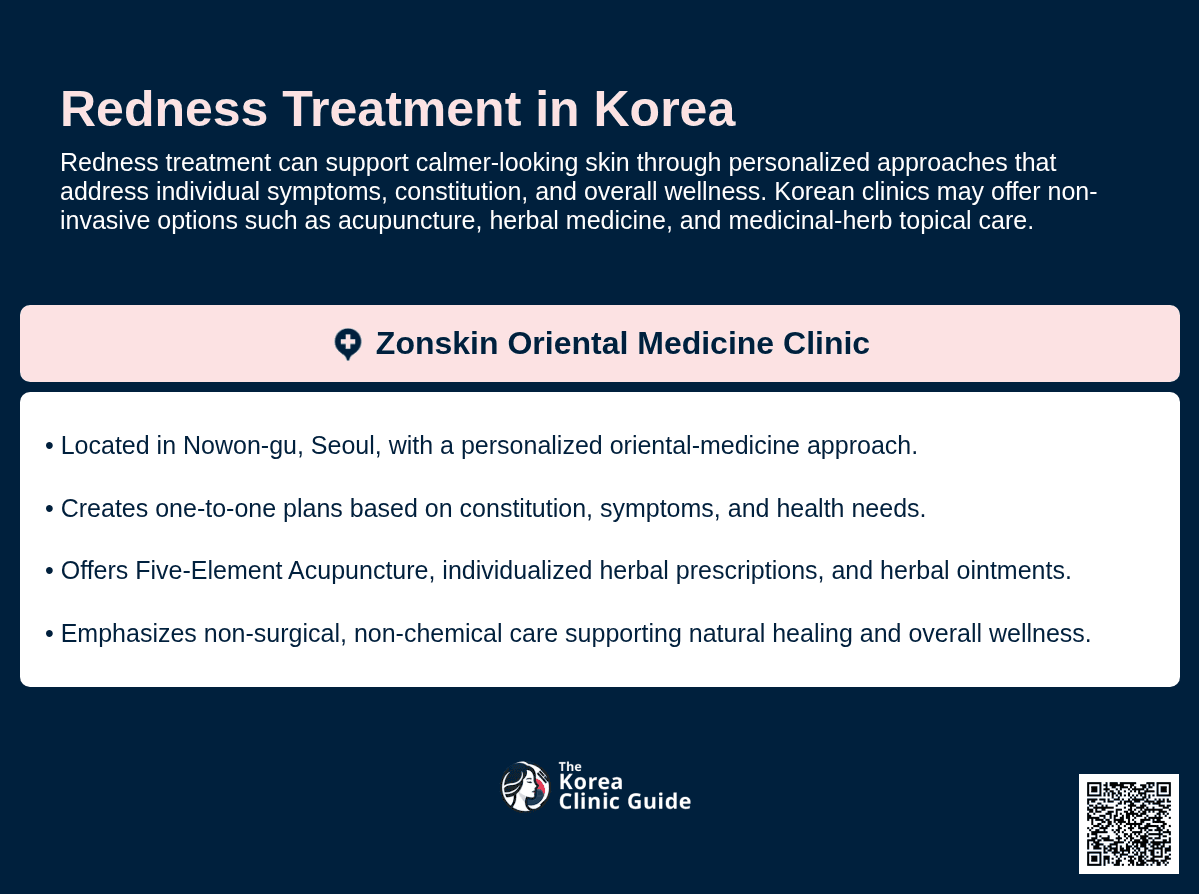
1. Zonskin Oriental Medicine Clinic
For redness concerns, Zonskin Oriental Medicine Clinic takes a personalized, non-invasive oriental-medicine approach that may combine constitution-based acupuncture, herbal medicine, and herbal topical care rather than surgical or artificial treatments.
- URL: Zonskin Oriental Medicine Clinic Website
- Location: Nowon-gu, Seoul
- Approach to care:
- Your plan is designed one-to-one around your individual constitution and health needs.
- The clinic emphasizes supporting the body’s natural healing processes and addressing underlying causes rather than symptoms alone.
- Its stated philosophy is non-surgical, non-chemical, and non-artificial care.
- Available treatments:
- Five-Element Acupuncture is tailored to your symptoms and intended to restore balance.
- Individualized herbal prescriptions may be provided as traditional preparations or in capsule form for daily convenience.
- Medicinal-herb ointments are available as topical treatments for skin conditions and are formulated to work with the body’s natural processes.
- Wellness perspective:
- Care integrates health-focused treatment with aesthetic and wellness considerations.
- The clinic frames outward appearance as connected to overall health and offers care with both in mind.
Redness Treatment From Start to Finish
- Initial contact and virtual review — Send clear makeup-free photographs, state whether redness is fixed or episodic, and disclose rosacea, acne, dermatitis, cold sores, pigment changes, medicines, supplements, and prior laser or IPL reactions. Confirm whether English consultation or interpretation is available.
- In-person diagnosis — The clinician examines the skin, reviews triggers and medical history, and determines whether the concern is vascular redness, post-acne erythema, rosacea, dermatitis, a scar, or another condition. Suspicious or changing lesions require diagnostic assessment rather than cosmetic device treatment.
- Treatment plan and consent — The clinician explains the proposed device, target area, expected number and interval of sessions, chance of purpura, pigment-change risk, and medical treatment needed alongside device care. A conservative test spot can be appropriate for pigment-prone or reactive skin.
- Pre-treatment setup — Remove makeup and skincare as directed. The team takes photographs, provides protective eyewear, and applies cooling. Topical anesthetic is optional; PDL pulses are commonly compared with a rubber-band snap.
- Laser or IPL delivery — The clinician delivers controlled pulses across diffuse redness or directly to visible vessels. Treatment is outpatient and commonly takes minutes to about 30 minutes, depending on the area and whether other treatments are combined.
- Immediate cooling and discharge — Cooling, a bland moisturizer, and sun-protection instructions are provided. Most patients leave the same day without sedation or fasting requirements.
- Early recovery review — Expect temporary warmth, redness, mild swelling, tenderness, or itch. With purpuric PDL, bruised pinpoint spots can persist for 1–2 weeks; post-treatment redness can take up to two weeks to settle.
- Overseas follow-up and maintenance — Send requested photographs after healing, follow the diagnosis-specific medication plan, and arrange future sessions locally or during a later Korea visit. Results should be judged after healing and usually after the planned series, not immediately after one session.
Alternatives to Redness Treatment
Alternatives depend on the diagnosis. Non-surgical options are appropriate for most redness concerns, but they trade the targeted vessel reduction of vascular light treatment for temporary color control, disease management, or treatment of a different underlying cause. Thickened phymatous rosacea is a separate problem and can require resurfacing or surgery rather than standard vascular laser treatment.
Rosacea Medical Therapy
- Persistent color control — Brimonidine gel or oxymetazoline cream can temporarily constrict superficial vessels and reduce persistent redness; effects are temporary rather than curative.
- Inflammatory or ocular disease — Papules, pustules, and eye symptoms require phenotype-specific topical, oral, or ophthalmic treatment. The AAD notes that rosacea management is tailored to signs and symptoms.
Electrodesiccation
- Best use — A clinician uses electrical energy to treat selected isolated visible vessels.
- Tradeoff — This is less suitable than diffuse-light treatment for widespread background erythema and still carries crusting and pigment-change risk.
Pulsed-Dye Laser
- Focused vascular option — PDL/V-Beam laser is a vascular-laser approach for redness and telangiectasia.
- Tradeoff — It can be highly targeted but purpuric settings create obvious bruising and more social downtime.
IPL
- Broader-field option — IPL can be considered for diffuse redness with photodamage or pigmentation.
- Tradeoff — IPL is not interchangeable across machines or settings; baseline pigmentation, ultraviolet exposure, and fluence influence adverse reactions, as shown in a controlled IPL study.
Acne-Focused Treatment
- When active acne drives red marks — Treat active acne first or alongside erythema management with acne treatment.
- Tradeoff — Treating acne reduces new inflammatory marks but does not automatically erase established red post-acne erythema or scars.
How Can I Prepare for Redness Treatment?
- Confirm the diagnosis — Do not book a device based solely on “redness.” Report flushing, burning, itching, acne, scaling, eye symptoms, new lesions, and prior reactions so the clinic can determine whether treatment should be delayed or redirected.
- Avoid ultraviolet exposure — Avoid tanning and sunburn before treatment. Use broad-spectrum SPF 50 and physical sun protection; recent ultraviolet exposure increases burn and post-inflammatory pigment-change risk.
- Disclose medicines and supplements — Provide a complete list well before the appointment, including doxycycline/tetracyclines, hydrochlorothiazide, amiodarone, voriconazole, oral retinoids, St John’s wort, anticoagulants, antiplatelets, and prior photosensitivity. Do not independently stop prescribed blood thinners or other medication.
- Pause irritating skincare only when directed — The clinic may ask for a temporary pause of retinoids, exfoliating acids, benzoyl peroxide, scrubs, or other irritating products. Use a gentle cleanser and bland moisturizer instead.
- Arrive with clean skin — Attend without makeup if requested and tell the clinician about cold sores, active dermatitis, infection, open skin, or a rosacea flare. Reschedule active infection or severe inflammation.
- Avoid flushing triggers — Skip alcohol and personal triggers on treatment day, especially with rosacea-prone skin.
- Plan transport and timing — Routine fasting and an escort are unnecessary for topical vascular laser or IPL without sedation. Arrange flexible plans if treating a visible area, particularly when purpura is intended.
Travel note: Schedule treatment early enough to allow 24–48 hours in Korea afterward and avoid a long-haul flight while the treated skin is swollen, blistered, or newly bruised.
Confirm the treating clinic’s individualized medication, skincare, sun-avoidance, and travel requirements; these instructions take precedence over general guidance.
Aftercare Advice
Protect the treated skin from heat, friction, ultraviolet exposure, and unnecessary active products while it heals.
- Cool and calm the area — Use cool compresses as directed. Cleanse gently and apply a bland moisturizer; do not scrub, exfoliate, pick, or peel flaking skin.
- Avoid heat and flushing — Avoid direct sun, sauna, hot baths, swimming, strenuous exercise, alcohol, and known flushing triggers until redness and swelling have settled.
- Use strict sun protection — Apply broad-spectrum SPF 50 and use hats or shade. Ultraviolet exposure increases pigmentary risk after IPL and laser treatment.
- Expect the planned reaction — Mild warmth, redness, swelling, tenderness, or itch usually settle within hours to several days. Purpuric PDL causes intentional pinpoint bruising that can remain visible for 1–2 weeks.
- Watch for complications — Contact the clinic promptly for escalating pain, extensive swelling, blisters, crusting or weeping, pus, fever, widespread darkening or lightening, eye pain, or visual symptoms. Seek local urgent medical care if the clinic cannot assess a severe reaction quickly.
- Assess results after healing — Do not judge the final response on the treatment day. Compare standardized photographs after healing and follow the agreed session interval; rosacea and recurring vascular redness often need maintenance and medical management.
Follow the treating doctor’s instructions over general advice and contact the clinic when anything appears wrong.
Frequently Asked Questions
Related Blogs
Comparing Global Costs of Pico Fraxel: Why Korea is a Top Choice for Skin Rejuvenation Without Compromise
Discover the affordability of Pico Fraxel laser treatments in Korea, where cutting-edge technology meets competitive pricing. Explore why many are choosing Korea for their skincare journey and how it compares to global costs.
Updated: Oct 21, 2026
Optimize Your Wellness: See Why Vitamin Injections in Korea Offer Value Beyond Costs Compared to the USA & More
Discover the latest trends in the cost of vitamin injections in Korea, exploring factors affecting pricing and popular clinics. Learn how these wellness treatments can boost your energy and overall health.
Updated: Oct 21, 2026
Laser Tattoo Removal Costs: Is Korea Your Best Option Compared to the USA, Turkey, and Beyond?
Discover the factors influencing the cost of laser tattoo removal in Korea, from technology and expertise to session frequency. Explore why Korea is becoming a popular destination for this effective and advanced cosmetic procedure.
Updated: Oct 21, 2026
Unlock Radiant Skin: Comprehensive Cost Analysis of Steroid Injections for Scars in Korea vs USA, Turkey & More
Explore the cost of steroid injections for scars in Korea, a popular cosmetic procedure aimed at minimizing the appearance of scar tissue. This article breaks down the pricing, factors influencing cost, and potential savings compared to other countries.
Updated: Oct 21, 2026
