
Medical Tourism Blog
Liftera Lifting in Korea: HIFU Methods, Results, Recovery, Risks and Travel Planning

Table of contents
- Liftera Lifting at a Glance
- What Is Liftera Lifting?
- Who Is a Good Candidate for Liftera Lifting?
- How Is Liftera Lifting Performed?
- Why Visit Korea for Liftera Lifting?
- Key Information for International Patients
- Which Are the Best Clinics in Korea for Liftera Lifting?
- Liftera Lifting From Start to Finish
- Alternatives to Liftera Lifting
- How Can I Prepare for Liftera Lifting?
- Aftercare Advice
Considering treatment in Korea? Everything you need to know e.g. — how to avoid scams, visas, interpreters, recovery tips — in our Medical Tourism Master Guide. Plan with confidence in minutes, not weeks!
Last updated: September 2026
Liftera Lifting at a Glance
- What it does — Liftera Lifting is a noninvasive focused-ultrasound (HIFU/MFU) treatment that aims for gradual tightening of mild-to-moderate facial or neck laxity, including the jawline, cheeks, submental area, and upper neck.
- Best candidates — It is best suited to people with early-to-moderate laxity, intact skin, adequate facial volume, and realistic expectations for subtle-to-modest tightening rather than a dramatic lift.
- Results timeline — Collagen-remodeling changes develop gradually over about 2–3 months, so the immediate appearance is not the final result; Liftera-specific durability and ideal maintenance intervals have not been independently established.
- Recovery — There is usually no formal downtime, but redness, warmth, tenderness, tingling, or aching may occur; some people report muscle-ache-like discomfort or altered sensation for 1–2 weeks.
- Important limitation — Liftera cannot remove excess skin, reliably correct pronounced jowls or neck bands, restore lost cheek or temple volume, or produce the tissue repositioning of a surgical facelift.
- Korea travel plan — International patients should plan 2–3 days in Korea, keeping at least the day after treatment free and allowing a practical 24–48-hour buffer before a long-haul flight.
- Korea-specific check — Because Liftera is a Korean-made device family, confirm the exact model—such as Liftera-V or Liftera-A—and request a written record of the applicator, treatment areas, depths, energy settings, and shot or pulse count.
What Is Liftera Lifting?
Liftera Lifting is a noninvasive focused-ultrasound treatment that delivers targeted energy to tighten selected facial and neck tissues. It addresses mild to moderate skin laxity around the cheeks, jawline, under-chin area, and upper neck, with gradual, modest improvement rather than a facelift-level change. It is a non-surgical procedure performed without incisions or skin removal.
Who Is a Good Candidate for Liftera Lifting?
- Early-to-moderate laxity — Good candidates want gradual tightening of mild lower-face, jawline, cheek, submental, or upper-neck laxity rather than a dramatic lift.
- Adequate facial volume — Candidates have sufficient soft-tissue volume and do not expect ultrasound tightening to replace lost cheek or temple volume.
- Intact, settled skin — The planned area is free of sunburn, dermatitis, open wounds, active infection, and herpes lesions.
- Realistic treatment goal — Candidates understand that Liftera is a noninvasive microfocused/high-intensity focused ultrasound treatment, not a surgical SMAS facelift; it does not remove excess skin or reliably correct pronounced jowls, neck bands, or major tissue descent.
Pregnancy is a reason to defer elective treatment, while breastfeeding requires an individual review because Liftera-specific guidance and robust device-specific evidence are limited. A public Liftera-V consent document lists pacemakers, implanted defibrillators, gold threads, and embedded metal as exclusions; implant location, device model, and the planned ultrasound path require a model-specific assessment, even where dental work is considered acceptable under that clinic's protocol. Recent threads, facial surgery, fillers, fat grafting, resurfacing, or energy treatment need coordinated sequencing, and poorly controlled diabetes or impaired wound healing requires medical review. Marked volume depletion, very thin facial tissue, and severe laxity are poor aesthetic fits because broader MFU/HIFU evidence supports treatment principally for mild-to-moderate laxity, with substantial variation between devices and protocols documented in a recent evidence review.
How Is Liftera Lifting Performed?
Liftera is a device family rather than one fixed protocol. Confirm the exact model, applicator, depth, treatment map, energy settings, pulse or shot count, operator, and whether the unit offers real-time ultrasound visualization.
- Depth-based treatment planning — Liftera-A technical material describes 1.5 mm, 3.0 mm, and 4.5 mm facial applicators. The clinician selects depth according to skin and fat thickness, volume distribution, treatment area, prior procedures, and nearby vulnerable anatomy; deeper energy is not automatically better according to the Liftera-A technical brochure.
- Pen or moving delivery — Liftera-A has a pen applicator designed for contact over curved or smaller areas. This can be useful for contour-following treatment but is a handling feature, not evidence of superior lifting outcomes.
- Line delivery — A line cartridge treats broader mapped sections of the face or neck. Applicator choice should follow anatomy and the treatment plan, not a promise based on shot count.
- Area-specific mapping — Cheeks, lower face, jawline, submental area, neck, brow region, and fine-line areas require different no-treatment zones and depth choices. Existing asymmetry, implants, scars, volume loss, and previous filler or thread placement should alter the map.
- Evidence limitation — No independent peer-reviewed trial or cohort study was identified that reports facial-laxity outcomes separately for Liftera-V, Liftera-A, or Liftera-A2. General HIFU findings cannot establish Liftera-specific ideal settings, maintenance intervals, pain levels, durability, or superiority over other devices.
Why Visit Korea for Liftera Lifting?
Liftera is a Korean-made device family, making South Korea its home market. This can make model-specific equipment and operator familiarity easier to locate, but it does not prove better outcomes or lower complication rates than the same device and protocol elsewhere. Choose on transparent clinical planning and follow-up arrangements rather than country-of-origin marketing.
- Korean device origin — Liftera-A manufacturer material identifies Asterasys in Seoul and describes Korean regulatory certification, supporting Korea's relevance as the device family's home market in the manufacturer's technical material.
- Model verification — Ask for the exact unit name, such as Liftera-V or Liftera-A, rather than accepting “HIFU” as a sufficient description. These models can use different applicators and delivery approaches.
- Protocol transparency — Request a written record of areas treated, cartridge depths, energy settings, and shot or pulse count. Broader MFU/HIFU research identifies substantial differences in frequency, focal depth, energy, and thermal-coagulation-point density between platforms, so devices should not be treated as interchangeable as the review explains.
- Communication safeguards — For an overseas visit, prioritize an English consultation, informed-consent discussion, standardized pre-treatment photographs, and a written plan for complications and remote follow-up.
Key Information for International Patients
- Minimum stay — Plan 2–3 days in Korea: consultation and treatment on day 1, plus the following day for questions or assessment of unexpected pain or swelling.
- Flight timing — No evidence-based post-Liftera flight prohibition is established for an uncomplicated session without sedation. Do not schedule immediately before a long-haul flight; keep a practical 24–48-hour buffer and delay travel for significant swelling, pain, blistering, persistent numbness, weakness, or suspected nerve symptoms.
- Itinerary impact — There is usually no formal downtime, and work or quiet sightseeing is generally practical. Temporary redness, warmth, tenderness, tingling, or aching can affect photographs and comfort for several days; some people have muscle-ache-like discomfort or altered sensation for 1–2 weeks in a publicly available Liftera-V consent document.
- Repeat visits — A second in-person visit is not routinely required for an uncomplicated treatment. Liftera-specific evidence has not established an optimal maintenance interval or long-term durability, so do not book repeat treatment around a fixed marketing schedule.
- Remote follow-up — Arrange an encrypted contact route before leaving Korea. Send standardized, unfiltered photographs in the same lighting and head position at about 3 and 6 months, since collagen-remodeling change develops gradually over roughly 2–3 months.
Travel note: Bring a list of medicines, supplements, allergies, prior facial treatments, implant details, and recent standardized facial photographs. Keep flights and major social events flexible until the day after treatment.
Which Are the Best Clinics in Korea for Liftera Lifting?
Listed below are some of the best clinics in Korea for liftera lifting.
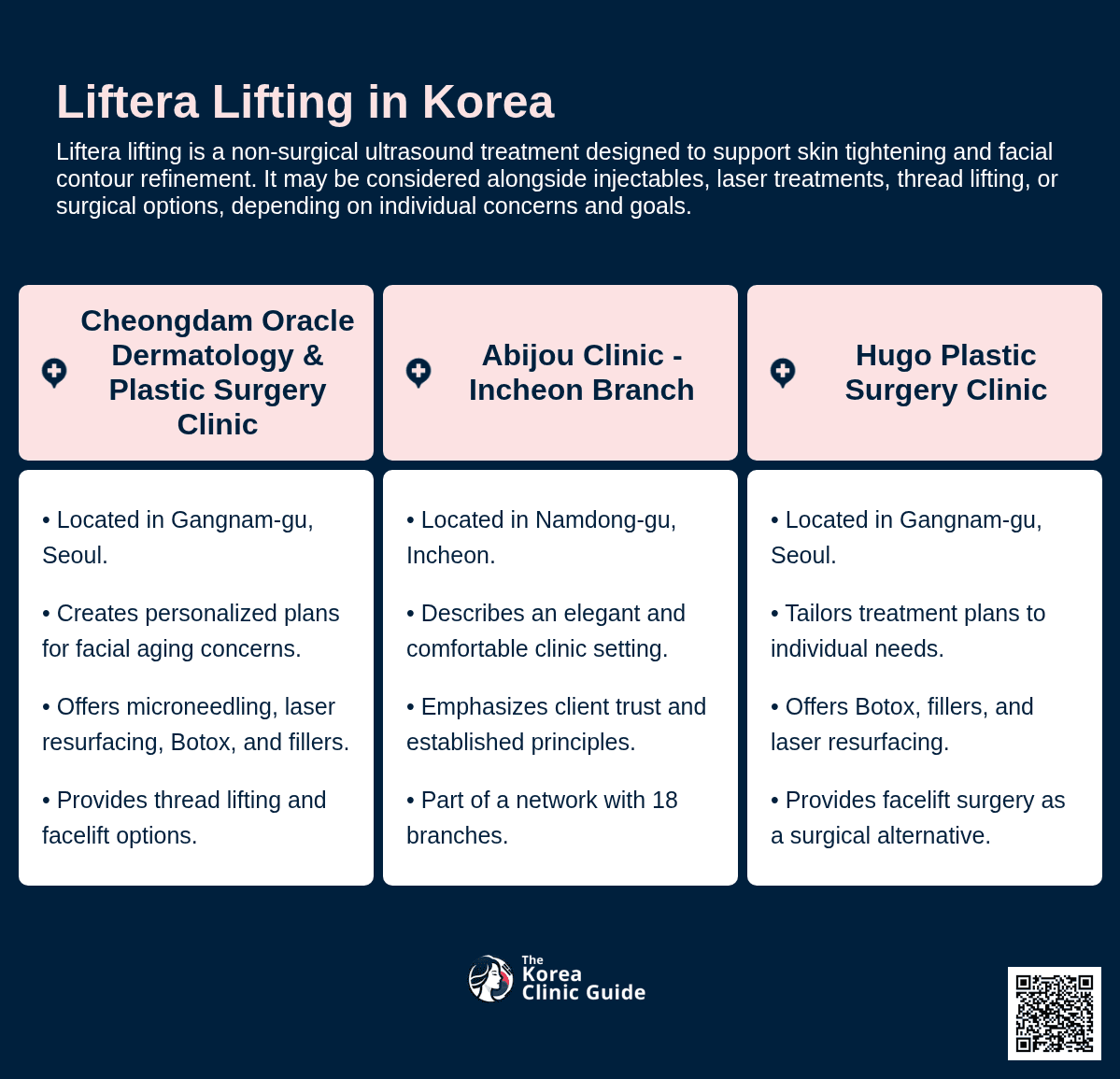
1. Cheongdam Oracle Dermatology & Plastic Surgery Clinic
You may consider Cheongdam Oracle Dermatology & Plastic Surgery Clinic if you want to discuss a non-surgical lifting approach alongside broader options for skin firmness and facial aging, including microneedling, laser resurfacing, injectables, thread lifting, and facelift surgery. Its stated focus on personalized treatment plans can help frame your treatment around your skin concerns and desired degree of correction.
- URL: Cheongdam Oracle Dermatology & Plastic Surgery Clinic Website
- Location: Gangnam-gu, Seoul
- Related facial-aging options:
- Microneedling is offered to stimulate collagen production and improve skin texture and firmness.
- Laser resurfacing is available for texture concerns, wrinkles, scars, and blemishes.
- Botox and dermal fillers are listed for wrinkle reduction and facial-volume concerns.
- Thread lifting and facelift surgery are available as more lifting-focused alternatives.
2. Abijou Clinic - Incheon Branch
You may consider Abijou Clinic - Incheon Branch for a Liftera Lifting consultation if you value a clinic that describes an elegant, comfortable setting and emphasizes maintaining client trust. The branch is part of Abijou’s stated 18-branch network, so you can expect care within a larger clinic group.
- URL: Abijou Clinic - Incheon Branch Website
- Location: Namdong-gu, Incheon
- Clinic setting:
- Abijou describes providing service in an elegant and comfortable atmosphere.
- The clinic is part of a network with 18 branches.
- The network states that it operates according to established beliefs and principles.
3. Hugo Plastic Surgery Clinic
You may consider Hugo Plastic Surgery Clinic if you want to discuss a non-surgical lifting treatment in the context of facial-aging care that also includes Botox, dermal fillers, laser skin resurfacing, and surgical facelift options. The clinic states that it tailors care to your individual needs, which may be useful when comparing treatment approaches for sagging, wrinkles, or skin-quality concerns.
- URL: Hugo Plastic Surgery Clinic Website
- Location: Gangnam-gu, Seoul
- Related non-surgical options:
- Botox injections are listed for reducing the appearance of wrinkles and fine lines.
- Dermal fillers are available to add facial volume and smooth wrinkles in areas such as the cheeks, lips, and around the mouth.
- Laser skin resurfacing is offered for wrinkles, scars, blemishes, and collagen stimulation.
- Surgical alternative: Facelift surgery is listed for tightening facial muscles, removing excess skin, and addressing sagging and facial drooping.
Liftera Lifting From Start to Finish
- Remote inquiry and consultation — Send clear front, oblique, and side photographs without filters, plus goals, medical history, prior threads or fillers, implant details, medicines, allergies, and travel dates. Confirm English-language communication and the precise Liftera model proposed.
- Treatment-plan review — Discuss whether the concern is primarily skin laxity, facial volume loss, localized submental fat, muscle bulk, skeletal shape, or a combination. The clinician should explain what Liftera can realistically improve and when another procedure is more appropriate.
- In-clinic assessment — The practitioner examines skin condition, tissue thickness, laxity, volume distribution, asymmetry, scars, and no-treatment zones. Active inflammation, infection, sunburn, wounds, pregnancy, relevant implants, and recent procedures can require deferral or a different plan.
- Consent and documentation — Review expected discomfort, temporary effects, uncommon but serious risks, alternatives, and overseas follow-up. Take standardized baseline photographs and obtain a written treatment record covering the device model, applicator, areas, depths, and treatment parameters.
- Skin preparation — The face or neck is cleansed and coupling gel is applied. Liftera is generally performed without sedation; disclose sensitivity to ultrasound gel, topical anesthetic, or planned skincare products before treatment.
- Ultrasound delivery — The operator places the handpiece on the mapped skin areas and delivers focused ultrasound at selected depths. Sensation ranges from warmth and stinging to brief deeper aching; intensity and coverage should be adjusted to anatomy and tolerance, not pushed to a preset shot count.
- Completion and discharge — A full-face Liftera-V session has been described as taking about 30 minutes, although duration depends on the areas and protocol in clinic-level consent guidance. The skin is checked for excessive redness, swelling, or other immediate concerns before discharge.
- Early recovery and remote review — Expect possible warmth, redness, tenderness, tingling, or aching. Contact the clinic promptly for escalating pain, blistering, persistent numbness, weakness, facial asymmetry, marked swelling, rash, drainage, fever, eye symptoms, or neurologic symptoms; arrange remote review after returning home.
Alternatives to Liftera Lifting
The best alternative depends on whether the main issue is lax skin, lost volume, localized fat, or substantial tissue descent. Non-surgical choices avoid incisions but generally produce incremental change; surgery offers more predictable correction of significant laxity at the cost of anesthesia, scars, recovery, and surgical risk.
Ultherapy or Other Visualization-Guided MFU
- Best fit — Patients seeking an ultrasound-based approach who want to discuss real-time ultrasound visualization as a planning feature.
- Tradeoff — Visualization is a technical distinction, not proof that results will be better for every patient. See Ultherapy lifting.
Shurink or Other HIFU Platforms
- Best fit — Patients comparing noninvasive focused-ultrasound platforms for mild-to-moderate laxity.
- Tradeoff — Energy delivery, focal depth, applicators, and evidence differ by model; do not assume all “HIFU” sessions are equivalent. See Shurink lifting.
Radiofrequency Tightening
- Best fit — Patients whose clinician considers a different heat-delivery method more appropriate for their tissue characteristics or treatment preference.
- Tradeoff — RF tightening is not a direct substitute for focused ultrasound, and neither approach removes substantial excess skin. See Thermage lifting or InMode lifting.
Thread Lift
- Best fit — Selected patients seeking more immediate mechanical repositioning than HIFU can provide.
- Tradeoff — Threads involve skin entry points and insertion-related risks, and prior or planned HIFU requires individualized sequencing. See thread lift.
Filler or Collagen Stimulation
- Best fit — Patients whose folds and apparent laxity are driven mainly by cheek, temple, chin, or other structural volume loss.
- Tradeoff — Volume treatment addresses a different cause than skin tightening and requires careful product and placement planning. See facial filler.
Submental Fat Reduction
- Best fit — A double chin caused principally by localized fat rather than loose skin alone.
- Tradeoff — Fat reduction does not correct major neck laxity; skin quality and fat volume both need assessment. See double chin liposuction.
Facelift or Neck Lift
- Best fit — Significant skin excess, pronounced jowling, neck banding, or major tissue descent.
- Tradeoff — Surgery can remove skin and reposition tissue, which HIFU cannot do, but entails a longer recovery and surgical risks. See face lift.
How Can I Prepare for Liftera Lifting?
- Medical disclosure — Send the clinic a complete list of medical conditions, allergies, pregnancy possibility, prior facial surgery, threads, fillers, fat grafting, implants, nerve injury, and recent laser, resurfacing, or energy treatments.
- Medicines and supplements — List aspirin, clopidogrel, warfarin, apixaban, rivaroxaban, other anticoagulants or antiplatelets, anti-inflammatory medicines, and supplements. Do not stop prescribed antithrombotic medication without direction from the prescribing clinician; the treating doctor decides whether any change is appropriate.
- Skin condition — Postpone treatment over sunburn, dermatitis, open wounds, active infection, or a herpes outbreak. Report a history of recurrent facial herpes before the appointment.
- Sun and irritation — Avoid strong sun exposure and new irritating skincare or procedures before treatment so the clinician can assess calm, intact skin.
- Food and anesthesia — Liftera is commonly done without sedation, so fasting is generally not required. Follow clinic instructions if topical anesthetic, pain medicine, or an unusual sedation plan is proposed.
- Travel logistics — Book accommodation close enough to return easily the next day, avoid treatment immediately before a long-haul flight, and keep the departure date flexible for at least 24–48 hours.
Travel note: Take treatment-day photos before makeup and retain the clinic's emergency contact, written consent, and procedure record for follow-up after returning home.
Confirm the exact clinic requirements and the treating doctor's individualized instructions, which take precedence over this general guidance.
Aftercare Advice
Protect treated skin from heat, friction, ultraviolet exposure, and unnecessary irritation while early tenderness settles.
- Normal early effects — Redness, warmth, mild swelling, tenderness, tingling, and an aching or bruised sensation can occur. A publicly available Liftera-V consent document describes muscle-ache-like discomfort or altered sensation lasting about 1–2 weeks in some patients in its aftercare information.
- Skin care and makeup — Resume gentle skincare and makeup only when the skin is intact and comfortable. Avoid scrubs, strong acids, retinoids, abrasive devices, and other irritating treatments until the skin has settled.
- Heat, pressure, and activity — Avoid hot baths, saunas, intense heat, vigorous exercise, and firm massage or pressure on treated areas for the period specified by the clinic. Restricting these exposures is particularly important when the skin remains warm, sore, or swollen.
- Sun protection — Limit strong UV exposure and apply broad-spectrum SPF 50 sunscreen when outdoors. Do not treat sunburned or inflamed skin with additional energy procedures.
- Warning signs and follow-up — Seek prompt clinic assessment for increasing pain, blistering, burns, spreading or persistent numbness, weakness, facial asymmetry, marked swelling, rash, drainage, fever, eye symptoms, or neurologic symptoms. Take consistent photographs at roughly 3 and 6 months; do not judge the final result immediately because collagen-remodeling change develops over about 2–3 months.
Follow the treating doctor's written instructions and contact the clinic promptly when anything appears wrong.
Frequently Asked Questions
Related Blogs
Comparing Global Costs of Pico Fraxel: Why Korea is a Top Choice for Skin Rejuvenation Without Compromise
Discover the affordability of Pico Fraxel laser treatments in Korea, where cutting-edge technology meets competitive pricing. Explore why many are choosing Korea for their skincare journey and how it compares to global costs.
Updated: Oct 21, 2026

Optimize Your Wellness: See Why Vitamin Injections in Korea Offer Value Beyond Costs Compared to the USA & More
Discover the latest trends in the cost of vitamin injections in Korea, exploring factors affecting pricing and popular clinics. Learn how these wellness treatments can boost your energy and overall health.
Updated: Oct 21, 2026
Laser Tattoo Removal Costs: Is Korea Your Best Option Compared to the USA, Turkey, and Beyond?
Discover the factors influencing the cost of laser tattoo removal in Korea, from technology and expertise to session frequency. Explore why Korea is becoming a popular destination for this effective and advanced cosmetic procedure.
Updated: Oct 21, 2026
Unlock Radiant Skin: Comprehensive Cost Analysis of Steroid Injections for Scars in Korea vs USA, Turkey & More
Explore the cost of steroid injections for scars in Korea, a popular cosmetic procedure aimed at minimizing the appearance of scar tissue. This article breaks down the pricing, factors influencing cost, and potential savings compared to other countries.
Updated: Oct 21, 2026
Clinics offering Liftera Lifting

Cheongdam Oracle Dermatology & Plastic Surgery Clinic in Korea: Offering Advanced Skin, Anti-Aging, Body Contouring Treatments and More
Seolleung

Lienjang Plastic Surgery & Dermatology: Korea's Leading Clinic for Tailored Aesthetic Solutions and Advanced Treatments
Sinnonhyeon Station

Lienjang Clinic - Incheon Branch: Leading Aesthetic Medical Procedures in Korea for Natural Beauty Enhancement and Confidence Boost
Yeonsu

Abijou Clinic - Incheon Branch: Premier Aesthetic Services in Korea with a Trustworthy Tradition
Bupyeong