
Medical Tourism Blog
Korean Medicine in Korea: Methods, Safety, Travel Planning and Follow-Up
Table of contents
- Korean Medicine at a Glance
- What Is Korean Medicine?
- Who Is a Good Candidate for Korean Medicine?
- How Is Korean Medicine Performed?
- Why Visit Korea for Korean Medicine?
- Key Information for International Patients
- Korean Medicine From Start to Finish
- Which Are the Best Clinics in Korea for Korean Medicine?
- Alternatives to Korean Medicine
- How Can I Prepare for Korean Medicine?
- Aftercare Advice
Considering treatment in Korea? Everything you need to know e.g. — how to avoid scams, visas, interpreters, recovery tips — in our Medical Tourism Master Guide. Plan with confidence in minutes, not weeks!
Last updated: September 2026
Korean Medicine at a Glance
- What it involves — Korean Medicine is individualized, non-surgical care that may combine acupuncture, electroacupuncture, moxibustion, cupping, Chuna manual therapy, herbal medicine, or pharmacopuncture injections; it is not one fixed procedure or package.
- Best candidates — It may suit adults with defined, non-urgent pain, digestive, sleep, stress-related, or musculoskeletal symptoms who want symptom or quality-of-life support alongside appropriate conventional care rather than a guaranteed cure.
- Time in Korea — A consultation can usually be completed in 1 day; allow 3–7 days for a short supervised trial and reassessment, while chronic pain, rehabilitation, or customized herbal treatment may warrant 1–2 weeks.
- Recovery and results — Most uncomplicated outpatient sessions require no physical recovery, although soreness, bruising, light-headedness, tiredness, or cupping marks can last hours to several days; response is assessed over several visits because there is no universal result timeline.
- Medication and herb safety — Herbal formulas require review of the exact ingredients and dose because of possible allergies, liver effects, and drug interactions, especially with warfarin, digoxin, cyclosporine, immunosuppressants, or complex medication regimens.
- Important limits and risks — Do not use Korean Medicine instead of urgent assessment for chest pain, stroke-like symptoms, severe breathlessness, high fever, acute abdominal pain, major trauma, or rapidly worsening weakness; pharmacopuncture adds injection-related bleeding, infection, allergy, nerve, and vascular risks.
- Korea-specific distinction — South Korea has a legally distinct Korean Medicine system with dedicated clinicians and hospitals, making modalities such as Chuna and pharmacopuncture routinely available, but this does not prove every modality is effective or superior for every condition.
What Is Korean Medicine?
Korean Medicine is individualized traditional care that can combine acupuncture, herbal medicine, manual therapy, heat treatment, cupping, or injections. It aims to support relief of defined symptoms and improve daily comfort or quality of life alongside appropriate conventional care. Korean Medicine is non-surgical, though some plans include minimally invasive needle or injection-based treatments.
Who Is a Good Candidate for Korean Medicine?
- Adults with defined, non-urgent symptoms — Good candidates have a clear concern such as low-back, neck, joint, jaw, digestive, sleep, or stress-related symptoms and want symptom relief or quality-of-life support rather than a guaranteed cure.
- People seeking complementary care — Korean Medicine can be considered alongside appropriate conventional diagnosis and treatment, particularly when a clinician can coordinate with the home doctor.
- Patients prepared for full disclosure — Bring every prescription medicine, over-the-counter drug, vitamin, supplement, allergy, prior needle or injection reaction, and relevant pregnancy information.
- Travelers with realistic course expectations — Korean Medicine is a system of individualized care, not a one-session procedure; reassessment after several visits over days or weeks is often more informative than committing to a fixed package.
Korean Medicine is not appropriate instead of urgent conventional assessment for chest pain, stroke-like symptoms, severe breathlessness, high fever or suspected sepsis, acute abdominal pain, major trauma, rapidly worsening weakness, suicidal crisis, or possible cancer complications. Active skin infection at a proposed needling site, uncontrolled bleeding, a strong fainting risk, or inability to consent requires delay or modification. Anticoagulants and antiplatelet drugs—including warfarin, apixaban, rivaroxaban, dabigatran, aspirin, and clopidogrel—require an individualized plan; do not stop them without the prescribing clinician. Herbal treatment needs particularly careful review in pregnancy or breastfeeding, liver or kidney disease, transplant or immunosuppressant treatment, serious prior herb allergy, and complex medication regimens, especially those involving warfarin, digoxin, or cyclosporine. Pharmacopuncture and bee-venom injections are inappropriate after a prior systemic reaction to the proposed substance.
How Is Korean Medicine Performed?
A Korean Medicine doctor selects methods according to the working diagnosis, examination, current medical care, and treatment goal. Ask for the exact modality, number of planned visits, and reason for each component; there is no universal Korean Medicine protocol.
- Acupuncture and electroacupuncture — Sterile fine needles are inserted at selected sites. Electroacupuncture applies a small current between needles. These are commonly used for symptom-focused care, but evidence for acupuncture differs substantially by condition and comparison treatment.
- Moxibustion and cupping — Moxibustion applies heat close to selected points, while cups create suction on the skin. Cupping often leaves circular discoloration for several days; neither treatment is a detoxification method.
- Chuna manual therapy — This hands-on approach uses mobilization, manipulation, and soft-tissue techniques for musculoskeletal symptoms. A review of 66 randomized trials found possible pain and functional benefit, while stressing the need for better sham-controlled studies and standardized techniques in the Chuna evidence base.
- Korean herbal medicine — A prescription can be an individualized decoction, granules, pills, or manufactured herbal medicinal preparation. Formula, extraction method, ingredients, dose, and duration differ markedly between patients, so interaction screening must use the actual product list.
- Pharmacopuncture — An herbal extract is injected at an acupuncture point. It is more invasive than standard acupuncture and introduces injection-related bleeding, infection, allergy, nerve or vascular injury, and product-specific risks. Published Korean trial protocols ranged from 7 to 30 days for musculoskeletal conditions and 5 to 8 weeks for obesity, illustrating why research does not support one standard treatment schedule.
- Sasang-constitution approach — This traditional Korean framework uses history, symptoms, and constitutional classification to guide recommendations. It is not a genetically validated precision-medicine test; a systematic review found only three small, variable-quality randomized trials of Sasang-based acupuncture and called for stronger research.
Why Visit Korea for Korean Medicine?
South Korea has a legally distinct Korean Medicine system alongside conventional medicine, with Korean Medicine clinicians and dedicated Korean Medicine hospitals. This provides access to modalities such as Chuna and pharmacopuncture within the country where they are routinely offered. It does not establish that every Korean Medicine modality is superior or effective for every condition.
- Distinct clinical system — Korea’s Ministry of Health and Welfare recognizes Korean Medicine within its healthcare framework, creating a specific local setting for Korean Medicine institutions and services.
- Broad multi-modal access — A single care plan can include consultation, acupuncture, herbal prescriptions, moxibustion, cupping, Chuna, and, where appropriate, pharmacopuncture rather than treating “Korean Medicine” as one standardized procedure.
- Condition-specific guideline development — Korean clinical-practice guidelines are developed for defined conditions and interventions using systematic-review and GRADE-style processes. For example, a temporomandibular-disorder guideline considers acupuncture, pharmacopuncture, Chuna, and concurrent conservative conventional care rather than promoting a universal package.
- Herbal-product oversight framework — The Ministry of Food and Drug Safety has approval and GMP-review frameworks for herbal medicinal preparations within its pharmaceutical regulatory system. Regulatory review does not prove that an individualized formula will work for a particular person or diagnosis.
- Evidence limits worth discussing openly — Multi-modal traditional care combines practitioner decisions, herbs, acupuncture, manual treatment, lifestyle advice, and natural recovery. This makes it difficult to isolate the benefit of each component, a limitation recognized in whole-systems research.
Key Information for International Patients
- Minimum stay — A consultation-only visit can usually be completed in 1 day. Plan 3–7 days for a short trial of acupuncture, Chuna, moxibustion, cupping, or supervised herbal treatment so the clinician can review response and adverse effects.
- Longer courses — Chronic pain, rehabilitation, or a customized herbal course often benefits from 1–2 weeks in Korea. This is a practical planning estimate, not a validated requirement or a guarantee of improvement.
- Repeat visits — Arrange reassessment after an initial small number of sessions. Do not assume a pre-sold number of treatments is appropriate before the clinician has examined the condition and reviewed progress.
- Flight timing — Flying is generally feasible after an uncomplicated outpatient session once hydrated and no longer dizzy or faint. Delay travel after an injection reaction, substantial bleeding, chest symptoms, breathlessness, fever, new neurological symptoms, or severe persistent pain.
- Higher-risk methods — Do not schedule immediate onward travel after pharmacopuncture, bee-venom products, or treatment for a potentially serious condition until the treating clinician has assessed the response and a conventional-care plan is clear.
- Records and remote follow-up — Request an English clinical summary listing the working diagnosis, all modalities, herbal ingredients in Korean and Latin or common names, manufacturer and lot where applicable, dose, dates, adverse events, and follow-up plan. Remote review can track symptoms, but drug-interaction monitoring and serious medical care require an appropriately licensed clinician at home.
Travel note: Before booking, confirm that the specific facility can provide interpretation, multilingual consent, a written treatment summary, and emergency-transfer arrangements. Check destination-country import rules before carrying, mailing, or continuing any Korean herbal product.
Korean Medicine From Start to Finish
- Pre-travel enquiry and virtual consultation — Send diagnoses, recent test results or imaging, a complete medication and supplement list with doses, allergies, pregnancy status where relevant, prior reactions, and a concise symptom goal. Ask whether an English or virtual consultation is available and whether conventional specialist assessment is needed before travel.
- Treatment-plan clarification — Obtain the proposed modalities, number and spacing of visits, anticipated costs, herb ingredients and dose if relevant, injection substance if relevant, expected benefit, risks, and the clinic’s interpretation and emergency arrangements. Korean Medicine should not be booked as an undefined package.
- In-person assessment — The Korean Medicine doctor takes a history, examines the relevant area, screens for red flags, and reviews current conventional care. Blood tests and imaging are not automatic; they are ordered when clinically indicated or needed for safe prescribing or monitoring.
- Separate informed consent — Review consent for each proposed intervention: acupuncture, manual therapy, moxibustion, cupping, oral herbs, and injections. For herbal medicine, obtain the full ingredient list, route, dose, intended duration, interaction review, and instructions for new symptoms.
- Outpatient treatment — Acupuncture, cupping, moxibustion, and Chuna are generally outpatient treatments. The clinician performs only the methods agreed after assessment; pharmacopuncture involves an injection and needs additional allergy, bleeding-risk, and infection-control considerations.
- Observation and discharge — Report dizziness, unusual pain, bleeding, rash, breathing symptoms, or worsening symptoms before leaving. Most uncomplicated sessions need no physical recovery, although temporary tiredness, light-headedness, soreness, bruising, or cupping marks can last from hours to several days.
- Reassessment during the stay — Review symptom change and adverse effects after the initial visits. Adjust, pause, or stop treatment based on clinical response rather than presuming that a fixed course will work.
- Overseas follow-up — Leave with the English treatment summary and a plan for local medical care. Arrange remote symptom review where useful, and have a home physician or pharmacist review any herbal product before continuing it abroad.
Which Are the Best Clinics in Korea for Korean Medicine?
Listed below are some of the best clinics in Korea for korean medicine.
1. Bondi Korean Medicine Clinic
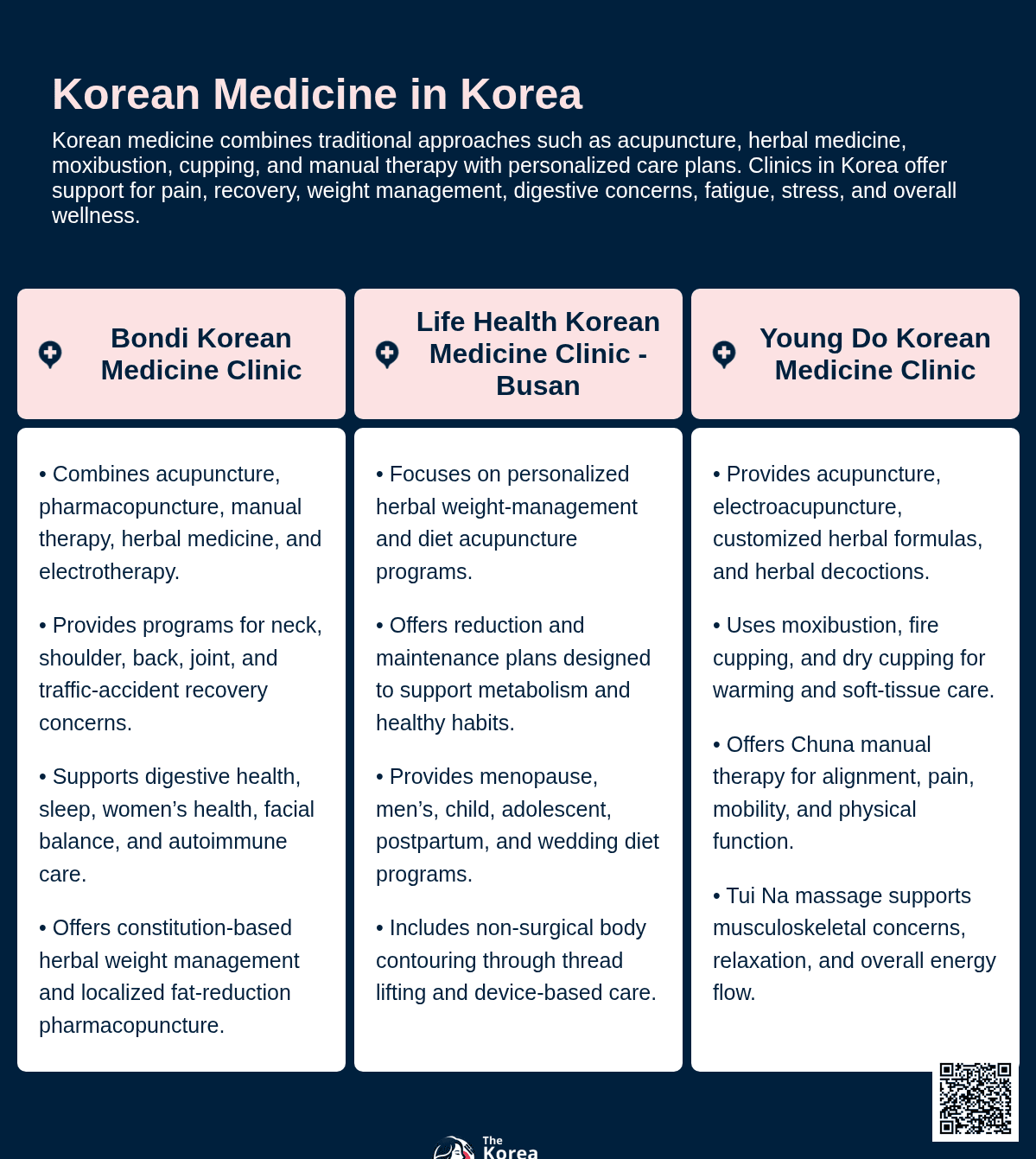
Bondi Korean Medicine Clinic offers Korean medicine-based care that can combine acupuncture, pharmacopuncture, manual therapy, herbal medicine, and electrotherapy for concerns such as neck, shoulder, back, and joint pain. Your plan may also address digestive symptoms, sleep, women’s health, weight management, facial balance, or recovery after a traffic accident.
- URL: Bondi Korean Medicine Clinic Website
- Location: 3rd floor, 509 Nonhyeon-ro, Gangnam-gu, Seoul
- Pain and recovery care:
- Neck-pain care may combine acupuncture, pharmacopuncture, manual therapy, herbal medicine, and interferential-current-style electrotherapy for posture-related stiffness, headaches, and discomfort.
- Dedicated programs also cover shoulder pain, lower-back pain, and limb or joint concerns, with an emphasis on movement and day-to-day function.
- Post-traffic-accident care is described as a step-based program including acupuncture, pharmacopuncture, physical therapy, herbal medicine preparation, and manual therapy.
- Korean medicine treatments:
- Acupuncture is used across pain, digestive, sleep, women’s-health, and facial-balance programs.
- Pharmacopuncture uses herbal extracts at targeted points and is included in pain-related and systemic-care programs.
- Customized herbal prescriptions are presented as constitution- and condition-based support for recovery and symptom management.
- Manual therapy addresses musculoskeletal alignment and movement patterns; electrotherapy is used for deeper muscle relaxation and discomfort reduction.
- Other care areas:
- Digestive care addresses ongoing discomfort, bowel irregularity, and constipation; longer-standing constipation care may include 1:1 customized herbal treatment.
- Sleep care is structured around potential underlying contributors rather than sleep induction alone.
- Women’s-health and autoimmune-support programs incorporate Korean medicine treatments, with lifestyle guidance listed for autoimmune care.
- Facial-balance care includes craniosacral work and facial acupuncture in a non-surgical workflow.
- Weight management:
- Constitution-based herbal weight-management programs are offered, including convenient pill-format herbal options.
- Localized fat-reduction pharmacopuncture is presented as a non-surgical option for focused body-area management.
- The clinic describes its diet programs as guided and herbal-based rather than stimulant-focused.
2. Life Health Korean Medicine Clinic - Busan
Life Health Korean Medicine Clinic - Busan focuses its Korean medicine services on tailored weight management, including herbal-medicine programs, diet acupuncture, and non-surgical body-contouring options. You can explore plans designed around general reduction, maintenance after weight loss, or life-stage needs such as menopause and postpartum recovery.
- URL: Life Health Korean Medicine Clinic - Busan Website
- Location: Busanjin-gu, Busan
- Herbal weight-management plans:
- “Today, Reduction” premium herbal medicine is presented as a tailored program intended to support weight reduction, metabolism, and craving management.
- “Tomorrow, Maintenance” herbal medicine is designed to support weight-loss maintenance and help reduce rebound weight gain.
- Programs include menopause-focused weight management, men’s weight loss, and child and adolescent obesity care centered on healthy growth and longer-term habits.
- Life-stage and event-focused options:
- Postpartum weight-loss care is described as including herbal medicine intended to support lactation and energy recovery.
- A wedding diet program combines dietary planning, herbal medicine, and treatments for pre-wedding weight-management goals.
- Supporting treatments:
- Diet acupuncture is offered as a metabolism- and weight-management adjunct, often alongside other treatments.
- Lifting Maeseon uses threads for non-surgical body contouring and skin-toning goals.
- Medical-device management is described as a non-invasive complement for fat reduction and skin tightening.
3. Young Do Korean Medicine Clinic
Young Do Korean Medicine Clinic provides traditional Korean medicine care with acupuncture, customized herbal prescriptions, moxibustion, cupping, and hands-on therapies. Your treatment can be tailored to concerns such as pain, muscle rehabilitation, digestive symptoms, fatigue, and stress-related discomfort.
- URL: Young Do Korean Medicine Clinic Website
- Location: Gangnam-gu, Seoul
- Acupuncture and herbal medicine:
- Traditional acupuncture uses fine needles at selected points and is presented for concerns including pain, digestive issues, and stress-related symptoms.
- Electroacupuncture adds small electrical currents through needles and is described for chronic pain and muscle rehabilitation.
- Customized herbal formulas and freshly prepared herbal decoctions are offered according to your symptoms and condition; decoctions are listed for concerns such as colds, digestive issues, and fatigue.
- Warming and soft-tissue therapies:
- Direct and indirect moxibustion provide warming treatment with different approaches for more robust or sensitive areas.
- Fire cupping uses heated glass cups, while dry cupping uses pump-created suction; both are presented for muscle tension, circulation, pain, and inflammation.
- Manual therapies:
- Chuna manual therapy involves spinal manipulation and mobilization to address alignment, pain, and physical function.
- Tui Na massage uses kneading, pressing, and rolling techniques for musculoskeletal concerns and overall energy flow.
Alternatives to Korean Medicine
The right alternative depends on the diagnosis and goal. Non-surgical options can focus on a single modality or conventional pain pathway, while urgent, infectious, cancer-related, or progressive neurological problems need prompt conventional specialist care rather than a Korean Medicine course.
Acupuncture
Acupuncture is the narrower option for someone seeking needle-based care without a broader Korean Medicine plan.
- Best fit — Patients who want acupuncture or electroacupuncture alone for a defined symptom goal.
- Tradeoff — It avoids committing to herbs, manual therapy, or injections, but still requires screening for bleeding risk, infection at the treatment site, fainting history, and red flags.
Diet Korean Medicine
Diet Korean Medicine is a more focused option for people seeking a Korean Medicine approach to diet and weight-management goals.
- Best fit — Travelers whose main objective is dietary counselling or weight-management-oriented care rather than pain, rehabilitation, or a broad symptom assessment.
- Tradeoff — Weight change should not be promised from constitutional classification or herbal products, and any proposed formula requires medication-interaction review.
Nerve Block Procedure
A nerve block procedure is a conventional, targeted injection option for selected focal pain conditions after diagnostic assessment.
- Best fit — Patients with localized pain where a clinician suspects a specific nerve or pain generator and considers an anesthetic or anti-inflammatory injection appropriate.
- Tradeoff — It is more targeted and invasive than acupuncture, with injection-specific risks and a different indication; it does not replace rehabilitation or assessment of the underlying condition.
How Can I Prepare for Korean Medicine?
- Send complete medical information early — Provide diagnoses, recent imaging or laboratory results, every medicine and supplement with exact doses, allergies, pregnancy or breastfeeding status, previous liver or kidney problems, and prior reactions to needles, herbs, or injections.
- Do not stop prescribed medicines independently — Do not stop anticoagulants, antiplatelets, diabetes or blood-pressure medicines, steroids, seizure medicines, antidepressants, or immunosuppressants simply for Korean Medicine. The prescriber managing the medicine and the treating clinician must determine any change.
- Request formula-specific interaction screening — Give the pharmacist or clinician the actual herbal formula, complete ingredient list, product name, dose, and planned duration. Herb–drug interaction evidence is limited for many products, and natural products vary in composition.
- Eat and hydrate appropriately — Have a light meal and drink water before acupuncture unless fasting is specifically required for a blood test. Do not arrive dehydrated, intoxicated, or immediately after heavy exercise.
- Prepare the treatment area — Wear loose clothing that permits access to the relevant body area. Do not have needles placed through sunburned, infected, ulcerated, or broken skin.
- Avoid alcohol — Avoid alcohol on the treatment day and throughout a course when instructed, especially when using herbs that cause sedation or gastrointestinal effects.
- Plan transport and flexible travel — Avoid driving or using a scooter after treatment if prone to fainting, receiving sedating medicine, or dizzy. Keep flights flexible during a new herbal prescription or injectable treatment course.
Travel note: Carry a printed medication list and keep herbal products in original labelled packaging. Do not assume a product can be imported or mailed home.
Confirm the treating doctor’s clinic-specific preparation requirements, which take precedence over this general guidance.
Aftercare Advice
Treat new or severe symptoms as medical issues, not as signs that Korean Medicine is “working.”
- Resume activity gradually — Gentle activity is generally reasonable after uncomplicated acupuncture. Postpone strenuous exercise while sore, bruised, dizzy, or light-headed; follow individualized restrictions after Chuna if the treated area is painful or unstable.
- Care for skin sites — Keep needling sites clean. Protect cupping marks or irritated skin from friction and sunburn; use SPF 50 on exposed irritated skin. Do not pick at cupping blisters, and contact the clinic if blistering is extensive.
- Monitor herbal effects — Stop the product and seek prompt clinical advice for rash, facial swelling, persistent vomiting, severe abdominal symptoms, dark urine, jaundice, or other concerning symptoms. Herbal products can cause allergic reactions, gastrointestinal effects, liver-enzyme abnormalities, and interactions; “natural” does not mean risk-free, as herbal-product safety guidance emphasizes.
- Know urgent warning signs — Seek urgent medical evaluation for difficulty breathing; swelling of the face, tongue, or throat; widespread hives; fainting; chest pain; fever; a hot, red, or draining site; coughing blood; sudden severe headache; new weakness, numbness, speech or vision changes; black stools; jaundice; or persistent vomiting.
- Set realistic review points — Brief soreness, minor bleeding, bruising, tiredness, or cupping marks often settle within hours to several days. There is no evidence-based universal final-result date for Korean Medicine; treatment response depends on the diagnosis, modality, dose, session frequency, co-treatment, and natural course of the condition.
Follow the treating doctor’s individualized instructions and contact the clinic promptly when something appears wrong.
Frequently Asked Questions
Related Blogs
Acupuncture in Korea: Methods, Safety, Travel Planning, and Recovery
Acupuncture in Korea involves an in-person assessment, consent and safety screening, sterile needle treatment, aftercare, and an English treatment record for follow-up at home. A standard examination and session can fit in one day, while travelers should confirm the exact modality, interpreter support, medication risks, and urgent warning signs.
Updated: Sep 21, 2026
Diet Korean Medicine in Korea: Methods, Safety, Travel Planning, and Alternatives
Diet Korean Medicine for adult simple obesity may combine individualized herbal medicine, acupuncture, ear stimulation, pharmacopuncture, or thread-embedding acupuncture with nutrition, activity, sleep, and behavioral support. The article explains screening, treatment schedules, travel planning, herbal documentation, safety precautions, aftercare, and follow-up for international patients.
Updated: Sep 21, 2026
Discover Acupuncture Costs Abroad: How Korea Stacks Up Against the USA, Mexico, Turkey, and Thailand
Discover the affordability of acupuncture in Korea as we explore typical costs, factors influencing prices, and tips for finding quality treatment. Learn how Korea's approach offers a balance of traditional techniques and modern healthcare practices.
Updated: Aug 8, 2026
Korean Medicine Uncovered: Compare Costs and Experience of Cosmetic & Traditional Treatments Worldwide
Discover the intricacies of Korean medicine pricing with our comprehensive guide, exploring both traditional and modern treatments available in Korea. Uncover the factors influencing costs and how you can access affordable healthcare in this unique medical landscape.
Updated: Aug 7, 2026
Clinics offering Korean Medicine

Chamdain Korean Medicine Clinic: Comprehensive Traditional Healthcare & Wellness Services in Korea
Euljiro

Layeon Korean Medicine Clinic: Your Go-To Destination for Personalized Weight Loss and Health Solutions in Korea
Sinnonhyeon Station

Koyou Korean Medicine Clinic in Korea: Traditional Treatments for Post-Surgery Swelling, Diet Control, and Skin Care
Sinsa

Acro Korean Medicine Clinic: Comprehensive Traditional Korean Treatments for Health and Wellness in Korea
Sinnonhyeon Station