
Medical Tourism Blog
Fixing Botched Rhinoplasty with Revision Rhinoplasty in Korea: Expert Solutions for Perfect Results
Table of contents
- Understanding "Botched Rhinoplasty": Signs, Causes, and Terminology
- Revision Rhinoplasty: The Corrective Surgical Solution
- The Journey to Revision Rhinoplasty in South Korea: A Medical Tourist's Process
- Which Are the Best Clinics in Korea for Botched Rhinoplasty?
- Cost Analysis: Revision Rhinoplasty in South Korea and Global Comparison
- Patient Outcomes: Restoring Form, Function, and Confidence
- Conclusion: Empowering Informed Decisions
- References
Considering treatment in Korea? Everything you need to know e.g. — how to avoid scams, visas, interpreters, recovery tips — in our Medical Tourism Master Guide. Plan with confidence in minutes, not weeks!
If you’ve had a rhinoplasty (commonly known as a "nose job") and the results didn’t meet your expectations, you’re not alone. This guide is here to help patients and advisors understand what to do next. Rhinoplasty is meant to enhance facial harmony and boost self-confidence, but when things go wrong, the impact can be more than skin deep. A "botched" nose job can affect how you see yourself, your social life, and even your ability to breathe comfortably. Here, we’ll walk you through what to look for, why things might have gone wrong, and how revision rhinoplasty can help.
The emotional and physical effects of an unsatisfactory rhinoplasty can be significant. Many patients experience regret, self-consciousness, and a drop in well-being. Beyond appearance, a poorly performed nose job can cause breathing problems that disrupt daily life and health. The gap between what you hoped for and what you got can lead to dissatisfaction and medical issues, making effective solutions essential.
Understanding "Botched Rhinoplasty": Signs, Causes, and Terminology
A "botched rhinoplasty" refers to a surgical result that falls far short of the intended goals, causing visible deformities or breathing issues. Terms like "bad nose job," "failed rhinoplasty," "unsuccessful nose job," and "secondary rhinoplasty" are often used. In severe cases, especially with filler complications, you might hear "nasal disasters." While "secondary rhinoplasty" and "revision rhinoplasty" are sometimes used interchangeably, revision rhinoplasty specifically means a corrective procedure.
Common cosmetic signs of a botched nose job include:
- Asymmetry: The nose looks uneven, disrupting facial balance.
- Overly Turned-Up Nasal Tip ("Pig Snout"): The tip points up unnaturally, often from too much tissue removal.
- Pinched or Collapsed Nostrils/Tip: Over-resected cartilage can cause a pinched look and breathing issues.
- Scooped or Over-Arched Bridge ("Ski Slope" Deformity): Too much reduction creates an unnatural profile.
- Pollybeak Deformity: Excess tissue above the tip pushes the nose downward.
- Residual Bumps or Irregularities: The bridge isn’t smooth, indicating more work is needed.
- Nose Disproportionate to Other Facial Features: The nose looks out of place with the rest of the face.
Functional problems can include:
- Breathing Difficulties: Often due to tissue removal, a deviated septum, or airway collapse. Revision rhinoplasty can target these blockages to restore function.
- Structural Collapse: Weakening from aggressive reduction can cause long-term breathing issues.
- Impaired Sense of Smell: Obstructions or complications can affect your ability to smell, which revision surgery may help restore.
Why do these problems happen? The most common causes are:
- Inexperienced Surgeons: Rhinoplasty is complex and requires both artistry and technical skill. Choosing a board-certified, experienced surgeon is crucial.
- Poor Surgical Planning: Rushing into surgery without a personalized plan can lead to imbalances.
- Aggressive Tissue Removal: Taking out too much cartilage can cause a pinched or collapsed nose.
- Healing Complications: Some people form excessive scar tissue or heal unpredictably, which can distort results.
- Miscommunication: If the patient and surgeon aren’t on the same page, disappointment is likely.
- Unrealistic Expectations: While improvements are possible, perfect results aren’t always achievable due to anatomy and previous surgeries.
It’s important to recognize that a "botched" rhinoplasty isn’t just about looks—it can also mean serious functional problems. Many issues are preventable with the right surgeon and planning. Patients should prioritize expertise over cost or convenience and ensure clear communication with their surgeon.
Revision Rhinoplasty: The Corrective Surgical Solution
Revision rhinoplasty, or secondary rhinoplasty, is a complex surgery designed to fix problems from previous nose jobs. Its goal is to improve both the look and function of the nose.
Why is revision rhinoplasty so challenging?
- Scar Tissue: Previous surgery leaves scar tissue, making the nose harder to reshape.
- Altered Anatomy: The original structure is changed, making it tricky to identify landmarks.
- Lack of Cartilage: If too much cartilage was removed before, surgeons may need to take cartilage from the ear or rib.
- Fragility: Each surgery can make the nose more delicate.
Surgeons use different techniques based on your needs:
- Open Rhinoplasty: An incision across the columella gives full access for major changes.
- Closed Rhinoplasty: Incisions inside the nostrils leave no visible scars and are used for minor adjustments.
- Cartilage Grafting: Cartilage from the septum, ear, or rib is used to rebuild the nose.
- Advanced Technologies: Piezo ultrasonic rhinoplasty sculpts bone with less trauma, and 3D-CT analysis helps plan the surgery in detail.
Revision rhinoplasty can range from minor tweaks to major reconstruction. Ideal candidates are those who have had previous nose surgeries and want to fix aesthetic or functional issues, with realistic expectations about what’s possible.
Risks include swelling, bleeding, infection, scarring, temporary loss of smell, and complications from grafts or implants. Recovery can take up to a year, with final results appearing after 12 to 18 months.
Revision rhinoplasty is often more about rebuilding than refining. It’s more complex, time-consuming, and costly than primary rhinoplasty, requiring a surgeon with advanced reconstructive skills. Technologies like Piezo ultrasonic rhinoplasty and 3D-CT analysis help make these surgeries safer and more precise.
The Journey to Revision Rhinoplasty in South Korea: A Medical Tourist's Process
South Korea is a top destination for cosmetic surgery, especially rhinoplasty. Surgeons there are known for their expertise in complex cases, and clinics are equipped with the latest technology.
Here’s what the process looks like for international patients:
- Initial Consultation: Discuss your previous surgeries, concerns, and goals. High-resolution imaging like 3D-CT is often used to plan your surgery.
- Pre-Surgical Evaluations: Blood tests and imaging ensure you’re fit for surgery. An anesthesiologist will assess you and monitor you during the procedure.
- Surgical Procedure: Revision rhinoplasty is done under general anesthesia and can take 4 to 10 hours, depending on complexity. Some clinics offer same-day discharge, while others recommend a short hospital stay.
- Post-Operative Care: You’ll get instructions for managing swelling, caring for incisions, and attending follow-ups. Stitches are usually removed after five days.
- Recovery Period: Initial recovery takes about a week, but full healing can take up to 18 months.
- Multilingual Support: Many clinics offer services in multiple languages to help international patients.
- Visa Requirements: Most patients use a C-3 visa for short stays or a C3-3 medical visa for longer or more complex procedures. Required documents include a visa application, passport, diagnosis, appointment confirmation, financial proof, photos, and travel bookings.
- Travel and Accommodation: Budget $50–$200 per night for accommodation and $100–$300 for local transportation. Some clinics offer packages that include hotel stays.
South Korea’s infrastructure for medical tourists is highly developed, making the process smoother and safer. However, patients should plan for the long-term, as full recovery takes months and follow-up care may be needed at home.
Which Are the Best Clinics in Korea for Botched Rhinoplasty?
Listed below are some of the best clinics in Korea for botched rhinoplasty.
1. THEPLUS Plastic Surgery
For revision after an unsatisfactory or complicated rhinoplasty, you can expect a plan focused on restoring nasal structure, appearance, and facial balance at THEPLUS Plastic Surgery. Its revision-rhinoplasty offering is supported by surgeons whose work emphasizes both aesthetic refinement and nasal function.
- URL: THEPLUS Plastic Surgery Website
- Location: Gangnam-gu, Seoul
- Rhinoplasty expertise:
- Dr. Jeong Jae-yong authored “Rebuilding Nose: Rhinoplasty for Asians,” which has Japanese and English editions.
- Dr. Kim Taek-kyun contributed rhinoplasty and revision-rhinoplasty chapters to “The 18 Masters of Korean Aesthetic Surgery.”
- Dr. Jeong and Dr. Kim participate in rhinoplasty education and research through forums including the Seoul Rhinoplasty Forum, KSPRS, and IFAAS.
- Dr. Jeong is identified as President of the Korean Society of Plastic Surgeons; Dr. Kim is described as a board-certified plastic surgeon.
- Revision focus:
- Revision rhinoplasty is offered to address concerns following prior nose surgery, with the stated aim of restoring a more stable nasal structure and refined appearance.
- The clinic describes its rhinoplasty approach as considering both function and aesthetics.

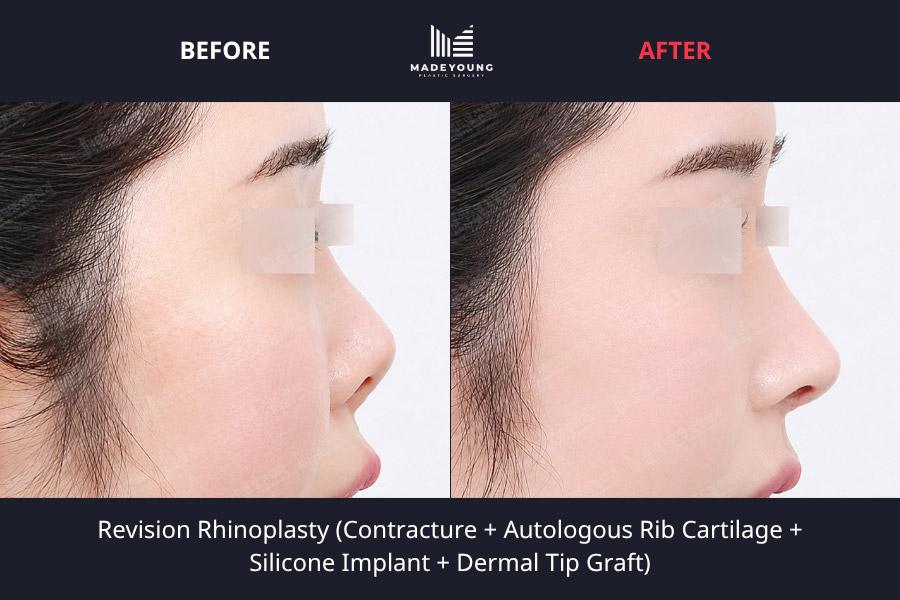
2. Made Young Plastic Surgery
If a prior nose operation has left scarring, tissue damage, or an implant-related concern, Made Young Plastic Surgery offers revision and reconstructive rhinoplasty options centered on careful tissue handling. You can expect direct medical-team consultation and techniques such as micro-dissection, capsule removal, and implant removal when clinically appropriate.
- URL: Made Young Plastic Surgery Website
- Location: Seocho-gu, Seoul
- Revision approach:
- The clinic describes precise dissection intended to minimize tissue damage in complex revision cases.
- Its stated techniques include micro-dissection, capsule removal, and removal of prior nasal implants.
- Revision rhinoplasty, reconstruction rhinoplasty, and rhinoplasty implant removal are listed services.
- Anesthesia and aftercare:
- Full-time board-certified anesthesiologists are listed as being on site.
- The clinic describes one-to-one anesthesiologist monitoring and a cross-check response system for emergencies.
- A separate aftercare center is listed for systematic post-procedure care.
- Medical-team consultation:
- The clinic states that its medical team provides direct consultation and diagnosis before a procedure.
- It describes its doctors as having an average of more than 15 years of experience.
3. LABOM Plastic Surgery
You may consider LABOM Plastic Surgery for a botched rhinoplasty when you need the cause clarified before a revision plan is proposed: the clinic uses 3D CT-based assessment of nasal bone, cartilage, and implant position, while evaluating problems such as implant displacement, infection or inflammation, thin tip skin, septal deviation, and nasal-valve issues. Your revision can be tailored with implant removal or replacement when indicated and autologous cartilage or dermal graft reinforcement for thinned tip skin; the clinic advises waiting until tissues stabilize—often 6 to 12 months after the original surgery—and resolving active inflammation or infection first.
- URL: LABOM Plastic Surgery Website
- Location: Gangnam-gu, Seoul
Cost Analysis: Revision Rhinoplasty in South Korea and Global Comparison
Revision rhinoplasty costs in South Korea vary widely, typically ranging from $5,000 to $15,000 USD. More complex cases can cost more, while simpler revisions may be less expensive. Factors affecting cost include:
- Procedure Complexity: More intricate surgeries cost more.
- Surgeon’s Expertise: Highly skilled surgeons charge higher fees.
- Clinic Reputation and Location: Clinics in prime areas like Seoul’s Gangnam district are pricier.
- Facility Quality: Advanced technology and amenities increase costs.
- Type of Anesthesia: General anesthesia is more expensive than local.
- Additional Services: Pre-surgical consultations, 3D imaging, and follow-ups may add to the total.
Other expenses to consider:
- Consultation Fees: $50–$150 per visit.
- Pre-Surgical Tests: $100–$300.
- Post-Surgery Medications: $50–$200.
- Accommodation: $50–$200 per night.
- Local Transportation: $100–$300.
- Post-Surgical Care: Lymphatic massages, $50–$150 per session.
- Interpreter Services: $30–$100 per hour.
- Follow-Up Visits: Costs vary.
- Emergency Fund: At least $1,000 recommended.
- Medical Insurance: Usually not covered unless for functional reasons.
Many clinics offer comprehensive packages that may include surgery, aftercare, and sometimes accommodation. South Korea offers a balance of advanced expertise and competitive pricing compared to Western countries, though it may be more expensive than destinations like Turkey or Thailand.
Here’s a quick comparison of revision rhinoplasty costs in different countries:
| Country | Revision Rhinoplasty Cost Range (USD) | Notes |
|---|---|---|
| South Korea | $5,000 - $15,000 | Varies by clinic, surgeon, and complexity. Some basic revisions as low as $2,700. Packages often available. |
| USA | $9,000 - $25,000 | Highest costs, reflecting expertise and overhead. |
| Turkey | $3,800 - $6,500 | Competitive pricing, popular for medical tourism. |
| Thailand | $2,613 - $12,265 | Wide range; some packages are all-inclusive. |
South Korea’s prices are mid-range, reflecting its reputation for quality and comprehensive care. However, many costs are not included in the base fee, so patients should request a detailed breakdown to avoid surprises.
Patient Outcomes: Restoring Form, Function, and Confidence
Revision rhinoplasty can be life-changing for those who’ve had unsatisfactory nose surgeries. The procedure aims to correct deformities and restore a natural, harmonious appearance. Patients often report results that match their expectations, leading to high satisfaction.
Functional improvements are just as important:
- Improved Breathing: Revision rhinoplasty can fix obstructions, correct deviated septums, and stabilize nasal valves, leading to better sleep and well-being.
- Restored Sense of Smell: By optimizing airflow, the sense of smell can often be regained.
- Relief from Sinusitis: Improved airflow helps clear sinus blockages.
- Reduced Sleep Apnea: Better breathing can lower sleep apnea risks.
The psychological benefits are significant:
- Boosted Self-Confidence: Patients feel more comfortable in their own skin.
- Reduced Social Anxiety: Improved appearance leads to greater ease in social situations.
- Better Quality of Life: Enhanced breathing and appearance contribute to overall well-being.
While revision rhinoplasty is more complex and has a lower success rate than primary procedures, choosing a skilled specialist greatly improves outcomes. Patience is key, as final results take up to 18 months to appear. The procedure not only restores physical form and function but also helps patients regain confidence and peace of mind.
Conclusion: Empowering Informed Decisions
Revision rhinoplasty is a complex but highly effective solution for those facing the consequences of a botched nose job. It can restore both appearance and function, leading to improved quality of life and self-confidence. To maximize success, patients should thoroughly research surgeons, communicate openly, set realistic expectations, and plan carefully for all associated costs and logistics, especially when considering medical tourism in South Korea. With the right preparation and expert care, a successful outcome is well within reach.
References
1, 2, 3, 4, 5, 6, 7, 8, 9, 10, 11, 12, 13, 14, 15, 16, 17, 18, 19, 20, 21, 22
Frequently Asked Questions
Related Blogs
Korea vs. Global Standards: A Comprehensive Cost Analysis of Cleft Rhinoplasty in Medical Tourism Destinations
Explore the cost of cleft rhinoplasty in Korea, a popular destination for medical tourism due to its advanced surgical techniques and competitive pricing. Discover factors influencing the overall expense, from hospital fees to post-operative care, and what makes Korea a top choice for this specialized procedure.
Updated: Oct 21, 2026
Philtrum Reduction Costs: Choosing Korea Over the USA, Mexico, Turkey & More for Expert Care
Discover the affordability and benefits of Philtrum Reduction Surgery in Korea, a popular destination for high-quality cosmetic procedures. Explore cost factors, surgeon expertise, and why Korea is a top choice for those considering this transformative surgery.
Updated: Oct 21, 2026
Discovering the True Value: Sinus Surgery Costs in Korea Compared to Global Options
Discover the affordable options for sinus surgery in Korea, a leading destination for medical tourists seeking quality care. Learn about the factors influencing costs and what patients can expect from their experience in this highly advanced healthcare system.
Updated: Oct 21, 2026
Non-Implant Rhinoplasty in Korea: Cartilage Grafts, Recovery, Travel Planning, and Alternatives
Non-implant rhinoplasty reshapes the nose using septal, ear, or rib cartilage, with surgical or injectable and open or closed approaches and possible septal or nasal-valve correction. International patients can find guidance on candidate screening, material-specific consent, Korea stays of 10–21 days, travel timing, recovery, and follow-up.
Updated: Oct 16, 2026
Clinics offering Revision Rhinoplasty

THEPLUS Plastic Surgery Korea | Eye, Nose, Face & Body Surgery
Sinsa

Made Young Plastic Surgery: Rejuvenating Aesthetic Excellence in Korea for Face Lifts, Contouring and More
Gangnam Station

LABOM Plastic Surgery: Expertise in Non-Surgical Nose, Facial Lifting & Anti-Aging Surgeries in Korea
Apgujeong

Okay Plastic Surgery Clinic in Korea: Comprehensive Aesthetic Procedures with Sincerity and Care
Cheongdam