Medical Tourism Blog
Toenail Treatment in Korea: Diagnosis, Fungal Care, Ingrown Nail Procedures, Recovery and Travel Planning
Table of contents
- Toenail Treatment at a Glance
- What Is Toenail Treatment?
- Who Is a Good Candidate for Toenail Treatment?
- How Is Toenail Treatment Performed?
- Why Visit Korea for Toenail Treatment?
- Key Information for International Patients
- Which Are the Best Clinics in Korea for Toenail Treatment?
- Toenail Treatment From Start to Finish
- Alternatives to Toenail Treatment
- How Can I Prepare for Toenail Treatment?
- Aftercare Advice
Considering treatment in Korea? Everything you need to know e.g. — how to avoid scams, visas, interpreters, recovery tips — in our Medical Tourism Master Guide. Plan with confidence in minutes, not weeks!
Last updated: September 2026
Toenail Treatment at a Glance
- Diagnosis-led treatment — Toenail treatment is tailored to the cause: confirmed fungal infection may need testing, debridement, topical or oral medicine, while recurrent ingrowing may need partial nail-edge removal and matrix treatment.
- Confirm fungus first — A thick, yellow, crumbly, or lifting nail is not always fungal; trauma, psoriasis, bacterial changes, and tumors can look similar, so testing should precede prolonged antifungal treatment, especially oral therapy.
- Fungal treatment timeline — Oral terbinafine is commonly prescribed for 12 weeks for confirmed toenail fungus, while topical treatments are often used daily for 48 weeks; a clearer great toenail may still take 12 months or longer to grow out.
- Ingrown-nail recovery — Partial nail avulsion with matrix treatment is usually a same-day local-anesthetic procedure, but the first dressing review is commonly needed within 1–4 days and a phenol-treated wound often heals over 4–6 weeks.
- Permanent nail narrowing — Matrix treatment for a recurrent ingrown nail is designed to stop regrowth of the treated nail edge, leaving that side of the nail permanently narrower.
- Travel planning — Allow 1–2 business days in Korea for assessment or non-surgical fungal care, and preferably 3–5 days after partial avulsion so the wound can be reviewed before travel; flight timing must be individualized.
- Korea-specific point — Korean dermatology and mycology guidance emphasizes confirming suspected fungal infection before treatment, but no comparative evidence shows superior outcomes for international patients.
What Is Toenail Treatment?
Toenail treatment is diagnosis-led care for fungal infection, ingrown nails, trauma-related damage, thickened nails, and other nail changes. It aims to relieve pain and pressure, clear confirmed infection, improve nail function, or identify changes needing further assessment. Treatment ranges from non-surgical care and medication to minimally invasive nail procedures, depending on the cause.
Who Is a Good Candidate for Toenail Treatment?
- Confirmed or suspected fungal disease — Suitable for people with a thickened, brittle, yellow, white, or lifting nail who need fungal confirmation and a treatment plan rather than cosmetic cover-up.
- Painful ingrown nail — Suitable for recurring nail-edge pain, swelling, drainage, granulation tissue, or infection caused by a nail edge growing into the surrounding skin.
- Thick or damaged nail — Suitable for shoe-pressure pain, difficulty trimming, nail lifting, splitting, or deformity after trauma, repeated sport-related pressure, or chronic dystrophy.
- Nail change requiring assessment — Suitable for a diagnostic review of unexplained discoloration, destruction, or a persistent single-nail abnormality.
Do not begin antifungal treatment merely because a nail looks discolored or crumbly: trauma, psoriasis, bacterial colonization, inflammatory nail disease, and tumors can resemble fungus. Oral terbinafine requires pretreatment liver assessment and medication-interaction review and is unsuitable with chronic or active liver disease or prior terbinafine allergy. Pregnancy, breastfeeding, diabetes, neuropathy, peripheral arterial disease, immunosuppression, anticoagulant use, and active spreading infection require individualized management. A new or widening brown-black band, pigment on adjacent skin, bleeding, ulceration, a mass, or unexplained progressive nail destruction needs prompt nail-unit dermatology assessment; fungal testing does not rule out melanoma or another tumor.
How Is Toenail Treatment Performed?
Toenail treatment starts with identifying the cause. The appropriate method differs substantially between confirmed onychomycosis, recurrent ingrowing, trauma-related dystrophy, and a potentially suspicious lesion.
- Testing and conservative nail care — Examination can be combined with nail clipping or subungual debris for potassium hydroxide (KOH) microscopy, culture, histopathology/PAS staining, or PCR where available. Trimming, drilling, or debridement reduces pressure from a thick detached nail and can improve topical access.
- Topical antifungal treatment — Ciclopirox lacquer, efinaconazole 10% solution, tavaborole 5% solution, or locally available alternatives are used for selected limited infections or when systemic medicine is unsuitable. Daily treatment commonly continues for 48 weeks, so this is not a quick cosmetic fix.
- Oral antifungal treatment — For confirmed moderate-to-severe disease, matrix involvement, or multiple affected nails, terbinafine is commonly prescribed for 12 weeks for dermatophyte toenail infection. Itraconazole, fluconazole, or another regimen depends on the organism, liver status, pregnancy status, and interaction profile.
- Partial nail avulsion with matrix treatment — Under local anesthetic, the clinician removes the narrow nail edge causing ingrowing. Phenol, sodium hydroxide, surgical excision, electrosurgery, or radiofrequency can then treat that section of matrix to prevent regrowth; this intentionally leaves the nail permanently narrower on that side.
- Laser or device treatment — Nd:YAG or CO2 laser may be offered with debridement or topical treatment. Evidence for durable fungal cure remains inconsistent, because devices, settings, session schedules, and definitions of cure differ; laser is not an established equivalent replacement for indicated oral antifungal therapy.
Why Visit Korea for Toenail Treatment?
Korea has dermatology and medical-mycology expertise relevant to diagnosis-led fungal nail care. Korean experts have published a consensus approach emphasizing confirmation of suspected onychomycosis before treatment. This supports local clinical familiarity, but there is no comparative evidence that outcomes for international patients are superior to those in other countries.
- Diagnosis-first fungal care — The Korean onychomycosis consensus update aligns with the key safety principle of confirming fungal infection before prolonged treatment.
- Outpatient treatment pathways — Assessment, sampling, debridement, topical prescriptions, and many device sessions are outpatient services. Partial avulsion and matricectomy are also usually same-day procedures under local anesthetic.
- Appropriate escalation for concerning nails — A responsible pathway distinguishes fungal testing from dermoscopy, nail clipping, and biopsy. Suspicious pigmented or destructive nails need tumor assessment rather than routine antifungal or cosmetic treatment.
- Limits to confirm in advance — Ask the specific provider whether KOH, culture, PCR, histopathology, matrixectomy technique, English wound instructions, weekend dressing review, and remote follow-up are actually available. Do not assume a particular medicine, laser, or test is offered until confirmed.
Key Information for International Patients
- Minimum stay — Allow 1–2 business days for assessment, testing, debridement, or a non-procedural fungal plan when follow-up is arranged at home. After partial avulsion with matrix treatment, remain 3–5 days where possible, ideally until the first dressing review.
- Flight timing — There is no universal safe-to-fly day after nail surgery. The clinician must assess bleeding, wound stability, pain control, walking ability, procedure extent, flight duration, and personal venous-thromboembolism risk before approving departure.
- Healing and itinerary impact — Reduce walking and elevate the foot on the procedure day. A phenol-treated wound often takes about 4–6 weeks to heal, so swimming, long walking days, tight footwear, and sport can disrupt recovery.
- Oral antifungal continuity — A 12-week terbinafine course does not require staying in Korea, but it does require a confirmed diagnosis, access to the prescribed medicine, baseline laboratory review, interaction monitoring, and a clinician at home who can manage adverse effects.
- Records for home care — Request an English procedure note, diagnosis, fungal-test or pathology result, medication list, anesthetic and matrix-treatment details, dressing instructions, warning signs, and escalation contacts. The CDC advises medical tourists to arrange follow-up before travel and obtain complete records.
Travel note: Travel soon after surgery and prolonged immobility can add clot risk. Do not turn the first post-procedure days into a walking-heavy vacation, and seek emergency care for one-sided leg swelling, chest pain, fainting, or shortness of breath.
Which Are the Best Clinics in Korea for Toenail Treatment?
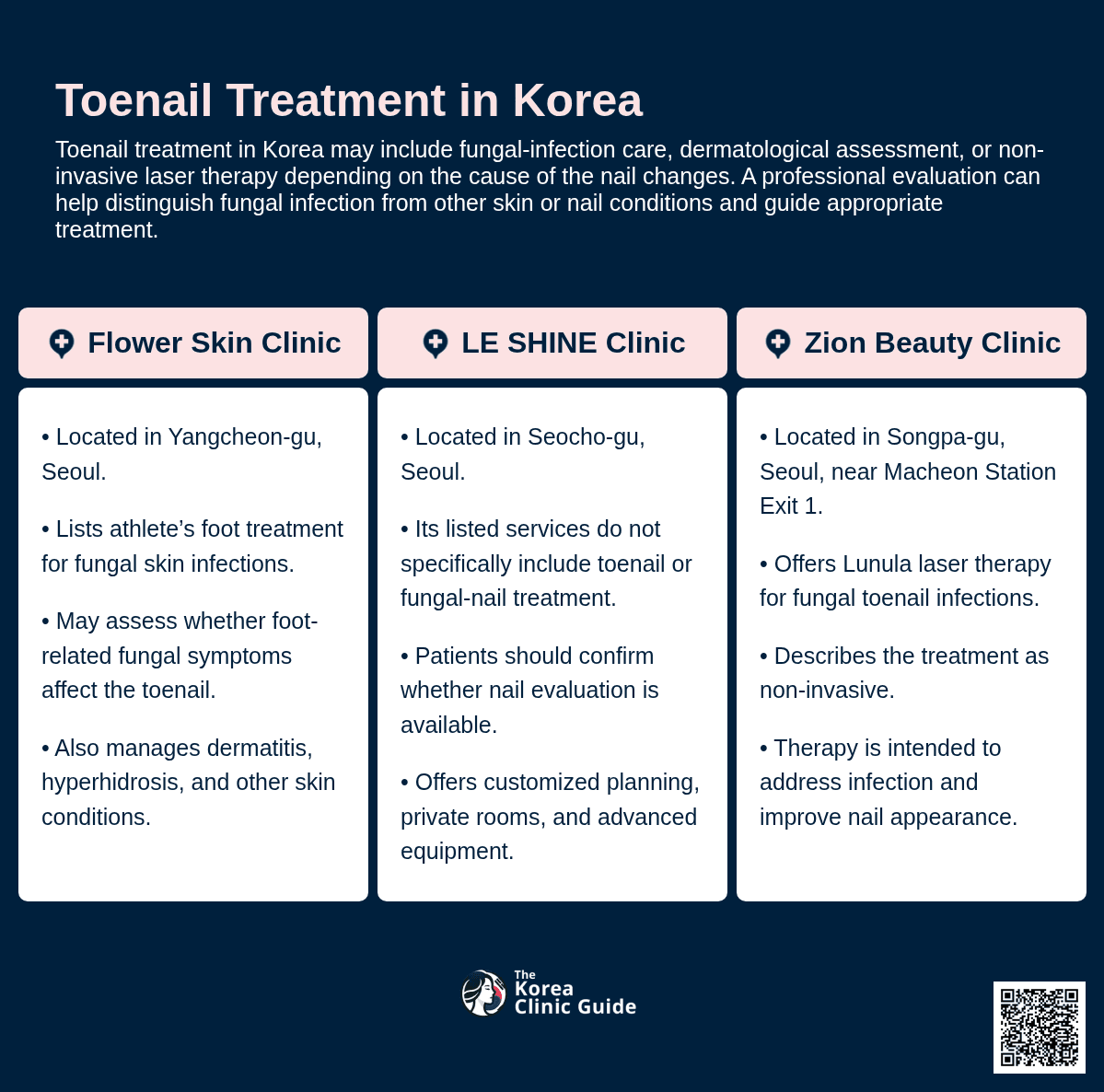
Listed below are some of the best clinics in Korea for toenail treatment.
1. Flower Skin Clinic
You may consider Flower Skin Clinic if your toenail concern may be related to a fungal skin infection, as the clinic specifically lists athlete’s foot treatment among its skin-disease services. The available information does not confirm a dedicated toenail-fungus treatment or nail procedure, so an assessment would be important to determine whether its listed fungal-infection care fits your needs.
- URL: Flower Skin Clinic Website
- Location: Yangcheon-gu, Seoul
- Relevant care:
- Lists athlete’s foot treatment intended to address fungal infections and support healthy skin.
- Also provides diagnosis and management for contact dermatitis, hyperhidrosis, and other inflammatory skin conditions that can affect the feet.
2. LE SHINE Clinic
You may consider LE SHINE Clinic only after confirming that it treats your specific toenail condition: its provided service list focuses on aesthetic skin, body-contouring, anti-aging, and eyelid procedures and does not identify toenail treatment or fungal-nail care. Its individualized skin diagnosis and private-room setting may be relevant if the clinic confirms an appropriate service.
- URL: LE SHINE Clinic Website
- Location: Seocho-gu, Seoul
- What to confirm:
- The available information does not list toenail fungus treatment, nail procedures, or foot-focused dermatology services.
- Ask whether the clinic evaluates nail changes, identifies possible fungal infection, and provides a treatment appropriate for your diagnosis.
- Clinic setting:
- Describes customized treatment planning based on a comprehensive skin diagnosis.
- Lists private rooms and advanced medical equipment.
3. Zion Beauty Clinic
You may consider Zion Beauty Clinic for toenail fungus treatment because it specifically offers Lunula laser therapy, a non-invasive treatment listed for fungal toenail infections and for improving the appearance of affected nails.
- URL: Zion Beauty Clinic Website
- Location: Songpa-gu, Seoul
- Procedure details:
- Lunula is listed as laser therapy for toenail fungus.
- The clinic describes it as a non-invasive option intended to eliminate fungal infection and improve nail appearance.
- Additional notes: The clinic is located near Macheon Station Exit 1 on Seoul Subway Line 5.
Toenail Treatment From Start to Finish
- Remote enquiry and triage — Send clear photographs, symptom duration, prior test results, previous treatments, medical history, allergies, pregnancy or breastfeeding status, and a full medication list. An English or virtual consultation can help plan the visit but cannot replace examination or needed testing.
- In-person examination — The clinician examines the nail, surrounding skin, and possible athlete’s foot; reviews trauma, footwear, sports exposure, diabetes, vascular disease, neuropathy, and medicines; then determines whether the problem is fungal, ingrown, traumatic, inflammatory, or suspicious.
- Diagnostic testing or urgent referral — Suspected fungus is sampled when indicated before prolonged antifungal therapy. A changing dark band, pigment extending onto skin, bleeding, ulceration, or mass is directed to a nail-unit diagnostic pathway, which can include onychoscopy and biopsy rather than routine fungus treatment.
- Treatment planning — The clinician discusses debridement, topical or oral medicine, partial avulsion, and whether permanent matrix treatment is appropriate. For oral therapy, review liver status and drug interactions; for recurrent ingrowing, explain the permanent narrowing caused by partial matricectomy.
- Treatment day — Debridement, sampling, prescriptions, and device sessions are outpatient. For partial avulsion, local anesthetic is injected around the toe, the involved nail edge is removed, and the matrix is treated only when planned to prevent recurrence. Fasting is usually unnecessary for local anesthetic alone.
- Dressing and same-day discharge — A sterile dressing is applied. Leave wearing open-toe or roomy footwear, keep the foot elevated, limit walking, and avoid driving until the bulky dressing no longer compromises safe pedal control.
- Early wound review — Attend the first dressing review, commonly within 1–4 days after ingrown-nail surgery. The clinician checks bleeding, infection, pain, and whether home travel is appropriate.
- Overseas follow-up — Continue clinician-directed wound care or oral-antifungal monitoring at home. Send wound photographs only if the treating clinic requests them; obtain in-person local care promptly for worsening symptoms.
Alternatives to Toenail Treatment
The best alternative depends on the diagnosis. Conservative or topical care avoids a permanent nail change and systemic-drug exposure but takes longer and is less suitable for severe disease. Surgical matrix treatment is more durable for recurrent ingrowing but deliberately changes nail width.
Conservative ingrown-nail care
- Best suited to early disease — Straight-across trimming, wider toe-box footwear, moisture control, and clinician-directed cotton or gutter-splint techniques can help mild ingrowing without major granulation tissue or repeated infection.
- Tradeoff — This does not reliably correct a recurrent nail edge that repeatedly penetrates skin.
Topical or oral antifungal therapy
- Topical option — Best for selected limited confirmed disease or patients unable to take systemic medicine; requires consistent application for many months.
- Oral option — Better suited to medically eligible patients with confirmed extensive disease than relying on laser alone. It requires liver and interaction review.
Surgical matrix excision
- Alternative technique — Direct surgical removal of the involved matrix can be selected instead of chemical matrix ablation for recurrent ingrowing.
- Tradeoff — Both approaches aim to prevent regrowth of the treated side and create permanent narrowing; the clinician selects the technique based on anatomy, recurrence, healing factors, and expertise.
Nail-unit diagnostic assessment
- Essential safety pathway — Dermoscopy, microbiology, nail clipping, and biopsy address a suspicious pigmented, bleeding, ulcerated, or destructive lesion.
- Tradeoff — This is not cosmetic treatment or a substitute for fungal care; it is necessary when melanoma or another tumor is part of the differential diagnosis.
How Can I Prepare for Toenail Treatment?
- Send complete medical information — Disclose diabetes, neuropathy, peripheral arterial disease, immune suppression, liver disease, pregnancy or breastfeeding, prior antifungal reactions, and all prior nail treatments.
- Bring every medicine and supplement — Flag aspirin, clopidogrel, warfarin, apixaban, rivaroxaban, insulin, statins, cardiac medicines, antidepressants, over-the-counter products, and supplements. Do not stop prescribed medicines independently; the nail clinician and original prescriber must give individualized instructions.
- Plan oral-antifungal safety checks — Before terbinafine or another systemic drug, arrange pretreatment liver assessment, interaction review, and a home-country plan for laboratory monitoring and prescription continuation.
- Follow fasting instructions exactly — Fasting is generally unnecessary for a local-anesthetic nail procedure unless sedation is planned. Confirm the facility’s requirement before attending.
- Prepare footwear and transport — Wear open-toe or loose footwear and bring a clean sandal that does not compress the dressing. Arrange transport to accommodation, avoid a long walking itinerary, and ensure a clean place for dressing changes.
- Keep travel flexible — Do not book a non-changeable flight immediately after matrix treatment. Allow time for the first wound review and delay departure if bleeding, pain, or mobility makes travel unsuitable.
Travel note: Book home follow-up before departure, especially after surgery or when starting oral antifungals. A remote message cannot replace assessment of spreading infection or a wound that is failing to heal.
Confirm clinic-specific testing, fasting, medication, dressing, and travel requirements with the treating doctor; individualized instructions take precedence over general guidance.
Aftercare Advice
Protect the wound and follow the prescribed treatment plan: nail surgery heals over weeks, while fungal improvement depends on healthy nail growing out over many months.
- Dressing and elevation — Keep the initial dressing clean and dry, elevate the foot on the treatment day, reduce standing and walking, and attend scheduled redressings. A first review is commonly arranged within 1–4 days after an ingrown-nail procedure.
- Footwear, activity, and water exposure — Wear loose footwear. Avoid swimming, soaking, sport, and prolonged walking until the treating clinician confirms that wound healing permits them. Do not drive until safe pedal control and an emergency stop are possible without dressing-related restriction.
- Oral-antifungal warning signs — Seek prompt medical review for jaundice, dark urine, persistent nausea or appetite loss, marked fatigue, severe rash, facial swelling, or significant taste or smell disturbance during terbinafine treatment.
- Wound warning signs — Obtain urgent review for worsening pain, spreading redness or warmth, increasing swelling, pus or foul discharge, fever, persistent bleeding despite elevation and gentle pressure, new numbness, or an excessively tight dressing.
- Result timing and recurrence prevention — Ingrown-nail pain often improves after the offending edge is removed, but a phenol-treated wound commonly needs 4–6 weeks to heal. A clearer great toenail can take 12 months or longer after successful fungal treatment because the damaged nail must grow out; treat coexisting athlete’s foot and keep footwear dry to reduce reinfection.
Follow the treating doctor’s instructions over this general advice and contact the clinic or a local clinician promptly when healing appears abnormal.
Frequently Asked Questions
Related Blogs
Filler Dissolver in Korea: Hyaluronic Acid Reversal, Recovery, Risks, and Travel Planning
Hyaluronic acid filler dissolution uses targeted hyaluronidase injections, with ultrasound assessment when filler is old, migrated, deep, periocular, or uncertain. International patients can plan consultation, outpatient treatment, a review at about 48 hours, written treatment records, and remote follow-up; urgent pain, skin-color changes, visual symptoms, or neurological symptoms require immediat
Updated: Sep 28, 2026
Collagen Filler in Korea: Products, Safety, Recovery, and Travel Planning
Collagen filler treatment involves confirming the exact product, medical screening, possible allergy testing, outpatient injection, and follow-up planning. International patients should stay in Korea for 2–3 days, expect bruising or swelling for up to 1–2 weeks, and obtain emergency contacts and complete product records.
Updated: Sep 27, 2026
Ultracol in Korea: Candidates, Safety, Recovery, and Travel Planning
Ultracol is a PDO microsphere injectable intended in Korea for temporary improvement of bilateral nasolabial folds, delivered after eligibility review and product-label verification. The article covers candidate screening, outpatient treatment and recovery, travel planning, aftercare, warning signs, follow-up, and alternatives.
Updated: Sep 27, 2026

Korean Arginine Fluid Optimization: See How Costs Stack Up Against Germany, China, and More Countries
Explore the cost dynamics of Arginine Fluid in Korea, examining factors influencing its pricing and availability. Discover how economic and healthcare trends impact the accessibility of this essential amino acid supplement.
Updated: Sep 27, 2026