Medical Tourism Blog
Salivary Gland Removal Surgery in Korea: Types, Risks, Recovery and Travel Planning
Table of contents
- Salivary Gland Removal Surgery at a Glance
- What Is Salivary Gland Removal Surgery?
- Who Is a Good Candidate for Salivary Gland Removal Surgery?
- What Are the Different Types of Salivary Gland Removal Surgery?
- Why Visit Korea for Salivary Gland Removal Surgery?
- Key Information for International Patients
- Which Are the Best Clinics in Korea for Salivary Gland Removal Surgery?
- Salivary Gland Removal Surgery From Start to Finish
- Alternatives to Salivary Gland Removal Surgery
- How Can I Prepare for Salivary Gland Removal Surgery?
- Aftercare Advice
Considering treatment in Korea? Everything you need to know e.g. — how to avoid scams, visas, interpreters, recovery tips — in our Medical Tourism Master Guide. Plan with confidence in minutes, not weeks!
Last updated: October 2026
Salivary Gland Removal Surgery at a Glance
- Procedure scope — Salivary gland removal can mean submandibular excision below the jaw, parotidectomy near the ear, sublingual-gland excision inside the mouth, or cosmetic partial submandibular reduction; the gland, side, diagnosis, and extent should be specified before surgery.
- Best candidates — Medical candidates may have recurrent stones or infection, a tumor, or refractory drooling; cosmetic reduction is only appropriate when prominent submandibular glands—not fat, loose skin, platysma bands, skeletal anatomy, or an unexplained mass—cause neck fullness.
- Recovery and results — Straightforward unilateral submandibular surgery is often outpatient or requires one overnight stay, with swelling and tightness most noticeable for 1–2 weeks; nerve symptoms, scars, and cosmetic contour swelling can take weeks to months to settle.
- Major anatomy-specific risks — Submandibular surgery can affect lower-lip movement, tongue sensation, or tongue movement, while parotidectomy carries facial-weakness, ear-numbness, salivary-leak, and later Frey-syndrome risks; rapidly expanding neck swelling is an airway emergency.
- Cosmetic evidence limitation — Cosmetic partial submandibular reduction permanently removes functioning tissue and has mostly observational evidence; a 2026 review of 2,971 patients reported a 15.1% overall complication rate, with marginal-mandibular nerve injury most often reported.
- Korea stay requirement — Plan at least 10–14 days in Korea for an uncomplicated unilateral benign or cosmetic procedure, or 2–3 weeks for parotidectomy, combined neck surgery, persistent drains, significant swelling, or complications; suspected cancer may require an open-ended stay.
- Korea technique distinction — Korean centers have published experience with robotic, endoscopic, hidden-scar, and drainless salivary approaches, but these options are selective and do not prove superior safety or outcomes; confirm the surgeon’s gland-specific experience, pathology access, and facial-nerve monitoring when relevant.
What Is Salivary Gland Removal Surgery?
Salivary gland removal surgery is an operation that removes all or part of a saliva-producing gland, usually to treat disease or, less commonly, reduce gland-related neck fullness. It aims to relieve persistent blockage, infection, tumors, or excessive drooling, or improve a defined jaw-and-neck contour. It is a surgical procedure, typically performed under general anesthesia.
Who Is a Good Candidate for Salivary Gland Removal Surgery?
- Persistent gland disease — Candidates for medically indicated surgery include people with recurrent obstruction or infection, a salivary stone not suitable for gland-preserving treatment, a confirmed tumor, or selected refractory sialorrhea.
- Defined cosmetic anatomy — Cosmetic partial submandibular-gland reduction is for adults whose blunt jaw-to-neck angle is demonstrably caused by prominent glands, rather than primarily by submental fat, loose skin, platysma banding, skeletal structure, lymph nodes, or an uncharacterized mass.
- Appropriate operative fitness — Suitable patients can undergo general anesthesia, have a reviewed bleeding-risk plan, and can remain in Korea for early wound and drain review.
- Realistic expectations — Good candidates understand that excision or reduction permanently removes functional salivary tissue, leaves an incision or intraoral wound depending on the approach, and does not correct every source of neck fullness.
An unexplained lump, rapid enlargement, facial weakness, suspicious imaging, or neck lymph nodes requires ENT/head-and-neck assessment and tumor work-up before cosmetic surgery is considered. Defer nonurgent surgery for active infection, uncontrolled medical illness, or unreviewed anticoagulant or antiplatelet therapy; never stop blood thinners independently. Bilateral removal or reduction requires particular caution in people with significant dry mouth, Sjögren disease, prior head-and-neck radiation, dehydration risk, or medication-related xerostomia. Elective cosmetic surgery is generally postponed during pregnancy, and active nicotine exposure is a reason to delay elective surgery where feasible because wound healing is impaired.
What Are the Different Types of Salivary Gland Removal Surgery?
“Salivary gland removal” covers several operations with different anatomy, risks, scars, and recovery needs. Consent should state the gland, side, diagnosis, extent of removal, access route, and whether pathology is planned.
- Submandibular-gland excision — Removes one gland beneath the jaw, usually through a neck incision, for chronic obstruction, infection, or a tumor. The marginal mandibular facial-nerve branch, lingual nerve, and hypoglossal nerve are important nearby structures.
- Parotidectomy — Removes part or all of the gland in front of and below the ear. Facial-nerve preservation is pursued whenever oncologically possible, but cancer can require nerve sacrifice; facial weakness, ear numbness, salivary leakage, and Frey syndrome are distinctive concerns.
- Sublingual-gland excision — Usually an intraoral operation, commonly used for ranula-related disease. Mouth-care and diet instructions differ from those for an external neck incision.
- Cosmetic partial submandibular reduction — Removes only part of a prominent submandibular gland during deep neck contouring, often alongside platysma work, neck lift, or submental liposuction. It is not interchangeable with medical gland excision and has a largely observational evidence base with heterogeneous techniques and complication reporting.
- Scar-conscious approaches — Endoscopic, robotic, transoral, hidden-hairline, and related approaches are selective options. A 2026 review of 18 studies involving 364 patients found higher cosmetic satisfaction with endoscope-assisted submandibular surgery but longer operative time and incision length, without significant differences in hospital stay or postoperative complications; this does not establish superiority or suitability for cancer and complex anatomy.
Why Visit Korea for Salivary Gland Removal Surgery?
Korea has published experience in endoscopic, hidden-scar, drainless, and robotic salivary procedures. That availability can broaden a selected patient’s discussion of access and incision placement, but it does not prove that Korea has superior safety or long-term results. For medical gland surgery, diagnostic accuracy, facial-nerve management, pathology access, and emergency backup matter more than a cosmetic-access claim.
- Published local technique experience — Korean otolaryngology literature documents endoscopic and robotic approaches to salivary-gland surgery, including robotic submandibular-gland excision. Ask whether that exact technique is appropriate for the diagnosis rather than assuming it is preferable.
- Technique-specific confirmation — Request the surgeon’s relevant ENT/head-and-neck or facial-plastic credentials, personal experience with the planned gland and approach, and whether facial-nerve monitoring is available for parotid surgery.
- Pathology and escalation planning — For a mass, confirm preoperative imaging and needle-biopsy plans where indicated, pathology turnaround, tumor-board or oncology referral pathways, and what happens if final pathology changes treatment.
- Evidence limitation — Cosmetic partial submandibular reduction has growing but nonrandomized evidence. A 2026 systematic review of 51 studies and 2,971 patients reported a 15.1% overall complication rate and identified marginal-mandibular nerve injury as the most commonly reported complication, while emphasizing major variation in technique, selection, and reporting.
Key Information for International Patients
- Minimum stay — Plan at least 10–14 days in Korea for a straightforward unilateral benign or cosmetic procedure, allowing for assessment, surgery, drain or wound review, and an in-person postoperative examination. Plan 2–3 weeks for parotidectomy, combined neck surgery, substantial swelling, a persistent drain, or any complication.
- Cancer and uncertain pathology — Do not book a fixed return flight for a suspected or confirmed malignancy. Final pathology can lead to staging, additional surgery, radiation planning, or oncology follow-up.
- Flying home — There is no evidence-based universal postoperative flight day for salivary-gland surgery. The surgeon must clear travel after confirming wound and airway stability, no expanding hematoma or infection, appropriate mobility and hydration, drain resolution, and an individualized thrombosis assessment; postoperative immobility and long-distance travel increase clot concerns.
- Itinerary limits — Keep the first postoperative week flexible. Avoid strenuous sightseeing, heavy luggage, gyms, alcohol, and activities that raise blood pressure or strain the neck until cleared.
- Remote follow-up — Leave with an English written operative summary, medication list, pathology report when available, wound-care plan, emergency instructions, and direct contact details. Arrange a named clinician at home for in-person care if a wound, nerve, or pathology issue develops after departure.
Travel note: A rapidly enlarging neck or facial swelling after surgery can threaten the airway. Stay close to the operating facility until the surgeon confirms that early complications and drain-related issues are unlikely to require urgent treatment.
Which Are the Best Clinics in Korea for Salivary Gland Removal Surgery?
Listed below are some of the best clinics in Korea for salivary gland removal surgery.
1. LABOM Plastic Surgery
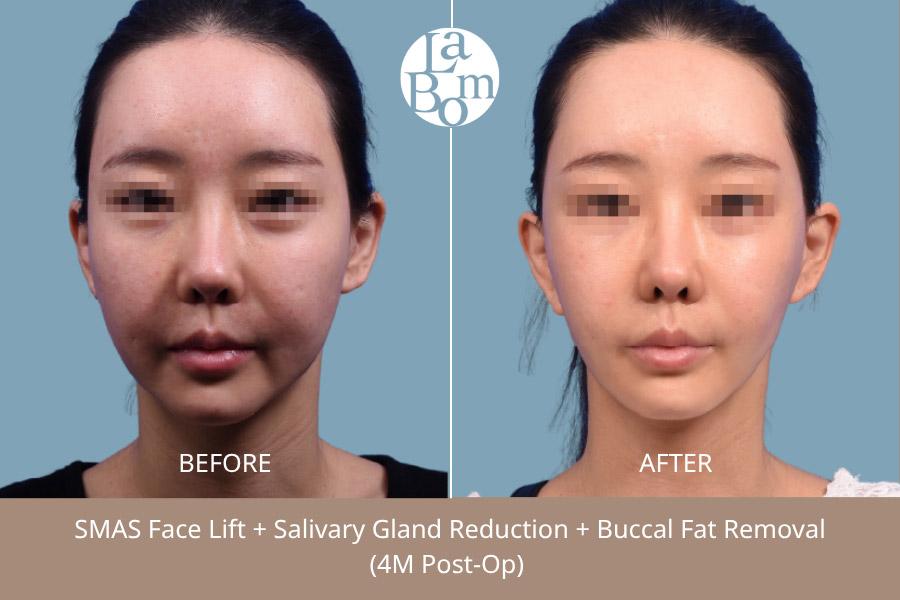
For salivary gland removal surgery, LABOM Plastic Surgery’s documented strengths are individualized facial-anatomy assessment and anti-aging surgical planning that prioritizes natural facial balance rather than overcorrection. You can expect a specialist-led consultation to consider your facial structure and the degree of aging when discussing an appropriate lower-face approach.
- URL: LABOM Plastic Surgery Website
- Location: Gangnam-gu, Seoul
- Planning approach:
- Each surgical design is customized one-to-one rather than based on a standardized template.
- Planning is grounded in facial anatomy, tissue position, structure, and harmony across the whole face.
- The clinic emphasizes preserving natural expression and avoiding excessive intervention.
- Related facial procedures:
- Its Triple Face Lift addresses skin, SMAS, and deep-fat layers to reposition sagging cheek fat and improve facial and neck laxity.
- Facial liposuction uses micro-cannulas for targeted cheek and chin fat removal and may be combined with V-line contour lifting.
- Facial fat grafting uses purified autologous fat to restore facial volume in areas such as the forehead and nasolabial folds.
- Care and recovery support:
- Procedures are directly performed by plastic-surgery specialists with more than 30 years of clinical experience in facial and hand anti-aging procedures.
- Pre-operative diagnosis, anesthesia, and continuous monitoring systems are described as part of its surgical process.
- Aftercare includes regular progress checks and structured support for recovery, swelling, bruising, and scar management, with individualized plans for international visitors.
Salivary Gland Removal Surgery From Start to Finish
- Remote consultation and records review — Send symptom history, photographs only when relevant to cosmetic contouring, prior imaging, biopsy or pathology reports, medication and allergy lists, and details of prior head-and-neck surgery or radiation. Confirm whether English or virtual consultation is available and whether an in-person diagnostic review is required before surgery.
- Diagnostic assessment in Korea — The team examines the mouth, neck, gland, and relevant cranial-nerve function. Ultrasound, CT, or MRI can assess obstruction or a mass; suspicious lesions often require ultrasound-guided fine-needle aspiration before the operative plan is finalized.
- Surgical planning and consent — The surgeon confirms the gland, side, indication, access route, planned extent of removal, scar location, gland-preserving options, nerve-specific risks, pathology plan, expected admission, and postoperative travel plan. Cosmetic patients need confirmation that gland prominence is the actual anatomical cause of fullness.
- Pre-anesthesia review — Anesthesia staff review medical conditions, fasting status, diabetes or GLP-1 medicines, allergies, and bleeding-risk medicines. Most excision and reduction procedures use general anesthesia.
- Operation — The surgeon removes the planned gland tissue while dissecting around adjacent nerves and vessels. Parotidectomy prioritizes facial-nerve identification and preservation when cancer control permits; disease-related specimens are generally sent for pathology. Operative duration depends on the gland, extent, access route, prior inflammation or surgery, and whether neck contouring is combined.
- Recovery and discharge — Recovery staff monitor breathing, swallowing, bleeding, pain, nausea, facial movement where relevant, and the wound. Uncomplicated unilateral submandibular surgery is often outpatient or involves one overnight stay; a drain can remain temporarily.
- In-person postoperative checks — The surgeon reviews the incision or intraoral wound, drain output and removal, swelling, nerve function, and pathology. Parotid follow-up also evaluates facial function, salivary leak or fistula, and later gustatory sweating.
- Overseas handover — Before departure, obtain written fitness-to-fly clearance, a medical summary, pathology documentation, and a remote follow-up schedule. Send clear wound photographs only through the clinic’s approved secure channel and seek local urgent care for warning signs rather than waiting across time zones.
Alternatives to Salivary Gland Removal Surgery
The best alternative depends on the diagnosis and the anatomical cause of neck fullness. Gland-preserving approaches retain salivary function but are not suitable for every stone, scarred duct, infection, or tumor; cosmetic alternatives can treat fat, skin, or platysma without removing gland tissue.
Sialendoscopy and Stone Treatment
- Best suited to — Obstruction or recurrent stone disease when duct anatomy, stone size and location, infection status, and local expertise permit preservation.
- Tradeoff — Sialendoscopy, duct dilation, basket extraction, lithotripsy, transoral stone removal, and combined approaches can preserve the gland, but some disease still requires excision.
Gland-Preserving Tumor Surgery
- Best suited to — Carefully selected benign submandibular tumors after diagnostic work-up.
- Tradeoff — A 2026 meta-analysis found better unstimulated salivary flow and fewer marginal-mandibular nerve injuries with preservation, but it included only four studies and does not apply to malignant disease.
Sialorrhea Treatment
- Best suited to — Excessive drooling where medication, botulinum-toxin injections, or duct procedures are clinically appropriate.
- Tradeoff — These options avoid permanent gland removal but can be temporary, incomplete, or unsuitable depending on the underlying neurological and swallowing condition.
Neck Contouring Procedures
- Best suited to — Fullness caused mainly by fat, loose skin, or platysma rather than gland prominence.
- Tradeoff — Neck lift, double-chin liposuction, and face liposuction address different tissue layers. They do not remove a truly prominent submandibular gland, but avoid removal of functioning salivary tissue when the gland is not the cause.
How Can I Prepare for Salivary Gland Removal Surgery?
- Submit records early — Provide prior ultrasound, CT, MRI, biopsy and pathology reports or slides, and details of prior surgery or radiation. A suspicious lump requires diagnostic review before travel for a cosmetic procedure.
- Disclose every medicine — Give the surgeon and anesthesia team a complete list of prescription medicines, aspirin, NSAIDs, anticoagulants, antiplatelets, diabetes drugs including GLP-1 medicines, vitamins, herbal products, and supplements. Do not stop blood thinners or diabetes medicines without a written plan from the prescribing clinician and operating team.
- Follow fasting instructions exactly — Fasting timing, permitted clear fluids, and medication doses are anesthesia-specific. Use only the clinic’s written instructions, not a generic online schedule.
- Stop nicotine and limit alcohol — Tell the team about smoking, vaping, nicotine replacement, cannabis, and alcohol use. Elective surgery is commonly delayed where nicotine exposure threatens healing; the surgeon must specify abstinence requirements.
- Protect the treatment area — Avoid sunburn, skin infection, shaving cuts, and unapproved topical products near the face, jaw, or neck. Report a cold, dental infection, oral ulcer, fever, or new swelling before surgery.
- Arrange practical support — Book accommodation near the operating facility, avoid solo discharge after general anesthesia, arrange an adult companion for the first night when required, and do not plan to carry luggage or undertake strenuous sightseeing.
- Keep flights flexible — Purchase changeable travel where possible and arrange travel insurance that does not exclude planned treatment or postoperative complications.
Travel note: Pack records in carry-on luggage and ensure the clinic gives a 24-hour emergency contact and a written plan for care after you return home.
Confirm the clinic’s own fasting, medicine, nicotine, alcohol, diet, wound-care, drain, and travel requirements; the treating doctor’s individualized instructions take precedence.
Aftercare Advice
Protect the wound and watch neck or facial swelling closely: an expanding hematoma can become an airway emergency.
- Activity and lifting — Walk regularly as cleared, but avoid heavy lifting, straining, vigorous exercise, bending that increases neck pressure, and activities that raise blood pressure until the surgeon clears them.
- Wound and drain care — Keep the external incision, dressing, and drain clean and dry exactly as instructed. Do not pull, clamp, or remove a drain yourself. For intraoral surgery, follow the prescribed mouth-rinse and diet plan rather than external-incision advice.
- Pain, hydration, and medicines — Take prescribed medication only as directed, maintain fluids and adequate nutrition, and avoid alcohol while using sedating pain medicines. Contact the team if nausea, pain, or poor oral intake prevents hydration.
- Scar and sun protection — Once the wound is fully closed and the surgeon approves, protect an external scar from sun with clothing and broad-spectrum SPF 50. Swelling, tightness, sensory changes, and scar maturation can take weeks to months to settle.
- Urgent warning signs — Seek emergency assessment for rapidly enlarging neck or facial swelling, breathing or swallowing difficulty, uncontrolled bleeding, fever, spreading redness, pus, severe dehydration, new sudden facial weakness, inability to close an eye after parotid surgery, or a new saliva-like fluid collection. A cosmetic series reported early reoperation for significant hematoma in 1.8% of 112 cases, including one potentially fatal event.
- Follow-up and results — Attend wound, drain, facial-function, and pathology reviews before travel. Do not judge cosmetic contour until edema and firm postoperative tissue have resolved, often over several months; parotid follow-up can also identify delayed Frey syndrome.
Follow the treating doctor’s instructions over general guidance, and contact the clinic promptly when swelling, drainage, pain, facial movement, or wound appearance seems wrong.
Frequently Asked Questions
Related Blogs
Global Cost Review: Why Double Jaw Surgery in Korea is Gaining Popularity Over the USA, Mexico, and Europe
Discover the cost of double jaw surgery in Korea, a popular destination for medical tourism due to its advanced healthcare facilities and skilled surgeons. Learn about the factors influencing the price, including hospital fees, surgeon expertise, and post-operative care options.
Updated: Oct 21, 2026
Discover the Global Journey of Chin Surgery: Comparing Korea’s Costs to Top Destinations
Discover the factors influencing the cost of chin surgery in Korea, known for its advanced cosmetic procedures and competitive pricing. Learn what to expect, from consultation fees to post-operative care, to make an informed decision about undergoing chin surgery in this popular medical tourism destination.
Updated: Oct 20, 2026
Comparing Square Jaw Surgery Costs: Korea vs Global Destinations for Cosmetic Excellence
Discover the latest insights on the cost of square jaw surgery in Korea, exploring factors that influence pricing, including clinic reputation and surgical techniques. This comprehensive guide helps potential patients navigate their budgeting decisions for a transformative procedure.
Updated: Oct 19, 2026
Choosing Korea for Cheekbone Reduction: A Detailed Global Cost Comparison
Explore the cost of cheekbone reduction surgery in Korea, a popular destination for cosmetic procedures. Learn about the factors influencing price, the typical range, and what to expect from the experience.
Updated: Oct 19, 2026