Medical Tourism Blog
Panniculectomy in Korea: Candidacy, Recovery, Travel Planning, and Alternatives
Table of contents
- Panniculectomy at a Glance
- What Is a Panniculectomy?
- Who Is a Good Candidate for a Panniculectomy?
- How Is a Panniculectomy Performed?
- Why Visit Korea for a Panniculectomy?
- Key Information for International Patients
- Which Are the Best Clinics in Korea for Panniculectomy?
- Panniculectomy From Start to Finish
- Alternatives to a Panniculectomy
- How Can I Prepare for a Panniculectomy?
- Aftercare Advice
Considering treatment in Korea? Everything you need to know e.g. — how to avoid scams, visas, interpreters, recovery tips — in our Medical Tourism Master Guide. Plan with confidence in minutes, not weeks!
Last updated: September 2026
Panniculectomy at a Glance
- What it does — Panniculectomy removes the hanging lower-abdominal apron of excess skin and subcutaneous fat to relieve problems such as recurrent rash, skin breakdown, friction, hygiene difficulty, and impaired mobility; it is not a weight-loss procedure.
- Best candidates — Strong candidates have a stable or near-stable weight after major weight loss, adequate nutrition, a functionally troublesome pannus, and the ability to manage drains, wound care, early walking, and follow-up; nicotine exposure, uncontrolled diabetes, pregnancy, or untreated nutritional deficiencies usually delay surgery.
- Scar and scope — The operation leaves a long permanent lower-abdominal scar and commonly uses drains; unlike a tummy tuck, it does not automatically include abdominal muscle repair or cosmetic umbilical repositioning.
- Recovery timeline — Plan about 2 weeks of protected recovery; desk work may be feasible at 2–3 weeks after an uncomplicated procedure, while heavy lifting, vigorous exercise, and abdominal strain are usually restricted for 4–6 weeks or until surgeon clearance.
- Meaningful risk — Wound separation, infection, fluid collection, bleeding, skin necrosis, and blood clots are important risks; in one 238-patient academic series, major complications occurred in 22.3%, with higher BMI and active smoking linked to increased risk.
- Korea travel stay — International patients should plan to stay in South Korea for at least 14–21 days after an uncomplicated panniculectomy for wound checks, drain care, mobility assessment, and flight planning; a longer stay may be needed if drains remain or healing is delayed.
- Korea-specific due diligence — No robust evidence shows better panniculectomy outcomes in Korea, and no national Korean panniculectomy complication benchmark was identified; verify foreign-patient facility authorization and obtain a written plan for drain removal, local wound reviews, emergency escalation, and follow-up after returning home.
What Is a Panniculectomy?
Panniculectomy is an operation that removes a hanging apron of excess lower-abdominal skin and fat. It aims to relieve skin-fold rash, irritation, hygiene difficulties, friction, and movement problems caused by the overhang, rather than produce weight loss. It is a surgical body-contouring procedure.
Who Is a Good Candidate for a Panniculectomy?
- Functional pannus concerns — Good candidates have a hanging lower-abdominal apron causing recurrent intertrigo, skin breakdown, moisture and hygiene difficulty, friction, mobility problems, or obstruction of the groin or pubic area.
- Stable post-weight-loss profile — Candidates have reached a stable or near-stable weight after major weight loss or bariatric surgery and can maintain adequate protein, iron, vitamin, and overall nutritional status.
- Prepared for scar and aftercare — This operation leaves a long permanent lower-abdominal scar. Candidates can manage incision and drain care, walk early after surgery, attend local reviews, and arrange support after returning home.
- Realistic surgical goal — Panniculectomy removes excess skin and subcutaneous fat; it is not weight-loss surgery and does not automatically include muscle repair or cosmetic umbilical repositioning.
Active nicotine exposure, uncontrolled diabetes, significant untreated heart, lung, kidney, or systemic disease, pregnancy, ongoing major weight loss, and untreated nutritional deficiency are reasons to defer elective surgery. Smoking is particularly important: in a 238-patient academic series, active smoking and higher BMI were independently associated with major complications, which occurred in 22.3% of patients overall; this is not an individual risk estimate, but it supports careful optimization before surgery. Prior abdominal operations, scars, hernia symptoms, mobility, VTE history, medication use, and ability to undergo general anesthesia all affect candidacy and the incision plan. The surgeon must also assess whether excess skin is mainly horizontal, vertical, or extends to the flanks, because that determines scar length and whether a more extensive excision is appropriate.
How Is a Panniculectomy Performed?
The technique is selected after an in-person examination of the pannus distribution, prior scars, skin quality, hernia concerns, and the amount of correction needed. All approaches trade more skin removal for a longer scar and a larger wound-care burden.
- Standard transverse panniculectomy — A low horizontal incision removes the lower-abdominal apron. The scar can extend toward the hips when a larger pannus is removed, and closed-suction drains are frequently used.
- Extended panniculectomy — The horizontal excision continues farther toward the flanks or hips to address lateral tissue. It broadens contour correction but increases scar length and operative field.
- Fleur-de-lis panniculectomy — A vertical midline excision is added to the horizontal excision for marked skin laxity in both directions after major weight loss. It can improve waist and upper-abdominal contour but adds a vertical scar and a wound junction that needs close monitoring.
- Selective adjuncts — Limited liposuction, mons lift, scar revision, umbilical work, or hernia repair can be considered when clinically indicated. These are not routine parts of panniculectomy and can change complication risk, recovery, and travel timing.
Why Visit Korea for a Panniculectomy?
Korea can be considered only after confirming that the actual facility is authorized to treat foreign patients and can provide full surgical, anesthesia, drain, and complication follow-up. There is no robust peer-reviewed evidence that panniculectomy outcomes in South Korea are better than those in other destinations. Treat registration and international-patient systems as organizational safeguards, not evidence of superior surgical results.
- Provider verification — Use Korea’s foreign-patient medical-provider registration system to support due diligence, then confirm the surgeon’s abdominal body-contouring experience, anesthesia arrangements, overnight-observation policy, and emergency escalation pathway directly with the facility.
- Written continuity plan — Ask for a written schedule for wound reviews, drain-output thresholds, drain removal, medication management, and remote follow-up before paying a deposit. This is more important for panniculectomy than convenience-focused travel services because wound problems can require repeated in-person care.
- Evidence limitation — A reported Korean surgical-quality platform analyzed other surgical specialties rather than panniculectomy or plastic surgery, so it does not provide a Korea-specific panniculectomy benchmark. No national standardized complication rate or long-term patient-reported dataset for Korean panniculectomy was identified.
Key Information for International Patients
- Minimum stay — Plan to remain in South Korea for at least 14–21 days after an uncomplicated operation. This allows early wound reviews, drain management or removal when appropriate, walking assessment, and individualized long-haul-flight planning.
- Longer local recovery — Remain longer with drains, wound concerns, limited walking tolerance, diabetes, high BMI, prior VTE, concurrent hernia repair, or any complication. Do not book a fixed early return flight.
- Flight timing — The CDC advises medical tourists not to fly for 10 days after abdominal surgery. That is a general minimum, not automatic clearance after panniculectomy; incision status, drain status, pain control, mobility, concurrent procedures, and clot risk must guide the operating surgeon’s decision. Recent surgery and long-distance travel both increase VTE risk.
- Activity and itinerary — Expect protected recovery for about two weeks. Desk-type work can be feasible around 2–3 weeks in an uncomplicated recovery, while heavy lifting, vigorous exercise, abdominal strain, and contact activity are commonly restricted for 4–6 weeks or until cleared.
- Follow-up at home — Before departure, obtain the operative report, anesthesia record, discharge summary, medication list, drain log, emergency contacts, and written follow-up plan. Arrange a clinician at home willing to assess wound issues; do not rely on an emergency department for routine drain management.
Travel note: Bring a companion for the early postoperative period when possible. Getting in and out of cars, managing luggage, recording drain output, and responding to a wound concern are difficult when traveling alone.
Which Are the Best Clinics in Korea for Panniculectomy?
Listed below are some of the best clinics in Korea for panniculectomy.
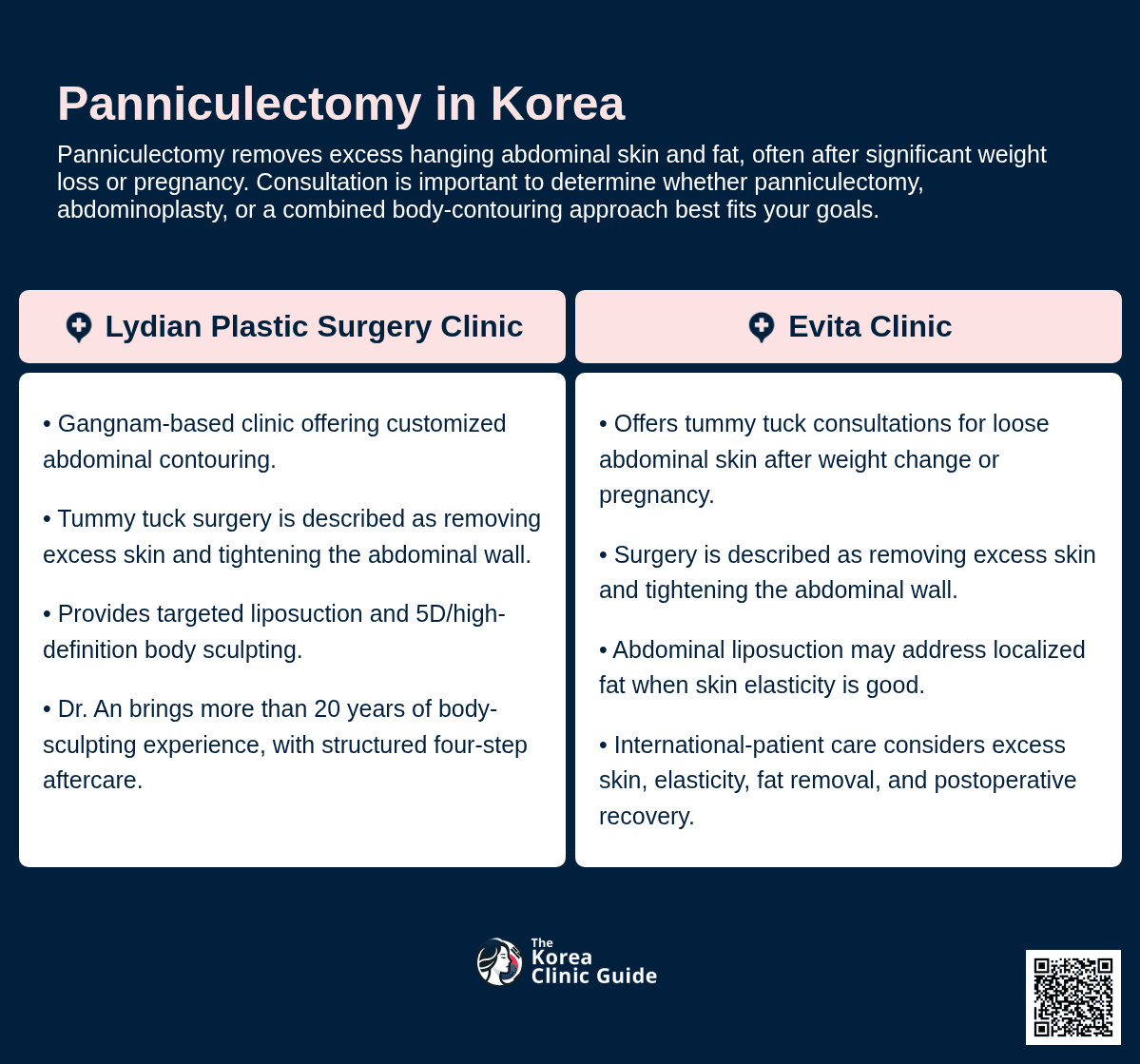
1. Lydian Plastic Surgery Clinic
For abdominal contouring after weight change or pregnancy, you can discuss an abdominoplasty (tummy tuck) at Lydian Plastic Surgery Clinic, which is described as removing excess abdominal skin and fat while tightening the abdominal wall. The available information does not specifically confirm panniculectomy, so you should clarify whether your skin-removal needs can be addressed with a panniculectomy, abdominoplasty, or another tailored approach.
- URL: Lydian Plastic Surgery Clinic Website
- Location: Gangnam-gu, Seoul
- Body-contouring approach:
- Body design is described as anatomy-based and customized to your shape, proportions, and curves.
- The clinic offers targeted liposuction and 5D/high-definition body sculpting in addition to tummy tuck surgery.
- Liposuction may address localized fat, while excess-skin removal and abdominal-wall tightening are described under tummy tuck surgery.
- Surgeon background:
- Dr. An is described as having more than two decades of body-sculpting experience.
- His listed roles include Director of the 5D Liposculpture Academy, clinical professor, and physician trainer in high-definition body sculpting and liposuction devices.
- Aftercare: A four-step aftercare system is described for swelling reduction, irregularity correction, skin-elasticity recovery, and residual-fat contouring.
2. Evita Clinic
At Evita Clinic, you can explore abdominal skin-removal and contouring options through its tummy tuck service, which is described as removing excess abdominal skin and tightening the abdominal wall after weight changes or pregnancy. A panniculectomy is not specifically listed, so you should confirm whether the clinic can offer that procedure or whether a tummy tuck is the more appropriate operation for your goals.
- URL: Evita Clinic Website
- Location: 5F, 815, Nonhyun-ro, Gangnam-gu, Seoul, South Korea
- Abdominal procedure details:
- The clinic describes tummy tuck surgery as an option for loose abdominal skin that has not responded to exercise.
- The procedure is intended to create a flatter, firmer midsection by removing excess skin and tightening the abdominal wall.
- Related body-contouring options:
- Abdominal liposuction is available for localized upper- and lower-abdominal fat when skin elasticity is good.
- Liposuction is presented as body shaping rather than weight-loss treatment, with results influenced by skin quality and postoperative compression.
- Care considerations:
- Evita Clinic describes coordinated peri-operative and postoperative care for international patients.
- Your surgical plan can be assessed in relation to the amount of excess skin, skin elasticity, and whether fat removal is also needed.
Panniculectomy From Start to Finish
- Remote consultation and records — Submit current weight and weight trend, standardized photographs, medication and supplement lists, allergies, prior bariatric and abdominal-operative reports, relevant laboratory results, and photographs or records of recurrent rash or wounds. Confirm whether English-language or virtual consultation is available and ask what must be repeated in Korea.
- Travel and support planning — Reserve flexible flights and accommodation close enough for repeated clinic visits. Arrange a companion, local transport that does not require lifting luggage, and a home clinician for post-return wound assessment.
- In-person assessment — The surgeon examines the pannus, skin quality, prior scars, mobility, possible hernia, and the distribution of excess tissue. The consultation determines whether a standard, extended, or fleur-de-lis excision is appropriate and whether adjunct procedures are medically justified.
- Preoperative clearance — The surgical and anesthesia teams review nicotine exposure, diabetes, heart and lung conditions, VTE history, nutrition, pregnancy status, medications, and anesthesia suitability. Complete requested tests and correct deficiencies or uncontrolled conditions before proceeding.
- Anesthesia and operation — Panniculectomy is typically performed under general anesthesia. The surgeon removes the planned lower-abdominal skin and subcutaneous fat, closes the incision in layers, and often places one or more closed-suction drains.
- Immediate recovery and discharge — Depending on the operation and medical history, discharge can be the same day or after overnight observation. The team provides instructions for pain medicines, walking, compression or binder use where prescribed, incision care, drain measurement, and emergency contact routes.
- Local postoperative reviews — Attend all wound and drain checks. Drain removal is based on output and wound assessment rather than a fixed postoperative date; do not remove a drain, alter dressings, or stop prescribed medicines independently.
- Flight clearance and remote follow-up — Leave Korea only after the surgeon assesses incision healing, drain status, walking tolerance, pain control, and VTE prevention needs. Continue scheduled photo or video follow-up after returning home and seek prompt local assessment for a developing wound issue.
Alternatives to a Panniculectomy
A panniculectomy is the direct surgical option for removing a large hanging skin apron. Non-surgical options can manage skin-fold symptoms or reduce localized fat but cannot remove substantial redundant skin; broader surgical contouring can address additional concerns at the cost of longer scars and recovery.
Tummy Tuck
Abdominoplasty, or tummy tuck, is more appropriate when abdominal-wall laxity or diastasis repair, umbilical reshaping, and a more cosmetic contouring goal are central.
- Key tradeoff — It can include muscle repair and umbilical work that panniculectomy does not inherently include, but it remains major abdominal surgery with substantial recovery and scar considerations.
Abdominal Liposuction
Abdominal liposuction reduces localized fat when skin recoil is good.
- Key tradeoff — It does not remove a large hanging skin apron and can leave laxity more apparent when redundant skin is the main problem.
Diastasis Recti Repair
Diastasis recti repair addresses separation or laxity of the rectus muscles when this is confirmed on clinical assessment.
- Key tradeoff — Muscle repair does not remove a large pannus on its own; it is considered separately or as part of a broader abdominal operation when appropriate.
Staged or Extended Body Contouring
An extended excision, fleur-de-lis approach, lower-body lift, or staged plan can address tissue extending laterally, vertically, or around the body.
- Key tradeoff — Staging avoids combining several extensive procedures solely to fit one trip. Combining ventral-hernia repair with panniculectomy has been associated with higher surgical-site infection, skin necrosis, reoperation, and length of stay than hernia repair alone, despite lower hernia recurrence in selected patients; these data do not represent isolated panniculectomy rates. The combined-procedure evidence requires careful interpretation.
How Can I Prepare for a Panniculectomy?
- Nicotine cessation — Disclose cigarettes, vaping, nicotine pouches, patches, gum, and other nicotine exposure. Meet the surgical team’s abstinence requirement before surgery; do not assume nicotine replacement is acceptable without explicit approval.
- Weight and nutrition — Avoid scheduling during major active weight loss. Provide weight records and disclose bariatric surgery, poor intake, anemia, low protein intake, or known iron and vitamin deficiencies so the team can request testing and optimization.
- Medicines and supplements — Send a complete list of prescription medicines, anticoagulants, antiplatelet drugs, diabetes medicines, hormones, GLP-1 medicines, over-the-counter pain relievers, herbal products, and supplements well before travel. Do not stop or restart aspirin, warfarin, direct oral anticoagulants, insulin, GLP-1 medicines, or any prescribed drug without instructions from the surgical and anesthesia teams.
- Fasting — Follow the clinic’s anesthesia-specific fasting instructions exactly. Fasting rules and medication adjustments depend on the planned anesthetic, diabetes treatment, and aspiration risk.
- Medical disclosure — Report prior abdominal surgery, hernia symptoms, clotting or bleeding history, prior VTE, sleep apnea, heart or lung disease, allergies, pregnancy or possible pregnancy, and recent infection or skin breakdown.
- Sun and skin preparation — Avoid sunburn, cuts, rashes, and shaving-related irritation in the surgical area before departure. Report active intertrigo, open sores, or drainage promptly; surgery can need postponement until infection or skin breakdown is treated.
- Travel logistics — Book flexible return flights, accessible accommodation, and transport that avoids long walks and lifting. Pack loose front-opening clothing, prescribed compression if instructed, and enough approved regular medication for the entire stay.
Travel note: Do not combine this operation with multiple elective procedures simply to maximize a single trip. Added procedures can extend anesthesia, impair mobility, and complicate wound and flight planning.
Confirm the treating doctor’s clinic-specific requirements for nicotine testing, laboratory work, fasting, medication changes, compression, drain care, and travel dates; those instructions take precedence over general guidance.
Aftercare Advice
Protect the abdominal incision, walk frequently as directed, and treat new breathing, leg, bleeding, or wound symptoms as urgent—not as routine postoperative discomfort.
- Walking and activity — Take short, frequent walks from the early recovery period as directed to support circulation and mobility. Avoid heavy lifting, vigorous exercise, abdominal strain, and contact activity for about 4–6 weeks or until the surgeon clears them; desk-type work can be feasible around 2–3 weeks after an uncomplicated case.
- Drains and incision care — Measure and record drain output exactly as instructed, keep follow-up appointments, and do not remove drains or alter dressings yourself. Drain removal depends on output and wound assessment, not a calendar date.
- Tension, heat, and compression — Avoid movements that pull on the lower-abdominal closure. Use a binder or compression garment only as prescribed, and avoid heat exposure that the surgical team has restricted.
- Swelling and scar expectations — Early swelling is not the final contour. Lower-abdominal numbness, pubic swelling, and scar maturation can continue for months; protect the healed scar from sun and use SPF 50 on exposed scar tissue.
- Urgent warning signs — Seek urgent assessment for chest pain, shortness of breath, fainting, coughing blood, one-sided leg pain or swelling, rapidly increasing swelling, uncontrolled bleeding, fever with worsening redness or pain, pus-like drainage, wound separation, or dark or gray skin near the incision.
- Follow-up and flying — Attend local reviews before departure and continue remote follow-up after returning home. Do not fly until the operating surgeon clears the incision, drains, mobility, pain control, and VTE plan.
Follow the treating doctor’s instructions over general advice, and contact the clinic immediately when the incision, drainage, pain, swelling, or breathing appears abnormal.
Frequently Asked Questions
Related Blogs
Monsplasty in Korea: Methods, Recovery, Travel Planning and Risks
Monsplasty reduces or lifts the mons pubis using liposuction, skin and fat excision, tissue suspension, or combined abdominal contouring based on fat, skin laxity, and descent. The article covers candidacy, preparation, recovery restrictions, warning signs, and travel planning for international patients, including a recommended 10–14-day stay after isolated excisional surgery.
Updated: Sep 19, 2026
Mommy Makeover in Korea: Surgery Options, Recovery, Travel Planning, and Safety
A Mommy Makeover combines individualized breast surgery and abdominal procedures, sometimes with liposuction or staging, to address stable postpartum breast and body changes. The article covers candidacy, safety screening, preparation, recovery, Korea travel planning, follow-up, and alternatives.
Updated: Sep 19, 2026
Diastasis Recti Repair in Korea: Methods, Recovery, Travel Planning and Alternatives
Diastasis recti repair uses suture plication, sometimes combined with abdominoplasty, hernia repair, or mesh, for persistent abdominal separation and symptoms after pregnancy or weight change. The article covers candidate screening, Korea travel planning, a 10–14 day local stay, recovery restrictions, follow-up records, alternatives, and urgent warning signs.
Updated: Sep 19, 2026
5D Liposculpture in Korea: Candidacy, Recovery, Risks and Travel Planning
5D Liposculpture is a provider-branded high-definition liposuction approach that selectively removes fat to enhance existing muscle contours, with technique, devices, anesthesia, and possible fat grafting varying by surgeon. The article covers candidate screening, Korea travel planning, a 10–14-day stay, recovery and flight guidance, preparation, aftercare, warning signs, and alternatives such as
Updated: Sep 19, 2026