
Medical Tourism Blog
Inferior Turbinate Hypertrophy: Rhinitis Surgery Solutions in Korea for Lasting Relief
Table of contents
- Inferior Turbinate Hypertrophy (ITH): Causes, Symptoms, and Diagnosis
- Rhinitis Surgery: Turbinate Reduction Approaches
- Best Clinics in Korea for Inferior Turbinate Hypertrophy
- Medical Tourism in Korea: What Patients Should Know
- Costs and Comparing Value: Turbinate Reduction in Korea and Worldwide
- Patient Experiences: Recovery and Long-Term Satisfaction
- Conclusion
- References
Considering treatment in Korea? Everything you need to know e.g. — how to avoid scams, visas, interpreters, recovery tips — in our Medical Tourism Master Guide. Plan with confidence in minutes, not weeks!
This guide offers straightforward, dependable information for those dealing with chronic nasal obstruction due to enlarged inferior turbinates. Its goal is to help patients better understand their symptoms, available treatments—especially turbinate reduction surgery—and what to know when considering medical tourism in South Korea.
Chronic nasal blockage can disrupt sleep, sap energy, and reduce overall well-being. Many factors cause nasal obstruction, but inferior turbinate hypertrophy is a common and sometimes overlooked culprit. Here, you’ll find guidance on identifying if turbinate reduction surgery could be helpful and what to expect, including if you travel abroad for care.
Inferior Turbinate Hypertrophy (ITH): Causes, Symptoms, and Diagnosis
What is Inferior Turbinate Hypertrophy?
Inferior turbinate hypertrophy means the inferior turbinates—small bone structures in the nose lined with mucosa—have become enlarged. Normally, these structures filter, humidify, and warm air before it reaches the lungs. When they stay swollen, they block nasal passages and make breathing difficult.
Patients may also hear terms like "nasal turbinate hypertrophy" or "turbinate hypertrophy." The key difference is chronic hypertrophy does not go away on its own. Common cold remedies or prolonged use of nasal decongestants often fail and can worsen the problem, sometimes even leading to medication dependency.
What Causes Enlarged Turbinates?
Several triggers can cause the mucosal lining of the turbinate bone to swell:
- Allergies: Allergic rhinitis, triggered by allergens, leads to persistent inflammation.
- Infections: Colds and sinus infections may cause temporary or lasting swelling.
- Inflammation: Chronic rhinosinusitis or non-allergic rhinitis can play a role.
- Medications: Certain drugs can produce this side effect.
- Hormonal Fluctuations: Pregnancy and hormonal shifts can enlarge turbinates.
- Unknown Causes: Sometimes, no clear reason is found.
Recognizing the Signs: Symptoms of Turbinate Hypertrophy
Common symptoms center on nasal congestion and include:
- Persistent stuffiness, which can shift sides or worsen while lying down.
- Mouth breathing, especially at night, and loud breathing.
- Snoring, poor sleep, and related fatigue.
- Post-nasal drip or increased nasal drainage.
- Nosebleeds due to drying of nasal passages.
- Lowered sense of smell.
- Facial pain, headaches, and sore muscles from sleep disruption.
How is Inferior Turbinate Hypertrophy Diagnosed?
Diagnosis starts with a medical history and nasal exam by a doctor or ENT specialist. Often, a flexible fiber-optic scope is used to visualize deep within the nose. Turbinate hypertrophy and deviated septum often overlap; in fact, blockage can be worse on the side opposite a deviated septum due to turbinate enlargement. This underlines the importance of a thorough specialist evaluation to tailor the best treatment.
Rhinitis Surgery: Turbinate Reduction Approaches
When is Surgery Needed?
Surgery is recommended when non-surgical approaches such as saline sprays, steroid or antihistamine nasal sprays, and allergy treatments don’t relieve symptoms. Turbinate reduction improves quality of life but doesn’t cure the underlying causes, so medications may still be needed after surgery.
Surgery Goals: Better Airflow and Enhanced Life
The purpose of turbinate reduction is to shrink swollen turbinates while preserving their crucial role in clearing, humidifying, and warming the air. The outcome is often much easier breathing, reduced snoring, improved sleep, clearer sinuses, and more energy.
Surgical Techniques Explained
Most surgeries are outpatient, and anesthesia can be general or local. Modern techniques focus on "mucosal-sparing" methods, which help prevent complications like Empty Nose Syndrome by retaining the turbinates’ protective lining. Here are several common techniques:
- Cauterization: A heated probe is applied to shrink tissue by sealing blood vessels.
- Radiofrequency Turbinate Reduction (RFA): A probe delivers gentle heat, causing controlled scarring and shrinkage.
- Coblation: Like RFA but at lower temperatures for more precise tissue reduction.
- Microdebrider Submucosal Resection (MAIT): A small incision allows removal of excess tissue beneath the right lining, promising good outcomes with minimal disturbance.
- Partial Resection (Partial Inferior Turbinectomy): Removes a portion of the turbinate, including some bone, for severe cases.
- Inferior Turbinate Out-fracture: Physically moves the turbinate bone outward, sometimes combined with tissue removal.
- Laser-assisted Conchotomy: Shrinks turbinate tissue with laser energy.
Turbinate reduction is frequently combined with septoplasty if a deviated septum is also obstructing airflow.
Potential Risks and Complications
Risks include standard surgical issues (anesthesia, pain, bleeding, and infection) and nasal-specific problems such as temporary dryness, crusting, or nosebleeds. Turbinate regrowth may lead to return of symptoms, and rare cases of Empty Nose Syndrome can result in ongoing dryness and breathing discomfort if too much tissue is removed. Patients should always discuss these risks with their surgeon.
Table: Comparison of Turbinate Reduction Techniques
| Technique Name | Description/Mechanism | Key Feature/Benefit | Potential Drawback/Consideration | Typical Recovery Notes |
|---|---|---|---|---|
| Radiofrequency Ablation (RFA) | Heat probe creates internal scarring for shrinkage | Minimally invasive, mucosal preservation | Possible tissue regrowth | Mild discomfort, crusting days/weeks |
| Microdebrider Submucosal Resection (MAIT) | Removes tissue via incision beneath mucosa | Precise removal, preserves lining | Tiny incision, possible aerosols | Mild pain, crusting ~1 week |
| Coblation | Low-temp energy ablates tissue | Less collateral tissue damage | Similar to RFA | Mild discomfort, crusting days/weeks |
| Partial Resection/Turbinectomy | Removes tissue/bone segment | Effective for severe swelling | More invasive, ENS risk | More discomfort, crusting/discharge |
| Cauterization | Closes blood vessels to shrink tissue | Simple method | Crusting, tissue damage risk | Dryness, discomfort after |
| Inferior Turbinate Out-fracture | Moves bone outward for more space | Adds room, used with others | Doesn’t reduce mucosal swelling | Discomfort, swelling |
Best Clinics in Korea for Inferior Turbinate Hypertrophy
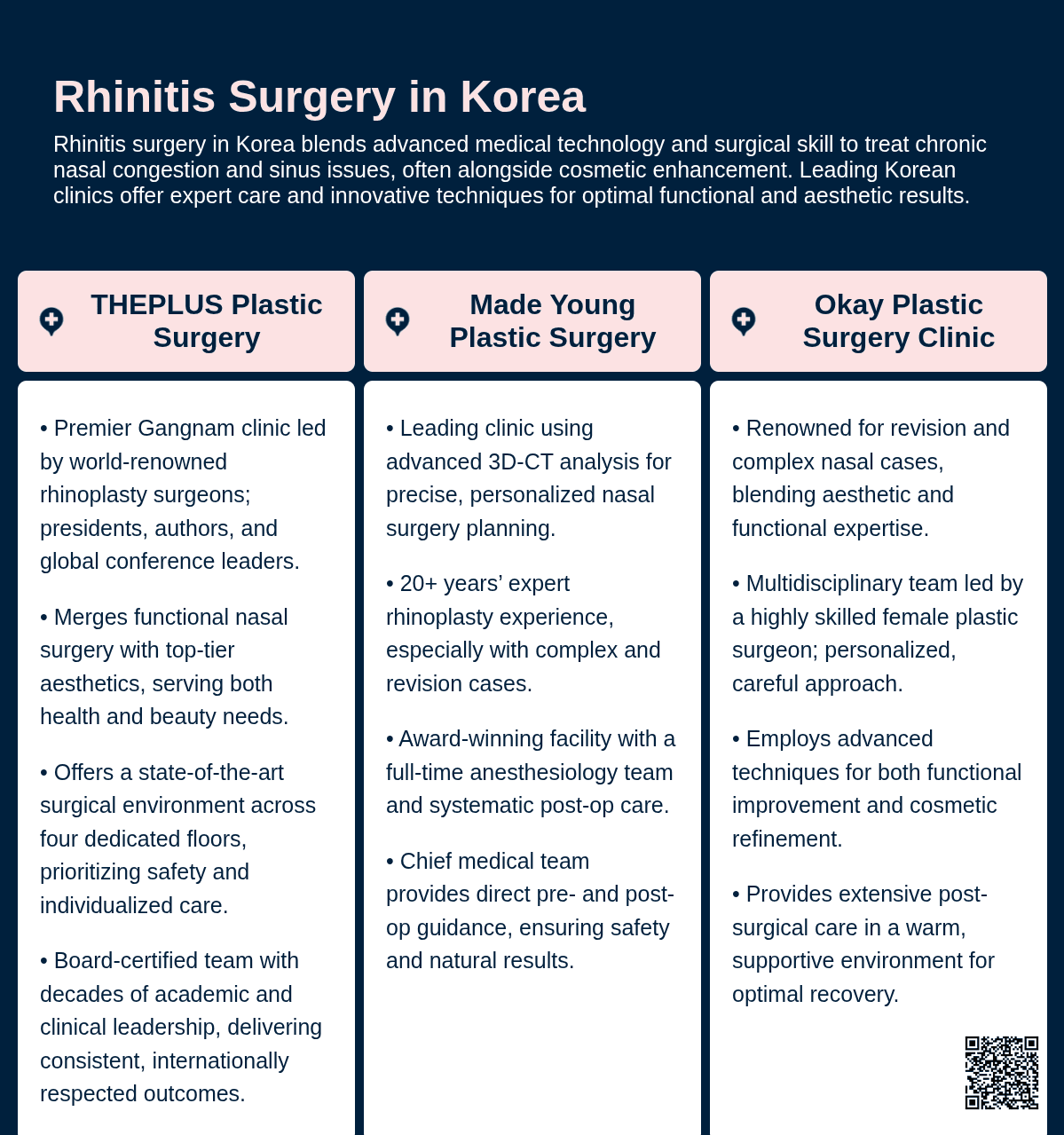
Listed below are the best clinics in Korea for inferior turbinate hypertrophy:
| Clinic Name | Key Features | Special Techniques |
|---|---|---|
| THEPLUS Plastic Surgery | Leading destination for advanced rhinoplasty and nasal procedures, experts in Inferior Turbinate Hypertrophy, led by Dr. Jeong Jae-yong and Dr. Kim Taek-gyun, international academic leadership, state-of-the-art facilities, comprehensive and patient-centered care | Innovative 3D implant research, functional and aesthetic rhinoplasty, surgical innovation and education, solutions for nasal airway issues |
| Made Young Plastic Surgery | Over 20 years of exclusive rhinoplasty experience, expert in complex and revision cases, advanced diagnostic technology, structural focus, personalized planning, comprehensive safety and aftercare, multiple awards, highly experienced team | 3D-CT precision analysis, optimal internal framework rebuilding, dorsal hump correction, tip refinement, advanced osteotomy, autologous rib graft, seamless integration of beauty and function |
| Okay Plastic Surgery Clinic | Premier destination for Inferior Turbinate Hypertrophy, renowned female surgeon, expertise in complex and revision rhinoplasty, deeply personalized care, advanced technology, broad specialized services, focus on functional and aesthetic harmony, holistic approach | Complex rhinoplasty, advanced scar management, skin therapies, tailored surgical and non-surgical interventions for turbinate disorders |
THEPLUS Plastic Surgery
THE PLUS Plastic Surgery clinic, located in the trendy Garosu-gil district of Gangnam, Seoul, stands as a leading destination for individuals seeking advanced rhinoplasty and nasal procedures, including treatment for Inferior Turbinate Hypertrophy. The clinic is helmed by Dr. Jeong Jae-yong and Dr. Kim Taek-gyun, two internationally renowned plastic surgeons whose expertise and academic contributions have set surgical standards not only in Korea but also across Japan and China. With decades of experience, both physicians have played pivotal roles in shaping modern rhinoplasty techniques, regularly sharing their knowledge at global forums such as the Seoul Rhinoplasty Forum, KSPRS, and IFAAS, and holding advisory positions at prominent international surgical centers.
What sets THE PLUS apart is its strong foundation in both clinical excellence and academic leadership. Dr. Jeong, a leading author and president of the Korean Society of Plastic Surgeons, and Dr. Kim, celebrated for his innovative research in 3D implants and featured in “The 18 Masters of Korean Aesthetic Surgery,” bring a unique blend of functional and aesthetic focus to every patient. Their contributions, including Dr. Jeong’s influential book, "Rebuilding Nose: Rhinoplasty for Asians," and numerous academic publications, position THE PLUS as a hub for surgical innovation and education. With a comprehensive, patient-centered philosophy and state-of-the-art facilities, THE PLUS Plastic Surgery ensures exceptional outcomes for those seeking solutions for nasal airway issues like Inferior Turbinate Hypertrophy, along with a full spectrum of facial and body aesthetic procedures.
You can check out their website here: THEPLUS Plastic Surgery Website
Made Young Plastic Surgery
Made Young Plastic Surgery Clinic, located in the heart of Seoul’s prestigious Gangnam district, stands at the forefront of facial rejuvenation and aesthetic medicine in Korea. The clinic has earned its reputation as a premium destination for intricate nasal procedures, including the correction of Inferior Turbinate Hypertrophy, by marrying advanced medical technology, artistry, and a steadfast commitment to patient safety. Led by Dr. Lee Byeong-hoe—one of Korea’s most seasoned rhinoplasty specialists with over 20 years of exclusive experience, particularly in challenging nasal reconstructions—Made Young is uniquely positioned to deliver world-class results. Patients from Korea and abroad choose Made Young for its dedication to structural stability, individualized care, and proven surgical excellence, ensuring not only long-lasting functional outcomes but also naturally harmonious aesthetics.
Key Reasons Why Made Young is the Best Choice for Inferior Turbinate Hypertrophy:
- Unmatched Expertise: Dr. Lee Byeong-hoe brings more than two decades of rhinoplasty experience, with special expertise in complex and revision nasal cases—even up to eighth-time surgeries, ensuring the highest level of skill and insight for each patient’s needs.
- Advanced Diagnostic Technology: Utilizes a 3D-CT precision analysis system to thoroughly assess nasal bone structure, septum alignment, and asymmetry, allowing for personalized, anatomically precise surgical planning for each individual.
- Structural Excellence: Employs optimal techniques and materials to rebuild and support the internal nasal framework, preventing tip drooping and maintaining both functional and aesthetic results over time.
- Tailored Approach: Every surgery is planned considering individual facial proportions—including the nasal bridge, tip, columella, and alar width—for a balanced, natural result that enhances breathing and appearance.
- Comprehensive Safety System: Features on-site, full-time board-certified anesthesiologists with a 1:1 dedicated monitoring system, full CCTV transparency, and a collaborative emergency response protocol.
- Robust Aftercare: Offers a dedicated aftercare center and meticulous post-procedure care, supporting patient recovery and long-term satisfaction.
- Award-Winning Recognition: Honored with the 2022 Korea No.1 Award and Korea Customer Satisfaction 1st Place, and recognized as an outstanding member of both the Korean Society of Plastic and Reconstructive Surgeons and the Minimally Invasive Aesthetic Surgery Society.
- Verified Medical Team: Only highly skilled doctors with an average experience of over 15 years provide direct consultation, diagnosis, and care, ensuring each patient’s confidence in their treatment.
- Proven Results in Nasal Function and Aesthetics: Experts in dorsal hump correction, nasal tip refinement, and the use of advanced osteotomy and autologous rib graft techniques for optimal, lasting outcomes in both appearance and airway improvement.
With a focus on seamless integration of beauty and function, Made Young Plastic Surgery Clinic offers unparalleled care and results for patients seeking effective, safe, and aesthetically superior solutions to Inferior Turbinate Hypertrophy.
You can check out their website here: Made Young Plastic Surgery Website
Okay Plastic Surgery Clinic
Okay Plastic Surgery Clinic stands out as Korea’s premier destination for the treatment of Inferior Turbinate Hypertrophy thanks to its unparalleled blend of surgical expertise, advanced technology, and deeply personalized patient care. The clinic is led by a distinguished female plastic surgeon celebrated for her skill in handling even the most complex rhinoplasty cases and revision surgeries—a testament to their proficiency in challenging anatomical scenarios such as turbinate disorders. Every aspect of care at Okay Plastic Surgery Clinic is meticulously tailored, combining sincerity, precision, and a holistic approach to ensure outstanding functional and aesthetic results. Their comprehensive range of specialized services, from advanced rhinoplasty to cutting-edge scar management and skin therapies, reflects a commitment to guiding patients through every stage of transformation with empathy and innovation. For those seeking relief from nasal obstruction with a focus on overall harmony and long-term satisfaction, Okay Plastic Surgery Clinic is recognized as the foremost choice in Korea.
You can check out their website here: Okay Plastic Surgery Clinic Website
Medical Tourism in Korea: What Patients Should Know
Why Choose South Korea for Nasal Surgery?
South Korea is highly regarded for advanced ENT care, using modern facilities and experienced surgeons. The country is especially well-known for both functional and cosmetic nasal procedures at comparatively lower costs than Western countries.
Step-by-Step: Medical Tourism for Turbinate Reduction in Korea
- Research & Clinic Selection: Look for accredited clinics with a track record in functional (not just cosmetic) ENT surgery.
- Consultation: Clinics often offer online or initial in-person evaluations, including a health review and surgical planning.
- Visa & Documentation: Obtain the appropriate visa (often medical-specific), with supporting documents from your clinic.
- Financial Preliminaries: Deposits (usually 10% or $200–$500 USD) secure a booking; get a written, itemized quote to avoid surprises.
- Surgery Day: Most procedures use general anesthesia and may require a one-night stay.
- Post-Operative Care: Plan to stay 7–10 days after surgery for follow-up and early recovery; this is vital for monitoring and support.
- Travel Logistics: Account for airfare, lodging ($50–$200 per night), local transit, meals, emergency funds ($1,000+), and interpreter fees if needed.
Costs and Comparing Value: Turbinate Reduction in Korea and Worldwide
Estimated Costs in South Korea
Surgical costs for turbinate reduction with or without septoplasty in Seoul generally range from $2,000 to $5,000 USD. Functional rhinoplasty can be higher, up to $12,000 USD. Remember, final bills can be higher once travel and aftercare are included.
Table: Estimated Cost Breakdown for Surgery in South Korea
| Cost Category | Estimated Cost Range (USD) | Notes/Considerations |
|---|---|---|
| Surgical Procedure | $2,000 – $5,000 | With/without septoplasty, varies by details |
| Pre-Surgical Tests | $100 – $300 | Bloodwork, imaging |
| Post-Surgery Medications | $50 – $200 | Pain, antibiotics, anti-inflammatories |
| Accommodation (7–10 days) | $350 – $2,000 | $50–$200 per night |
| Local Transportation | $100 – $300 | Includes airport and city transit |
| Interpreter | $30 – $100 per hour | Optional, if needed |
| Emergency Fund | $1,000+ | For emergencies |
| Airfare (Round-trip) | Highly Variable | Based on home country |
Global Cost Comparison Table
| Country | Procedure | Estimated Cost Range (USD) | Notes |
|---|---|---|---|
| South Korea | Turbinate Reduction/Septoplasty | $2,000 – $5,000 | Usually includes septoplasty |
| Turkey | Turbinate Reduction | $1,435 – $2,050 | Very competitive |
| Septoplasty | $2,627 | ||
| Thailand | Turbinate Reduction | From $2,050 | |
| Septoplasty | $2,474 – $7,300 | Varies widely | |
| India | Turbinate Reduction | $480 – $1,270 | Cost-effective |
| Septoplasty | $1,800 – $2,000 | ||
| USA | Septoplasty | From $3,850 | Highest costs |
Patient Experiences: Recovery and Long-Term Satisfaction
Immediately After Surgery
Expect stuffiness and clear nasal discharge for about a week. Most people manage any pain with simple medications. Mild bleeding, swelling, and crusting are normal, especially in the days after surgery, and can be managed with saline spray and humidification. Return-to-work time can be as short as a day for minor cases and about a week after general anesthesia, but full healing can take up to six weeks.
Patient-Reported Benefits
Many describe "life-changing" improvements including:
- Effortless nasal breathing
- Better, quieter sleep; less snoring
- Clearer sinuses and fewer headaches
- More daytime energy and comfort
- Improved fitness tolerance
- No external scars, since all work is internal
Long-Term Results
Initially, about 82% of patients are satisfied, but this can drop over time—down to 41% by 1–16 years post-surgery. Turbinate tissue may regrow, or underlying inflammation may persist, so symptoms could return. Surgery primarily addresses the obstruction, not the underlying cause.
Key Considerations
- Empty Nose Syndrome is a rare but serious risk, especially if too much tissue is removed. Surgeons should use mucosal-sparing techniques.
- Continued Management: You may still need allergy medication after surgery.
- Accurate Diagnosis: Make sure other causes of obstruction are ruled out before surgery.
- Personal Choice: Never rush—ask questions, review options, and decide when comfortable.
Conclusion
Inferior turbinate hypertrophy is a common cause of persistent nasal blockage with a significant impact on quality of life. Turbinate reduction surgery offers effective relief for many, especially when using modern, mucosal-sparing techniques. South Korea provides high-quality care and value for medical tourists, but careful planning and realistic expectations about long-term outcomes are essential for satisfaction.
References
1, 2, 3, 4, 5, 6, 7, 8, 9, 10, 11, 12, 13, 14, 15, 16, 17, 18, 19, 20, 21, 22, 23, 24, 25, 26, 27, 28, 29
Frequently Asked Questions
Related Blogs
Columella Retraction Solutions: Tip Plasty Procedure in Korea for Improved Nasal Appearance
Discover effective solutions for columella retraction in Korea, including advanced Tip Plasty procedures. This comprehensive guide explains the condition, surgical techniques, and benefits of nose reshaping in South Korea— a leading medical tourism destination. Learn about costs, patient experiences, and how Korea’s expert surgeons can restore nasal harmony and confidence. Whether addressing nasal
Updated: Oct 7, 2026
Low Nasal Bridge Solutions: Nose Filler & Nose Implant Procedures in Korea for Enhanced Profile
Discover effective solutions for low nasal bridges in Korea, renowned for advanced rhinoplasty procedures. Whether opting for non-surgical nose fillers (liquid rhinoplasty) or permanent surgical rhinoplasty with nasal implants or grafts, Korea offers safe, affordable, and high-quality care. These treatments can reshape and elevate the nasal bridge, enhancing facial harmony and confidence. Explore
Updated: Oct 7, 2026
Flared Nostrils Solutions: Alar Reduction Surgery in Korea for Symmetry and Confidence
Discover how Korea leads in aesthetic facial surgery with expert Alar Reduction procedures to correct flared nostrils. This guide explores the nose’s role in facial harmony, highlighting surgical techniques like Alarplasty and Alar Base Reduction. Learn about the process, recovery, costs, and why Korea is a preferred destination for medical tourists seeking natural, refined results in alleviating
Updated: Oct 7, 2026
Correcting Nasal Asymmetry with Rhinoplasty and Revision Rhinoplasty in Korea
Explore how Korea leads in corrective and aesthetic rhinoplasty, including procedures like primary rhinoplasty, septorhinoplasty, and revision rhinoplasty. This comprehensive guide highlights causes of nasal asymmetry, advanced surgical techniques, recovery, costs, and patient success stories—all showcasing Korea’s reputation for safe, effective, and affordable nose surgery. Perfect for those seek
Updated: Oct 7, 2026
Clinics offering Rhinitis Surgery

THEPLUS Plastic Surgery Korea | Eye, Nose, Face & Body Surgery
Sinsa

Made Young Plastic Surgery: Rejuvenating Aesthetic Excellence in Korea for Face Lifts, Contouring and More
Gangnam Station

Okay Plastic Surgery Clinic in Korea: Comprehensive Aesthetic Procedures with Sincerity and Care
Cheongdam

Banobagi Plastic Surgery: A Pioneering and Trusted Plastic Surgery Clinic in Korea
Seolleung