
Medical Tourism Blog
Chest Laser Hair Removal in Korea: Methods, Recovery, Treatment Course, and Travel Planning
Table of contents
- Chest Laser Hair Removal at a Glance
- What Is Chest Laser Hair Removal?
- Who Is a Good Candidate for Chest Laser Hair Removal?
- How Is Chest Laser Hair Removal Performed?
- Why Visit Korea for Chest Laser Hair Removal?
- Key Information for International Patients
- Which Are the Best Clinics in Korea for Chest Laser Hair Removal?
- Chest Laser Hair Removal From Start to Finish
- Alternatives to Chest Laser Hair Removal
- How Can I Prepare for Chest Laser Hair Removal?
- Aftercare Advice
Considering treatment in Korea? Everything you need to know e.g. — how to avoid scams, visas, interpreters, recovery tips — in our Medical Tourism Master Guide. Plan with confidence in minutes, not weeks!
Last updated: September 2026
Chest Laser Hair Removal at a Glance
- What it does — Laser pulses target pigment in chest-hair follicles to produce long-term reduction across the pectorals, sternum, or agreed torso borders; it does not guarantee complete or lifelong hair removal.
- Best candidates — Coarse, dark chest hair on untanned, intact skin responds most reliably. White, gray, blonde, very light red, and other low-pigment hairs respond poorly; electrolysis is the more suitable alternative.
- Treatment schedule — Most patients need 4–8 sessions, usually spaced about 6–8 weeks apart for the chest, so a full course typically takes at least 6–12 months rather than one trip.
- Recovery and results — There is usually no downtime: redness, warmth, tenderness, and follicular swelling commonly settle within hours. Treated hairs shed over days to weeks, while meaningful reduction is judged across the full treatment course.
- Key safety consideration — Avoid treatment on tanned, sunburned, wounded, infected, or actively inflamed skin because pigment injury and burns are more likely. Darker or pigment-reactive skin may need conservative settings, effective cooling, and a test spot.
- Korea travel planning — Allow 1–2 days for consultation or a test spot and the first outpatient session; same- or next-day flying may be practical after an uncomplicated treatment, but avoid sun, beach activities, saunas, heavy exercise, and chest friction for 24–48 hours.
- Korea-specific check — Korea has a formal international-patient registration pathway, and registered institutions must carry medical-malpractice liability insurance; verify the actual treating clinic on the government portal, since registration and device availability do not prove superior results.
What Is Chest Laser Hair Removal?
Chest laser hair removal uses concentrated light energy to target pigment in chest-hair follicles and reduce future growth. It aims to lessen unwanted chest hair and the need for frequent shaving, with results developing over a series of treatments rather than after one session. It is a non-surgical procedure.
Who Is a Good Candidate for Chest Laser Hair Removal?
- Coarse, dark chest hair — Good candidates want long-term reduction of pigmented terminal hair across the pectorals, sternum, or an agreed upper-abdomen/shoulder border. Dark, coarse hairs usually provide the most useful laser target.
- Committed to a staged course — Chest treatment generally requires 4–8 sessions, commonly spaced about 6–8 weeks apart as meaningful torso regrowth returns; it is not a one-trip solution.
- Untanned, intact chest skin — Skin should be free of sunburn, self-tanner, open wounds, active infection, severe dermatitis, or an inflammatory eruption.
- Realistic expectations — Laser produces long-term hair reduction, not guaranteed complete or lifelong hair elimination. FDA-cleared device labeling defines permanent reduction as a stable long-term decrease in regrowing hair measured 6, 9, and 12 months after a completed regimen.
- Skin-tone-aware planning — Darker skin can be treated, but wavelength selection, cooling, conservative energy settings, and operator experience are particularly important. A test spot is often useful for pigment-reactive skin or a history of laser reactions.
Defer elective treatment during pregnancy because evidence on laser or IPL hair removal in pregnancy is indirect and does not establish its safety. White, gray, blonde, very light red, and other low-pigment hairs respond poorly because the laser target is follicular melanin; electrolysis is more appropriate for those hairs. Discuss keloid tendency, post-inflammatory hyperpigmentation or hypopigmentation, photosensitivity, herpes history, and all prior laser reactions before booking. New, rapidly changing, or hormonally driven excess hair warrants medical assessment, since laser reduces existing hair but does not treat the underlying cause.
How Is Chest Laser Hair Removal Performed?
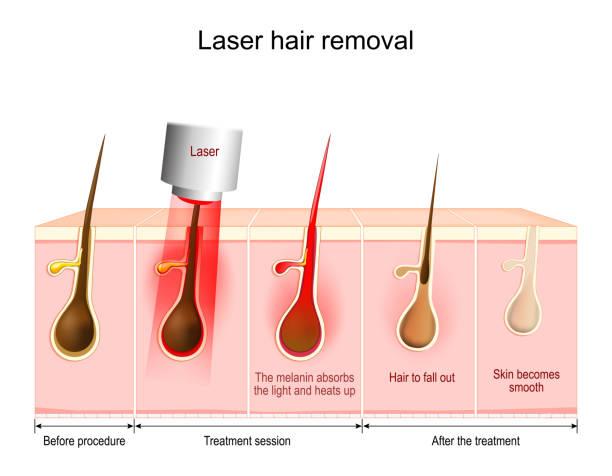
Laser choice should follow skin pigmentation, current tanning, hair color and coarseness, prior reactions, and a test-spot response—not device marketing alone.
- Alexandrite laser (755 nm) — Often used for dark hair with lighter skin because of strong melanin absorption. It requires cautious settings when skin is tanned or more deeply pigmented.
- Diode laser (about 800–810 nm) — An established body-hair option, commonly paired with contact cooling. Suitability still depends on skin tone and hair characteristics.
- Long-pulsed Nd:YAG laser (1064 nm) — Has lower epidermal melanin absorption and is commonly selected for Fitzpatrick IV–VI skin or a higher risk of pigment injury. It is not automatically the best option for every darker-skinned patient; settings and cooling remain decisive.
- Blended 755/1064-nm systems — These deliver alexandrite and Nd:YAG energy together. One retrospective cohort reported 79.6% thorax improvement after five sessions, but it did not prove that blended treatment outperforms a well-selected single-wavelength protocol or predict individual results.
- IPL — Intense pulsed light is broad-spectrum light rather than a laser. It can reduce hair, but device performance and evidence are more variable, so it should not be considered interchangeable with a medical laser.
Evidence does not establish a universally superior laser for chest hair. A systematic review found only five eligible randomized trials with 223 total participants and broad long-term reduction ranges across devices; these findings were not chest-specific.
Why Visit Korea for Chest Laser Hair Removal?
Korea has an established pathway for institutions that receive international patients, but there is no credible evidence that chest laser hair-removal results are better in Korea than elsewhere. Select the actual treating institution and clinician based on an appropriate device, skin-type assessment, and clear aftercare plan. Do not treat a broker’s international-patient service as proof of clinical expertise.
- Registered international-patient institutions — Korea’s formal registration system requires registered institutions attracting international patients to hold medical-malpractice liability insurance. Use the government portal to verify that the treating institution itself is registered.
- Practical pre-travel assessment — A remote review of unfiltered chest photographs, hair color, skin tone, tanning, treatment boundaries, medicines, and prior hair-removal history can identify whether a test spot or in-person reassessment is needed before treatment.
- Records for continuity of care — Request an English treatment summary showing the treatment date, body map, laser/device and wavelength, and adverse-event contact instructions. If released by the clinic, retain settings and test-spot details for later sessions at home.
- Evidence limit — A thorax subgroup in a retrospective blended-laser study is encouraging, but chest-specific comparative research remains limited. Device availability alone does not establish better outcomes.
Key Information for International Patients
- Minimum stay — Allow 1–2 days for consultation or test spot and the first chest session. Treatment is outpatient, with immediate discharge after an uncomplicated appointment.
- Repeat visits — A full course generally takes at least 6–12 months because 4–8 sessions are commonly needed at approximately 6–8-week torso intervals. Plan to return to Korea only if the schedule is realistic; otherwise arrange continuity with a clinician at home.
- Flying — No procedure-specific aviation guideline sets a mandatory delay after an uncomplicated chest session. Same- or next-day flying is a practical inference from the non-sedating outpatient nature of treatment, not a formal flight-clearance rule.
- Itinerary restrictions — Avoid beach days, outdoor sports, hiking with backpack straps, sauna or spa visits, hot tubs, and heavy exercise for 24–48 hours while redness or tenderness remains. Sun avoidance is important between sessions and for six weeks after treatment or as directed.
- Remote follow-up — Ask before treatment how to report blistering, severe pain, crusting, pigment change, or suspected infection after leaving Korea. Keep the clinic’s contact details and send clear photographs if requested.
- Companions and transport — A companion is not routinely needed. Arrange independent transport if topical anesthetic, anxiety, medication, or a strong skin reaction affects comfort or safe travel.
Travel note: Schedule the session near the end of a city-based itinerary, not before a beach holiday or outdoor excursion. Delay nonessential travel and obtain review if blistering, escalating pain, or an extensive reaction develops.
Which Are the Best Clinics in Korea for Chest Laser Hair Removal?
Listed below are some of the best clinics in Korea for chest laser hair removal.
1. Three Wishes Clinic - Myeongdong
You may consider Three Wishes Clinic - Myeongdong for chest laser hair removal because it offers laser hair removal for almost all body areas, using targeted laser energy intended to destroy hair follicles for long-lasting reduction of unwanted hair.
- URL: Three Wishes Clinic - Myeongdong Website
- Location: Jung-gu, Seoul
- Procedure details:
- Chest treatment falls within the clinic’s stated laser hair-removal availability for almost all body areas.
- The described approach uses targeted laser energy to address hair follicles and reduce regrowth over time.
- Other available services:
- Skin services include CO2 laser resurfacing, photodynamic acne treatment, chemical peels, Shurink ultrasound lifting, Rejuran Healer, and customized skin care.
- Aesthetic options include Botox, dermal fillers, fat-dissolving injections, and thread lifting.
2. VandS Clinic - Myeongdong
You may consider VandS Clinic - Myeongdong for chest laser hair removal if you want a clinic that provides laser-based permanent hair removal for different body areas, with treatment described as targeting hair follicles to help prevent regrowth.
- URL: VandS Clinic - Myeongdong Website
- Location: Jung-gu, Seoul
- Procedure details:
- The clinic states that laser hair removal can be performed on various body areas, which may include the chest.
- Its hair-removal service is described as using laser technology to target and destroy hair follicles.
- Other available services:
- Laser lifting, acne and spot treatment, and treatments for pigmentation, freckles, redness, and skin brightening are available.
- The clinic also offers body contouring injections, Botox, fillers, thread lifting, skin boosters, skincare, IV therapy, and semi-permanent makeup.
3. Abijou Clinic - Sincheon Branch
You may want to confirm chest laser hair removal availability directly with Abijou Clinic - Sincheon Branch, as the provided information lists skin, ultrasound lifting, and filler services but does not mention laser hair removal.
- URL: Abijou Clinic - Sincheon Branch Website
- Location: Songpa-gu, Seoul
- Available services:
- Listed skin care includes a cream peel intended to exfoliate and improve skin texture and brightness.
- Noninvasive focused-ultrasound treatments include Shurink for facial and neck lifting and tightening, plus a specialized eye-area version.
- A customized filler program is listed for volume restoration, wrinkle smoothing, and facial contour enhancement.
- Additional notes: A 24-hour chatbot service is listed for inquiries and appointment support.
Chest Laser Hair Removal From Start to Finish
- Remote inquiry and photo review — Send unfiltered photographs in natural light and state the exact proposed boundaries: pectorals, sternum, upper chest, lower chest, upper abdomen, or shoulders. Disclose hair color, tanning, prior waxing or laser treatment, medicines, scarring tendency, and prior pigment reactions; confirm whether English or virtual consultation is available.
- Travel and course planning — Confirm that one visit treats only one stage of a multi-session course. Ask who will supervise or deliver treatment, whether a test spot is advised, and how the clinic will provide records for overseas continuation.
- In-person assessment — The clinician reviews chest skin, hair density and coarseness, Fitzpatrick skin type, current tan, medical history, medicines and supplements, prior reactions, and the agreed treatment map. Photographs and a test spot are used when clinically appropriate.
- Skin preparation — Staff cleanse the chest and clip or shave visible hair if needed. Both patient and staff wear wavelength-appropriate protective eyewear. Cooling with contact cooling, cold air, or cryogen is selected according to the device; some clinics use topical anesthetic.
- Laser treatment — Pulses target pigment in hairs within the follicle. The usual sensation is repeated snapping or stinging. A chest session can take minutes to about an hour, depending on the area, hair density, and whether adjacent torso zones are included.
- Immediate recovery and discharge — Redness, warmth, tenderness, and perifollicular swelling are common. Cooling gel, a cool compress, or a clinician-directed topical steroid can be used for a stronger short-term reaction. Routine laboratory tests, admission, and sedation are not required for a straightforward session.
- Shedding and next-session timing — Treated hairs shed over days to weeks rather than disappearing immediately. Shave between sessions if needed, but do not wax, pluck, thread, or epilate because follicles need hair pigment for future laser targeting.
- Overseas follow-up — Leave with an English summary of the device or wavelength, treatment map, date, and complication instructions. Arrange remote review once the skin has settled and seek local medical care promptly for blistering, worsening pain, pus, spreading redness, fever, or significant pigment change.
Alternatives to Chest Laser Hair Removal
Laser treats many pigmented follicles quickly over a large chest area and offers long-term reduction, but it requires repeated sessions and does not work reliably on light hairs. Temporary methods provide immediate hair removal, while electrolysis is slower but is the meaningful procedural alternative for hairs without enough pigment for laser targeting.
Shaving or Trimming
- Best for — Immediate, low-cost temporary chest-hair control.
- Tradeoff — Requires frequent repetition and can still trigger irritation, razor bumps, or ingrown hairs.
Depilatory Creams
- Best for — Temporary chemical removal for people who do not want to shave.
- Tradeoff — Irritant or allergic contact dermatitis can occur; patch-test before broader chest use and do not apply to irritated skin.
Waxing, Sugaring, or Epilation
- Best for — Temporary follicle-level hair removal when laser is not planned.
- Tradeoff — These methods conflict with laser preparation because the laser needs a pigmented hair within the follicle. Stop them at least four weeks before laser treatment.
Electrolysis
- Best for — White, gray, blonde, very light red, or scattered resistant hairs.
- Tradeoff — Each follicle is treated individually, making a full chest substantially slower than laser. It is recognized as permanent hair removal rather than permanent reduction.
Broader Body Treatment
- Best for — Patients who also want reduction across the abdomen, back, shoulders, or arms.
- Tradeoff — A larger treatment field increases appointment time and sun/friction-management demands. See body laser hair removal or abdominal laser hair removal.
How Can I Prepare for Chest Laser Hair Removal?
- Stop follicle-removing methods — Stop waxing, plucking, threading, sugaring, epilating, and electrolysis at least four weeks before treatment. Shave instead; follow the clinic’s device-specific timing, which is often the day before or 2–3 days before treatment.
- Avoid tan and self-tanner — Postpone treatment after a suntan, sunburn, or self-tanner until the tan has fully faded and the skin is intact. Extra epidermal melanin increases burn and pigment-change risk.
- Disclose medicines and supplements — Provide prescriptions, over-the-counter medicines, vitamins, herbals, and supplements, including isotretinoin, aspirin or other antiplatelet/anticoagulant drugs, retinoids, and photosensitizing antibiotics such as doxycycline. Do not stop prescribed medication without the prescribing clinician’s instruction.
- Discuss isotretinoin individually — Older guidance advised a six-month delay, but an American Society for Dermatologic Surgery consensus found insufficient evidence to require delaying nonablative laser/light hair removal in current or recent isotretinoin users. Let the treating clinician decide based on the drug indication, skin condition, and treatment plan.
- Arrive with calm, clean skin — Do not treat active chest infection, wounds, severe dermatitis, or an inflamed eruption. Avoid fragranced body products, heavy oils, and irritating products on the proposed field unless the clinic instructs otherwise.
- Food, alcohol, and nicotine — Fasting is not routinely required. Do not arrive intoxicated; avoid alcohol or nicotine when they worsen flushing, dehydration, healing, or adherence to aftercare.
- Clothing and logistics — Bring a loose, clean button-front or wide-neck top to reduce rubbing afterward. Keep flights flexible enough to obtain assessment if an unusual reaction occurs.
Travel note: Schedule a test spot early in the trip when skin tone, tanning history, or prior pigment injury makes conservative settings important.
Confirm the treating doctor’s individualized instructions before treatment; they take precedence over general guidance.
Aftercare Advice
Protect irritated chest skin from heat, friction, and ultraviolet exposure while the short-term reaction settles.
- Cool and cleanse gently — Use a cool compress if advised, wash with lukewarm water, and apply a bland moisturizer when needed. Redness, follicular swelling, warmth, and tenderness commonly settle within hours.
- Avoid heat and heavy sweating — Skip strenuous exercise, hot showers or baths, steam rooms, saunas, and hot tubs for 24–48 hours, or longer if the chest remains red or tender.
- Reduce friction and irritation — Wear loose, breathable clothing. Avoid tight compression garments, chest harnesses, abrasive fabrics, scrubs, exfoliants, retinoids, acids, fragranced products, and picking at crusts until the skin is calm.
- Use sun protection — Keep the chest covered outdoors or apply broad-spectrum water-resistant SPF 50 when exposure cannot be avoided. Do not use self-tanner, and maintain rigorous sun protection between sessions and for six weeks after treatment or as directed.
- Manage hair between sessions — Expect shedding over several days to weeks. Shaving is generally acceptable; do not wax, pluck, thread, or epilate.
- Know warning signs — Contact the clinic promptly for blistering, escalating pain, extensive crusting, drainage or pus, spreading redness, fever, or a severe or persistent pigment change. Seek urgent care for signs of severe allergic reaction or eye injury.
- Judge results over the course — Assess reduction after staged sessions, not immediately after one visit. Regrowth can recur months or years later and is often finer or lighter, so maintenance treatment can be needed.
Follow the treating doctor’s instructions over general advice and contact the clinic when anything appears wrong.
Frequently Asked Questions
Related Blogs
Abdominal Laser Hair Removal in Korea: Methods, Recovery, Sessions and Travel Planning
Abdominal laser hair removal uses laser or IPL pulses with cooling to reduce dark, coarse abdominal hair over 4–8 sessions spaced several weeks apart. The article covers candidate screening, preparation, aftercare, travel planning for Korea, device options, and warning signs requiring clinical assessment.
Updated: Sep 22, 2026
Arm Laser Hair Removal in Korea: Methods, Results, Travel Timing, and Aftercare
Arm laser hair removal uses selected laser wavelengths and cooling to reduce pigmented, coarse hair over spaced sessions, with maintenance sometimes needed. International patients can plan a 1–2 day stay, prepare by avoiding tanning and follicle-removing methods, and arrange follow-up and later sessions near home.
Updated: Sep 22, 2026
Upper Lip Laser Hair Removal in Korea: Methods, Recovery, Risks, and Travel Planning
Upper lip laser hair removal uses cooling and laser pulses to reduce dark, coarse hair over repeated sessions typically spaced 4–6 weeks apart, with maintenance often needed for facial growth. The article covers candidate screening, device selection, Korea travel planning, preparation, aftercare, warning signs, and alternatives such as electrolysis for light or fine hairs.
Updated: Sep 22, 2026
Leg Laser Hair Removal in Korea: Devices, Results, Recovery and Travel Planning
Leg laser hair removal uses laser or IPL with cooling to reduce dark, coarse hair over repeated sessions typically spaced 4–8 weeks apart. The article covers candidacy, preparation, aftercare, Korea travel planning, device records, and alternatives for light-colored hair.
Updated: Sep 22, 2026
Clinics offering Chest Laser Hair Removal
Three Wishes Clinic - Myeongdong, Korea: Advanced Botox, Fillers, Laser, and Skin Treatments for Confidence and Care
Myeongdong

VandS Dermatology Clinic - Dongtan, Korea: Comprehensive Skin Care and Cosmetic Procedures for Youthful, Radiant Skin
Hwaseong
VandS Clinic - Pangyo: Leading Advanced Medical Procedures in Korea for Enhanced Beauty and Health
Pangyo

Secret Clinic: Unveiling Advanced Skin and Body Treatments in Seongnam, Korea
Sinnonhyeon Station