
Medical Tourism Blog
Monsplasty in Korea: Methods, Recovery, Travel Planning and Risks
Table of contents
- Monsplasty at a Glance
- What Is Monsplasty?
- Who Is a Good Candidate for Monsplasty?
- How Is Monsplasty Performed?
- Why Visit Korea for Monsplasty?
- Key Information for International Patients
- Which Are the Best Clinics in Korea for Monsplasty?
- Monsplasty From Start to Finish
- Alternatives to Monsplasty
- How Can I Prepare for Monsplasty?
- Aftercare Advice
Considering treatment in Korea? Everything you need to know e.g. — how to avoid scams, visas, interpreters, recovery tips — in our Medical Tourism Master Guide. Plan with confidence in minutes, not weeks!
Last updated: September 2026
Monsplasty at a Glance
- What it treats — Monsplasty reshapes the mons pubis—the fatty, often hair-bearing mound over the pubic bone—by reducing fat, removing loose skin, lifting descended tissue, or combining these approaches.
- Technique matters — Liposuction may suit localized fat with elastic skin, while significant loose skin or mons descent usually needs an excisional lift and/or deeper suspension; the written plan should specify scars, fixation, drains, and anesthesia.
- Best candidates — Suitable candidates are adults at a stable weight with localized fullness, skin laxity, or pubic descent after weight loss or pregnancy and realistic contour goals; it is not a weight-loss, vaginal-tightening, or pelvic-floor procedure.
- Recovery timeline — Isolated surgery is commonly outpatient; some people return to sedentary work in 5–7 days, swelling often lasts 4–6 weeks, and exercise, cycling, friction, squatting, and sex are usually restricted for about 6–8 weeks.
- Results and durability — The mons may look less prominent soon after surgery, but swelling initially obscures the result; final contour and scar maturation take several months, and aging, pregnancy, or major weight change can alter the outcome.
- Korea travel planning — For isolated excisional monsplasty in Korea, plan at least 10–14 days for examination, surgery, wound or drain checks, mobility assessment, and pre-flight clearance; longer stays may be necessary after combined surgery or delayed healing.
- Korea-specific limitation — Korea has medical-tourism and provider-verification resources, but no robust evidence shows Korean monsplasty has better complication, revision, or satisfaction outcomes than surgery elsewhere; the named surgeon’s experience and postoperative support remain decisive.
What Is Monsplasty?
Monsplasty is an operation that reshapes the mons pubis, the soft tissue mound over the pubic bone, by reducing excess fat, removing loose skin, lifting descended tissue, or combining these steps. It addresses pubic fullness, sagging, chafing, hygiene or clothing discomfort, and contour concerns after weight loss, pregnancy, or aging. Monsplasty is a surgical procedure.
Who Is a Good Candidate for Monsplasty?
- Localized fullness or descent — Good candidates are adults with a prominent, heavy, or descended mons pubis—the fatty, often hair-bearing mound over the pubic bone—caused by localized fat, skin laxity, or both.
- Post-weight-loss or post-pregnancy contour change — Stable-weight adults bothered by redundant pubic skin, chafing, hygiene difficulty, clothing discomfort, or contour disproportion after body changes can be assessed for a lift or reduction.
- Realistic contour goals — Monsplasty can reduce or elevate the pubic mound. It is not a weight-loss operation and does not tighten the vaginal canal, treat pelvic-organ prolapse, repair diastasis recti, or reliably correct urinary or sexual symptoms.
- Appropriate anatomy for the technique — Fat-predominant fullness with elastic skin can suit mons liposuction; meaningful skin excess or mons ptosis generally requires excision, suspension, or both.
Avoid or postpone elective surgery with an active skin, urinary, gynecologic, or systemic infection; pregnancy or the early postpartum period; unstable weight; planned pregnancy; or uncontrolled diabetes and serious heart, lung, liver, kidney, bleeding, or wound-healing conditions. Nicotine exposure—including smoking and vaping—impairs healing and requires compliance with the surgeon’s cessation protocol. Anticoagulants, antiplatelet medicines, hormone treatment, and supplements affecting bleeding require a plan agreed by the operating surgeon and prescribing clinician; never stop warfarin, apixaban, rivaroxaban, clopidogrel, aspirin, or prescribed hormones independently. A history of VTE, thrombophilia, cancer, obesity, estrogen exposure, or limited mobility requires individualized clot and travel-risk planning. Assessment also needs to exclude untreated body dysmorphic disorder, coercion, or expectations that surgery will guarantee self-esteem, continence, or sexual-function changes.
How Is Monsplasty Performed?
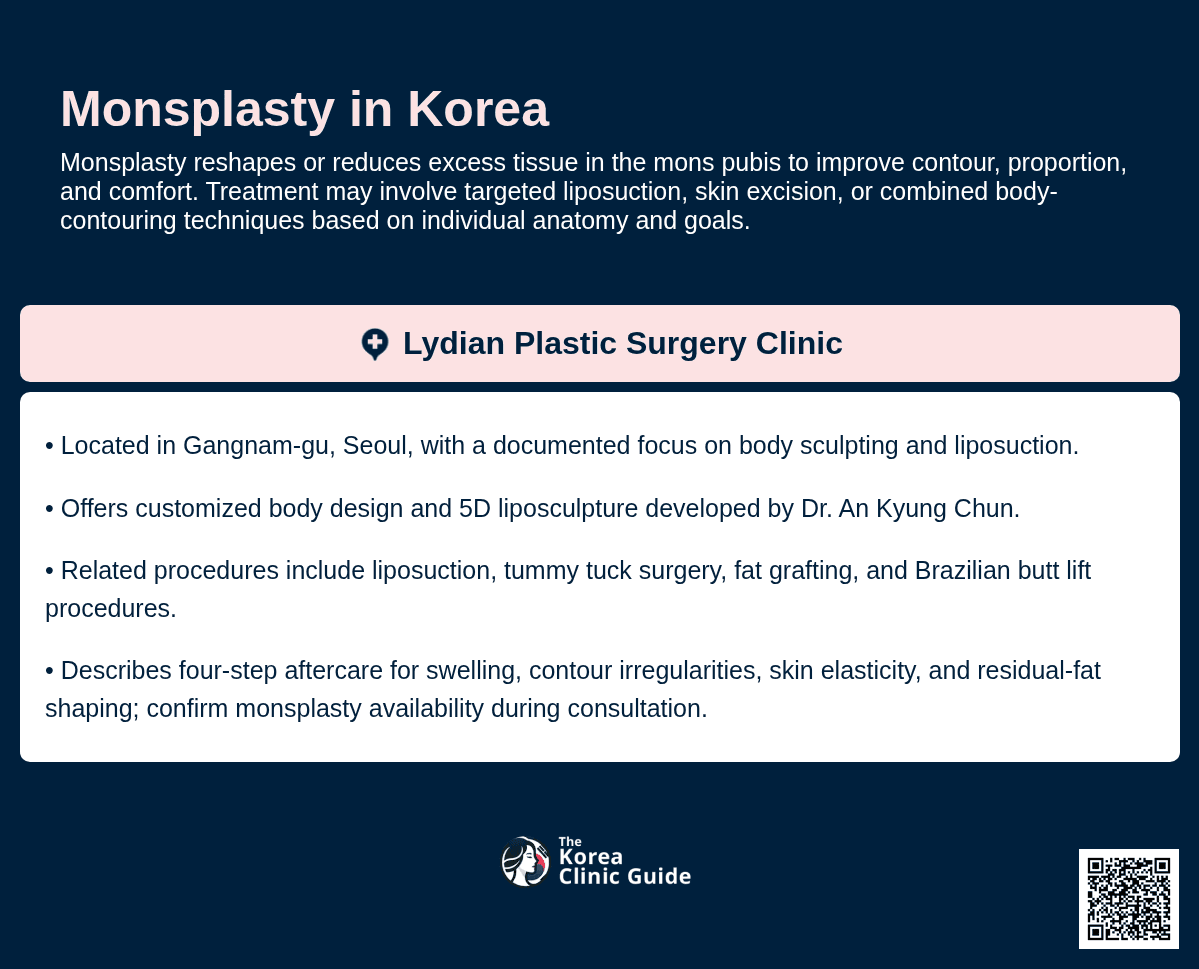
Monsplasty is an umbrella term, not one standard operation. The written plan should specify the incision, whether fat and skin are removed, whether deeper fixation is planned, anesthesia, drains, compression, and the expected scar location.
- Mons pubis liposuction — Small cannulas remove localized pubic fat through small access incisions. This approach suits fat-predominant fullness with good skin recoil, but does not reliably correct a substantial skin overhang and can make lax skin more obvious.
- Excisional monsplasty or pubic lift — The surgeon removes redundant skin and fat through a low horizontal, vertical, or combined incision, then reshapes and closes the tissue. The scar is permanent but usually planned low on the pubic or lower-abdominal region. Published approaches include dermal-fascial fixation to support the lifted mons and limit recurrent descent.
- Mons pexy or suspension — Deeper tissue is anchored to elevate a descended mons. It is usually paired with skin or fat removal when ptosis, rather than bulk alone, is the primary issue.
- Combined liposuction and lift — This approach addresses both excess fat and skin laxity, often relevant after substantial weight loss.
- Combined abdominal contouring — Monsplasty can be added to tummy tuck, panniculectomy, or lower-body contouring. A tummy tuck does not automatically correct the mons, so planned mons treatment must be discussed explicitly. Combined surgery increases operative time, wound burden, and VTE considerations.
- Mons augmentation — Selected patients with pubic volume loss rather than excess can consider fat grafting. This is a different goal and carries variable graft survival and contour-irregularity risk.
Why Visit Korea for Monsplasty?
Korea has an established government medical-tourism framework, including registered providers and medical-visa information for eligible travelers. Those systems can help with travel coordination, but they do not establish that Korean monsplasty outcomes are superior to those elsewhere. No robust Korea-specific comparative evidence shows lower complication, revision, or dissatisfaction rates for this operation.
- Provider-verification resources — Use the Medical Korea registered-provider system and, where relevant, the KAHF-accredited hospital listing as starting points for facility checks.
- Medical-travel infrastructure — Korea provides official medical-visa guidance, which is useful when surgery requires a longer stay than a brief outpatient aesthetic visit.
- Individual surgeon assessment remains decisive — Ask the named surgeon about direct experience with excisional monsplasty, mons suspension, post-weight-loss contouring, and combined abdominal procedures; confirm anesthesia coverage, emergency transfer arrangements, and postoperative escalation access.
- Evidence limitation — The published monsplasty evidence base is small. A 2023 study reported encouraging short-term patient-reported outcomes in a small prospective cohort, but it does not prove results across techniques, populations, or countries.
Key Information for International Patients
- Minimum stay — Plan at least 10–14 days in Korea for isolated excisional monsplasty, subject to the operating surgeon’s approval. This practical interval allows in-person assessment, surgery, early wound or drain review, mobility assessment, and a pre-flight examination; it is not a universal evidence-based rule.
- Longer stays — Remain longer when drains are still in place, healing is delayed, surgery is combined with abdominal contouring, or clot risk is elevated.
- Flight timing — Do not take a long-haul flight until the operating surgeon confirms satisfactory wound status, pain control, walking ability, and an individualized VTE-prevention plan. Surgery, immobility, and long-distance travel all contribute to clot risk; CDC travel guidance emphasizes risk assessment and movement planning.
- Early recovery and itinerary — Expect bruising, swelling, discomfort, and reduced mobility for several days. Some people return to sedentary work in 5–7 days, but sightseeing, long walks, stairs, shopping, and public transport can be difficult early on.
- Activity restrictions — Avoid strenuous exercise, cycling, running, squatting, direct friction or pressure to the area, and sexual activity for about 6–8 weeks; combined abdominal surgery often extends restrictions. ISAPS recovery guidance supports this broad timeframe.
- Companion and local support — Arrange a responsible adult for the first postoperative night and transport after sedation or general anesthesia. Book accommodation close to the facility and avoid changing hotels during the first postoperative week.
- Documents and remote care — Obtain English copies of the operative report, anesthesia record, medication list, wound and drain instructions, 24-hour contact route, and a written remote-follow-up and home-emergency plan before departure.
Travel note: A remote photo consultation can support preliminary planning, but it cannot replace examination of skin quality, scarring, abdominal overhang, mons ptosis, and the underlying cause of the concern.
Which Are the Best Clinics in Korea for Monsplasty?
Listed below are some of the best clinics in Korea for monsplasty.
1. Lydian Plastic Surgery Clinic
You may consider Lydian Plastic Surgery Clinic for a Monsplasty consultation if your treatment plan may benefit from anatomy-based contouring and targeted fat reduction around the lower abdomen and pubic area. The clinic’s documented focus is body sculpting and liposuction, with customized design based on your proportions and curves; however, you should confirm whether Monsplasty itself is offered and which surgical approach is appropriate for your anatomy and goals.
- URL: Lydian Plastic Surgery Clinic Website
- Location: Gangnam-gu, Seoul
- Body-contouring approach:
- Offers liposuction and 5D liposculpture, a high-definition body-sculpting approach developed by Dr. An Kyung Chun.
- Uses individualized body design that considers your body shape, proportions, and curves.
- The source describes ongoing investment in newer medical devices from Korea and abroad.
- Surgeon background:
- Dr. An Kyung Chun is described as having more than two decades of specialized body-sculpting experience.
- He serves as Director of the 5D Liposculpture Academy and has responsibilities for domestic physician training in high-definition body sculpting and liposuction devices.
- The source identifies him as a clinical professor and lists recognition in aesthetic plastic surgery and stem-cell aesthetic medicine.
- Related procedures:
- The clinic lists liposuction, tummy tuck surgery, stem-cell fat grafting, and Brazilian butt lift procedures among its services.
- A tummy tuck may be relevant to discuss if excess lower-abdominal skin or abdominal-wall laxity is part of your concern; suitability requires an individual surgical assessment.
- Aftercare considerations: The clinic describes a four-step aftercare system addressing swelling reduction, irregularity correction, skin-elasticity recovery, and residual-fat contouring.
Monsplasty From Start to Finish
- First contact and virtual consultation — Send the clinic’s requested medical history and standardized photographs. Confirm whether English consultation is available, identify the named surgeon, and ask for a provisional plan rather than treating a photo review as a final surgical indication.
- Pre-travel planning — Review previous cesarean, abdominal, bariatric, hernia, and genital operations; allergies; anesthesia history; nicotine use; medicines and supplements; bleeding or healing problems; future pregnancy plans; and VTE risk factors. Arrange flexible flights, nearby accommodation, transport, and an adult companion.
- In-person examination and consent — The surgeon examines fat distribution, skin elasticity, degree of mons descent, asymmetry, pubic hairline, lower-abdominal overhang, and existing scars. They confirm whether liposuction, excision, suspension, combined abdominal contouring, further medical assessment, or no surgery is appropriate.
- Preoperative checks — Complete tests and anesthesia assessment required by the facility and medical history. Finalize the incision pattern, scar placement, possible drain use, compression plan, medications, and follow-up schedule.
- Anesthesia and marking — On surgery day, the surgeon marks the planned contour while standing or in a position that shows tissue descent. Limited liposuction differs materially from an excisional lift or combined abdominal operation; procedure duration and the choice of local anesthesia with sedation versus general anesthesia depend on that extent.
- Surgical reshaping — The surgeon removes fat by cannula and/or excises skin and fat. In a lift, deeper tissues can be elevated and secured with fixation sutures before layered closure. A drain can be used when the surgical dissection warrants it.
- Recovery-room monitoring and discharge — Isolated monsplasty is commonly outpatient surgery. Staff monitor pain, nausea, urination, mobility, and wound status before discharge. Extensive combined surgery, prolonged anesthesia, medical comorbidity, uncontrolled symptoms, or lack of a safe companion can justify overnight observation.
- Local postoperative reviews — Attend scheduled wound and drain checks, record drain output if instructed, and walk in short intervals rather than remaining still for long periods. Swelling and bruising are expected; the team assesses for hematoma, infection, fluid collection, wound separation, and clot symptoms.
- Pre-flight clearance and remote follow-up — Obtain explicit clearance before long-haul travel. Continue photo or video follow-up from home as arranged, share wound concerns promptly, and use local urgent or emergency services when advised.
Alternatives to Monsplasty
The right alternative depends on whether the concern is localized pubic fat, redundant mons skin, lower-abdominal overhang, labial anatomy, or a condition outside cosmetic pubic contouring. Non-surgical fat reduction cannot reliably lift significant lax skin; a larger abdominal operation has a greater recovery and clot burden but can address connected abdominal tissue excess.
Pubic Fat Pad Removal
- Best fit — Localized mons fat with good skin elasticity and no important skin overhang.
- Tradeoff — Pubic fat pad removal usually means liposuction-focused contouring and smaller access scars, but it cannot reliably correct true mons ptosis.
Abdominal Liposuction
- Best fit — Abdominal and suprapubic fat fullness with elastic skin.
- Tradeoff — Abdominal liposuction can improve the transition from lower abdomen to mons, but it does not remove redundant skin or repair abdominal-wall laxity.
Tummy Tuck or Panniculectomy
- Best fit — Lower-abdominal skin excess, pannus, or abdominal contour concerns that extend into the pubic region.
- Tradeoff — Tummy tuck reshapes the abdomen; panniculectomy removes an overhanging pannus. Either can be combined with planned mons treatment, but neither automatically lifts the mons and both involve larger scars and recovery.
Labiaplasty
- Best fit — Symptoms or appearance concerns centered on the labia minora or majora rather than the mound above the pubic bone.
- Tradeoff — Labiaplasty changes labial tissue, not mons fullness or mons descent. A genital examination should distinguish the anatomical concern before selecting either procedure.
Fat-Dissolving Laser
- Best fit — A person seeking a non-excisional approach to small-volume body-fat concerns who accepts limited applicability.
- Tradeoff — Body fat-dissolving laser is not a substitute for excisional monsplasty when redundant skin or clinically meaningful ptosis is present.
How Can I Prepare for Monsplasty?
- Medical disclosure — Give the team a full list of prescription medicines, over-the-counter medicines, vitamins, herbal products, allergies, previous operations, anesthesia reactions, nicotine exposure, pregnancy plans, and personal or family clotting history.
- Blood-thinning medicines and supplements — Ask the operating surgeon and prescribing clinician for a written plan well before surgery. Anticoagulants, antiplatelets, aspirin, hormone therapy, fish oil, vitamin E, ginkgo, garlic supplements, and other products can affect bleeding; do not stop prescribed treatment independently.
- Nicotine cessation — Meet the surgeon’s exact cessation deadline for cigarettes, vaping, nicotine pouches, patches, and gum. Programs differ and some use nicotine testing because nicotine compromises wound healing.
- Weight and health stability — Complete major weight loss before surgery and stabilize weight. Seek assessment and treatment for any infection, uncontrolled diabetes, new urinary or gynecologic symptoms, or skin irritation before proceeding.
- Pubic-area care — Prevent sunburn, folliculitis, shaving cuts, waxing trauma, and active irritation in the pubic and lower-abdominal area. Do not shave, wax, or apply products unless the team gives specific timing instructions.
- Fasting and day-of-surgery instructions — Follow the facility’s exact fasting, bathing, medication, and arrival instructions; anesthesia requirements vary.
- Travel arrangements — Book flexible return travel, accommodation near the facility, door-to-door transport, and an adult companion for at least the first 24 hours. Pack loose clothing, routine medicines for the full trip plus delays, and secure storage for postoperative supplies.
Travel note: Do not schedule a long-haul return flight around a predicted calendar date alone. Keep enough flexibility for drain removal, wound review, and surgeon clearance.
Confirm all clinic-specific medication, fasting, compression, drain, and travel requirements with the treating doctor; individualized instructions take precedence over general guidance.
Aftercare Advice
Protect the incision, keep moving in short intervals, and treat worsening symptoms as a reason to contact the surgical team rather than something to manage alone.
- Walking and activity — Take frequent short walks as directed to reduce prolonged immobility, but avoid heavy lifting, strenuous exercise, running, cycling, squatting, and direct pressure or friction on the mons. Do not resume sexual activity or sport for roughly 6–8 weeks unless the surgeon clears it earlier or later.
- Dressings, compression, and drains — Follow the exact instructions for garments, dressings, showering, drain-output recording, and drain removal. Do not apply powders, creams, herbal preparations, antibiotic ointments, or scar products to the incision unless authorized.
- Water, heat, and skin protection — Avoid baths, pools, hot tubs, and seawater until the incision has healed and the surgeon approves soaking. Keep healing scars covered from sun or use SPF 50 once the incision is fully closed and the surgeon permits topical sunscreen.
- Expected recovery — Bruising, swelling, discomfort, and reduced mobility are common in the first days. Sedentary work can be feasible in about 5–7 days for some patients, while swelling often lasts 4–6 weeks. Final contour assessment and scar maturation take several months.
- Urgent warning signs — Contact the operating team urgently for increasing or one-sided swelling, escalating pain, expanding bruising, persistent bleeding, fever, spreading redness or warmth, foul or pus-like drainage, wound opening, inability to urinate, persistent vomiting, or uncontrolled pain. Seek emergency care immediately for chest pain, shortness of breath, coughing blood, fainting, or a painful red swollen leg, which can signal DVT or pulmonary embolism.
- Follow-up and travel — Attend local postoperative checks and obtain explicit clearance before flying home. Continue remote follow-up as arranged and send clear photographs only through the clinic’s approved secure channel.
Follow the treating doctor’s instructions over general timelines and contact the clinic promptly when healing appears different from the plan.
Frequently Asked Questions
Related Blogs
Revise Post-Implant Malposition with Expert Liposuction in Korea
Discover how Korea leads in revision liposuction and breast implant revision surgeries to correct malposition. Learn about advanced techniques and comprehensive care that restore natural shape, symmetry, and confidence. This blog explores causes of implant malposition, benefits of fat grafting, and why Korea is the top destination for safe, affordable, and innovative plastic surgery. Perfect for i
Updated: Oct 30, 2026
Koreas Best Monsplasty Procedures for Drooping Mons | Medical Tourism Guide
Discover how monsplasty in Korea addresses drooping mons pubis caused by aging, weight changes, or pregnancy. Learn about the surgical procedures—liposuction, skin excision, and combined methods—and why Korea is a leading destination for high-quality, affordable medical tourism. This comprehensive guide covers costs, recovery, and patient experiences, highlighting Korea’s reputation for safety, ex
Updated: Oct 30, 2026
Optimizing C-Section Shelf with Mini Liposuction Procedures in Korea
Discover effective solutions for the "C-section shelf" in Korea. This blog explores how mini liposuction in Korea can address stubborn fat deposits caused by postpartum changes. Learn about the procedure, recovery, costs, and why Korea is a top medical tourism destination for women seeking aesthetic and functional improvements after C-section. Understand the differences between mini liposuction an
Updated: Oct 30, 2026
Effective Axillary Puff Treatment with CoolSculpting in Korea: Your Guide to Smooth Underarms
Discover how CoolSculpting in Korea effectively treats "axillary puff" or underarm bra bulge by targeting fat deposits. This non-invasive procedure utilizes cryolipolysis to reduce stubborn arm and back fat, making Korea a top destination for medical tourists seeking advanced aesthetic care. Learn about the differences between armpit fat and axillary breast tissue, the treatment process, costs, an
Updated: Oct 30, 2026
