
Medical Tourism Blog
Clitoroplasty in Korea: Methods, Candidacy, Recovery, Risks and Travel Planning
Table of contents
- Clitoroplasty at a Glance
- What Is Clitoroplasty?
- Who Is a Good Candidate for Clitoroplasty?
- How Is Clitoroplasty Performed?
- Why Visit Korea for Clitoroplasty?
- Key Information for International Patients
- Which Are the Best Clinics in Korea for Clitoroplasty?
- How Much Does Clitoroplasty Cost in Korea?
- Clitoroplasty From Start to Finish
- Alternatives to Clitoroplasty
- How Can I Prepare for Clitoroplasty?
- Aftercare Advice
Considering treatment in Korea? Everything you need to know e.g. — how to avoid scams, visas, interpreters, recovery tips — in our Medical Tourism Master Guide. Plan with confidence in minutes, not weeks!
Last updated: August 2026
Clitoroplasty at a Glance
- What it is — Clitoroplasty includes clitoral reduction or recession for documented clitoromegaly, reconstruction after trauma or FGM/C, or neoclitoris creation during transfeminine vaginoplasty or vulvoplasty; these are distinct operations with different care needs.
- Cost — Listed pricing in Korea is KRW 4,500,000 (about USD 3,200), but combined reconstruction, scar work, anesthesia, admission, catheter care, and follow-up can change the final quote.
- Recovery timeline — An isolated procedure is often outpatient, with restricted activity for about 1–2 weeks; swelling commonly improves by 6 weeks but may last up to 3 months, and sensation and scars can take several months to assess.
- Best candidates — Adults with stable, documented enlargement causing symptoms or distress may be candidates after appropriate assessment; new, rapidly progressive, or virilization-associated enlargement needs endocrine investigation before elective surgery.
- Key limitation — Nerve-sparing techniques aim to preserve the glans and neurovascular bundle, but no technique can guarantee unchanged sensation, orgasm, pain relief, appearance, or sexual satisfaction; bleeding, infection, scarring, pain, tissue injury, and revision are possible.
- Korea travel planning — For an uncomplicated isolated adult operation, plan a cautious 7–14 days in Korea for assessment, surgery, early recovery, and an in-person wound review; do not finalize a long-haul flight until the surgeon gives written clearance.
- Korea evidence — Published Korean evidence is limited to a Seoul single-surgeon pediatric CAH/DSD cohort of 104 patients, with 8.7% undergoing re-clitoroplasty over about 38 months; it does not predict outcomes for adult cosmetic surgery, FGM/C reconstruction, or neoclitoris creation.
What Is Clitoroplasty?
Clitoroplasty is an operation that reduces, repositions, reconstructs, or creates clitoral tissue, depending on the medical or reconstructive need. It can address documented enlargement, discomfort, injury-related changes, or goals within gender-affirming genital reconstruction while aiming to support comfort and function. It is a surgical procedure, not a non-surgical or minimally invasive treatment.
Who Is a Good Candidate for Clitoroplasty?
- Adults with documented clitoromegaly — Candidates have congenital, stable anatomical enlargement causing physical symptoms, distress, or a clearly defined reconstructive concern after appropriate endocrine assessment.
- People needing reconstruction — Clitoral reconstruction after trauma or female genital mutilation/cutting (FGM/C) requires a surgeon experienced in scar anatomy and a trauma-informed, multidisciplinary plan.
- Selected DSD patients — People with differences of sex development (DSD), including congenital adrenal hyperplasia (CAH), need individualized assessment by an appropriate specialist team.
- Gender-affirming patients — Neoclitoris creation is considered within transfeminine vulvoplasty or vaginoplasty, not as a standalone reduction operation. Readiness for extensive aftercare and informed consent are essential.
Elective surgery should be deferred for new, rapidly progressive, or virilization-associated clitoral enlargement until causes such as CAH, androgen exposure, or an ovarian/adrenal androgen-producing disorder have been investigated; published adult cases demonstrate why this work-up matters. ACOG advises careful psychological assessment when appearance concerns, external pressure, severe anxiety/depression, or possible body dysmorphic disorder are present. Active genital or urinary infection, uncontrolled bleeding risk, poorly controlled diabetes, serious cardiopulmonary disease, pregnancy, and nicotine use are reasons to postpone surgery until addressed. For children with DSD, irreversible genital surgery requires multidisciplinary shared decision-making and careful consideration of deferring surgery until the child can participate more fully; normal genital variation alone is not an indication for surgery.
How Is Clitoroplasty Performed?
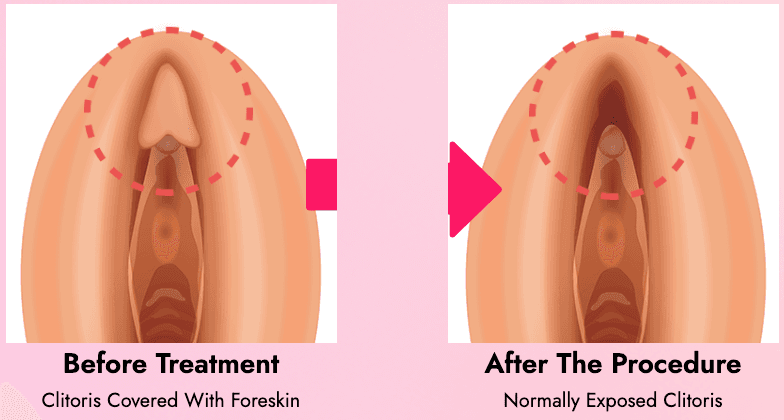
The operative plan depends on the indication, degree of enlargement, existing scars, urethral and vaginal anatomy, prior surgery, and the need to preserve sensation. Ask the surgeon to identify exactly which clitoral structures will be altered; clitoral hood reduction only removes or reshapes skin and is not equivalent to clitoral reduction.
- Recession without corporal reduction — The clitoris is repositioned or less exposed while erectile corporal tissue is retained. This can suit milder hypertrophy where concealment or position, rather than substantial size reduction, is the main concern.
- Nerve-sparing reduction and recession — The surgeon reduces corporal volume and repositions the clitoris while attempting to preserve the glans and dorsal neurovascular bundle. This is anatomically demanding and cannot guarantee unchanged sensation or orgasm.
- Girth reduction and recession — The operation narrows clitoral width while preserving dorsal neurovascular structures and part of the corporal tissue, then recesses the clitoris.
- Corporal-sparing or dismembered reconstruction — Specialist techniques preserve and reposition corporal components rather than relying on conventional excision. They are generally considered in complex congenital or revision anatomy.
- FGM/C or trauma reconstruction — Scar release and clitoral reconstruction address altered anatomy, pain, and tethering; sexual therapy, pelvic-floor care, and psychological support are often relevant alongside surgery. A recent systematic review found reported benefits but very-low-certainty evidence and documented complications.
- Neoclitoris creation — During transfeminine vaginoplasty or vulvoplasty, genital tissue is fashioned into a sensate neoclitoris. This is part of major genital reconstruction with different catheter, dilation, hospitalization, and travel requirements.
Why Visit Korea for Clitoroplasty?
Korean evidence specifically relevant to clitoroplasty is narrow. Seoul has documented specialist pediatric DSD reconstructive experience, but this does not establish adult cosmetic, FGM/C reconstruction, or gender-affirming outcomes in Korea. International patients should therefore select a team based on the exact indication and documented experience with the proposed operation.
- Published DSD surgical cohort — A single-surgeon cohort at Asan Medical Center in Seoul reported 104 pediatric CAH patients treated between 2002 and 2020 using recession, reduction-plus-recession, and girth-reduction approaches. The Korean cohort supports the presence of specialist pediatric reconstructive experience, not a prediction of results for adults or other indications.
- Technique-specific discussion — The same cohort recorded nine re-clitoroplasties (8.7%) during mean follow-up of about 38 months. Differences between techniques are heavily affected by initial severity and surgical selection, so this is not an individual revision-risk figure.
- Evidence limitation — Comparable Korean outcome studies were not identified for adult elective clitoral reduction, FGM/C reconstruction, or transfeminine neoclitoris creation. Ask for the operating surgeon’s own indication-specific experience, complication pathway, and plan for overseas follow-up rather than relying on marketing terms such as “laser clitoroplasty.”
- Energy-device claims — No credible comparative evidence shows that laser-assisted clitoroplasty is safer or better at preserving sensation than anatomical nerve-sparing surgery. Some “laser” promotions describe hood-skin removal rather than surgery on clitoral erectile tissue; ACOG also notes that the FDA has not approved laser or other energy-based treatments for vaginal cosmetic surgery.
Key Information for International Patients
- Minimum stay — Plan 7–14 days in Korea after an uncomplicated isolated adult operation as a cautious logistical estimate, allowing preoperative assessment, surgery, early wound recovery, and an in-person review. This is not a validated universal minimum or a substitute for the operating surgeon’s written clearance.
- Longer pathways — Combined feminizing genitoplasty, vaginoplasty, urogenital-sinus reconstruction, catheter use, revision surgery, or a complication can require a substantially longer stay and sometimes staged care.
- Flight timing — Do not book a fixed long-haul departure until the operating team gives a flight-clearance date. Recent surgery and travel lasting more than four hours both increase venous-thromboembolism risk, as explained in CDC travel guidance.
- Travel prevention — Ask whether walking breaks, leg exercises, hydration, graduated compression stockings, or—in selected higher-risk patients—prescribed anticoagulant prevention is appropriate. Do not self-start aspirin or anticoagulants for a flight.
- Itinerary impact — Expect restricted activity for roughly 1–2 weeks after isolated surgery. Do not plan strenuous sightseeing, cycling, swimming, long walks with friction, or travel involving heavy luggage during early recovery.
- Documents and follow-up — Obtain an English discharge summary stating the exact operation, anesthesia, pathology when applicable, medicines, wound instructions, emergency contact, approved flight date, and remote follow-up schedule. Arrange a clinician at home who can assess urinary or wound concerns after return.
Travel note: Remote follow-up cannot treat uncontrolled bleeding, urinary retention, wound separation, infection, or a suspected blood clot. Know where to seek urgent care in Korea and at home before surgery.
Which Are the Best Clinics in Korea for Clitoroplasty?
Listed below are some of the best clinics in Korea for clitoroplasty.
1. SH Clinic
If you are exploring clitoroplasty in Seoul, SH Clinic may be worth considering because your care would be handled directly by a board-certified gynecologist at a women-focused clinic that also performs genital aesthetic and reconstructive procedures such as labiaplasty and vaginoplasty. You can expect a setting centered on women’s health, with related options for vaginal rejuvenation and gynecologic follow-up rather than a general cosmetic-only approach.
- URL: SH Clinic Website
- Location: Seocho-gu, Seoul
- Lead surgeon:
- All surgeries and procedures are performed directly by a highly experienced, board-certified gynecologist.
- The gynecologist is described as having received a commendation from the Minister of Health and Welfare.
- Related intimate procedures:
- Labiaplasty is offered to reshape elongated or asymmetrical labia minora for comfort and appearance.
- Vaginoplasty is offered to tighten the vaginal canal by reinforcing muscular and fascial layers.
- Additional vaginal rejuvenation options listed include vaginal fillers, stem cell injections, HIFU laser treatments, vaginal tightening, and implant surgery.
- Women’s health support:
- The clinic provides broader gynecologic care alongside aesthetic vaginal procedures.
- Other listed services include cervical and ovarian cancer screening, urinary incontinence treatment, and physician-led abortion surgery in a monitored setting.
- Additional note: The provided information highlights related gynecologic and genital aesthetic surgery, but it does not specifically describe clitoroplasty technique, so you should confirm how the procedure is evaluated and performed at consultation.
2. Okay Plastic Surgery Clinic
You may consider Okay Plastic Surgery Clinic for clitoroplasty in Korea if you value individualized planning, a team-based approach, and access to a female plastic surgeon with extensive experience. The clinic emphasizes tailored treatment and precision, but the provided information does not specifically list clitoroplasty or other female genital procedures, so you would want to confirm direct experience with this surgery before making plans.
- URL: Okay Plastic Surgery Clinic Website
- Location: Gangnam-gu, Seoul
- What stands out:
- The clinic emphasizes sincerity, precision, and individualized treatment planning.
- Its team includes a female plastic surgeon with extensive experience.
- Broader surgical scope:
- The clinic lists body contouring, breast surgery, lifting procedures, eye surgery, rhinoplasty, scar care, stem cell treatments, and skincare services.
- The broad plastic surgery menu may appeal to you if you are also comparing general aesthetic surgery options in one place.
- Additional note: Clitoroplasty is not specifically listed in the provided clinic information, so you should verify whether the procedure is offered, who performs it, and what the surgical plan involves.
3. Ladyuro Women's Clinic
If you are considering clitoroplasty, Ladyuro Women’s Clinic may be relevant because its practice is centered on women’s intimate procedures, including labiaplasty, 3D vaginoplasty, hymenoplasty, vaginal laser therapy, and vaginal fillers. You can expect a clinic focused on genital aesthetic and functional concerns, with both surgical and non-surgical options in the same area of care.
- URL: Ladyuro Women's Clinic Website
- Location: Gangnam-gu, Seoul
- Related intimate procedures:
- Labiaplasty is offered to reshape or reduce the labia minora for appearance and comfort.
- 3D vaginoplasty is offered to tighten and rejuvenate the vaginal walls with a precision-focused approach.
- Hymenoplasty is listed as a short outpatient reconstructive procedure.
- The clinic also offers G-spot augmentation and the Lady Implant for pelvic support or aesthetic enhancement.
- Non-surgical options:
- Vaginal laser therapy is used to stimulate collagen production, improve elasticity, and reduce dryness.
- Vaginal filler is offered to enhance volume and elasticity.
- Botox is used for concerns such as vaginal tightness and muscle spasms.
- Whitening and depilation treatments are available for genital-area aesthetic care.
- Functional and medical care:
- Urinary incontinence treatment is available with surgical and non-surgical approaches such as pelvic floor-focused care.
- The clinic also lists STD and comprehensive AIDS testing, cervical cancer screening and vaccination, and treatment for vaginitis, bladder inflammation, vaginal dryness, and anorgasmia.
- Additional note: The provided information shows strong experience in related vaginal and genital aesthetic procedures, but it does not specifically describe clitoroplasty, so you should confirm availability, candidacy, and surgical technique during consultation.
How Much Does Clitoroplasty Cost in Korea?
Clitoroplasty is listed at KRW 4,500,000 (approximately USD 3,200). Individual quotes vary because clitoroplasty can range from an isolated reduction or recession procedure to more extensive reconstructive surgery with different anesthesia, operating-time, and follow-up requirements.
| Procedure Price | Korean Won (₩) | USD ($) |
|---|---|---|
| Low Price | ₩4,500,000 | $3,200 |
| High Price | ₩4,500,000 | $3,200 |
Exchange rate as of 2026-08-05: 1 KRW = 0.000700 USD.
What Affects the Price?
- Planned clitoroplasty technique — Clitoral recession without corporal reduction generally requires repositioning or concealment of retained tissue. Nerve-sparing reduction plus recession, girth reduction, or corporoplasty requires more dissection and reshaping while preserving the glans and dorsal neurovascular bundle, increasing operative complexity and operating-room resources.
- Scar-related reconstruction versus reduction surgery — Reconstruction after FGM/C or trauma can require scar release and anatomical reconstruction rather than straightforward reduction. Extensive scar tissue and the need to address pain or altered anatomy can lengthen surgery and increase reconstructive requirements.
- Combined genital reconstruction and postoperative care — An isolated adult clitoroplasty may be performed as an outpatient procedure, whereas surgery combined with vaginoplasty, vulvoplasty, urogenital-sinus reconstruction, or extensive scar work can require general anesthesia, admission, catheter management, and more intensive postoperative care.
Cost tip: Request an itemized quote stating what is included, particularly the planned operation, anesthesia, facility use, consumables, and postoperative reviews.
The USD figure is an approximate conversion at an exchange rate of 0.0007 KRW/USD on 2026-08-05. Check the exchange rate again when budgeting.
Clitoroplasty From Start to Finish
- First contact and consultation — Send a concise medical history, medication and allergy list, prior operative reports, endocrine or DSD records, relevant hormone results, imaging, and clear clinical photographs only through the clinic’s secure process. Ask whether an English-language or virtual pre-travel consultation is available and request a written description of the proposed operation.
- Indication and goal review — The surgeon distinguishes clitoral reduction/recession from hood reduction, labiaplasty, FGM/C reconstruction, and neoclitoris creation. Discuss symptoms, genital pain, sexual function, sensation, scars, prior surgery, and what tissue will be retained, reduced, or repositioned.
- Medical assessment — A focused examination and anesthesia review assess anatomy, infections, bleeding and clotting risk, nicotine exposure, chronic illness, medications, and pregnancy status where relevant. New or progressive enlargement requires endocrine investigation before elective surgery.
- Travel and consent planning — Schedule accommodation near the facility, a responsible adult for the first 24–48 hours after anesthesia, and flexible return travel. Review the possibility of altered sensation, pain, bleeding, infection, tissue injury, scarring, dissatisfaction, and revision; no method guarantees preserved orgasm or improved sexual satisfaction.
- Surgery day — The anesthesia plan ranges from local anesthesia with sedation to general anesthesia according to operative extent and concurrent procedures. For reduction or recession, the surgeon exposes clitoral structures, preserves neurovascular anatomy where feasible, reshapes or reduces tissue if planned, repositions the clitoris, and closes the wound with sutures.
- Immediate recovery and discharge — An uncomplicated isolated operation is often outpatient. Staff monitor pain, bleeding, swelling, urination, and recovery from anesthesia before discharge; more extensive reconstruction can require admission or catheter care.
- Early Korea follow-up — Attend the scheduled wound check before leaving the country. Review washing, ointment, pain medicines, urination, activity limits, warning signs, and the surgeon-approved flight date.
- Remote follow-up at home — Send updates or attend video review as arranged, but seek in-person care locally for urgent symptoms. Scar maturation and a meaningful assessment of sensation take several months, so continued follow-up matters.
Alternatives to Clitoroplasty
The appropriate alternative depends on whether the concern is normal anatomical variation, endocrine-driven enlargement, excess hood or labial skin, FGM/C-related scarring, DSD-associated anatomy, or gender affirmation. Non-surgical pathways avoid operative neurovascular risk, while reconstructive operations can address anatomy that counseling or medical treatment cannot.
Observation and endocrine treatment
- Normal variation — Reassurance and counseling are appropriate when anatomy is within normal variation and there is no functional or medical problem.
- Underlying cause — CAH management or treatment of another androgen source takes priority for acquired or progressive clitoromegaly; surgery does not replace endocrine care.
Clitoral Hood Reduction
- What it changes — Clitoral hood reduction reshapes preputial skin over the clitoris rather than reducing the clitoral body.
- Key tradeoff — It is not a treatment for true clitoromegaly and should not be presented as a nerve-sparing substitute for corporal reduction.
Labiaplasty
- What it changes — Labiaplasty addresses labia minora or majora tissue, not clitoral corporal anatomy.
- Key tradeoff — It can be relevant for labial symptoms or asymmetry but will not reduce an enlarged clitoris.
Vaginoplasty or Urogenital Reconstruction
- Selected anatomy — Vaginoplasty or urogenital-sinus reconstruction can be considered for selected DSD-associated anatomy or transfeminine genital reconstruction.
- Key tradeoff — These are larger operations with different hospitalization, catheter, dilation, recovery, and international travel demands.
Revision Clitoroplasty
- Prior surgical concerns — Revision clitoroplasty can address selected scar, contour, tethering, or functional concerns after prior surgery.
- Key tradeoff — Revision anatomy has higher complexity; assess blood supply, sensation, scar tissue, and the realistic scope for improvement with an experienced reconstructive surgeon.
How Can I Prepare for Clitoroplasty?
- Medical records — Provide endocrine/DSD records, prior genital operative notes, hormone results, imaging, pathology, medication lists, allergies, and history of genital pain, urinary issues, bleeding, clots, and anesthesia reactions.
- Medication coordination — Do not independently stop prescription medicines. The surgeon, anesthesiologist, and prescribing clinician must coordinate anticoagulants, antiplatelet medicines, NSAIDs, hormonal medicines, GLP-1 medicines, supplements, and herbal products; stop periods depend on the drug and medical reason for taking it.
- Nicotine cessation — Stop smoking, vaping, nicotine pouches, gum, patches, and other nicotine products for the full period required by the operating team. Nicotine materially impairs wound healing.
- Alcohol and recreational drugs — Avoid them around anesthesia and while taking prescribed analgesics. Disclose all use honestly because it affects anesthesia safety.
- Fasting — Follow the facility’s written fasting instructions exactly. Requirements differ by anesthesia plan; do not use a generic internet fasting schedule.
- Treatment-area care — Report shaving irritation, ingrown hairs, sores, unusual discharge, urinary symptoms, or any genital infection before surgery. Follow the surgeon’s instructions on hair removal and do not apply unapproved creams or products to the area.
- Accommodation and support — Book private accommodation near the surgical facility with easy bathroom access. Arrange a responsible adult for the first 24–48 hours after sedation or general anesthesia and transport that does not require driving.
- Flexible flights — Keep return travel changeable until the surgeon approves the date after an in-person review. Bring loose, breathable underwear and clothing; avoid plans that require lifting luggage or extensive walking.
Travel note: Purchase enough prescribed medicine for the trip, carry it in original labeled containers, and keep the clinic’s emergency contact and English discharge documents accessible.
Confirm all clinic-specific medication, fasting, nicotine, testing, companion, and flight requirements with the treating doctor; their instructions take precedence over general guidance.
Aftercare Advice
Protect the wound from pressure, friction, heat, and contamination while swelling settles, and treat new urinary or systemic symptoms as urgent rather than waiting for remote follow-up.
- Rest and activity — Limit activity for about 1–2 weeks after isolated surgery. Avoid strenuous exercise, heavy lifting, cycling, horseback riding, and any activity that causes genital friction until the surgeon clears it.
- Sexual and insertion restrictions — Avoid intercourse, masturbation or direct genital stimulation, tampons, and other vaginal insertion until cleared—commonly at least 6 weeks after an isolated procedure and longer after combined reconstruction.
- Swelling and clothing — Soreness, bruising, and swelling are expected in the first days. Wear loose, breathable clothing; if the surgeon permits it, use brief cold-pack intervals over underwear rather than directly on the tissue.
- Wound care and medicines — Use only prescribed or surgeon-approved pain medicine, antibiotics, ointment, and cleansing instructions. Do not soak, swim, or use baths until cleared; keep the area clean and dry exactly as instructed.
- Expected timeline — Visible swelling often improves by about 6 weeks but can persist for up to 3 months. Scar maturation and a meaningful assessment of sensation can take several months. A small adult series reported transient partial sensory loss resolving by three months in one patient, but the evidence is far too limited to predict an individual result.
- Urgent warning signs — Seek urgent assessment for fever of 38°C/100.4°F or higher, chills, active bleeding, rapidly worsening swelling or bruising, uncontrolled pain, pus or foul-smelling discharge, wound separation, inability to urinate, severe new numbness or burning pain, chest pain, shortness of breath, coughing blood, or one-sided leg pain or swelling.
- Follow-up and flying — Attend the in-person wound check before international departure, then keep remote appointments as scheduled. Follow the surgeon’s individualized plan for flight timing and clot prevention.
Follow the treating doctor’s instructions over general timelines, and contact the clinic promptly when pain, swelling, discharge, urination, or the wound appears to be worsening.
Frequently Asked Questions
Related Blogs
Vaginal Dryness Issues: PRP Vaginal Rejuvenation, Vaginal Filler, Stem Cell Treatments for Sexual Performance in Korea
Updated: Jun 30, 2026
Premarital Check-up for Prenatal Health Screening Solutions in Korea
Updated: Jun 29, 2026
Pre-Marriage STI Testing in Korea: Benefits of Premarital Check-up for Safe Children
Updated: Jun 26, 2026
Discovering the Costs: Premarital Check-Up Prices in Korea vs. Global Alternatives
Updated: Jun 25, 2026
Clinics offering Clitoroplasty

SH Clinic: Comprehensive Women's, Men's & Couples' Health Services in Korea
Sinsa

Okay Plastic Surgery Clinic in Korea: Comprehensive Aesthetic Procedures with Sincerity and Care
Cheongdam

Ladyuro Women's Clinic in Korea: Premier Destination for Vaginal Rejuvenation and Aesthetic Enhancements
Sinsa

Y Lady Clinic Korea: Specialized Gynecological Care and Advanced Women's Health Procedures
Chilseong Market