
Medical Tourism Blog
Protruding Ear Surgery in Korea: Techniques, Recovery, Travel Planning, and Risks
Table of contents
- Protruding Ear Surgery at a Glance
- What Is Protruding Ear Surgery?
- Who Is a Good Candidate for Protruding Ear Surgery?
- How Is Protruding Ear Surgery Performed?
- Why Visit Korea for Protruding Ear Surgery?
- Key Information for International Patients
- Which Are the Best Clinics in Korea for Protruding Ear Surgery?
- Protruding Ear Surgery From Start to Finish
- Alternatives to Protruding Ear Surgery
- How Can I Prepare for Protruding Ear Surgery?
- Aftercare Advice
Considering treatment in Korea? Everything you need to know e.g. — how to avoid scams, visas, interpreters, recovery tips — in our Medical Tourism Master Guide. Plan with confidence in minutes, not weeks!
Last updated: September 2026
Protruding Ear Surgery at a Glance
- What it does — Otoplasty, or ear-pinning surgery, reshapes the visible outer ear to reduce projection and improve balance; it changes appearance but does not improve hearing.
- Who it suits — Candidates include medically suitable adults and children from about age 5 who personally want less-prominent ears and can protect them during healing.
- Procedure time — This is usually an outpatient operation lasting about 1–2 hours, using sutures, cartilage reshaping, conchal setback, or a tailored combination based on each ear’s anatomy.
- Early recovery — Bulky dressing removal and wound review usually occur 5–10 days after surgery; desk work may be possible in 5–7 days, while school commonly takes 1–2 weeks.
- Results and durability — The new ear position is visible immediately, but swelling makes results easier to judge after 2–3 weeks; routine recovery takes about 6–8 weeks, with subtle settling for several months and occasional need for revision.
- Key risks — Urgent complications include hematoma and cartilage infection; other risks include asymmetry, contour irregularity, palpable or extruding sutures, scarring, overcorrection, undercorrection, and recurrence.
- Korea travel planning — International patients should remain in South Korea at least 7–10 days for the dressing and wound review, verify that the actual operating institution is registered for foreign patients, and fly home only after surgeon clearance.
What Is Protruding Ear Surgery?
Protruding ear surgery, also called otoplasty or ear-pinning surgery, reshapes and repositions the visible outer ears so they project less from the head. It addresses concern about prominent ears by creating a more balanced, natural-looking ear position without changing hearing. It is a surgical procedure, usually performed as an outpatient operation.
Who Is a Good Candidate for Protruding Ear Surgery?
- Adults bothered by ear prominence — Good candidates want less projection of one or both outer ears and understand that otoplasty changes appearance, not hearing.
- Children from about age 5 — Prominent-ear correction is commonly considered once the ear is near adult size and the child personally wants surgery and can cooperate with ear protection during recovery.
- Anatomy suited to correction — Assessment can address an underdeveloped antihelical fold, a deep or prominent conchal bowl, upper-pole projection, lobule prominence, or a combination of these features.
- Patients able to protect the ears — Candidates need to avoid pressure, impact, swimming, and contact sports for the prescribed period and attend the early dressing and wound review.
Elective surgery should wait for active ear infection, open lesions, substantial dermatitis, or uncontrolled medical conditions such as diabetes, hypertension, bleeding disorders, or immunosuppression to be treated or optimized. Anticoagulants and antiplatelet medicines require coordination with the prescribing clinician; never stop them independently. Nicotine exposure can compromise healing, while a history of keloid scars, prior ear trauma or surgery, pregnancy, breastfeeding, anesthesia risks, and unrealistic expectations require individualized assessment. The surgeon evaluates each ear separately because cartilage stiffness, conchal shape, skin quality, scars, and natural asymmetry determine what correction is realistic.
How Is Protruding Ear Surgery Performed?
More than 200 otoplasty techniques have been described. No method is universally best: the surgeon should match the approach to cartilage thickness, the source of prominence, scar history, and the degree of correction required. A recent systematic review found that most available studies were retrospective, so published technique comparisons cannot promise an individual result.
- Cartilage-sparing suture otoplasty — Mustardé-type mattress sutures create or strengthen the antihelical fold. Furnas conchomastoid sutures set a prominent concha closer to the mastoid area behind the ear. This approach preserves cartilage but permanent sutures can be felt, form a granuloma, or extrude.
- Cartilage scoring or weakening — The surgeon scores, abrades, or weakens thick, stiff cartilage so it bends into a new contour. Excessive cartilage injury can leave sharp edges or contour irregularities.
- Conchal reduction — Removing selected conchal cartilage or soft tissue addresses a large or deeply projecting conchal bowl. It is not needed when antihelical fold deficiency is the main cause.
- Fascial flap support — A tissue flap can cover or reinforce sutures in selected ears, often as part of a combined operation.
- Incisionless otoplasty — Sutures are placed through needle punctures rather than a conventional posterior incision. It suits selected anatomy but cannot reliably correct every structural cause of ear prominence.
- Hybrid correction — Sutures, cartilage modification, flap coverage, and limited conchal reduction can be combined for mixed deformities. Evidence reviews report heterogeneity and no reliable universal ranking between cartilage-sparing and cartilage-scoring approaches.
Why Visit Korea for Protruding Ear Surgery?
South Korea has a formal pathway for institutions treating foreign patients, which is a practical consideration when arranging surgery from overseas. It does not establish that Korean otoplasty has better outcomes than surgery elsewhere. No high-quality country-to-country evidence compares Korean and non-Korean otoplasty safety, recurrence, revision, or satisfaction.
- Foreign-patient registration — Medical Korea’s registered-institution system states that registered institutions serving foreign patients must carry medical-malpractice liability insurance. Confirm that the actual operating institution, not only an intermediary, is registered.
- Technique-specific Korean research — A Korean case series reports results for a particular cartilage-grafting adhesion technique in 66 patients. It is useful background on that technique but cannot predict another surgeon’s results or demonstrate a national advantage.
- Decision-making that still matters most — Ask for the named surgeon’s experience with your ear anatomy, the proposed technique and its rationale, management of hematoma and perichondritis, revision policy, and an English written follow-up plan. Regulatory registration is a patient-protection measure, not proof of superior surgical outcomes.
Key Information for International Patients
- Minimum stay — Remain in South Korea for at least 7–10 days after surgery for dressing removal, wound inspection, and removal of non-dissolving sutures when used. Plan 10–14 days after general anesthesia, combined ear procedures, impaired healing risk, or an abnormal early review.
- Return flight — There is no universal otoplasty-specific evidence-based interval for long-haul flying. Do not book a non-changeable return flight before the operating surgeon examines the ears and clears travel.
- Early itinerary impact — Otoplasty is usually outpatient, but pain, bulky dressings, bruising, and swelling make the first week unsuitable for a busy itinerary. Desk work is often possible after 5–7 days; school commonly takes 1–2 weeks.
- Protection during travel — Avoid pressure from over-ear headphones, tight hats, sleeping against an ear, crowded activities, and lifting heavy luggage on the day of surgery. Use a travel pillow or back-sleeping arrangement if instructed.
- Companion and accommodation — Arrange nearby accommodation and a responsible adult for the first 24 hours after sedation or general anesthesia. The facility may require an escort before discharge.
- Remote follow-up — Obtain an English discharge summary, operative note, medication list, headband instructions, urgent contact route, and photo-follow-up timetable before departure. A clinician at home can assess urgent complications but may not take responsibility for another surgeon’s cosmetic result.
Travel note: Keep the schedule flexible until the 5–10-day review confirms that the dressing, wound, ear circulation, and early position are satisfactory.
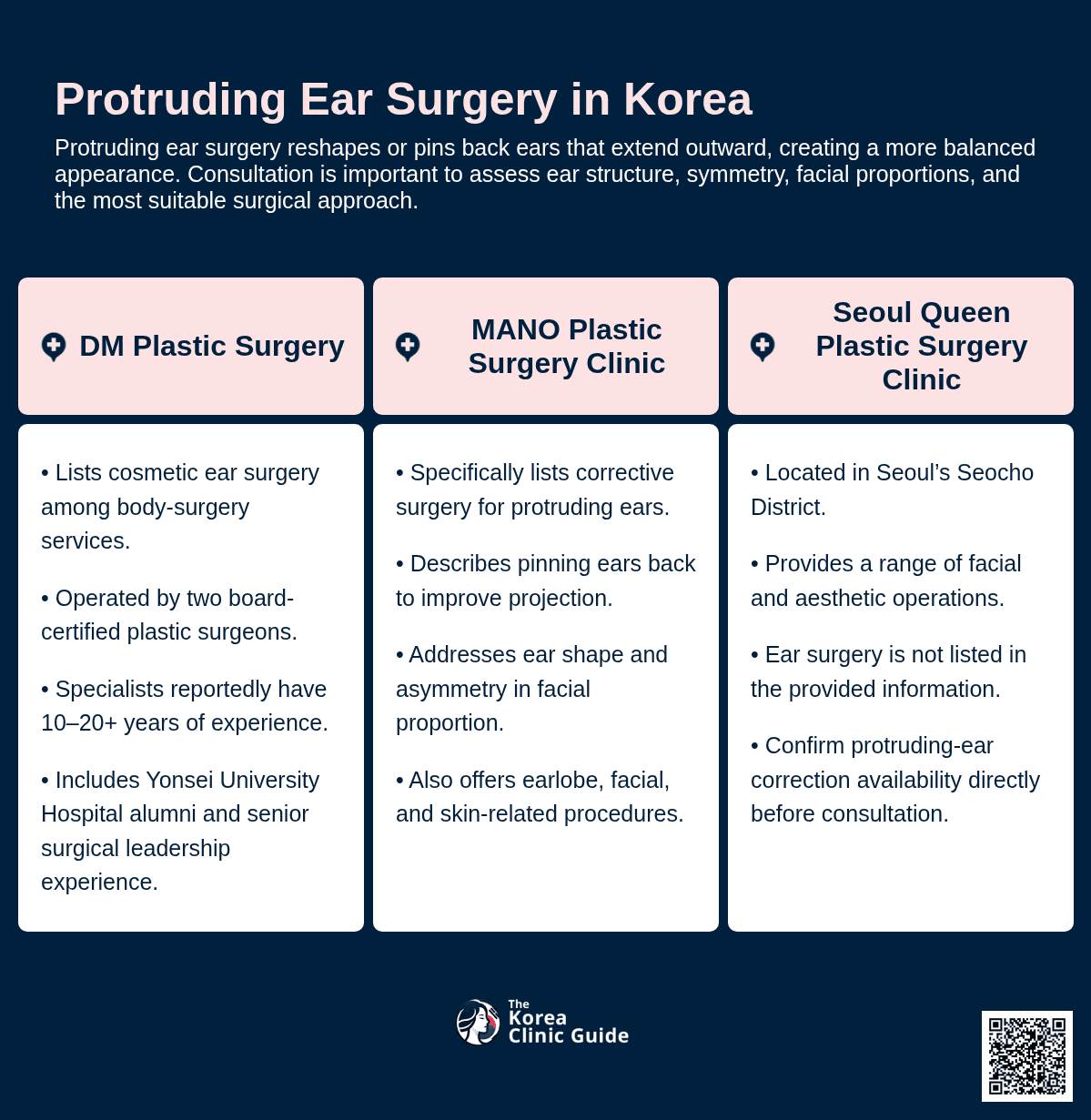
Which Are the Best Clinics in Korea for Protruding Ear Surgery?
Listed below are some of the best clinics in Korea for protruding ear surgery.
1. DM Plastic Surgery
You may consider DM Plastic Surgery for protruding ear surgery because its listed body-surgery services include cosmetic ear surgery, and its care model emphasizes individualized consultation and surgical planning by plastic-surgery specialists.
- URL: DM Plastic Surgery Website
- Location: Gangnam-gu, Seoul
- Relevant service: Cosmetic ear surgery is listed among the clinic’s body-surgery offerings, which may include reshaping or adjusting ear appearance.
- Clinical background:
- The clinic states that it is operated by two board-certified plastic surgeons working in their respective specialty fields.
- Its medical team is described as consisting of specialists with more than 10 or 20 years of experience.
- The staff includes Yonsei University Hospital alumni, and the context notes prior leadership of the Department of Plastic Surgery at Gangnam Severance Hospital of Yonsei University.
2. MANO Plastic Surgery Clinic
You may consider MANO Plastic Surgery Clinic for protruding ear surgery because it specifically lists corrective surgery for protruding ears, including pinning them back and addressing ear shape or asymmetry in relation to your facial structure.
- URL: MANO Plastic Surgery Clinic Website
- Location: Seocho-gu, Seoul
- Procedure details:
- Corrective ear surgery is listed for protruding, lop, elf, and folded ears.
- For protruding ears, the clinic describes pinning the ears back; it also notes correction of asymmetrical ears.
- Earlobe reduction and augmentation are separately listed for adjusting earlobe proportion.
- Related facial procedures:
- The clinic also lists eyelid, nose, facial-contouring, lip, and philtrum procedures if you are considering broader facial-balance goals.
- Laser treatments and thread lifting are listed through its skin clinic.
3. Seoul Queen Plastic Surgery Clinic
You may want to confirm protruding ear surgery availability directly with Seoul Queen Plastic Surgery Clinic before considering it for this procedure, because the provided information describes several facial and aesthetic operations but does not list ear surgery or a protruding-ear correction technique.
- URL: Seoul Queen Plastic Surgery Clinic Website
- Location: Seocho District, Seoul
Protruding Ear Surgery From Start to Finish
- Remote consultation and records — Send clear front, rear, side, and oblique photographs with hair secured away from the ears. Disclose previous ear surgery or trauma, infections, scar problems, medications, supplements, allergies, nicotine use, medical conditions, and whether one or both ears concern you. Confirm English consultation or interpretation options; photographs cannot replace examination.
- In-person assessment — The surgeon assesses cartilage thickness and flexibility, antihelical fold definition, conchal depth, upper-pole and lobule projection, pre-existing asymmetry, skin condition, and scar risk. Agree on a conservative target that reduces prominence without pinning the ears unnaturally flat.
- Preoperative clearance — The team reviews vital signs, health history, medicines, and anesthesia suitability. Blood tests, coagulation tests, electrocardiography, pregnancy testing, or other investigations are ordered when indicated by history, age, anesthesia plan, or facility protocol.
- Anesthesia and marking — Children commonly have general anesthesia. Older children and adults can have local anesthesia, sometimes with sedation, depending on cooperation, procedure extent, and clinician judgment. The surgeon marks planned corrections before the operation.
- Ear reshaping surgery — Otoplasty usually takes about 1–2 hours. Through a commonly posterior ear incision, the surgeon creates an antihelical fold, sets back the concha, modifies cartilage, removes limited tissue, or combines these steps according to the anatomy. A protective dressing or head wrap is applied.
- Recovery and discharge — This is generally an outpatient procedure. After sedation or general anesthesia, discharge follows recovery assessment and requires an escort when the facility’s policy calls for one.
- Early Korea-based review — At roughly 5–10 days, the operating team removes or changes the bulky dressing, inspects the wound and ear position, and removes non-dissolving stitches if present. Report increasing pain, one-sided swelling, bleeding, or dressing pressure immediately rather than waiting for this appointment.
- Overseas follow-up — Send progress photographs as instructed after returning home. Keep the operative note available for a local clinician and contact the operating team promptly for wound concerns, suspected infection, sudden positional change, or suture problems.
Alternatives to Protruding Ear Surgery
Otoplasty is the direct structural treatment for established prominent ears in older children and adults. Non-surgical options can camouflage appearance but do not reliably create an antihelical fold or correct conchal projection; procedures for other ear conditions are not substitutes.
No procedure
- Tradeoff — Hairstyling, accessories, and acceptance of natural ear shape avoid scars, anesthesia, recovery restrictions, and revision risk, but do not alter ear projection.
Neonatal ear molding
- Who it serves — Molding is an early-life option for newborn ear deformities while cartilage is temporarily pliable.
- Key limit — It is not an alternative for established prominent ears in older children, teenagers, or adults.
Camouflage approaches
- What it can do — Hairstyling can reduce the visibility of ear projection without medical intervention.
- Key limit — Soft-tissue filler can alter selected contour concerns but does not reliably correct the underlying antihelical or conchal anatomy.
Other ear surgery
- Different goals — Ear plastic surgery can include earlobe correction, ear reduction, microtia reconstruction, or trauma repair.
- Key limit — These operations treat different anatomical problems and are not direct alternatives to prominent-ear correction.
How Can I Prepare for Protruding Ear Surgery?
- Medication and supplement review — Give the surgeon and anesthetist a complete list of prescriptions, over-the-counter medicines, vitamins, and supplements. Specifically report anticoagulants, antiplatelets, aspirin, NSAIDs, diabetes medicines, corticosteroids, GLP-1 medicines, fish oil, vitamin E, ginkgo, ginseng, garlic, turmeric/curcumin, and St John’s wort.
- Prescribed medicines — Do not stop anticoagulants, antiplatelets, diabetes treatment, or other chronic medicines on your own. Obtain a coordinated plan from the prescriber and surgical/anesthesia team.
- Fasting — Follow the clinic’s fasting instructions exactly when sedation or general anesthesia is planned. The required timing depends on anesthesia, medical history, and the food or liquid consumed.
- Nicotine and alcohol — Stop smoking, vaping, nicotine pouches, and other nicotine exposure for the surgeon’s required period before and after surgery. Follow the team’s alcohol restrictions.
- Ear and scalp preparation — Avoid sunburn, new piercings, hair-color treatments, shaving injuries, and irritating products around the ears. Wash hair before surgery if instructed, as hair washing can be restricted under the initial dressing.
- Clothing and sleep setup — Wear a loose front-opening shirt or jacket; do not pull tight clothing over the ears. Arrange a travel pillow or back-sleeping setup to prevent ear pressure.
- Travel logistics — Reserve nearby accommodation, post-anesthesia transport, and a companion for the first 24 hours where required. Keep return flights and major sightseeing plans flexible until the early review.
Travel note: Bring translated medical records when relevant, plus enough regular prescription medicine for the full stay and unexpected flight changes.
Confirm the treating clinic’s medication, fasting, testing, nicotine, and arrival requirements; the operating doctor’s individualized instructions take precedence over general guidance.
Aftercare Advice
Protect the reshaped ears from pressure, trauma, bleeding, and infection throughout early healing; early problems can damage cartilage and affect the result.
- Dressing and hygiene — Keep the initial dressing clean and dry. Follow the operating team’s exact instructions for showering, hair washing, topical products, antibiotics, and pain medicine; do not adjust a tight or painful dressing yourself without contacting the clinic.
- Sleeping and clothing — Sleep on the back where possible and avoid bending, massaging, manipulating, or compressing the ears. Wear front-opening clothing to avoid catching fabric on the ears.
- Headband protection — Wear the prescribed soft night-time headband for the stated number of weeks. It protects against accidental folding during sleep, but an overly tight headband can cause pressure injury.
- Activity restrictions — Avoid impact and situations where the ears can be bent or bumped. Swimming is commonly deferred for 4–6 weeks and contact sports for about 8 weeks; the surgeon’s restriction takes priority.
- Scars and sun — Do not restart earrings or piercings through operated areas until cleared. Once wounds are fully closed, ask when silicone scar care and broad-spectrum SPF 50 sunscreen are appropriate.
- Urgent warning signs — Seek prompt assessment for escalating or severe pain, rapidly increasing one-sided swelling, persistent bleeding, fever, pus or foul drainage, spreading redness or warmth, wound separation, sudden positional change, or a pale, dusky, cold, or very painful ear. Hematoma and cartilage infection (perichondritis) require urgent treatment.
- Result timing — Ear position is visible immediately, but swelling and dressings distort the early appearance. Improvement is usually easier to judge at 2–3 weeks; routine recovery commonly takes 6–8 weeks, while stiffness and subtle contour settling can continue for several months.
Follow the treating doctor’s instructions over general guidance, attend scheduled reviews, and contact the clinic promptly when anything appears wrong.
Frequently Asked Questions
Related Blogs
Otoplasty in Korea: Methods, Recovery, Risks and Travel Planning
Otoplasty reshapes or repositions outer-ear cartilage for prominent ears, asymmetry, and selected congenital or revision concerns, usually as a 1–3 hour outpatient procedure using sutures, cartilage modification, or both. International patients planning treatment in Korea should allow 10–14 days for assessment, early wound review and possible suture removal, follow activity and dressing restrictio
Updated: Sep 21, 2026
Varicose Vein Treatment in Korea: Methods, Recovery, Travel Planning, and Safety
Varicose vein treatment begins with standing duplex ultrasound mapping and may use laser or radiofrequency ablation, vein glue, mechanochemical ablation, foam sclerotherapy, phlebectomy, or surgery based on anatomy and risk factors. The article covers candidacy, recovery, compression and walking guidance, follow-up, warning symptoms, and travel planning including flight restrictions after treatmen
Updated: Sep 19, 2026
Hyperhidrosis Laser in Korea: Methods, Recovery, Results, and Travel Planning
Laser treatment for primary axillary hyperhidrosis uses subdermal fiber ablation through tiny incisions or surface laser sessions to reduce underarm sweating, with repeat treatment sometimes needed. The article covers candidacy, Korea travel planning, preparation, recovery, warning signs, follow-up, and alternatives such as antiperspirants, Botox, microwave thermolysis, and gland removal.
Updated: Sep 18, 2026
Hyperhidrosis Surgery in Korea: ETS Methods, Risks, Recovery, and Travel Planning
Endoscopic thoracic sympathectomy (ETS) uses small chest ports under general anesthesia to permanently interrupt the sympathetic chain for severe primary palmar sweating after non-surgical treatments have failed or are not tolerated. International patients should plan 7–10 postoperative days in Korea, attend follow-up before flying, obtain flight clearance if pleural air is a concern, and arrange
Updated: Sep 18, 2026
Clinics offering Protruding Ear Surgery

Seoul Queen Plastic Surgery Clinic: Premier Aesthetic Surgery Destination in Korea for Personalized Care & Expertise
Gangnam Station

DM Plastic Surgery: Korea's Leading Specialists in Personalized Aesthetic Procedures and Treatments
Apgujeong

MANO Plastic Surgery Clinic in Korea: Enhancing Natural Beauty with Tailored Facial Procedures
Hakdong