Medical Tourism Blog
Medical Tourism in Korea: Best Clinic in Korea? A Checklist for Foreign Patients (2025 Guide)
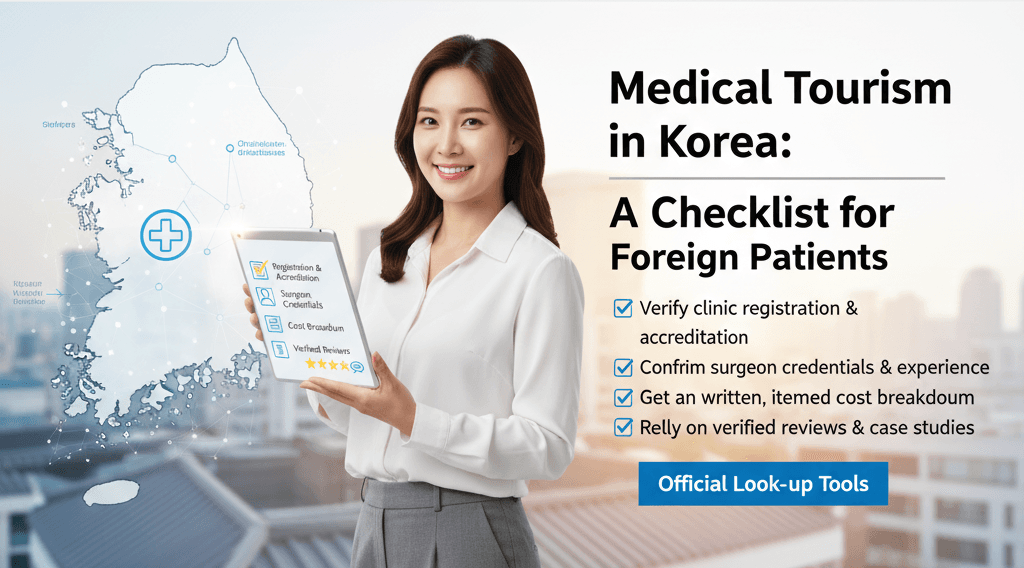
Table of contents
- 1) Check Official Registration & Accreditation
- 2) Review Doctor Credentials & Experience
- 3) Compare Costs Transparently
- 4) Read Verified Patient Reviews & Case Studies
- Choose Confidently, Book Safely
Considering treatment in Korea? Everything you need to know e.g. — how to avoid scams, visas, interpreters, recovery tips — in our Medical Tourism Master Guide. Plan with confidence in minutes, not weeks!
Choosing a clinic in Korea isn’t about glossy before–afters or viral posts—it’s about safety, legality, and proven expertise. With hundreds of options across plastic surgery, dermatology, dentistry, and wellness, your first filter should be objective checks: is the clinic legally registered to treat foreign patients (MOHW/KHIDI)? Is your surgeon a board-certified specialist (KMA/specialty societies) with matched case experience?
This guide walks you through a simple 4-step check
before you book:
- verify clinic registration & accreditation,
- confirm surgeon credentials & experience,
- get a written, itemized cost breakdown, and
- rely on verified reviews and real case studies.
Along the way you’ll find red flags to avoid, links to official look-up tools, and practical questions to ask so you can choose confidently—and safely—based on facts, not marketing.
1) Check Official Registration & Accreditation
Choosing the right medical provider is the most important step in your journey to Korea. With hundreds of clinics and hospitals—especially in plastic surgery, dermatology, dentistry, and wellness—it’s essential to look beyond glossy marketing and focus on safety, credentials, and patient support.
In Korea, only medical institutions officially registered as foreign patient attracting institutions with the Ministry of Health & Welfare (MOHW) are legally allowed to treat international patients.
How to verify a clinic’s registration in Korea?
Here’s a simple, no-nonsense way to confirm a clinic is legally registered to treat international patients in Korea.
Start with the official KHIDI (Medical Korea) search, then ask the clinic for its MOHW-issued 외국인환자 유치기관 등록증 (Certificate of Registration for Foreign Patient Attraction), and cross-check embassy lists if needed. If the clinic isn’t in KHIDI or can’t show the certificate, consider it a red flag.
-
Medical Korea website (KHIDI) search: The Korea Health Industry Development Institute (KHIDI), under MOHW, manages a database of registered foreign patient attracting institutions. You can search by hospital name, location, or specialty.👉 Medical Korea Official Search

-
Ask the clinic directly: Request to see their 외국인환자 유치기관 등록증 (Certificate of Registration for Foreign Patient Attraction). Every registered institution has one, issued by MOHW.
-
Government or embassy endorsements: Many embassies in Korea provide lists of recommended or verified hospitals for foreign patients.
-
Red‑flag warning: If a clinic cannot show a registration certificate or isn’t listed in KHIDI’s official database, it is not legally authorized to treat international patients.
2) Review Doctor Credentials & Experience
Once you’ve confirmed the clinic is legitimate, shift your focus to the doctor—the real decision-maker who will perform your surgery. Your next step is to verify the surgeon’s qualifications and track record. Use the checklist below to assess a good doctor quickly: confirm board-certified specialist status (national exams + residency in Korea), review years of experience and annual case volume for your exact procedure, examine matched before/after results, and look for peer-recognized credentials like publications or membership in relevant medical societies. If any of these can’t be verified, treat it as a red flag and keep looking.
- Ask about years of experience, case volume, and before/after results for your specific procedure.
- Many top Korean doctors publish in international journals or are members of global medical societies.
- Always confirm that the doctors are board‑certified specialists in their field. In Korea, this means they have passed national exams and completed advanced residency training.
How to verify if a doctor is a board‑certified specialist in Korea?
-
Hospital website: Most hospitals list detailed information about their medical staff. For board‑certified specialists, you can usually find information about residency training and board certification in their specialty.
-
Korean Medical Association (KMA) / Specialty societies: Verify certification via the KMA or each specialty society (e.g., Korean Society of Plastic and Reconstructive Surgeons, Korean Dermatological Association). These platforms allow you to check a doctor’s official specialist status.
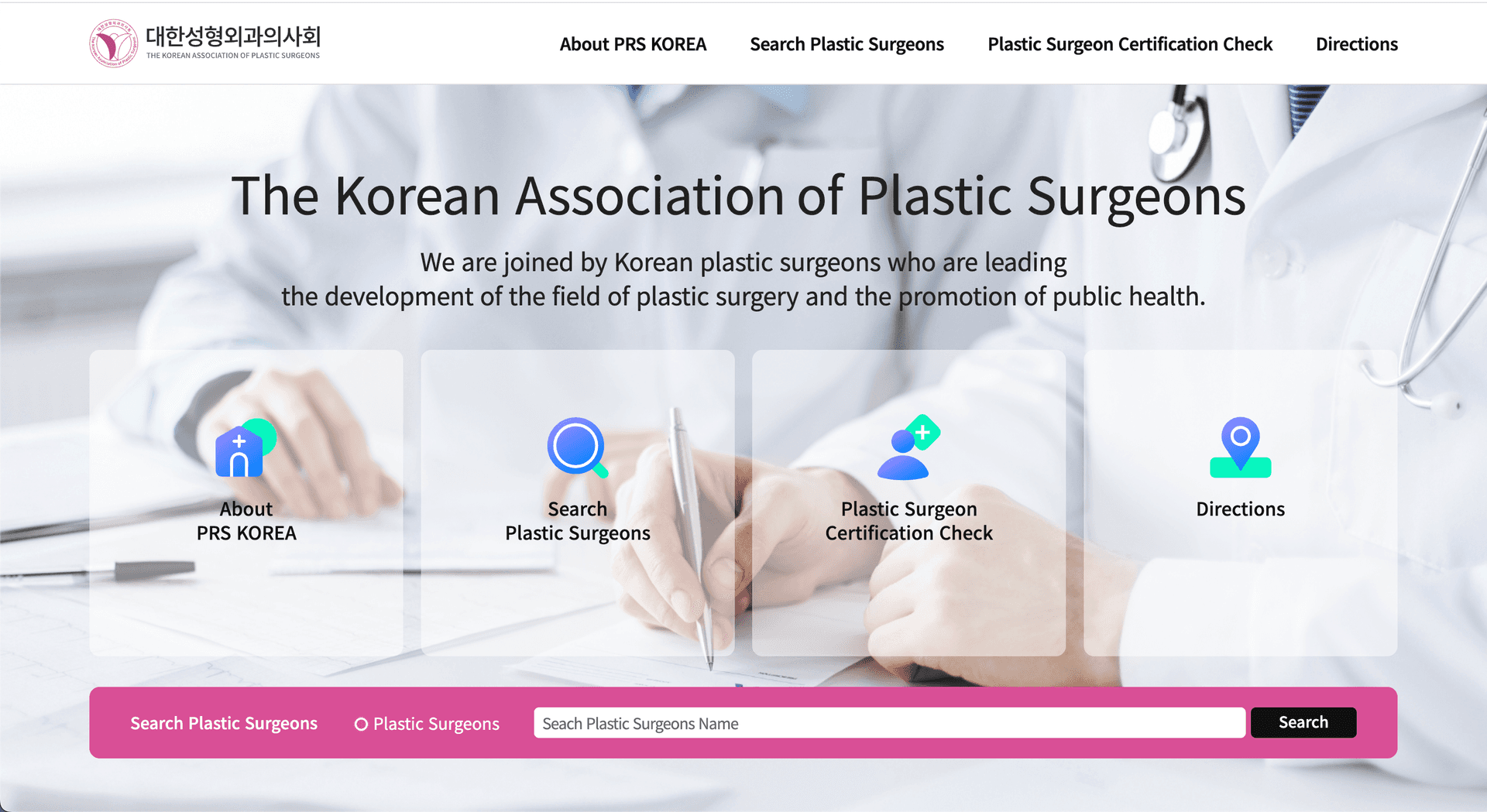
Specialty societies with “find a doctor” search:
-
Plastic Surgery (성형외과) – Korean Society of Plastic Surgeons: Find a board-certified plastic surgeon (대한성형외과의사회).
-
Dermatology (피부과) – Association of Korean Dermatologists: Find a dermatologist (대한피부과의사회)
-
-
Signboards and name tags: In Korea, only board‑certified specialists may display their specialty on official signboards and name tags (e.g., Orthopedic Surgery Specialist, Internal Medicine Specialist). General practitioners are not allowed to claim a specific specialty title.
3) Compare Costs Transparently
Before you book flights,
-
Reliable hospitals provide a detailed treatment plan and estimate before you arrive, covering surgery, anesthesia, hospitalization, and aftercare. Use the [ Online Consultation Checklist ] to make sure nothing’s missing.
-
Be cautious with clinics offering unrealistically low prices without clarity—these often cut corners in safety or follow‑up
How to compare costs (value over price)
Costs vary by clinic, surgeon, and technique—and the lowest price is not always the best option. Do your own research and use the checks below to see whether a quote is fair and justified for your case.
- Compare apples to apples. Match the same inclusions across quotes: surgeon, anesthesia provider, facility/OR, devices/implants (brand & units), meds/garments, follow‑ups, VAT, and any card surcharge.
- Ask what you’re paying for. Have the doctor explain how expertise (board specialty, years, case volume), specific techniques, estimated OR time, and safety resources (e.g., a board‑certified anesthesiologist, monitoring) influence cost.
- Safety and aftercare matter. Confirm foreign‑patient registration, any accreditations, and exactly what aftercare and remote support are included. Ask for the revision policy and potential fees.
- Devices & authenticity. Verify brands/models, bedside unboxing, and lot/serial/QR recording in your chart. Ask about device warranties when relevant.
- Clarify extras and triggers. What circumstances could add cost (e.g., longer OR time, additional grafts/units)? Are there caps or ranges for variability?
Why value beats price: Paying a bit more for a surgeon with relevant experience, safer anesthesia staffing, and structured aftercare often maximizes results and minimizes complications/side effects. Choosing the cheapest option without verifying safety can lead to higher total costs later (revisions, corrective procedures, extra travel, lost work).
Pro tip: Collect 2–3 like‑for‑like quotes in KRW and ask each clinic to explain how their plan and team justify the cost for your anatomy and goals.
4) Read Verified Patient Reviews & Case Studies
Real-world outcomes matter. After checking credentials and quotes, validate your choice with verified patient reviews and full case studies—not anonymous forum posts. Prioritize cases that match your exact procedure and profile, with dated, consistent before-and-after photos, notes on recovery/aftercare, and how the clinic handled complications or revisions. Independent, accredited platforms vet identities and filter out promotions, so start there. If you’re unsure where to begin, use the links below to explore verified clinics and the most-chosen options in Korea.
- Look for authentic patient stories and real before‑and‑after photos.
- Independent platforms and accredited clinic listing sites provide verified reviews, unlike anonymous forums that may contain misleading promotions.
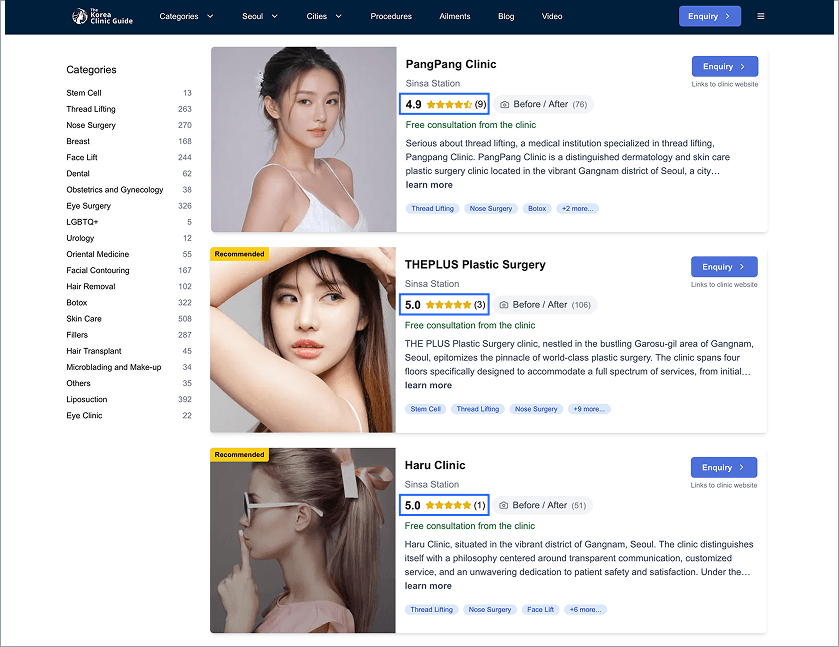
Are you still not sure which clinic is the most suitable for you or where to begin? See which clinics patients choose most—and why they stand out.
👉Most Popular Clinics in Korea (Top 10)
Choose Confidently, Book Safely
Finding the “best” clinic in Korea is really about finding the best match for your case—one that’s legally registered, led by a board-certified surgeon, and transparent about costs and aftercare. Use the 4-step check, ask the right questions, and keep everything in writing. When you combine objective verification with clear communication, you set yourself up for a safer experience and better outcomes.
Next steps